Recognition: no theorem link
A bent straw as a tool for an affordable student-safe experiment in vortex ring dynamics
Pith reviewed 2026-05-12 00:56 UTC · model grok-4.3
The pith
A bent straw and dyed water generate vortex rings that students can study with a smartphone camera and simple measurements.
A machine-rendered reading of the paper's core claim, the machinery that carries it, and where it could break.
Core claim
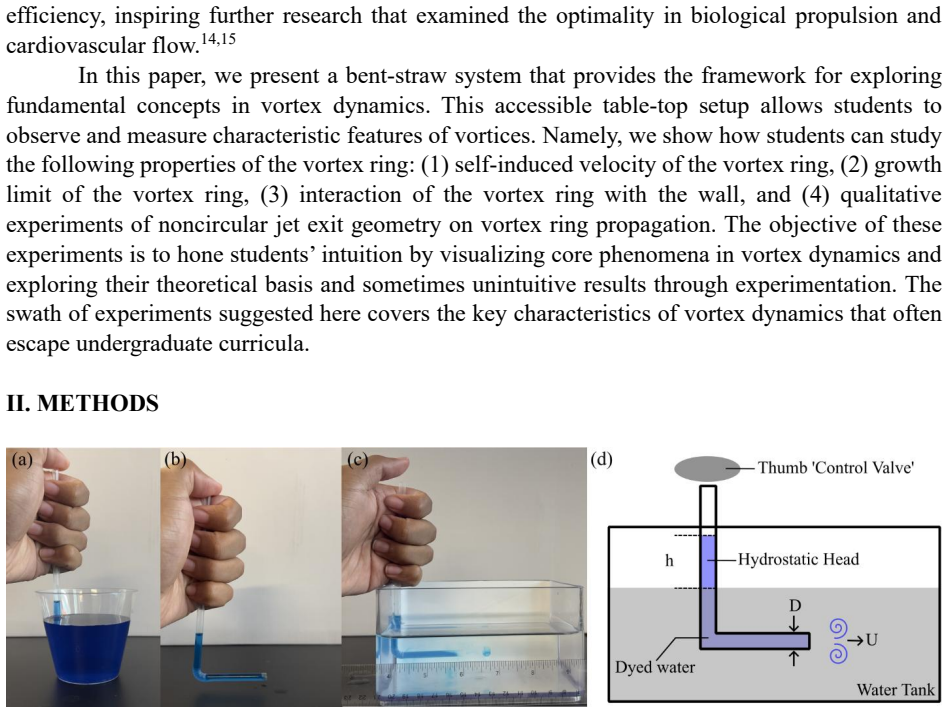
We present an affordable student-safe experiment to generate vortex rings and study their dynamics using a bent straw and dyed water that allows students to control key parameters, can be imaged using a smartphone camera, and explains the complex physics with simple and easily measured parameters. Vortex rings are produced that parallel seminal experiments, demonstrating secondary structures and the mirroring effect. Meanwhile, nonplanar and triangular jet exits are used to demonstrate asymmetric vortex rings and vortex ring inversion.
What carries the argument
The bent straw as a generator of dyed-water vortex rings, with changeable exit shapes that control ring symmetry and stability.
If this is right
- Students gain direct control over ejection volume, speed, and exit geometry to vary ring behavior.
- Smartphone video captures the full evolution of rings including secondary structures and mirroring without specialized cameras.
- Nonplanar and triangular exits produce observable asymmetric rings and ring inversion using the same basic setup.
- Complex vortex physics can be explained and quantified with only length, time, and volume measurements that students record themselves.
Where Pith is reading between the lines
- Schools without access to laser sheets or high-speed cameras could still include vortex-ring demonstrations in fluid-dynamics units.
- The same low-cost method might be adapted to explore related phenomena such as smoke-ring propulsion or underwater jet instabilities.
- Widespread classroom use could generate crowdsourced video datasets of vortex behavior under varying exit conditions.
- The approach suggests that other seemingly advanced fluid structures may also yield to simple mechanical proxies.
Load-bearing premise
The bent straw and dyed water can reliably produce vortex rings that show the same secondary structures, mirroring, asymmetry, and inversion seen in advanced laboratory experiments.
What would settle it
High-speed or smartphone video of the rings shows no secondary structures or mirroring effect when compared side-by-side with published images from conventional vortex generators.
Figures


read the original abstract
Vortex dynamics are an important topic in fluid dynamics, explaining phenomena like drag and lift generation, jet propulsion, and corner flows. It is also often excluded from introductory or undergraduate fluid dynamics courses on account of its complexity and the inaccessibility of practical and engaging experiments. We present an affordable student-safe experiment to generate vortex rings and study their dynamics using a bent straw and dyed water that allows students to control key parameters, can be imaged using a smartphone camera, and explains the complex physics with simple and easily measured parameters. Vortex rings are produced that parallel seminal experiments, demonstrating secondary structures and the mirroring effect. Meanwhile, nonplanar and triangular jet exits are used to demonstrate asymmetric vortex rings and vortex ring inversion.
Editorial analysis
A structured set of objections, weighed in public.
Referee Report
Summary. The manuscript presents an affordable, student-safe experimental method using a bent straw and dyed water to generate vortex rings. It claims this setup enables control of key parameters, smartphone-camera imaging, and explanation via simple measurable quantities, while producing rings that exhibit secondary structures, the mirroring effect, asymmetry from nonplanar/triangular exits, and inversion, thereby paralleling seminal vortex-ring experiments for educational use in fluid dynamics.
Significance. If the described apparatus reliably generates recognizable vortex-ring behavior under the stated conditions, the work provides a practical, low-cost pedagogical tool that could increase accessibility of vortex dynamics in undergraduate courses. The emphasis on consumer-grade equipment and qualitative demonstration of established phenomena (secondary structures, mirroring) is a clear strength for teaching contexts, though the contribution remains primarily methodological rather than advancing new quantitative understanding of the fluid mechanics.
major comments (2)
- [Experimental Setup] The central pedagogical claim that the setup 'explains the complex physics with simple and easily measured parameters' is not supported by concrete examples of parameter measurement protocols, calibration procedures, or how quantities such as jet velocity or ring circulation are obtained from smartphone images; this detail is load-bearing for reproducibility by students.
- [Results] In the results descriptions of secondary structures, mirroring, asymmetry, and inversion, the parallels to seminal experiments are asserted qualitatively without any reported measurements (e.g., ring propagation speed, diameter, or Reynolds number estimates) or direct visual comparisons, leaving the fidelity of the demonstration unverified.
minor comments (2)
- [Abstract and Methods] The abstract and methods should explicitly state the range of Reynolds numbers or Strouhal numbers achievable with the bent-straw apparatus to allow instructors to map the demonstrations onto standard vortex-ring literature.
- [Figures] Figure captions and text references to smartphone images should include scale bars or pixel-to-length calibration details so that readers can assess the physical sizes of the observed rings.
Simulated Author's Rebuttal
We thank the referee for their constructive comments and positive evaluation of the manuscript's pedagogical potential. We address each major comment below with specific plans for revision.
read point-by-point responses
-
Referee: [Experimental Setup] The central pedagogical claim that the setup 'explains the complex physics with simple and easily measured parameters' is not supported by concrete examples of parameter measurement protocols, calibration procedures, or how quantities such as jet velocity or ring circulation are obtained from smartphone images; this detail is load-bearing for reproducibility by students.
Authors: We agree that explicit protocols are necessary to substantiate the claim and ensure student reproducibility. In the revised manuscript we will add a new subsection in Experimental Setup that provides concrete, step-by-step instructions: (i) calibration of straw diameter and dispensed volume using a ruler and graduated cylinder or syringe; (ii) determination of jet velocity by filming the dyed-water front and using frame-by-frame smartphone video analysis (or free apps) to measure distance versus time; (iii) estimation of ring circulation via the approximate relation Γ ≈ π D V, where D and V are obtained directly from the same video. These additions will make the measurement process transparent without requiring specialized equipment. revision: yes
-
Referee: [Results] In the results descriptions of secondary structures, mirroring, asymmetry, and inversion, the parallels to seminal experiments are asserted qualitatively without any reported measurements (e.g., ring propagation speed, diameter, or Reynolds number estimates) or direct visual comparisons, leaving the fidelity of the demonstration unverified.
Authors: The demonstrations are intentionally qualitative to keep the experiment affordable and accessible. Nevertheless, we accept that order-of-magnitude anchors would strengthen the claimed parallels. In the revised Results section we will insert typical values observed with smartphone video (ring diameters ~2–4 cm, propagation speeds ~0.3–0.7 m/s) and the corresponding Reynolds-number range (Re ~ 1000–3000 based on ring diameter and water properties). These estimates will be compared to the regimes reported in the cited seminal works. Direct side-by-side images are not feasible, but we will add explicit citations to specific figures in the literature (e.g., Gharib et al., Maxworthy) so readers can perform their own visual comparisons. This constitutes a partial but substantive response that preserves the low-cost character of the setup. revision: partial
Circularity Check
No significant circularity; purely descriptive experimental contribution
full rationale
The paper is an experimental methods contribution describing an affordable vortex-ring demonstration using a bent straw and dyed water. It contains no equations, derivations, fitted parameters, or quantitative predictions. All claims reduce directly to the described apparatus and qualitative observations (secondary structures, mirroring, asymmetry) without any self-referential reduction or load-bearing self-citation. The central pedagogical claim is supported by the experimental description itself and does not invoke any internal chain that collapses to its own inputs.
Axiom & Free-Parameter Ledger
Reference graph
Works this paper leans on
-
[1]
Asymmetry in the jet opening: underwater jet vectoring mechanism by dragonfly larvae,
1C. Roh and M. Gharib, “Asymmetry in the jet opening: underwater jet vectoring mechanism by dragonfly larvae,” Bioinspir. Biomim. 13 (2018). 2G.P. Williams, “Planetary vortices and Jupiter's vertical structure,” J. Geophys. Res. 104, 9303- 9308 (1997). 3G.K. Batchelor, An Introduction to Fluid Dynamics, (Cambridge University Press, Cambridge 1967), p
work page 2018
-
[2]
Use of interactive lecture demonstrations: a ten year study,
4M.D. Sharma, I.D. Johnston, H. Johnston, K. Varvell, G. Robertson, A. Hopkins, C. Stewart, I. Cooper, and R. Thorton, “Use of interactive lecture demonstrations: a ten year study,” Phys. Rev. Phys. Educ. Res. 6, 020119 (2010). 5D.R. Sokoloff and R.K. Thornton, “Using interactive lecture demonstrations to create an active learning environment,” Phys. Teac...
work page 2010
discussion (0)
Sign in with ORCID, Apple, or X to comment. Anyone can read and Pith papers without signing in.