Recognition: 2 theorem links
· Lean TheoremMultiscale modeling of materials and neural operators
Pith reviewed 2026-05-12 00:48 UTC · model grok-4.3
The pith
Neural operators transfer all relevant information across scales in multiscale materials modeling.
A machine-rendered reading of the paper's core claim, the machinery that carries it, and where it could break.
Core claim
Multiscale modeling requires accurate transfer of all relevant information from one scale to another, an outstanding challenge that neural operators address because they are discretization-independent generalizations of neural networks that learn operators between function spaces, as demonstrated through three selected examples from materials problems.
What carries the argument
Neural operators: discretization-independent generalizations of neural networks that learn mappings between function spaces rather than pointwise values on a grid.
If this is right
- Multiscale simulations can retain full information content when moving between atomistic and continuum descriptions without grid-dependent artifacts.
- The same operator-learning approach applies across different classes of materials once the three examples are taken as proof of concept.
- Computational cost of repeated scale transfers drops because the learned operator replaces repeated fine-scale solves.
Where Pith is reading between the lines
- The approach could be tested on problems where the scales are not cleanly separated, such as those with strong feedback between micro and macro behavior.
- If the operator is trained once on representative data, it might serve as a reusable surrogate in many related materials systems.
- Similar operator learning could be applied to bridge scales in other physics domains that share the same information-transfer bottleneck.
Load-bearing premise
The three selected examples sufficiently represent the range of multiscale materials problems so that success there indicates general utility for the information-transfer challenge.
What would settle it
Application of the same neural-operator approach to a fourth, independent multiscale materials problem in which the learned mapping misses essential physics or fails to preserve accuracy across scales.
Figures


read the original abstract
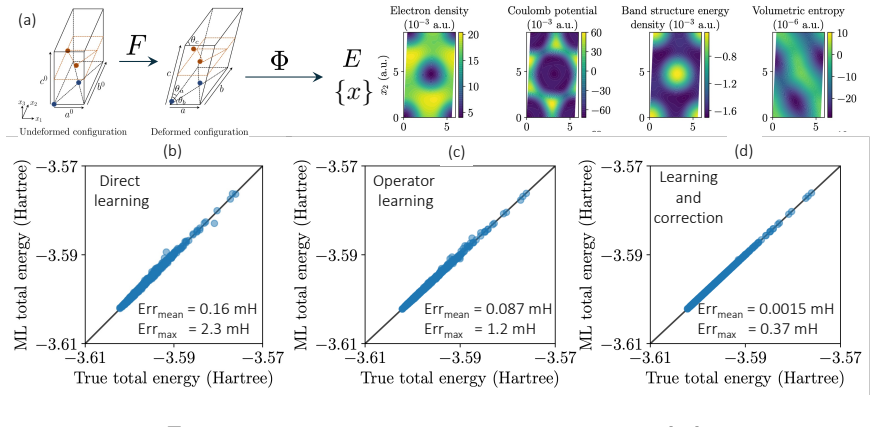
Multiscale modeling is essential for understanding the complex behavior of materials. However, accurately transferring all relevant information from one scale to another has remained an outstanding challenge. Neural operators, discretization-independent generalizations of neural networks, is proving to be a powerful tool in addressing this challenge. This article provides an introduction to neural operators, and illustrates their use in multiscale modeling of materials through three selected examples.
Editorial analysis
A structured set of objections, weighed in public.
Referee Report
Summary. The manuscript is an introductory tutorial that defines neural operators as discretization-independent generalizations of neural networks and illustrates their application to multiscale materials modeling via three selected examples. It positions neural operators as a tool for transferring information across scales in materials science but does not advance new theoretical derivations, empirical benchmarks, or universality claims.
Significance. As a tutorial rather than a research article, the work has modest significance if the explanations are clear and the examples are pedagogically effective. It could help bridge machine-learning methods to the materials community, but its value is limited by the absence of detailed error analysis, validation metrics, or discussion of limitations in the provided abstract and framing. No machine-checked proofs, reproducible code, or falsifiable predictions are indicated.
minor comments (3)
- Abstract: The sentence 'Neural operators, discretization-independent generalizations of neural networks, is proving to be a powerful tool...' contains a subject-verb agreement error ('operators' is plural, so 'are proving' is required). This should be corrected for clarity.
- Abstract and introduction: The claim that neural operators 'is proving to be a powerful tool' is presented without citing specific prior benchmarks or error metrics in the abstract; adding one or two key references to external validation studies would strengthen the motivation without altering the tutorial scope.
- Overall structure: As an introductory article, the manuscript would benefit from an explicit 'Limitations' subsection after the examples to discuss when neural operators may not be suitable (e.g., data requirements or training stability), even if brief.
Simulated Author's Rebuttal
We thank the referee for the careful review and the recommendation for minor revision. We agree that the manuscript is an introductory tutorial rather than a research article presenting new theory or benchmarks, and we appreciate the opportunity to clarify its scope and improve the framing for the materials community.
read point-by-point responses
-
Referee: The manuscript is an introductory tutorial that defines neural operators as discretization-independent generalizations of neural networks and illustrates their application to multiscale materials modeling via three selected examples. It positions neural operators as a tool for transferring information across scales in materials science but does not advance new theoretical derivations, empirical benchmarks, or universality claims.
Authors: We agree completely with this characterization. The paper is deliberately written as a tutorial to introduce neural operators to materials scientists and to demonstrate their use through three illustrative examples. No new theoretical results, benchmarks, or universality theorems are claimed or derived. revision: no
-
Referee: its value is limited by the absence of detailed error analysis, validation metrics, or discussion of limitations in the provided abstract and framing.
Authors: We acknowledge the point. In the revised manuscript we will expand the abstract to emphasize the tutorial character and add a dedicated subsection on limitations, including a qualitative discussion of approximation errors and the conditions under which the neural-operator approach is expected to be accurate or less reliable. revision: yes
-
Referee: No machine-checked proofs, reproducible code, or falsifiable predictions are indicated.
Authors: As a tutorial, the manuscript does not contain new theorems requiring machine-checked proofs or new falsifiable predictions. We will, however, add explicit pointers to publicly available code repositories that implement the neural-operator examples shown in the paper, thereby improving reproducibility for readers who wish to reproduce or extend the illustrations. revision: partial
Circularity Check
No significant circularity; tutorial structure keeps claims independent
full rationale
The manuscript is explicitly an introductory/tutorial article whose purpose is to define neural operators and illustrate their use via three selected examples in multiscale materials modeling. The strongest claim—that neural operators are proving to be a powerful tool—is presented as background motivation drawn from prior external development, not as a new result derived or validated within the paper. No derivation chain, equation, or central premise reduces by construction to a fitted input, self-definition, or self-citation load-bearing step. The examples function as illustrations rather than exhaustive proofs of generality, so representativeness is not load-bearing for the argument advanced. The paper remains self-contained against external benchmarks with no circular reductions.
Axiom & Free-Parameter Ledger
Lean theorems connected to this paper
-
IndisputableMonolith/Foundation/RealityFromDistinction.leanreality_from_one_distinction unclearNeural operators, discretization-independent generalizations of neural networks, is proving to be a powerful tool in addressing this challenge. ... recurrent neural operator (RNO) ... Fourier neural operator (FNO)
-
IndisputableMonolith/Cost/FunctionalEquation.leanwashburn_uniqueness_aczel unclearWe define a recurrent neural operator (RNO) as a mapping Φ_RNO : F → G defined through the relations (S̄(t)=ψ_S(F̄(t),ξ(t)), ξ̇(t)=ψ_ξ(F̄(t),ξ(t)))
Reference graph
Works this paper leans on
-
[1]
R. J. Asaro. Crystal plasticity.Journal of Applied Mechanics, 50:921–934, 1983
work page 1983
-
[2]
A. Bensoussan, J. L. Lions, and G. Papanicolau.Asymptotic Analysis for Periodic Structures. Elsevier, 1978
work page 1978
-
[3]
V. Berdichevskii and L. Sedov. Dynamic theory of continuously distributed dislocations. Its relation to plasticity theory: PMM vol. 31, no. 6, 1967, pp. 981-1000.Journal of Applied Mathematics and Mechanics, 31:989–1006, 1967
work page 1967
-
[4]
K. Bhattacharya, B. Hosseini, N. Kovachki, and A. M. Stuart. Model reduction and neural networks for parametric PDEs.SMAI Journal of Computational Mechanics, pages 121–157, 2021. 15
work page 2021
-
[5]
K. Bhattacharya, N. B. Kovachki, A. Rajan, A. M. Stuart, and M. Trautner. Learning homogenization for elliptic operators.SIAM Journal on Numerical Analysis, 62:1844– 1873, 2024
work page 2024
-
[6]
K. Bhattacharya, B. Liu, A. Stuart, and M. Trautner. Learning Markovian homogenized models in viscoelasticity.Multiscale Modeling & Simulation, 21:641–679, 2023
work page 2023
-
[7]
C. Bonatti and D. Mohr. On the importance of self-consistency in recurrent neural network models representing elasto-plastic solids.Journal of the Mechanics and Physics of Solids, 158:104697, 2022
work page 2022
-
[8]
V. Bulatov and W. Cai.Computer Simulations of Dislocations. Oxford University Press, 2013
work page 2013
- [9]
-
[10]
Y. Chang and D. M. Kochmann. A variational constitutive model for slip-twinning interactions in hcp metals: Application to single- and polycrystalline magnesium.In- ternational Journal of Plasticity, 73:39–61, 2015
work page 2015
-
[11]
B.-J. Choi, H. S. Jin, and B. Lkhagvasuren. Applications of the fourier neural operator in a regional ocean modeling and prediction.Frontiers in Marine Science, 11:1383997, 2024
work page 2024
-
[12]
S. Das, P. Motamarri, V. Gavini, B. Turcksin, Y. W. Li, and B. Leback. Fast, scalable and accurate finite-element based ab initio calculations using mixed precision comput- ing: 46 PFLOPS simulation of a metallic dislocation system. InProceedings of the International Conference for High Performance Computing, Networking, Storage and Analysis, pages 1–11. ...
work page 2019
-
[13]
E.Principles of multiscale modeling
W. E.Principles of multiscale modeling. Cambridge University Press, 2011
work page 2011
-
[14]
Fish.Multiscale Methods: Bridging the Scales in Science and Engineering
J. Fish.Multiscale Methods: Bridging the Scales in Science and Engineering. Oxford University Press, Oxford, 2009
work page 2009
-
[15]
F. Ghavamian and A. Simone. Accelerating multiscale finite element simulations of history-dependent materials using a recurrent neural network.Computer Methods in Applied Mechanics and Engineering, 357:112594, 2019
work page 2019
-
[16]
S. Ghosh and P. Suryanarayana. SPARC: Accurate and efficient finite-difference formu- lation and parallel implementation of Density Functional Theory: Extended systems. Computer Physics Communications, 216:109–125, 2017
work page 2017
-
[17]
S. Ghosh and P. Suryanarayana. SPARC: Accurate and efficient finite-difference for- mulation and parallel implementation of Density Functional Theory: Isolated clusters. Computer Physics Communications, 212:189–204, 2017. 16
work page 2017
-
[18]
E. V. d. Giessen and A. Needleman. Discrete dislocation plasticity: a simple planar model.Modelling and Simulation in Materials Science and Engineering, 3:689–735, 1995
work page 1995
-
[19]
H. I. Ing´ olfsson, H. Bhatia, F. Aydin, T. Oppelstrup, C. A. L´ opez, L. G. Stanton, T. S. Carpenter, S. Wong, F. Di Natale, X. Zhang, J. Y. Moon, C. B. Stanley, J. R. Chavez, K. Nguyen, G. Dharuman, V. Burns, R. Shrestha, D. Goswami, G. Gulten, Q. N. Van, A. Ramanathan, B. Van Essen, N. W. Hengartner, A. G. Stephen, T. Turbyville, P.- T. Bremer, S. Gnan...
work page 2023
-
[20]
M. Karimi and K. Bhattacharya. A learning-based multiscale model for reactive flow in porous media.Water Resources Research, 60:e2023WR036303, 2024
work page 2024
-
[21]
J. Kossaifi, N. Kovachki, Z. Li, D. Pitt, M. Liu-Schiaffini, R. J. George, B. Bonev, K. Azizzadenesheli, J. Berner, V. Duruisseaux, and A. Anandku- mar. A library for learning neural operators.Preprint, arXiv:2412.10354, 2025. https://github.com/neuraloperator/neuraloperator
-
[22]
N. Kovachki, Z. Li, B. Liu, K. Azizzadenesheli, K. Bhattacharya, and A. Stuart. Neural operator: Learning maps between function spaces with applications to PDEs.Journal of Machine Learning Research, 24:1–97, 2023
work page 2023
-
[23]
N. Kovachki, B. Liu, X. Sun, H. Zhou, K. Bhattacharya, M. Ortiz, and A. Stuart. Mul- tiscale modeling of materials: Computing, data science, uncertainty and goal-oriented optimization.Mechanics of Materials, 165:104156, 2022
work page 2022
-
[24]
N. B. Kovachki.Machine Learning and Scientific Computing. PhD thesis, California Institute of Technology, 2022
work page 2022
-
[25]
K. Le. Three-dimensional continuum dislocation theory.International Journal of Plas- ticity, 76:213–230, 2016
work page 2016
-
[26]
R. A. Lebensohn and A. D. Rollett. Spectral methods for full-field micromechanical modelling of polycrystalline materials.Computational Materials Science, 173:109336, 2020
work page 2020
- [27]
-
[28]
F. Lehmann, F. Gatti, M. Bertin, and D. Clouteau. 3D elastic wave propagation with a factorized fourier neural operator (f-fno).Computer Methods in Applied Mechanics and Engineering, 420:116718, 2024. 17
work page 2024
-
[29]
Z. Li, N. Kovachki, K. Azizzadenesheli, B. Liu, K. Bhattacharya, A. Stuart, and A. Anandkumar. Multipole graph neural operator for parametric partial differential equations. InAdvances in Neural Information Processing Systems 33 (NeurIPS 2020), pages 1–17, 2020
work page 2020
-
[30]
Z. Li, N. Kovachki, K. Azizzadenesheli, B. Liu, K. Bhattacharya, A. Stuart, and A. Anandkumar. Fourier neural operator for parametric partial differential equations. InProceedings of the International Conference on Learning Representations, pages 1–16, 2021
work page 2021
-
[31]
Z. Li, H. Zheng, N. Kovachki, D. Jin, H. Chen, B. Liu, K. Azizzadenesheli, and A. Anandkumar. Physics-informed neural operator for learning partial differential equa- tions.ACM/IMS Journal of Data Science, 1:1–27, 2024
work page 2024
-
[32]
B. Liu, N. Kovachki, Z. Li, K. Azizzadenesheli, A. Anandkumar, A. M. Stuart, and K. Bhattacharya. A learning-based multiscale method and its application to inelastic impact problems.Journal of the Mechanics and Physics of Solids, 158:104668, 2022
work page 2022
-
[33]
B. Liu, E. Ocegueda, M. Trautner, A. M. Stuart, and K. Bhattacharya. Learning macroscopic internal variables and history dependence from microscopic models.Journal of the Mechanics and Physics of Solids, 178:105329, 2023
work page 2023
-
[34]
S. Liu, K. Bhattacharya, and N. Lapusta. Learning a potential formulation for rate- and-state friction.Mechanics of Materials, 212:105540, 2025
work page 2025
-
[35]
M. Liu-Schiaffini, J. Berner, B. Bonev, T. Kurth, K. Azizzadenesheli, and A. Anand- kumar. Neural operators with localized integral and differential kernels. InProceedings of the 41st International Conference on Machine Learning, ICML’24. JMLR.org, 2024
work page 2024
-
[36]
F. Maresca and E. van der Giessen. Present and future of atomistic simulations of dislocation plasticity.KIM REVIEW, 2(04), 2024
work page 2024
-
[37]
M. Mozaffar, R. Bostanabad, W. Chen, K. Ehmann, J. Cao, and M. A. Bessa. Deep learning predicts path-dependent plasticity.Proceedings of the National Academy of Sciences, 116:26414–26420, 2019
work page 2019
-
[38]
G. Pavliotis and A. Stuart.Multiscale methods: averaging and homogenization. Springer Science, 2008
work page 2008
-
[39]
G. C. Y. Peng, M. Alber, A. Buganza Tepole, W. R. Cannon, S. De, S. Dura-Bernal, K. Garikipati, G. Karniadakis, W. W. Lytton, P. Perdikaris, L. Petzold, and E. Kuhl. Multiscale modeling meets machine learning: What can we learn?Archives of Compu- tational Methods in Engineering, 28:1017–1037, 2021
work page 2021
-
[40]
Phillips.Crystals, defects and microstructures: Modeling across scales
R. Phillips.Crystals, defects and microstructures: Modeling across scales. Cambridge University Press, 2001
work page 2001
-
[41]
R. Radhakrishnan. A survey of multiscale modeling: Foundations, historical milestones, current status, and future prospects.AIChE Journal, 67:e17026, 2021. 18
work page 2021
- [42]
-
[43]
F. Shah, T. L. Patti, J. Berner, B. Tolooshams, J. Kossaifi, and A. Anandkumar. Fourier neural operators for learning dynamics in quantum spin systems, 2026
work page 2026
-
[44]
E. B. Tadmor and R. E. Miller.Modeling Materials: Continuum, Atomistic and Multi- scale Techniques. Cambridge University Press, 2011
work page 2011
-
[45]
E. B. Tadmor, M. Ortiz, and R. Phillips. Quasicontinuum analysis of defects in solids. Philosophical magazine A, 73:1529–1563, 1996
work page 1996
-
[46]
Y. S. Teh, S. Ghosh, and K. Bhattacharya. Machine-learned prediction of the electronic fields in a crystal.Mechanics of Materials, 163:104070, 2021
work page 2021
-
[47]
E. Van Der Giessen, P. A. Schultz, N. Bertin, V. V. Bulatov, W. Cai, G. Cs´ anyi, S. M. Foiles, M. G. Geers, C. Gonz´ alez, M. H¨ utter, et al. Roadmap on multiscale materials modeling.Modelling and Simulation in Materials Science and Engineering, 28:043001, 2020
work page 2020
-
[48]
C. Woodward, D. R. Trinkle, L. G. Hector, and D. L. Olmsted. Prediction of dislocation cores in Aluminum from density functional theory.Physcial Review Letters, 100, 2008
work page 2008
-
[49]
L. Wu, V. D. Nguyen, N. G. Kilingar, and L. Noels. A recurrent neural network- accelerated multi-scale model for elasto-plastic heterogeneous materials subjected to random cyclic and non-proportional loading paths.Computer Methods in Applied Me- chanics and Engineering, 369:113234, 2020
work page 2020
-
[50]
Y. Zhang and K. Bhattacharya. Iterated learning and multiscale modeling of history- dependent architectured metamaterials.Mechanics of Materials, 197:105090, 2024. 19
work page 2024
discussion (0)
Sign in with ORCID, Apple, or X to comment. Anyone can read and Pith papers without signing in.