Recognition: 2 theorem links
· Lean TheoremAsymptotics for likelihood ratio tests of boundary points with singular information and unidentifiable nuisance parameters
Pith reviewed 2026-05-13 07:42 UTC · model grok-4.3
The pith
The likelihood ratio test statistic for boundary parameters with unidentifiable nuisance parameters converges in distribution to the supremum of a bar-chi-squared process.
A machine-rendered reading of the paper's core claim, the machinery that carries it, and where it could break.
Core claim
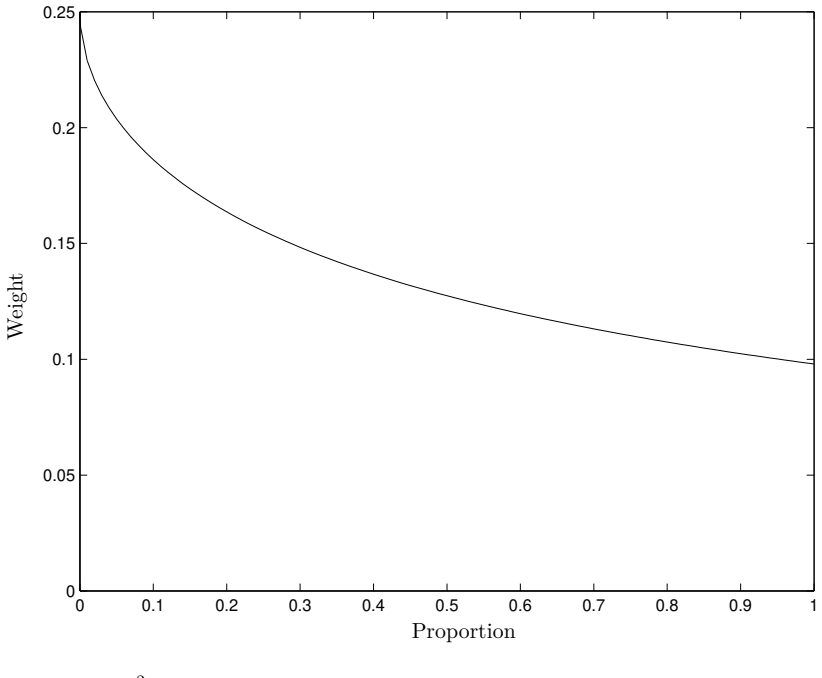
Under suitable regularity conditions the asymptotic distribution of the LRT statistic under the null hypothesis is the supremum of a bar-chi-squared process, that is, a stochastic process whose marginal distributions are mixtures of chi-squared distributions with weights depending on the nuisance parameter. Under local alternatives the asymptotic distribution is the supremum of a noncentral bar-chi-squared process. Singularity in the information matrix stemming from the nuisance parameter does not alter the form of the limit, unlike when singularity arises from the parameter of interest.
What carries the argument
The supremum of a bar-chi-squared process, a stochastic process with marginal distributions that are mixtures of chi-squared distributions weighted according to the value of the nuisance parameter.
If this is right
- The results recover all existing cases with nonsingular information or absent nuisance parameters as special cases.
- Several application-specific results for mixture models and genetic linkage analysis are recovered and extended.
- The same limiting form applies even when the information matrix is singular due to the nuisance parameters.
- Analogous results hold for change-point detection problems that share these features.
Where Pith is reading between the lines
- If the regularity conditions hold in a given model, one can simulate the bar-chi-squared process to obtain critical values for the test.
- This framework suggests similar asymptotic analyses could apply to other models with unidentifiable components, such as certain clustering or regime-switching models.
- The local alternative results enable power calculations that depend on the nuisance in a structured way.
Load-bearing premise
The statistical model satisfies suitable regularity conditions ensuring the information matrix behaves appropriately and the supremum of the process is well-defined.
What would settle it
If in a concrete model such as a finite Gaussian mixture the finite-sample distribution of the LRT statistic under the null differs substantially from what the supremum of the bar-chi-squared process predicts, even as sample size grows, the asymptotic claim would be falsified.
Figures

read the original abstract
We establish the asymptotic distribution of likelihood ratio tests (LRTs) in settings where some of the nuisance parameters are unidentifiable under the null hypothesis, parameters of interest lie on the boundary of the parameter space, and the information matrix of the identifiable parameters may be singular. Our work is motivated by mixture models and genetic linkage analysis, which exhibit all three features simultaneously, but it is applicable more broadly to other problems such as change-point detection. Under suitable regularity conditions, the asymptotic distribution of the LRT statistic under the null hypothesis is the supremum of a $\bar{\chi}^2$-process, that is, a stochastic process whose marginal distributions are mixtures of $\chi^2$-distributions with weights depending on the nuisance parameter. Under local alternatives, the asymptotic distribution of the LRT statistic is the supremum of a noncentral $\bar{\chi}^2$-process, whose marginal distributions are mixtures of truncated, noncentral $\chi^2$-distributions. In contrast to prior work on singular information, where singularity stems from the parameter of interest and changes the form of the limit distribution, here singularity is determined by the nuisance parameter and the limit has the same form as in the nonsingular case. Existing results for boundary inference with nonsingular information or without nuisance parameters are obtained as special cases, and several existing application-specific results for mixture models and genetic linkage analysis are recovered and extended.
Editorial analysis
A structured set of objections, weighed in public.
Referee Report
Summary. The paper establishes the asymptotic distribution of likelihood ratio tests (LRTs) in settings where nuisance parameters are unidentifiable under the null, parameters of interest lie on the boundary, and the information matrix may be singular. Under suitable regularity conditions, the null asymptotic distribution of the LRT statistic is the supremum of a bar-chi-squared process whose marginals are mixtures of chi-squared distributions with nuisance-dependent weights. Under local alternatives, it is the supremum of a noncentral bar-chi-squared process. The result recovers special cases from mixture models, genetic linkage, and change-point detection, and shows that nuisance-induced singularity does not change the form of the limit unlike interest-parameter singularity.
Significance. This work is significant as it provides a unified asymptotic theory for non-regular LRT problems that arise frequently in statistical applications involving mixtures and boundary constraints. By demonstrating that the limit retains the standard bar-chi-squared form when singularity comes from the nuisance parameter, it simplifies inference in these models and extends prior results on boundary testing and singular information. The recovery of application-specific results as special cases adds credibility, and the local alternative analysis supports power calculations.
major comments (1)
- The proof of convergence to the supremum of the bar-chi-squared process (main theorem) relies on tightness and stochastic equicontinuity arguments that are outlined but not fully detailed for the case of singular information induced by the nuisance parameter; this is load-bearing for the central asymptotic claim.
minor comments (2)
- The abstract introduces the bar-chi-squared process without a brief inline definition or pointer to its marginal distribution, which reduces accessibility for readers new to the area.
- In the introduction and comparison section, the contrast with prior singular-information results (where singularity arises from the parameter of interest) could be made more explicit by citing the specific change in limit form that is avoided here.
Simulated Author's Rebuttal
We thank the referee for their careful reading and positive assessment of the manuscript. We address the single major comment below and will revise accordingly.
read point-by-point responses
-
Referee: The proof of convergence to the supremum of the bar-chi-squared process (main theorem) relies on tightness and stochastic equicontinuity arguments that are outlined but not fully detailed for the case of singular information induced by the nuisance parameter; this is load-bearing for the central asymptotic claim.
Authors: We agree that the tightness and stochastic equicontinuity arguments in the proof of the main theorem (Theorem 3.1) are outlined at a high level in the main text and appendix but would benefit from fuller expansion when the information singularity arises from the nuisance parameter. In the revised manuscript we will add a dedicated subsection in the appendix that derives these arguments explicitly under the stated regularity conditions. The derivation will verify the moment and Lipschitz conditions on the score process, confirm that nuisance-induced singularity does not alter the modulus-of-continuity bounds, and show that the same chaining arguments used in the nonsingular case continue to apply, thereby establishing the required tightness without changing the form of the limiting bar-chi-squared process. revision: yes
Circularity Check
No significant circularity detected
full rationale
The paper derives the asymptotic distribution of the LRT statistic as the supremum of a bar-chi-squared process under regularity conditions on the model, information matrix, and nuisance parameters. This follows from standard likelihood theory extensions for boundary and singular cases without reducing the target limit distribution to any fitted parameter, self-defined quantity, or load-bearing self-citation chain. Existing results are recovered as special cases, but the central claim is obtained directly from the likelihood and information structure rather than by construction from inputs. No equation equates the predicted limit to a data-dependent fit or renames a known result via ansatz smuggling.
Axiom & Free-Parameter Ledger
axioms (1)
- domain assumption suitable regularity conditions on the likelihood and information matrix
Lean theorems connected to this paper
-
IndisputableMonolith/Cost/FunctionalEquation.leanwashburn_uniqueness_aczel unclearUnder suitable regularity conditions, the asymptotic distribution of the LRT statistic under the null hypothesis is the supremum of a bar-chi-squared process... X(t) = sup delta in Delta(t) Q(delta,t) with Q = 2 delta^T Z(t) - ||delta||^2
-
IndisputableMonolith/Foundation/RealityFromDistinction.leanreality_from_one_distinction unclearX(t) has a bar-chi^2 distribution... mixture of chi^2_j with weights w_j(t) determined by Delta(t)
Reference graph
Works this paper leans on
-
[1]
Donald W. K. Andrews. Admissibility of the likelihood ratio test when the parameter space is restricted under the alternative. Econometrica, 64 0 (3): 0 705--718, 1996
work page 1996
-
[2]
Donald W. K. Andrews. Testing when a parameter is on the boundary of the maintained hypothesis. Econometrica, 69 0 (3): 0 683--734, 2001
work page 2001
-
[3]
Donald W. K. Andrews and W. Ploberger. Admissibility of the likelihood ratio test when a nuisance parameter is present only under the alternative. Annals of Statistics, 23 0 (5): 0 1609--1629, 1995
work page 1995
-
[4]
P. J. Bickel and H. Chernoff. Asymptotic distribution of the likelihood ratio statistic in a prototypical non-regular problem. In J.K. Ghosh, S.K. Mitra, K.R. Parthasarathy, and Prakasa B.L.S Rao, editors, A Raghu Raj Bahadur Festschrift, pages 83--96. Wiley, New York, 1993
work page 1993
-
[5]
Confidence regions when the Fisher information is zero
Matteo Bottai. Confidence regions when the Fisher information is zero. Biometrika, 90 0 (1): 0 73--84, 2003. doi:10.1093/biomet/90.1.73
-
[6]
Large sample distribution of the likelihood ratio test for normal mixtures
Hanfeng Chen and Jiahua Chen. Large sample distribution of the likelihood ratio test for normal mixtures. Statistics & Probability Letters, 52: 0 125--133, 2001. doi:10.1016/S0167-7152(00)00171-1
-
[7]
Tests for homogeneity in normal mixtures in the presence of a structural parameter
Jiahua Chen and Hanfeng Chen. Tests for homogeneity in normal mixtures in the presence of a structural parameter. Statistica Sinica, 13: 0 351--365, 2003
work page 2003
-
[8]
On the distribution of the likelihood ratio
Herman Chernoff. On the distribution of the likelihood ratio. The Annals of Mathematical Statistics, 25 0 (3): 0 573--578, 1954. doi:10.1214/aoms/1177728725
-
[9]
Herman Chernoff and Eric Lander. Asymptotic distribution of the likelihood ratio test that a mixture of two binomials is a single binomial. Journal of Statistical Planning and Inference, 43: 0 19--40, 1995
work page 1995
-
[10]
A generalized argmax theorem with applications
Gregory Cox. A generalized argmax theorem with applications. arXiv preprint arXiv:2209.08793, 2022
-
[11]
D. Dacunha-Castelle and E. Gassiat. Testing the order of a model using locally conic parametrization: Population mixtures and stationary arma processes. Annals of Statistics, 27 0 (4): 0 1178--1209, 1999
work page 1999
-
[12]
Robert B. Davies. Hypothesis testing when a nuisance parameter is present only under the alternative. Biometrika, 62 0 (2): 0 247--254, 1977
work page 1977
-
[13]
Robert B. Davies. Hypothesis testing when a nuisance parameter is present only under the alternative. Biometrika, 74 0 (1): 0 33--43, 1987
work page 1987
-
[14]
Jos \'e e Dupuis, Philip O. Brown, and David Siegmund. Statistical methods for linkage analysis of complex traits from high-resolution maps of identity by descent. Genetics, 140: 0 843--856, 1995
work page 1995
-
[15]
Confidence regions near singular information and boundary points with applications to mixed models
Karl Oskar Ekvall and Matteo Bottai. Confidence regions near singular information and boundary points with applications to mixed models. The Annals of Statistics, 50 0 (3): 0 1806--1832, 2022. doi:10.1214/22-AOS2177
-
[16]
The log likelihood ratio in segmented regression
Paul Feder. The log likelihood ratio in segmented regression. The Annals of Statistics, 3 0 (1): 0 84--97, 1975
work page 1975
-
[17]
Eleanor Feingold, Philip O. Brown, and David Siegmund. Gaussian models for genetic linkage analysis using complete high-resolution maps of identity by descent. American Journal of Human Genetics, 53: 0 234--251, 1993
work page 1993
-
[18]
Charles J. Geyer. On the asymptotics of constrained M-estimation . The Annals of Statistics, 22 0 (4): 0 1993--2010, 1994. doi:10.1214/aos/1176325768
-
[19]
T Gu \'e don, C Baey, and E Kuhn. Bootstrap test procedure for variance components in nonlinear mixed effects models in the presence of nuisance parameters and a singular Fisher information matrix. Biometrika, 111 0 (4): 0 1331--1348, 2024. doi:10.1093/biomet/asae025
-
[20]
Asymptotic properties of affected-sib-pair linkage analysis
Peter Holmans. Asymptotic properties of affected-sib-pair linkage analysis. American Journal of Human Genetics, 52: 0 362--374, 1993
work page 1993
-
[21]
Determining inheritance distributions via stochastic penetrances
Ola H \"o ssjer. Determining inheritance distributions via stochastic penetrances. Journal of the American Statistical Association, 98: 0 1035--1051, 2003
work page 2003
-
[22]
Conditional likelihood score functions in linkage analysis
Ola H \"o ssjer. Conditional likelihood score functions in linkage analysis. Biostatistics, 6: 0 313--332, 2005 a
work page 2005
-
[23]
Spectral decomposition of score functions in linkage analysis
Ola H \"o ssjer. Spectral decomposition of score functions in linkage analysis. Bernoulli, 11 0 (6): 0 1093--1113, 2005 b
work page 2005
-
[24]
Eric S. Lander and David Botstein. Mapping mendelian factors underlying quantitative traits using RFLP linkage maps. Genetics, 121: 0 185--199, 1989
work page 1989
-
[25]
Likelihood ratio tests for genetic linkage
Mohamed Lemdani and Odile Pons. Likelihood ratio tests for genetic linkage. Statistics and Probability Letters, 33: 0 15--22, 1997
work page 1997
-
[26]
Mixture Models: Theory, Geometry and Applications
B.G Lindsay. Mixture Models: Theory, Geometry and Applications. IMS, Hayward, CA, 1995
work page 1995
-
[27]
Optimal allele-sharing statistics for genetic mapping using affected relatives
Mary Sara McPeek. Optimal allele-sharing statistics for genetic mapping using affected relatives. Genetic Epidemiology, 16: 0 225--249, 1999
work page 1999
- [28]
-
[29]
Cox, Matteo Bottai, and James Robins
Andrea Rotnitzky, David R. Cox, Matteo Bottai, and James Robins. Likelihood-based inference with singular information matrix. Bernoulli, 6: 0 243--284, 2000
work page 2000
-
[30]
Steven G. Self and Kung-Yee Liang. Asymptotic properties of maximum likelihood estimators and likelihood ratio tests under nonstandard conditions. Journal of the American Statistical Association, 82 0 (3): 0 605--610, 1987
work page 1987
-
[31]
P. K. Sen and M.J. Silvapulle. An appraisal of statistical inference under inequality constraints. Journal of Statistical Planning and Inference, 107: 0 3--43, 2002
work page 2002
-
[32]
Robert J. Serfling. Approximation Theorems of Mathematical Statistics . Wiley Series in Probability and Mathematical Statistics. John Wiley & Sons, Hoboken, NJ, USA, 2002. ISBN 978-0-470-31648-1. doi:10.1002/9780470316481
-
[33]
Pak Sham. Statistics in Human Genetics. Arnold Applications of Statistics Series. Arnold, London, 1998. ISBN 978-0-340-66241-0 978-0-471-19488-0
work page 1998
-
[34]
A. Shapiro. Towards a unified theory of inequality constrained testing in multivariate analysis. International Statistical Review / Revue Internationale de Statistique, 56 0 (1): 0 49--62, 1988. doi:10.2307/1403361
-
[35]
Alexander Shapiro. Asymptotic distribution of test statistics in the analysis of moment structures under inequality constraints. Biometrika, 72 0 (1): 0 133--144, 1985. doi:10.1093/biomet/72.1.133
-
[36]
B. K. Suarez, J. Rice, and T. Reich. The generalized sib pair IBD distribution: Its use in detection of linkage. Annals of Human Genetics, 44: 0 87--94, 1978
work page 1978
-
[37]
Aad W. van der Vaart and Jon A. Wellner. Weak Convergence and Empirical Processes: With Applications to Statistics . Springer Series in Statistics. Springer, Cham, Switzerland, 2 edition, 2023. ISBN 978-3-031-29038-1 978-3-031-29040-4
work page 2023
-
[38]
Whittemore and Jennifer Halpern
Alice S. Whittemore and Jennifer Halpern. A class of tests for linkage using affected pedigree members. Biometrics, 50: 0 118--127, 1994
work page 1994
-
[39]
S. S. Wilks. The large-sample distribution of the likelihood ratio for testing composite hypotheses. The Annals of Mathematical Statistics, 9 0 (1): 0 60--62, 1938. doi:10.1214/aoms/1177732360
discussion (0)
Sign in with ORCID, Apple, or X to comment. Anyone can read and Pith papers without signing in.