pith. machine review for the scientific record. sign in

arxiv: 2605.08479 · v1 · submitted 2026-05-08 · 🌌 astro-ph.IM

Recognition: 2 theorem links

· Lean Theorem

Wideband RFI Monitor Requirements, Design, and Commissioning at DRAO

Abraham J. Otto, Benoit Robert, Charl Baard, Dustin Lagoy, Mohammad Islam, Nicholas Bruce, Peter F. Driessen, Robert Messing, Stephen Harrison, Timothy Robishaw

Pith reviewed 2026-05-12 01:56 UTC · model grok-4.3

classification 🌌 astro-ph.IM
keywords RFI monitorDRAOradio frequency interferencetransient detectiongain driftwideband monitoringradio astronomyenvironment characterization
0
0 comments X

The pith

The RFI monitor at DRAO now provides 2 GHz bandwidth for transient detection and long-term environment monitoring after calibration upgrades.

A machine-rendered reading of the paper's core claim, the machinery that carries it, and where it could break.

This paper describes the requirements, design, and commissioning of a wideband radio frequency interference monitor installed at the Dominion Radio Astrophysical Observatory. The instrument delivers 2 GHz of instantaneous bandwidth, allowing either spectral channels as narrow as 100 Hz over 1-second integrations or integrations as short as 50 ms at 3.33 kHz channels. After several years as a prototype, the monitor received upgrades to its calibration method, analog section temperature control, and gain stability. These changes enable it to function simultaneously as a real-time transient detector and a tool for ongoing characterization of the local radio environment. The authors present new applications for the system and derive a method to calculate how gain drift influences integrated data products.

Core claim

The commissioned RFI monitor supplies 2 GHz instantaneous bandwidth with flexible resolution and integration settings, operating reliably as both a transient detector and long-term radio environment characterization instrument once calibration, temperature, and gain stability are improved. Novel applications of the monitor are introduced, and a new calculation method is derived for quantifying the effect of gain drift on integrated observations.

What carries the argument

The wideband RFI monitor instrument with its 2 GHz bandwidth and channel/integration flexibility, together with the derived method for calculating gain drift effects on integrated data.

Load-bearing premise

The improvements in calibration method, analog section temperature, and gain stability are assumed to be sufficient for reliable long-term operation and accurate transient detection without introducing new systematic errors.

What would settle it

Long-term data sets showing residual gain drift signatures in integrated products or missed transients attributable to calibration drift would demonstrate that the commissioning changes fall short.

Figures
Figures reproduced from arXiv: 2605.08479 by Abraham J. Otto, Benoit Robert, Charl Baard, Dustin Lagoy, Mohammad Islam, Nicholas Bruce, Peter F. Driessen, Robert Messing, Stephen Harrison, Timothy Robishaw.

Figure 1
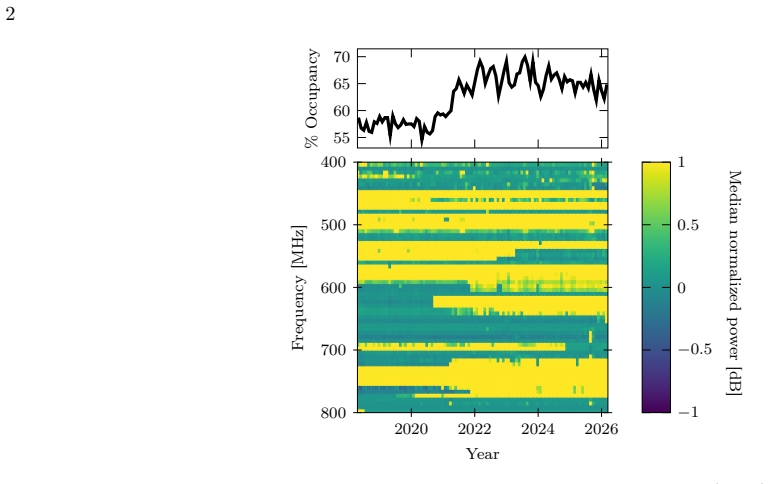
Figure 1. Figure 1: Annual snapshots of CHIME data normalized against a snapshot median (lower) showing an increasing trend in percent occupancy above 0 dB (upper) ( The CHIME Collaboration et al. 2022). While the monitor operated as a prototype, telemetry data revealed that the analog signal chain—which must remain stable for accurate calibration—fluctuated with the outdoor temperature ( [PITH_FULL_IMAGE:figures/full_fig_p0… view at source ↗
Figure 2
Figure 2. Figure 2: Analog signal chain temperature (black) and ambient temperature (red) during a day in mid-March, when ambient fluctuations were small relative to those in the summer months. To assess the gain stability of the prototype, we computed the overlapping Allan deviation (W. J. Riley 2008). This metric requires a contiguous, uninterrupted time series, so we disabled the calibration cycle, replaced the antenna wit… view at source ↗
Figure 3
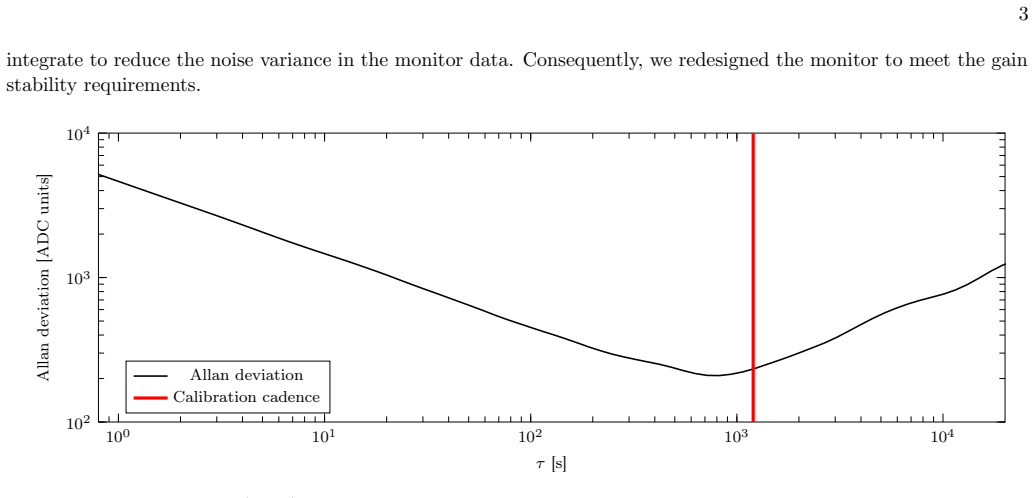
Figure 3. Figure 3: Allan deviation (black) at 1250 MHz demonstrating a stability limit at ≈ 750 s, beyond which systematic gain fluctuations dominate. The prototype calibration cadence of 1200 s (red) exceeded this useful integration window. In this paper, we present the design, construction, and validation of an RFI monitor, emphasizing system gain stability for long-term RF environment characterization. In § 2, we present … view at source ↗
Figure 4
Figure 4. Figure 4: Frequency ranges of DRAO telescopes along with the RFI monitor frequency coverage. The primary frequency range of the RFI monitor covers the majority of current and proposed instruments. Weighting these temperatures by the monitor’s spatial coverage yields an expected antenna noise temperature of Tant ≈ 174 K. Adopting a slightly conservative value of Tant = 170 K, we specified a matching target noise figu… view at source ↗
Figure 5
Figure 5. Figure 5: Antenna position geometric model, where ht is the transmitter height, he is the height of the diffracting building edge, and ha is the receiving antenna height above the building edge. The total propagation loss, L, comprises two distinct components. The first is the FSPL defined by ITU-R (2019b) as 20 log10  4πd λ  , where d is the total path distance. The second is the additional attenuation due to kni… view at source ↗
Figure 6
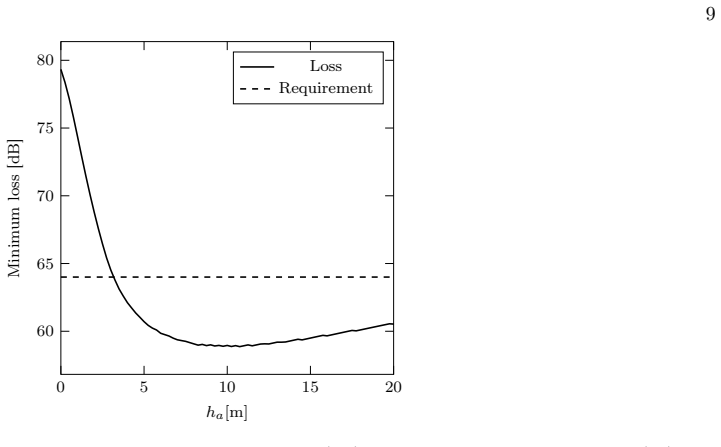
Figure 6. Figure 6: Worst-case path loss evaluated across all transmitter distances (dte) as a function of antenna height (ha). To guarantee the target loss of 64 dB, the antenna must be mounted lower than 4.4 m above the diffracting edge. To provide complete 360◦ coverage of the terrestrial RF environment and capture all local interference events, the system requires a vertically polarized, wideband, omnidirectional antenna.… view at source ↗
Figure 7
Figure 7. Figure 7: The passive Alaris OMNI-A0190 monitoring antenna mounted on the roof of the main building, alongside the delineated sections of the downstream signal chain. The mounting height is strictly constrained by the knife-edge diffraction loss required to shield the receiver from publicly accessible areas [PITH_FULL_IMAGE:figures/full_fig_p009_7.png] view at source ↗
Figure 8
Figure 8. Figure 8: Simplified model of the insulated box containing the RF signal chain. Assuming an adiabatic boundary (dashed) and steady-state power dissipation from the RF components, heat transfer is restricted exclusively to the TEA. Because the feedback sensor is located near the TEA–copper interface, ambient temperature variations are actively rejected, and the RF components experience negligible temperature variatio… view at source ↗
Figure 9
Figure 9. Figure 9: A 3D rendering of the signal chain enclosure illustrating the component layout. To minimize thermal leakage, all depicted void spaces within the physical steel enclosure are completely filled with insulating foam. 3.4.1. Generating Calibrated Integrations The “hot” and “cold” measurements yield the uncalibrated power spectra, Phot and Pcold, respectively, in dimension￾less analog-to-digital converter (ADC)… view at source ↗
Figure 10
Figure 10. Figure 10: The signal chain enclosure at successive stages of foam insulation assembly [PITH_FULL_IMAGE:figures/full_fig_p012_10.png] view at source ↗
Figure 11
Figure 11. Figure 11: Simplified block diagram of the calibration system architecture. The first switch selects between the antenna (TA) and a primary 50 Ω matched load (TL1). The second switch toggles the calibration input between a noise diode (TN ) and a secondary 50 Ω matched reference load (TL2). 3.4.2. Meeting the On-Sky Requirement To maximize the system’s sensitivity to transient RFI, the monitor must maintain an on-sk… view at source ↗
Figure 12
Figure 12. Figure 12: Fractional Y -factor uncertainty as a function of the number of averaged integrations (N). The curves represent the maximum (worst-case; red) and 95th percentile (blue) values across the measured spectrum. At N = 9, 95% of the frequency bins achieve a fractional 1σ uncertainty of less than 1%. are dequeued from the FIFO and applied directly to the GPIO pins, ensuring microsecond-level switching alignment … view at source ↗
Figure 13
Figure 13. Figure 13: Analog receiver block diagram. The temperature-controlled section is deployed outdoors adjacent to the antenna mast and contains the calibration hardware. The ambient section is deployed indoors and contains an equalizer, adjustable gain, and an anti-aliasing filter. The sections are connected by 64 m of coaxial cable. 0 5 10 0 0.5 1 Time from oscilloscope trigger [ns] Voltage [ V] J1 port J2 port [PITH_… view at source ↗
Figure 14
Figure 14. Figure 14 [PITH_FULL_IMAGE:figures/full_fig_p015_14.png] view at source ↗
Figure 15
Figure 15. Figure 15: DSP block diagram detailing the 16-channel oversampled filterbank implemented in the FPGA, which feeds into 16 critically sampled channelizers implemented in the GPU. The first DSP stage is an FPGA-based oversampled polyphase filterbank (OSPFB) (oversampling factor O = 16/15) that produces 16 single-polarization channels from the digitized input. The sample rate for each channel is 133 MHz, providing a us… view at source ↗
Figure 16
Figure 16. Figure 16: FPGA DSP block diagram showing the digitized data being processed by the OSPFB, a saturation detector, and an input monitor, all of which broadcast their outputs over UDP channels. dictates a minimum integration time of ≈ 50 ms (constrained by memory bandwidth), whereas an integration time of 1 s allows for a minimum channel bandwidth of ≈ 100 Hz (constrained by GPU memory). For standard operations, a cha… view at source ↗
Figure 17
Figure 17. Figure 17: Two days of occupancy data for the 350–1050 MHz band, demonstrating a strong diurnal cycle. Standard working hours (07:30–17:30) are shaded in red. 4. VALIDATION 4.1. Receiver Noise Temperature To determine the receiver noise temperature, Trec, we measured the analog signal chain using a noise-figure analyzer (NFA) [PITH_FULL_IMAGE:figures/full_fig_p018_17.png] view at source ↗
Figure 18
Figure 18. Figure 18: Receiver noise temperature across the operational bandwidth, demonstrating a maximum of less than 170 K. 0.2 0.3 0.4 0.5 0.6 0.7 0.8 0.9 1 1.1 1.2 1.3 1.4 1.5 1.6 1.7 1.8 −5 · 10−2 0 5 · 10−2 0.1 Frequency [GHz] ∆ Tgain,integrated ∆ Tthermal Signal chain gain stability Requirement [PITH_FULL_IMAGE:figures/full_fig_p019_18.png] view at source ↗
Figure 19
Figure 19. Figure 19: Gain stability of the system, demonstrating that the performance requirement is safely met over a 1200 s duration across the entire operational bandwidth. 4.3. Integrated System Stability The final validation test was a repeated characterization of the system’s Allan deviation, following the methodology described in § 2.5. The commissioned system was reinstalled at the same physical location on the DRAO m… view at source ↗
Figure 20
Figure 20. Figure 20: Uncalibrated Allan deviation (black) at 1250 MHz. The RFI monitor data cannot be integrated for longer than ≈ 1400 s before system drift causes the noise variance to increase. The original prototype calibration cadence of 1200 s (red) occurs prior to this stability knee, and the minimum possible calibration cadence for the commissioned instrument (270 s, blue) is well to the left of the drift-limited regi… view at source ↗
Figure 21
Figure 21. Figure 21: Calibrated Allan deviation at 1250 MHz, demonstrating that the RFI monitor data can be integrated up to ≈ 100 000 s without system drift dominating the noise variance. 4.4. Sensitivity As established in § 3.4, the calibrated data produced by the RFI monitor are expressed as PSDs. As shown in [PITH_FULL_IMAGE:figures/full_fig_p020_21.png] view at source ↗
Figure 22
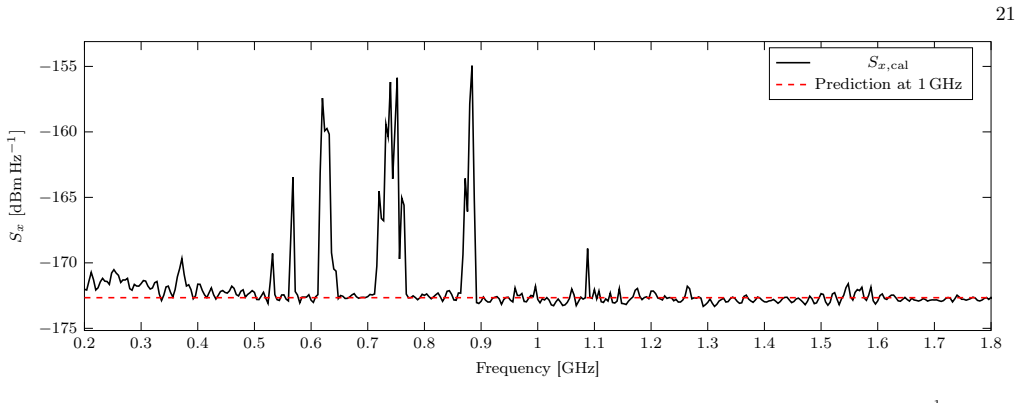
Figure 22. Figure 22: Sample spectra output from the RFI monitor showing a measured system sensitivity of ≈ −172 dBm Hz−1 , aligning with the theoretical prediction (red dashed line) of Sx = −172.7 dBm Hz−1 . a system sensitivity of approximately −172 dBm Hz−1 and stability sufficient for integrations exceeding 24 hours; a comprehensive summary of instrument specifications is provided in [PITH_FULL_IMAGE:figures/full_fig_p021… view at source ↗
Figure 23
Figure 23. Figure 23: Matched-load temperature during switching before (red) and after (black) the redesign, showing that the matched load no longer heats up. ACKNOWLEDGMENTS The authors gratefully acknowledge Elena Bergeron, Werner Dueck, Tayron Dueck, Ralph Webber, and Greg Nuspel for their help with the construction, mechanical design, and machining of the analog signal chain components. The authors thank the CHIME collabor… view at source ↗
Figure 24
Figure 24. Figure 24: shows the matched-load temperature for both systems as the ambient temperature varied. In both tests, the TEA had a temperature setpoint of 24 ◦C. −25 −20 −15 −10 −5 0 5 10 15 20 25 30 35 40 45 18 20 22 24 Ambient temperature [◦C] Matched-load temperature [ ◦C] Prototype Commissioned [PITH_FULL_IMAGE:figures/full_fig_p023_24.png] view at source ↗
Figure 25
Figure 25. Figure 25: Receiver noise temperature for both the prototype (red) and the commissioned monitor (black) showing an ≈ 10 K improvement. A.6. Temperature-Induced Gain Stability To determine if the prototype met the gain-stability requirement outlined in § 4.2, we evaluated its performance to establish a baseline before implementing any hardware modifications [PITH_FULL_IMAGE:figures/full_fig_p024_25.png] view at source ↗
Figure 26
Figure 26. Figure 26: Gain stability comparison before (red) and after (black) changes were made to the system, showing that the requirement is now met for a 1200 s duration. A.7. Calibration System The calibration system described in § 3.4 significantly reduced the calibration duration compared to the prototype. The original design relied on a networked LabJack T4 to control both the antenna-to-matched-load switch and the noi… view at source ↗
read the original abstract

In this paper, we introduce the radio frequency interference monitor deployed at the Dominion Radio Astrophysical Observatory. It provides 2 GHz of instantaneous bandwidth, supporting channel bandwidths as fine as ~100 Hz for 1 s integrations, or integration times as low as ~50 ms for the standard 3.33 kHz channel bandwidth. After operating as a prototype instrument for several years, the monitor was commissioned to improve the calibration method, analog section temperature, and gain stability. It now operates both as a transient detector and as a long-term radio environment characterization tool. We introduce novel applications for the monitor and derive a new method for calculating the effect of gain drift on integrated data.

Editorial analysis

A structured set of objections, weighed in public.

Desk editor's note, referee report, simulated authors' rebuttal, and a circularity audit. Tearing a paper down is the easy half of reading it; the pith above is the substance, this is the friction.

Referee Report

2 major / 1 minor

Summary. The manuscript describes the requirements, design, and commissioning of a wideband RFI monitor at the Dominion Radio Astrophysical Observatory (DRAO). The instrument delivers 2 GHz instantaneous bandwidth, supporting channel widths as fine as ~100 Hz for 1 s integrations or integration times down to ~50 ms for the standard 3.33 kHz channels. After several years as a prototype, the monitor was commissioned with revisions to the calibration method, analog-section temperature control, and gain stability. It now operates as both a transient detector and a long-term radio-environment characterization tool. The authors introduce novel applications and derive a new method for calculating the effect of gain drift on integrated data.

Significance. If the commissioning changes and the gain-drift calculation method prove robust, the work supplies a practical wideband RFI monitoring capability that can support transient searches and long-term environmental characterization at DRAO and comparable facilities. The engineering focus on stability improvements and the explicit derivation of a gain-drift correction represent concrete contributions to radio-astronomy instrumentation.

major comments (2)
  1. [Commissioning section] The central claim that the revised calibration method, stabilized analog-section temperature, and improved gain stability now enable reliable long-term operation and accurate transient detection rests on the assertion that residuals are negligible for 50 ms integrations and 100 Hz channels. However, the commissioning section provides no quantitative error budget, Allan-variance stability curves, or side-by-side pre-/post-commissioning metrics that would demonstrate the residuals meet the required thresholds. This absence is load-bearing for the claim that the instrument supports the novel applications without introducing new systematics.
  2. [Gain-drift calculation section] The new method for calculating the effect of gain drift on integrated data is presented as a key contribution, yet the derivation, underlying assumptions, and any validation against measured data are not shown in sufficient detail to allow independent assessment of its accuracy for the stated integration times and channel bandwidths.
minor comments (1)
  1. [Abstract] The abstract refers to 'novel applications' without enumerating them; a brief list or forward reference in the introduction would improve clarity.

Simulated Author's Rebuttal

2 responses · 0 unresolved

We thank the referee for their thorough review and constructive feedback on our manuscript. We address each of the major comments below and outline the revisions we will make to improve the clarity and robustness of our presentation.

read point-by-point responses
  1. Referee: [Commissioning section] The central claim that the revised calibration method, stabilized analog-section temperature, and improved gain stability now enable reliable long-term operation and accurate transient detection rests on the assertion that residuals are negligible for 50 ms integrations and 100 Hz channels. However, the commissioning section provides no quantitative error budget, Allan-variance stability curves, or side-by-side pre-/post-commissioning metrics that would demonstrate the residuals meet the required thresholds. This absence is load-bearing for the claim that the instrument supports the novel applications without introducing new systematics.

    Authors: We agree that the commissioning section would benefit from additional quantitative support to substantiate the improvements. In the revised manuscript, we will incorporate a detailed error budget for the 50 ms integrations and 100 Hz channels, Allan-variance stability curves, and direct pre-/post-commissioning metric comparisons. These additions will demonstrate that residuals remain negligible and confirm the instrument's suitability for transient detection and long-term characterization without introducing new systematics. revision: yes

  2. Referee: [Gain-drift calculation section] The new method for calculating the effect of gain drift on integrated data is presented as a key contribution, yet the derivation, underlying assumptions, and any validation against measured data are not shown in sufficient detail to allow independent assessment of its accuracy for the stated integration times and channel bandwidths.

    Authors: We acknowledge that the gain-drift calculation method requires expanded detail for independent assessment. In the revised manuscript, we will present the full derivation, explicitly enumerate all underlying assumptions, and include validation against measured data for the relevant integration times and channel bandwidths. This will enable readers to evaluate the method's accuracy and applicability. revision: yes

Circularity Check

0 steps flagged

No significant circularity; engineering derivation is self-contained

full rationale

The paper describes RFI monitor hardware, commissioning changes to calibration/temperature/gain, novel applications, and a derived method for gain-drift effects on integrated data. No load-bearing step reduces by construction to a fitted parameter, self-definition, or self-citation chain. The gain-drift calculation is presented as an independent engineering derivation rather than a renaming or tautology. Commissioning claims rest on implemented improvements without quantitative self-referential validation loops. This matches the default expectation of a non-circular hardware/engineering paper.

Axiom & Free-Parameter Ledger

0 free parameters · 0 axioms · 0 invented entities

Abstract-only review provides no explicit free parameters, axioms, or invented entities; the work is descriptive engineering with a derived calculation whose assumptions are not detailed here.

pith-pipeline@v0.9.0 · 5439 in / 1146 out tokens · 55143 ms · 2026-05-12T01:56:40.806012+00:00 · methodology

discussion (0)

Sign in with ORCID, Apple, or X to comment. Anyone can read and Pith papers without signing in.

Lean theorems connected to this paper

Citations machine-checked in the Pith Canon. Every link opens the source theorem in the public Lean library.

Reference graph

Works this paper leans on

14 extracted references · 14 canonical work pages

  1. [1]

    2024, Compact Monitoring Antenna, Alaris Antennas

    Alaris Antennas. 2024, Compact Monitoring Antenna, Alaris Antennas. https://alaris.tech/storage/antennas/ datasheets/98 OMNI-A0190Version2.3.pdf

  2. [2]

    2016, Journal of Astronomical Instrumentation, 5, 1641005 26

    Bandura, K., Bender, A., Cliche, J., et al. 2016, Journal of Astronomical Instrumentation, 5, 1641005 26

  3. [3]

    2022, in Proceedings for RFI 2022, doi: 10.46620/RFI22-011

    Bruce, N., Harrison, S., & Driessen, P. 2022, in Proceedings for RFI 2022, doi: 10.46620/RFI22-011

  4. [4]

    Bruce, N., Moa, B., Harrison, S., & Driessen, P. F. 2025, in Proceedings of Radio Frequency Interference Conference — PoS(RFI2024), Vol. 471, 025, doi: 10.22323/1.471.0025

  5. [5]

    F., Graham-Smith, F., & Wilkinson, P

    Burke, B. F., Graham-Smith, F., & Wilkinson, P. N. 2019, An Introduction to Radio Astronomy, 4th edn. (Cambridge University Press), doi: 10.1017/9781316987506

  6. [6]

    2019, in RFI2019: Coexisting with Radio Frequency Interference

    Harrison, S., Coles, R., Robishaw, T., & Del Rizzo, D. 2019, in RFI2019: Coexisting with Radio Frequency Interference

  7. [7]

    Harrison, S., Lakhani, A., Lavigne, J.-P., et al. 2021, in 2021 XXXIVth General Assembly and Scientific Symposium of the International Union of Radio Science (URSI GASS) (Rome, Italy: IEEE), 1–4, doi: 10.23919/URSIGASS51995.2021.9560505

  8. [8]

    T., Robishaw, T., & Hovey, G

    Harrison, S. T., Robishaw, T., & Hovey, G. 2018b, in 2018 2nd URSI Atlantic Radio Science Meeting (AT-RASC), IEEE, 1–4

  9. [9]

    N., Dunning, A., et al

    Hobbs, G., Manchester, R. N., Dunning, A., et al. 2020, PASA, 37, e012, doi: 10.1017/pasa.2020.2 ITU-R. 2003, Protection criteria used for radio astronomical measurements, Tech. Rep. RA.769-2, ITU-R ITU-R. 2015, Levels of data loss to radio astronomy observations and percentage-of-time criteria resulting from degradation by interference for frequency band...

  10. [10]

    J., Di Vruno, F., Nkawu, T., et al

    Otto, A. J., Di Vruno, F., Nkawu, T., et al. 2021, SKA RFI/EMC STANDARD, Tech. Rep. SKA-TEL-SKO-0000202 Rev. 4, SKAO

  11. [11]

    Riley, W. J. 2008, Handbook of Frequency Stability

  12. [12]

    Boulder, CO Rohde and Schwarz GmbH & Co. KG. 2025, FSWX Signal and Spectrum Analyzer, Rohde and Schwarz GmbH & Co. KG. https://cdn.rohde-schwarz.com.cn/pws/dl downloads/ pdm/cl brochures and datasheets/product brochure/ 3684 1314 12/FSWX bro en 3684-1314-12 v0400.pdf Tango Controls software community. 2025, Tango Controls,, https://tango-controls.org Tekt...

  13. [13]

    https://download.tek.com/datasheet/ RSA7100B Datasheet-EN US 37W-61645-5.pdf The CHIME Collaboration, Amiri, M., Bandura, K., et al

    Datasheet, Tektronix Inc. https://download.tek.com/datasheet/ RSA7100B Datasheet-EN US 37W-61645-5.pdf The CHIME Collaboration, Amiri, M., Bandura, K., et al. 2022, The Astrophysical Journal Supplement Series, 261, 29, doi: 10.3847/1538-4365/ac6fd9

  14. [14]

    T., Moore, R

    Ulaby, F. T., Moore, R. K., & Fung, A. K. 1981, Microwave remote sensing : active and passive, Remote sensing ; no. 2-4 (Reading, Mass: Addison-Wesley Pub. Co., Advanced Book Program/World Science Division) VITA developers. 2015, VITA Radio Transport (VRT), Tech. Rep. VITA 49.0, ANSI