Recognition: 1 theorem link
· Lean TheoremOn the existence of distinct equilibrium configurations under orienting external electric fields
Pith reviewed 2026-05-12 00:48 UTC · model grok-4.3
The pith
Polar molecules can settle into multiple distinct equilibrium orientations under external electric fields by exploiting polarizability.
A machine-rendered reading of the paper's core claim, the machinery that carries it, and where it could break.
Core claim
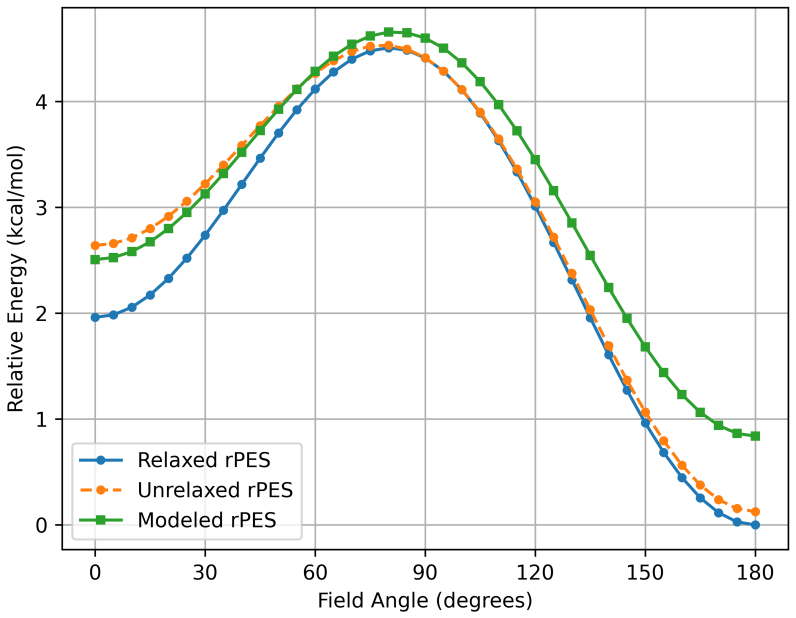
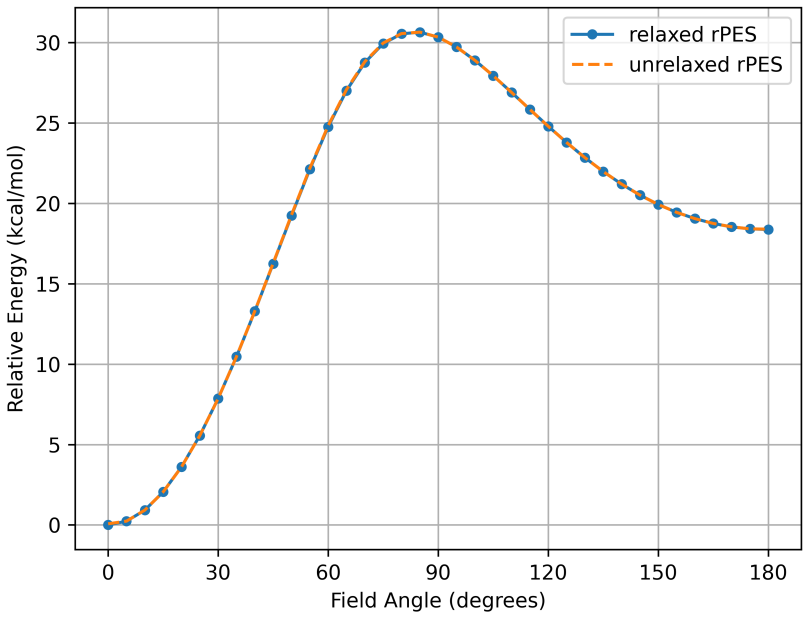
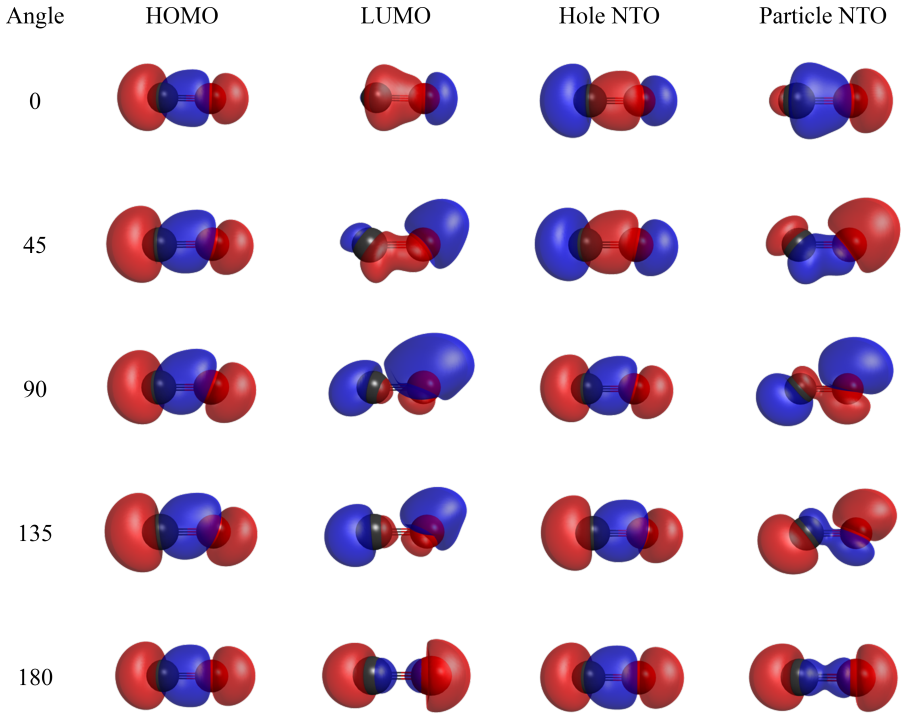
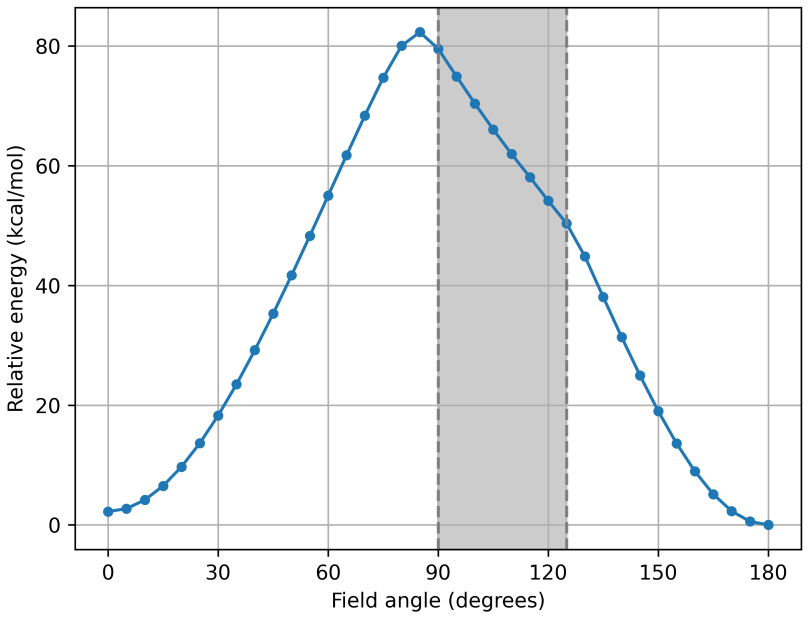
Oriented electric field vectors referenced to a molecule-fixed principal axis frame reveal distinct equilibrium configurations that differ in the relative direction between the external field and the molecular frame. These directomers exhibit unique electronic and nuclear configurations, particularly in their low-lying excited states, because the field interacts with polarizability rather than acting only through the static dipole moment. Hybrid analytical-numerical geometry optimization on the rotational potential energy surface locates the separate minima, while an analytic model based on equilibrium electrical properties reproduces the double-well character and includes some geometry-relx
What carries the argument
Directomers: distinct equilibrium configurations that differ in the relative direction of the external field and the molecular frame, located by hybrid analytical-numerical optimization on the rotational potential energy surface.
If this is right
- Each directomer possesses its own set of low-lying excited states with distinct energies and character.
- The rotational potential energy surface displays double-well behavior driven by polarizability contributions.
- An analytic model using only equilibrium dipole and polarizability values reproduces the essential features including partial geometry relaxation.
- Interpretation of any orientation-dependent spectroscopic or reactivity measurement must account for the possibility of multiple coexisting equilibria.
Where Pith is reading between the lines
- Field-direction control could be used to select between different excited-state manifolds in the same molecule without changing field strength.
- The same framework may apply to larger flexible molecules where rotational and vibrational degrees of freedom couple under strong fields.
- Experimental distinction between directomers could be achieved by comparing time-resolved spectra recorded after rapid field reorientation.
Load-bearing premise
The hybrid analytical-numerical geometry optimization on the rotational potential energy surface accurately locates distinct minima without artifacts from the choice of molecule-fixed frame or field strength.
What would settle it
Calculations showing that all field directions converge to a single minimum with identical excited-state properties regardless of starting orientation.
Figures




read the original abstract
Oriented external electric fields are ubiquitous in chemistry; however, the effects of fields applied in different directions on molecular systems remain underexplored. A major challenge is that an applied field exerts a torque on a molecule, reorienting the molecular frame and complicating the interpretation of orientation-dependent electric-field effects. Thus, free polar molecules experience orienting rather than oriented fields. In this work, we explore a new regime of distinct molecular equilibrium configurations, differing in the relative direction of the external field and the molecular frame, enabled by exploiting molecular polarizability rather than static dipole moment. These distinct "directomers" exhibit unique electronic and nuclear configurations, particularly in their low-lying excited states. We employ oriented electric field vectors referenced to a molecule-fixed principal axis frame along with hybrid analytical-numerical geometry optimization in order to explore the rotational potential energy surface (rRES), as well as a simply analytic model based on equilibrium electrical properties which captures the double-well character of the rPES, including some geometry relaxation effects.
Editorial analysis
A structured set of objections, weighed in public.
Referee Report
Summary. The manuscript claims that distinct equilibrium configurations ('directomers') exist for molecules under orienting external electric fields, differing in the relative direction of the field vector and the molecular principal-axis frame. These are located by imposing the field in a molecule-fixed frame and performing hybrid analytical-numerical geometry optimization on the rotational potential energy surface (rPES), with an analytic model derived from equilibrium electrical properties shown to reproduce the double-well character of the surface (including limited geometry relaxation). The directomers are asserted to possess distinct electronic and nuclear structures, especially in low-lying excited states.
Significance. If the minima are shown to be robust, the work identifies a polarizability-driven regime of field control that is distinct from conventional dipole-based orientation, with possible implications for spectroscopy and reactivity under oriented fields. The hybrid optimization procedure and the simple analytic double-well model constitute practical tools for exploring such surfaces.
major comments (3)
- [hybrid optimization procedure (Methods)] The hybrid analytical-numerical geometry optimization is performed with the field fixed in the molecule-fixed principal-axis frame. No explicit test is reported that the located minima survive a change to a lab-frame treatment or a full separation of rotational and vibrational coordinates, which is load-bearing for the claim that the directomers are genuine distinct equilibria rather than frame artifacts.
- [analytic model (Results)] The analytic model is constructed from equilibrium electrical properties (dipole moment and polarizability tensor components) that are themselves extracted from the same geometry optimizations used to map the rPES. This makes the double-well prediction dependent on the computed inputs rather than an independent derivation, undermining the assertion that the model confirms the existence of distinct minima.
- [Results] No numerical results, error estimates, or comparisons against independent benchmarks (e.g., full rotational treatments or alternative optimization methods) are provided to validate the locations or depths of the reported minima. This absence directly affects the ability to assess whether the identified directomers are numerically stable.
minor comments (2)
- [Abstract] The acronym 'rRES' in the abstract is likely a typographical error for the standard 'rPES' (rotational potential energy surface).
- [Abstract] The phrase 'simply analytic model' should be corrected to 'simple analytic model'.
Simulated Author's Rebuttal
We are grateful to the referee for their thorough review and valuable suggestions. Below we respond to each major comment and outline the revisions we will make to address them.
read point-by-point responses
-
Referee: [hybrid optimization procedure (Methods)] The hybrid analytical-numerical geometry optimization is performed with the field fixed in the molecule-fixed principal-axis frame. No explicit test is reported that the located minima survive a change to a lab-frame treatment or a full separation of rotational and vibrational coordinates, which is load-bearing for the claim that the directomers are genuine distinct equilibria rather than frame artifacts.
Authors: We thank the referee for this observation. Our approach fixes the field in the molecule-fixed frame to directly probe the rotational potential energy surface for different relative orientations, which defines the directomers. This is not an artifact but the natural way to identify stable configurations under orienting fields. Nevertheless, we agree that additional validation would be useful. In the revised manuscript, we will add a discussion explaining why the minima are expected to persist in a lab-frame treatment and include a qualitative analysis of the rotational-vibrational separation. We will also report a test with a slightly rotated field direction to confirm stability. revision: partial
-
Referee: [analytic model (Results)] The analytic model is constructed from equilibrium electrical properties (dipole moment and polarizability tensor components) that are themselves extracted from the same geometry optimizations used to map the rPES. This makes the double-well prediction dependent on the computed inputs rather than an independent derivation, undermining the assertion that the model confirms the existence of distinct minima.
Authors: The referee correctly notes the dependence. The analytic model is intended as an interpretive tool to demonstrate that the double-well character originates from the polarizability anisotropy in the field-molecule interaction energy, and that it persists even when allowing limited geometry relaxation. It is not meant to be an independent proof but to provide physical insight into the numerical findings. We will revise the text in the Results section to make this purpose clear and to avoid any suggestion that it independently confirms the minima. revision: yes
-
Referee: [Results] No numerical results, error estimates, or comparisons against independent benchmarks (e.g., full rotational treatments or alternative optimization methods) are provided to validate the locations or depths of the reported minima. This absence directly affects the ability to assess whether the identified directomers are numerically stable.
Authors: We agree that more quantitative details are needed. The revised version will include specific numerical values for the rPES minima depths, optimized coordinates, and estimated uncertainties from the computational protocol. We will also compare the results with an alternative numerical optimization method to validate the locations. Full ab initio rotational treatments are computationally prohibitive for the systems studied, but we will add a section justifying the approximations used based on the separation of energy scales. revision: yes
Circularity Check
Analytic double-well model for rPES constructed from equilibrium electrical properties obtained via the same geometry optimizations
specific steps
-
fitted input called prediction
[Abstract (analytic model description)]
"as well as a simply analytic model based on equilibrium electrical properties which captures the double-well character of the rPES, including some geometry relaxation effects."
Equilibrium electrical properties (dipole, polarizability) are obtained from the hybrid analytical-numerical geometry optimizations on the rPES that locate the purported distinct minima. The analytic model is then defined to reproduce the double-well using exactly those properties, so the model's 'capture' of the double-well and support for distinct directomers reduces to a post-hoc reconstruction of the optimization inputs rather than a separate prediction.
full rationale
The paper's central claim of distinct directomers rests on hybrid optimization locating minima on the molecule-fixed rPES and an analytic model reproducing the double-well character. The model is explicitly built from equilibrium electrical properties computed at those optimized geometries, so its agreement with the double-well is by construction from the optimization outputs rather than an independent first-principles derivation. This matches the fitted-input-called-prediction pattern. No self-citation load-bearing, uniqueness theorems, or ansatz smuggling are evident in the provided text; the optimization procedure itself is presented as numerical exploration without reducing to a prior self-result.
Axiom & Free-Parameter Ledger
axioms (1)
- domain assumption Molecular polarizability can be treated as a tensor referenced to the principal axis frame and used to generate a rotational potential energy surface.
invented entities (1)
-
directomers
no independent evidence
Lean theorems connected to this paper
-
IndisputableMonolith/Cost/FunctionalEquation.leanwashburn_uniqueness_aczel unclearE(θ,∥ε∥) = E0 − μz cosθ∥ε∥ − ½ αxx sin²θ∥ε∥² − ½ αzz cos²θ∥ε∥² ... condition −∥ε∥ < μz/Δα < ∥ε∥
Reference graph
Works this paper leans on
-
[1]
Journal of the American Chemical Society , author =
Electric-. Journal of the American Chemical Society , author =. 2020 , note =. doi:10.1021/jacs.0c05128 , number =
-
[2]
Oriented electric fields as future smart reagents in chemistry , volume =. Nature chemistry , author =. 2016 , note =
work page 2016
-
[3]
Chemical Society Reviews , author =
Structure and reactivity/selectivity control by oriented-external electric fields , volume =. Chemical Society Reviews , author =. 2018 , note =. doi:10.1039/C8CS00354H , abstract =
-
[4]
Journal of Molecular Structure: THEOCHEM , author =
Vibrations and dissociation of molecules in strong electric fields:. Journal of Molecular Structure: THEOCHEM , author =. 1998 , keywords =. doi:10.1016/S0166-1280(98)00111-0 , abstract =
-
[5]
Journal of Computational Chemistry , author =
Molecules under external electric field:. Journal of Computational Chemistry , author =. 2018 , note =. doi:10.1002/jcc.25229 , abstract =
-
[6]
The Journal of Chemical Physics , author =
The chemical bond in external electric fields:. The Journal of Chemical Physics , author =. 2013 , note =. doi:10.1063/1.4820487 , number =
-
[7]
The Journal of Physical Chemistry , author =
Polar properties of carbon monoxide , volume =. The Journal of Physical Chemistry , author =. 1981 , note =. doi:10.1021/j150626a021 , number =
-
[8]
Buckingham, A. D. , month = jan, year =. Permanent and. Advances in. doi:10.1002/9780470143582.ch2 , keywords =
-
[9]
Journal of the American Chemical Society , author =
Oriented. Journal of the American Chemical Society , author =. 2019 , note =. doi:10.1021/jacs.9b02174 , number =
-
[10]
Nature Communications , author =
Measuring the mechanical properties of molecular conformers , volume =. Nature Communications , author =. 2015 , keywords =. doi:10.1038/ncomms9338 , abstract =
-
[11]
Transition-potential coupled cluster II: optimisation of the core orbital occupation number
Electronic excitation and electric field as switching mechanism for a single-molecule switch , volume =. Molecular Physics , author =. 2023 , note =. doi:10.1080/00268976.2022.2108517 , number =
-
[13]
The Journal of Chemical Physics , author =
Excited vibrational states and potential energy function for. The Journal of Chemical Physics , author =. 2000 , keywords =. doi:10.1063/1.1290383 , abstract =
-
[14]
Annual Review of Biomedical Engineering , author =
Molecular. Annual Review of Biomedical Engineering , author =. 2004 , note =. doi:10.1146/annurev.bioeng.6.040803.140143 , abstract =
-
[15]
Design of. Chemical Reviews , author =. 2020 , note =. doi:10.1021/acs.chemrev.9b00288 , number =
-
[16]
Accounts of Chemical Research , author =
Measuring. Accounts of Chemical Research , author =. 2015 , note =. doi:10.1021/ar500464j , number =
-
[17]
Linear. ACS Catalysis , author =. 2022 , note =. doi:10.1021/acscatal.2c02234 , number =
-
[18]
Fast and. ACS Catalysis , author =. 2021 , note =. doi:10.1021/acscatal.1c04247 , number =
-
[19]
Isotropic and anisotropic static dipole polarizabilities of the first-row stable atomic anions , volume =. Phys. Rev. A , author =. 1994 , note =. doi:10.1103/PhysRevA.49.3515 , number =
-
[20]
Anisotropic polarizability of ultracold ground-state. Phys. Rev. A , author =. 2021 , note =. doi:10.1103/PhysRevA.103.023332 , number =
-
[21]
The Journal of Physical Chemistry A , author =
Polarizabilities of. The Journal of Physical Chemistry A , author =. 2000 , note =. doi:10.1021/jp002927r , number =
-
[22]
The Journal of Physical Chemistry A , author =
Distributed. The Journal of Physical Chemistry A , author =. 2015 , note =. doi:10.1021/acs.jpca.5b00069 , number =
-
[23]
Electric-Field-Induced Connectivity Switch- ing in Single-Molecule Junctions.iScience2020,23, 100770
Fast. Angewandte Chemie International Edition , author =. 2008 , note =. doi:10.1002/anie.200705699 , abstract =
-
[24]
Angewandte Chemie International Edition , author =
Single-. Angewandte Chemie International Edition , author =. 2015 , note =. doi:10.1002/anie.201505447 , abstract =
-
[25]
Physical Chemistry Chemical Physics , author =
Dipolar molecules inside. Physical Chemistry Chemical Physics , author =. 2016 , note =. doi:10.1039/C6CP06986J , abstract =
-
[26]
Multi-. Nano Letters , author =. 2014 , note =. doi:10.1021/nl5034599 , abstract =
-
[27]
Electric-field-driven dual-functional molecular switches in tunnel junctions , volume =. Nature Materials , author =. 2020 , note =. doi:10.1038/s41563-020-0697-5 , abstract =
-
[28]
Physical Chemistry Chemical Physics , author =
Protonation state control of electric field induced molecular switching mechanisms , volume =. Physical Chemistry Chemical Physics , author =. 2023 , note =. doi:10.1039/D2CP04494C , abstract =
-
[29]
Electric-. iScience , author =. 2020 , keywords =. doi:10.1016/j.isci.2019.100770 , abstract =
-
[30]
The Journal of Physical Chemistry A , author =
Quantum. The Journal of Physical Chemistry A , author =. 2009 , note =. doi:10.1021/jp9021344 , abstract =
-
[31]
Journal of the American Chemical Society , author =
Electric. Journal of the American Chemical Society , author =. 2006 , note =. doi:10.1021/ja065449s , abstract =
-
[32]
Nature Communications , author =
High performance mechano-optoelectronic molecular switch , volume =. Nature Communications , author =. 2023 , note =. doi:10.1038/s41467-023-41433-0 , abstract =
-
[33]
Chemical Society Reviews , author =
Molecular photoswitches in aqueous environments , volume =. Chemical Society Reviews , author =. 2021 , note =. doi:10.1039/D0CS00547A , language =
-
[34]
Angewandte Chemie International Edition , author =
The. Angewandte Chemie International Edition , author =. 2017 , note =. doi:10.1002/anie.201702979 , abstract =
-
[35]
Journal of the American Chemical Society , author =
Electric-. Journal of the American Chemical Society , author =. 2019 , note =. doi:10.1021/jacs.9b09233 , abstract =
-
[36]
Journal of the American Chemical Society , author =
Electrophilic. Journal of the American Chemical Society , author =. 2019 , note =. doi:10.1021/jacs.9b04982 , abstract =
-
[37]
Journal of the American Chemical Society , author =
Catalysis of. Journal of the American Chemical Society , author =. 2018 , note =. doi:10.1021/jacs.8b00192 , abstract =
-
[38]
Oriented electric fields as future smart reagents in chemistry , volume =. Nature Chemistry , author =. 2016 , note =. doi:10.1038/nchem.2651 , abstract =
-
[39]
The Journal of Physical Chemistry Letters , author =
External. The Journal of Physical Chemistry Letters , author =. 2010 , note =. doi:10.1021/jz100695n , abstract =
-
[40]
Electric-field-stimulated protein mechanics , volume =. Nature , author =. 2016 , pmid =. doi:10.1038/nature20571 , abstract =
-
[41]
Nature Communications , author =
Electric fields control the orientation of peptides irreversibly immobilized on radical-functionalized surfaces , volume =. Nature Communications , author =. 2018 , note =. doi:10.1038/s41467-017-02545-6 , abstract =
-
[42]
Electrostatic catalysis of a. Nature , author =. 2016 , note =. doi:10.1038/nature16989 , abstract =
-
[43]
Journal of the American Chemical Society , author =
Solvent. Journal of the American Chemical Society , author =. 2020 , note =. doi:10.1021/jacs.9b13029 , abstract =
-
[44]
Electric. Science , author =. 2006 , note =. doi:10.1126/science.1127159 , abstract =
-
[45]
A two-directional vibrational probe reveals different electric field orientations in solution and an enzyme active site , volume =. Nature Chemistry , author =. 2022 , note =. doi:10.1038/s41557-022-00937-w , abstract =
-
[46]
Electric. ACS Catalysis , author =. 2021 , note =. doi:10.1021/acscatal.1c02084 , abstract =
-
[47]
Spectrochimica Acta Part A: Molecular and Biomolecular Spectroscopy , author =
Nonlinear optical properties and optimization strategies of. Spectrochimica Acta Part A: Molecular and Biomolecular Spectroscopy , author =. 2022 , keywords =. doi:10.1016/j.saa.2022.121539 , abstract =
- [48]
-
[49]
Sowlati-Hashjin, Shahin and Karttunen, Mikko and Matta, Chérif F. , editor =. Electrostatic. Effects of. 2021 , doi =
work page 2021
-
[50]
The Journal of Chemical Physics , author =
Photodissociation of laboratory oriented molecules:. The Journal of Chemical Physics , author =. 2004 , keywords =. doi:10.1063/1.1812756 , abstract =
-
[51]
Competition between decay and dissociation of core-excited carbonyl sulfide studied by x-ray scattering , volume =. Physical Review A , author =. 1999 , note =. doi:10.1103/PhysRevA.59.4281 , abstract =
-
[52]
Nonadiabatic effects in long-pulse mixed-field orientation of a linear polar molecule , volume =. Physical Review A , author =. 2012 , note =. doi:10.1103/PhysRevA.86.043437 , abstract =
-
[53]
Shaik, S. and Danovich, D. and Dubey, K. D. and Stuyver, T. , editor =. The. Effects of. 2021 , doi =
work page 2021
-
[54]
Nature Communications , author =
How to control single-molecule rotation , volume =. Nature Communications , author =. 2019 , note =. doi:10.1038/s41467-019-12605-8 , abstract =
-
[55]
Darwish, N. and Foroutan-Nejad, C. and Domulevicz, L. and Hihath, J. and Díez-Pérez, I. , month = mar, year =. Principles of. doi:10.1039/9781839163043-00147 , abstract =
-
[56]
The Journal of Chemical Physics , author =
Effect of absolute laser phase on reaction paths in laser-induced chemical reactions , volume =. The Journal of Chemical Physics , author =. 2004 , keywords =. doi:10.1063/1.1793931 , abstract =
-
[57]
Physical Chemistry Chemical Physics , author =
Effects of external electric fields on double proton transfer kinetics in the formic acid dimer , volume =. Physical Chemistry Chemical Physics , author =. 2011 , note =. doi:10.1039/C1CP20175A , abstract =
-
[58]
Physical Chemistry Chemical Physics , author =
Molecular dissociation and proton transfer in aqueous methane solution under an electric field , volume =. Physical Chemistry Chemical Physics , author =. 2021 , note =. doi:10.1039/D1CP04202E , abstract =
-
[59]
Zeitschrift für Physikalische Chemie , author =
Schwingungsstruktur der. Zeitschrift für Physikalische Chemie , author =. 1933 , note =. doi:10.1515/zpch-1933-2136 , abstract =
-
[60]
Zeitschrift für Physik , author =
Zur. Zeitschrift für Physik , author =. 1934 , keywords =. doi:10.1007/BF01350054 , abstract =
-
[61]
Anisotropic. Molecular Physics , author =. 2020 , note =. doi:10.1080/00268976.2019.1597198 , abstract =
-
[62]
The Journal of Chemical Physics , author =
Theoretical quest for photoconversion molecules having opposite directions of the electric dipole moment in. The Journal of Chemical Physics , author =. 2009 , keywords =. doi:10.1063/1.3127245 , abstract =
-
[63]
Physical Chemistry Chemical Physics , author =
Principal molecular axis and transition dipole moment orientations in liquid crystal systems: an assessment based on studies of guest anthraquinone dyes in a nematic host , volume =. Physical Chemistry Chemical Physics , author =. 2017 , note =. doi:10.1039/C6CP05979A , language =
-
[64]
Size and shape effects on the orientation of rigid molecules in nematic liquid crystals , volume =. Molecular Physics , author =. 1987 , note =. doi:10.1080/00268978700100271 , number =
-
[65]
Angewandte Chemie International Edition , author =
The. Angewandte Chemie International Edition , author =. 2011 , note =. doi:10.1002/anie.201101852 , abstract =
-
[66]
Molecular dynamics simulations explore effects of electric field orientations on spike proteins of. Scientific Reports , author =. 2022 , note =. doi:10.1038/s41598-022-17009-1 , abstract =
-
[67]
The Journal of Chemical Physics , author =
Effect of an external electric field on the dynamics and intramolecular structures of ions in an ionic liquid , volume =. The Journal of Chemical Physics , author =. 2019 , keywords =. doi:10.1063/1.5129367 , abstract =
-
[68]
The Journal of Chemical Physics , author =
How do external forces related to mass and charge affect the structures and dynamics of an ionic liquid? , volume =. The Journal of Chemical Physics , author =. 2022 , keywords =. doi:10.1063/5.0091322 , abstract =
-
[69]
Physical Chemistry Chemical Physics , author =
Perspectives on external electric fields in molecular simulation: progress, prospects and challenges , volume =. Physical Chemistry Chemical Physics , author =. 2015 , note =. doi:10.1039/C5CP00629E , abstract =
-
[70]
IEEE Transactions on Microwave Theory and Techniques , author =
Mixed. IEEE Transactions on Microwave Theory and Techniques , author =. 2008 , note =. doi:10.1109/TMTT.2008.2005890 , abstract =
-
[71]
Electric field effects on vibrating polar molecules from weak to strong fields , volume =. Molecular Physics , author =. 1996 , note =. doi:10.1080/002689796173183 , abstract =
-
[72]
The Journal of Chemical Physics , author =
Human aquaporin 4 gating dynamics under and after nanosecond-scale static and alternating electric-field impulses:. The Journal of Chemical Physics , author =. 2013 , keywords =. doi:10.1063/1.4832383 , abstract =
-
[73]
The Journal of Physical Chemistry A , author =
Atomistic. The Journal of Physical Chemistry A , author =. 2014 , note =. doi:10.1021/jp5040147 , abstract =
-
[74]
Low-temperature anharmonicity of barium titanate:. Physical Review B , author =. 2013 , note =. doi:10.1103/PhysRevB.87.014113 , abstract =
-
[75]
The Journal of Chemical Physics , author =
Theory and. The Journal of Chemical Physics , author =. 2012 , keywords =. doi:10.1063/1.4772656 , abstract =
-
[76]
Oriented. ChemPhysChem , author =. 2010 , note =. doi:10.1002/cphc.200900848 , abstract =
-
[77]
Journal of the American Chemical Society , author =
Oriented-. Journal of the American Chemical Society , author =. 2018 , note =. doi:10.1021/jacs.8b08233 , abstract =
-
[78]
Journal of the American Chemical Society , author =
Interfacial. Journal of the American Chemical Society , author =. 2013 , note =. doi:10.1021/ja404394z , abstract =
-
[79]
Proceedings of the National Academy of Sciences , author =
Quantitative, directional measurement of electric field heterogeneity in the active site of ketosteroid isomerase , volume =. Proceedings of the National Academy of Sciences , author =. 2012 , note =. doi:10.1073/pnas.1111566109 , abstract =
-
[80]
Journal of the American Chemical Society , author =
Calculation of. Journal of the American Chemical Society , author =. 2013 , note =. doi:10.1021/ja3084384 , abstract =
-
[81]
Analytical Chemistry , author =
Electric-. Analytical Chemistry , author =. 2008 , note =. doi:10.1021/ac701808z , abstract =
discussion (0)
Sign in with ORCID, Apple, or X to comment. Anyone can read and Pith papers without signing in.