Recognition: 1 theorem link
· Lean TheoremDesign and fabrication of a micro-ion trap with a 3D-printed loading zone for improved hot-ion capture
Pith reviewed 2026-05-12 01:20 UTC · model grok-4.3
The pith
A micro-ion trap with an expanded 3D-printed loading zone maintains high capture of hot ions from thermal sources across a wide range of stability parameters without temporarily lowering the RF voltage.
A machine-rendered reading of the paper's core claim, the machinery that carries it, and where it could break.
Core claim
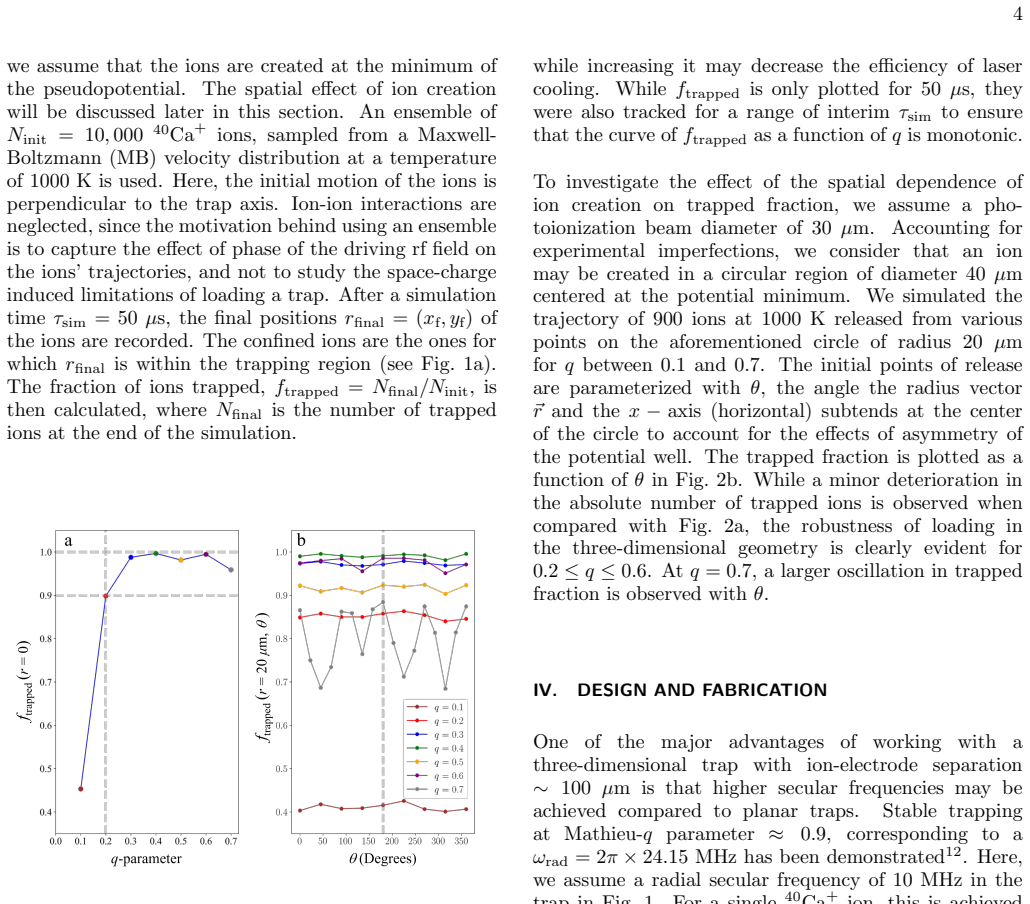
By increasing the characteristic radius r0 in a spatially distinct loading zone of a four-rod micro-ion trap, the Mathieu-q parameter is reduced in that zone alone. Simulations of ions emitted from a simulated thermal source demonstrate that the trapped ion fraction stays high across a broad range of Mathieu-q values, which permits effective laser cooling of initially hot ions while the full RF potential remains applied everywhere.
What carries the argument
The spatially distinct loading zone with enlarged ion-electrode separation r0, which lowers the Mathieu-q parameter (the dimensionless quantity governing stability of ion motion under RF fields) to improve capture and cooling of hot ions from effusive sources.
If this is right
- Simulations predict the trapped ion fraction from a thermal source remains high across a wide range of Mathieu-q parameters.
- 3D printing of the RF rails demonstrates that the expanded-zone design can be manufactured with current additive techniques.
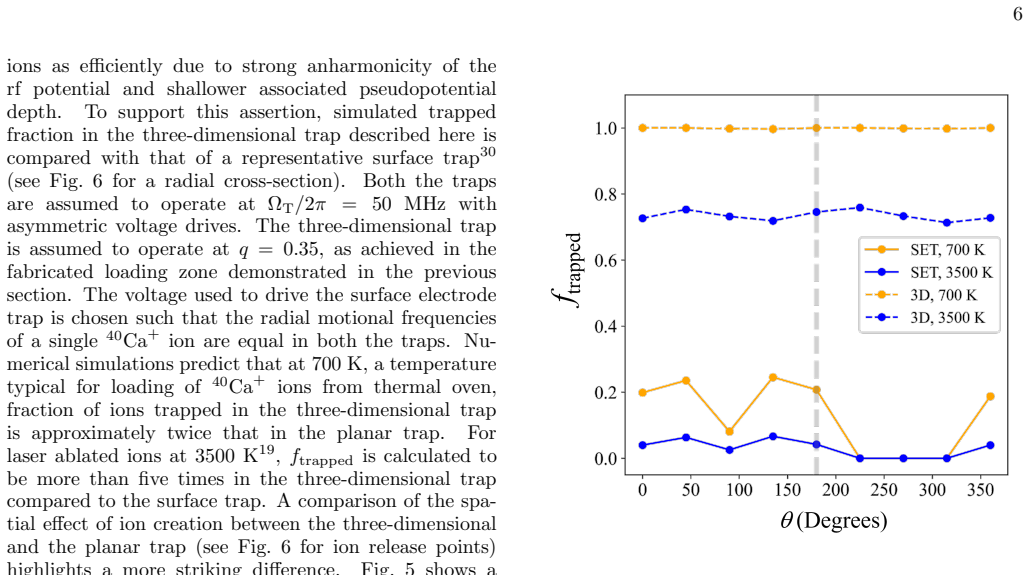
- Hot-ion capture in the three-dimensional design is better than in a representative planar trap for the case examined.
- The design can be incorporated into a quantum-CCD architecture to improve loading efficiency and lower associated overhead.
Where Pith is reading between the lines
- The design could support continuous trap operation during loading by eliminating the need to modulate the RF amplitude.
- Similar zone-expansion ideas might apply to other trap geometries or electrode arrangements beyond the four-rod case shown.
- Testing would require comparing actual capture rates under matched oven conditions with and without the expanded loading zone.
Load-bearing premise
Increasing the electrode separation in the loading zone will lower the Mathieu-q parameter enough for laser cooling to work on hot ions without the ions leaving the trap or the cooling failing.
What would settle it
Direct measurement of the fraction of ions captured and cooled from an effusive oven in the fabricated trap, compared against a standard trap that temporarily lowers RF voltage, or a mismatch between simulation and experiment if the real ion energy distribution differs from the thermal model used.
Figures




read the original abstract
We leverage recent advances in 3D-printing technology to design and fabricate a micro-ion trap with a spatially distinct loading zone for more efficient loading of ions from effusive thermal ovens. The design reduces the Mathieu-$q$ parameter in the loading zone by increasing the ion-electrode separation $r_0$, thereby potentially facilitating more effective laser cooling of hot ions. This circumvents the temporary thermal instability that arises when the rf potential is reduced during ion loading, a common practice to enable efficient laser cooling of hot ions. Simulations predict that expanding $r_0$ maintains a high trapped ion fraction from a simulated thermal source across a wide range of Mathieu-$q$ parameters. We demonstrate the manufacturability of this design by 3D-printing the rf rails of a four-rod ion trap and discuss the limitations imposed by state-of-the-art additive manufacturing techniques. We briefly compare hot-ion capture in the three-dimensional design presented here with that in a representative planar trap, illustrating one instance in which the former may be better for loading. The article concludes with an outlook for how this design may be incorporated into a quantum-CCD architecture to enhance ion loading and reduce associated experimental overheads.
Editorial analysis
A structured set of objections, weighed in public.
Referee Report
Summary. The manuscript describes the design of a micro-ion trap incorporating a spatially distinct loading zone fabricated via 3D printing, where the ion-electrode separation r0 is increased to reduce the Mathieu-q parameter. This is proposed to enable more effective laser cooling of hot ions from effusive thermal ovens without the need to temporarily lower the RF potential (which can cause thermal instability). Simulations are reported to show that this expanded r0 maintains a high trapped-ion fraction from a thermal source across a wide range of Mathieu-q values. The authors demonstrate fabrication of the four-rod RF rails, discuss additive-manufacturing limitations, briefly compare hot-ion capture to a planar trap, and outline potential integration into quantum-CCD architectures.
Significance. If the simulations are robust and the design tolerances can be controlled, the approach could meaningfully improve ion-loading efficiency in trapped-ion experiments, addressing a practical bottleneck for scaling quantum information processors. The concrete fabrication demonstration of 3D-printed RF rails and the explicit discussion of state-of-the-art additive-manufacturing constraints are strengths that ground the work in experimental reality. However, the absence of detailed simulation methodology and quantitative tolerance analysis limits the assessed significance at present.
major comments (2)
- [Simulations (abstract and main text)] The central simulation claim (high trapped fraction maintained across wide Mathieu-q when r0 is expanded) is presented without any description of the simulation method, ion initial conditions (temperature, velocity distribution from the effusive source), integration of the Mathieu stability parameters, or validation against known trap geometries. This information is required to evaluate whether the reported advantage is robust or sensitive to modeling assumptions.
- [Fabrication demonstration and limitations] In the fabrication and limitations discussion, the authors note that 3D printing introduces resolution and surface-finish deviations (tens of microns) from the ideal CAD geometry, yet no quantitative estimate or simulation is provided of how these perturbations generate higher-order multipoles or shrink the stable phase-space volume for ions with large initial velocities. This directly affects the load-bearing claim that the design improves hot-ion capture.
minor comments (2)
- [Abstract] The abstract refers to 'a simulated thermal source' without specifying the temperature or distribution parameters; adding this would improve reproducibility and clarity.
- [Comparison section] The brief comparison to a representative planar trap would benefit from explicit quantitative metrics (e.g., trapped fractions or phase-space volumes) or an accompanying figure to substantiate the stated advantage.
Simulated Author's Rebuttal
We thank the referee for their constructive feedback and for recognizing the potential of our 3D-printed micro-ion trap design to improve hot-ion capture. We address each of the major comments below and will revise the manuscript to incorporate the suggested improvements.
read point-by-point responses
-
Referee: [Simulations (abstract and main text)] The central simulation claim (high trapped fraction maintained across wide Mathieu-q when r0 is expanded) is presented without any description of the simulation method, ion initial conditions (temperature, velocity distribution from the effusive source), integration of the Mathieu stability parameters, or validation against known trap geometries. This information is required to evaluate whether the reported advantage is robust or sensitive to modeling assumptions.
Authors: We agree that the manuscript would benefit from a more detailed description of the simulations. We will add this information in a revised version, specifying the simulation method (numerical integration of the equations of motion in the time-dependent potential), the ion initial conditions (positions and velocities sampled from a thermal distribution at the oven temperature, with the effusive source modeled accordingly), the computation of Mathieu stability parameters from the trap geometry, and validation against standard trap configurations. This will enable a better assessment of the robustness of our findings on the trapped ion fraction. revision: yes
-
Referee: [Fabrication demonstration and limitations] In the fabrication and limitations discussion, the authors note that 3D printing introduces resolution and surface-finish deviations (tens of microns) from the ideal CAD geometry, yet no quantitative estimate or simulation is provided of how these perturbations generate higher-order multipoles or shrink the stable phase-space volume for ions with large initial velocities. This directly affects the load-bearing claim that the design improves hot-ion capture.
Authors: We recognize the importance of quantifying the effects of fabrication tolerances. In the revised manuscript, we will provide estimates or simulations of how deviations of tens of microns in electrode positions and surface finish impact the higher-order multipoles and the stable phase space for hot ions. This analysis will be based on perturbing the ideal geometry in our models and evaluating the resulting changes in trapping efficiency, thereby strengthening the support for the design's advantages. revision: yes
Circularity Check
No circularity: simulations use independent standard Mathieu analysis on idealized geometry.
full rationale
The paper's load-bearing claim is a numerical simulation result showing that increasing r0 in the loading zone preserves high trapped-ion fraction from a thermal source across Mathieu-q values. This rests on the standard Mathieu equations for RF quadrupole traps (external to the paper) applied to a four-rod geometry; no parameter is fitted inside the paper and then renamed as a prediction, no self-definition equates the output to the input, and no load-bearing step reduces to a self-citation chain. The 3D-printing demonstration and comparison to planar traps are separate engineering steps that do not feed back into the simulation result. The derivation chain is therefore self-contained against external benchmarks.
Axiom & Free-Parameter Ledger
free parameters (1)
- ion-electrode separation r0 in loading zone
axioms (1)
- standard math Mathieu stability parameters govern ion trap behavior for given electrode geometry and RF voltage
Lean theorems connected to this paper
-
IndisputableMonolith/Foundation/AlexanderDuality.leanalexander_duality_circle_linking echoesSimulations predict that expanding r0 maintains a high trapped ion fraction... three-dimensional design... compared with... planar trap
Reference graph
Works this paper leans on
-
[1]
Maunz, Peter Lukas Wilhelm , month = jan, year =. High
-
[2]
Revelle, Melissa C. , month = sep, year =. Phoenix and. doi:10.48550/arXiv.2009.02398 , abstract =
-
[3]
IEEE Transactions on Quantum Engineering , author =
Engineering the. IEEE Transactions on Quantum Engineering , author =. 2021 , keywords =. doi:10.1109/TQE.2021.3096480 , abstract =
-
[4]
Architecture for a large-scale ion-trap quantum computer , volume =. Nature , author =. 2002 , keywords =. doi:10.1038/nature00784 , abstract =
-
[5]
Quinn, A. and Brown, M. and Gardner, T. J. and Allcock, D. T. C. , month = may, year =. Geometries and fabrication methods for. doi:10.48550/arXiv.2205.15892 , abstract =
-
[6]
Scaling the. Science , author =. 2013 , pages =. doi:10.1126/science.1231298 , abstract =
-
[7]
3D-Printed Micro Ion Trap Technology for Scalable Quantum Information Processing , author=. 2023 , eprint=
work page 2023
-
[8]
Quantum Science and Technology , abstract =
Auchter, S and Axline, C and Decaroli, C and Valentini, M and Purwin, L and Oswald, R and Matt, R and Aschauer, E and Colombe, Y and Holz, P and Monz, T and Blatt, R and Schindler, P and Rössler, C and Home, J , title =. Quantum Science and Technology , abstract =. 2022 , month =. doi:10.1088/2058-9565/ac7072 , url =
-
[9]
Ragg, Simon and Decaroli, Chiara and Lutz, Thomas and Home, Jonathan P. , title =. Review of Scientific Instruments , volume =. 2019 , month =. doi:10.1063/1.5119785 , url =
-
[10]
Pyka, Karsten and Herschbach, Norbert and Keller, Jonas and Mehlst. A high-precision segmented Paul trap with minimized micromotion for an optical multiple-ion clock , journal=. 2014 , month=. doi:10.1007/s00340-013-5580-5 , url=
-
[11]
Scaling and Suppression of Anomalous Heating in Ion Traps , author =. Phys. Rev. Lett. , volume =. 2006 , month =. doi:10.1103/PhysRevLett.97.103007 , url =
-
[12]
Loading of a surface-electrode ion trap from a remote, precooled source , author =. Phys. Rev. A , volume =. 2012 , month =. doi:10.1103/PhysRevA.86.013417 , url =
-
[13]
Integrated Technologies and Control Techniques for Trapped Ion Array Architectures , author =. 2021 , month =
work page 2021
-
[14]
Nägerl, H.C. and Roos, Ch. and Rohde, H. and Leibfried, D. and Eschner, J. and Schmidt-Kaler, F. and Blatt, R. , title =. Fortschritte der Physik , volume =. doi:https://doi.org/10.1002/(SICI)1521-3978(200005)48:5/7<623::AID-PROP623>3.0.CO;2-S , url =
-
[15]
Amplifying a Zeptonewton Force with a Single-Ion Nonlinear Oscillator , author =. Phys. Rev. Lett. , volume =. 2023 , month =. doi:10.1103/PhysRevLett.131.153601 , url =
-
[16]
Shinji Urabe and Masayoshi Watanabe and Hidetsuka Imajo and Kazuhiro Hayasaka , journal =. Laser cooling of trapped. 1992 , url =. doi:10.1364/OL.17.001140 , abstract =
-
[17]
Kuo, C.-H. and Hsiao, Y.-C. and Jhang, C.-Y. and Chen, Y.-D. and Tung, S. , title=. Scientific Reports , year=. doi:10.1038/s41598-024-69166-0 , url=
- [18]
-
[19]
Isotope-selective photoionization for calcium ion trapping , author =. Phys. Rev. A , volume =. 2004 , month =. doi:10.1103/PhysRevA.69.012711 , url =
-
[20]
Efficient photoionization loading of trapped ions with ultrafast pulses , author =. Phys. Rev. A , volume =. 2006 , month =. doi:10.1103/PhysRevA.74.063421 , url =
-
[21]
AIP Conference Proceedings , volume =
Kim, Jungsang and Maunz, Peter and Kim, Taehyun and Hussman, Jeffrey and Noek, Rachel and Mehta, Abhijit and Monroe, Christopher , title =. AIP Conference Proceedings , volume =. 2011 , month =. doi:10.1063/1.3630178 , url =
-
[22]
Penning micro-trap for quantum computing , journal=
Jain, Shreyans and S. Penning micro-trap for quantum computing , journal=. 2024 , month=. doi:10.1038/s41586-024-07111-x , url=
-
[23]
Role of laser damping in trapped ion crystals , author =. Phys. Rev. A , volume =. 1989 , month =. doi:10.1103/PhysRevA.39.4362 , url =
-
[24]
Hensinger, W. K. and Olmschenk, S. and Stick, D. and Hucul, D. and Yeo, M. and Acton, M. and Deslauriers, L. and Monroe, C. and Rabchuk, J. , title =. Applied Physics Letters , volume =. 2006 , month =. doi:10.1063/1.2164910 , url =
-
[25]
Xu, Shuqi and Xia, Xiaoxing and Yu, Qian and Parakh, Abhinav and Khan, Sumanta and Megidish, Eli and You, Bingran and Hemmerling, Boerge and Jayich, Andrew and Beck, Kristin and Biener, Juergen and H. 3. Nature , year=. doi:10.1038/s41586-025-09474-1 , url=
-
[26]
Maunz, Peter Lukas Wilhelm , title =. 2016 , month =. doi:10.2172/1237003 , url =
-
[27]
doi:10.22331/q-2024-11-07-1516 , url =
Benchmarking a trapped-ion quantum computer with 30 qubits , author =. doi:10.22331/q-2024-11-07-1516 , url =
-
[28]
Zhang, J. and Pagano, G. and Hess, P. W. and Kyprianidis, A. and Becker, P. and Kaplan, H. and Gorshkov, A. V. and Gong, Z.-X. and Monroe, C. , title=. Nature , year=. doi:10.1038/nature24654 , url=
-
[29]
Scalable Multispecies Ion Transport in a Grid-Based Surface-Electrode Trap , author =. Phys. Rev. X , volume =. 2024 , month =. doi:10.1103/PhysRevX.14.041028 , url =
-
[30]
and McConnell, Robert and Chiaverini, John and Sage, Jeremy M
Bruzewicz, Colin D. and McConnell, Robert and Chiaverini, John and Sage, Jeremy M. , title=. Nature Communications , year=. doi:10.1038/ncomms13005 , url=
-
[31]
Fast ion swapping for quantum-information processing , author =. Phys. Rev. A , volume =. 2017 , month =. doi:10.1103/PhysRevA.95.052319 , url =
-
[32]
A Race-Track Trapped-Ion Quantum Processor , author =. Phys. Rev. X , volume =. 2023 , month =. doi:10.1103/PhysRevX.13.041052 , url =
-
[33]
Fowler and Klaus Mølmer and Simon J
Bjoern Lekitsch and Sebastian Weidt and Austin G. Fowler and Klaus Mølmer and Simon J. Devitt and Christof Wunderlich and Winfried K. Hensinger , title =. Science Advances , volume =. 2017 , doi =
work page 2017
-
[34]
Britton, J. and Leibfried, D. and Beall, J. A. and Blakestad, R. B. and Wesenberg, J. H. and Wineland, D. J. , title =. Applied Physics Letters , volume =. 2009 , month =. doi:10.1063/1.3254188 , url =
-
[35]
Experimental investigation of planar ion traps , author =. Phys. Rev. A , volume =. 2006 , month =. doi:10.1103/PhysRevA.73.032307 , url =
-
[36]
Journal of Physics B: Atomic, Molecular and Optical Physics , abstract =
Tanaka, U and Naka, R and Iwata, F and Ujimaru, T and Brown, K R and Chuang, I L and Urabe, S , title =. Journal of Physics B: Atomic, Molecular and Optical Physics , abstract =. 2009 , month =. doi:10.1088/0953-4075/42/15/154006 , url =
-
[37]
Stick, D. and Hensinger, W. K. and Olmschenk, S. and Madsen, M. J. and Schwab, K. and Monroe, C. , title=. Nature Physics , year=. doi:10.1038/nphys171 , url=
-
[38]
Fast Loading of a Trapped Ion Quantum Computer Using a 2
Johansen, Jacob and Estey, Brian and Rowe, Mary and Ransford, Anthony , booktitle=. Fast Loading of a Trapped Ion Quantum Computer Using a 2. 2022 , volume=
work page 2022
-
[39]
Heating of trapped ions from the quantum ground state , author =. Phys. Rev. A , volume =. 2000 , month =. doi:10.1103/PhysRevA.61.063418 , url =
-
[40]
Smith, Daisy R. H. and Muralidharan, Silpa and Habl. A comparison of calcium sources for ion-trap loading via laser ablation , journal=. 2025 , month=. doi:10.1007/s00340-025-08521-z , url=
-
[41]
Greenberg, Noah and Jozani, Akbar Jahangiri and Epstein, Collin J. C. and Tan, Xinghe and Islam, Rajibul and Senko, Crystal , title =. Review of Scientific Instruments , volume =. 2024 , month =. doi:10.1063/5.0198336 , url =
-
[42]
New Journal of Physics , abstract =
Amini, J M and Uys, H and Wesenberg, J H and Seidelin, S and Britton, J and Bollinger, J J and Leibfried, D and Ospelkaus, C and VanDevender, A P and Wineland, D J , title =. New Journal of Physics , abstract =. 2010 , month =. doi:10.1088/1367-2630/12/3/033031 , url =
-
[43]
Kento Taniguchi and Ke Sun and Shuqi Xu and Abhinav Parakh and Xiaoxing Xia and Michael Schecter and Curtis Volin and Eric Hudson and Hartmut Haeffner , year=. Feasibility Study of 3. 2509.17275 , archivePrefix=
-
[44]
Schneider, Caroline A. and Rasband, Wayne S. and Eliceiri, Kevin W. , title=. Nature Methods , year=. doi:10.1038/nmeth.2089 , url=
-
[45]
Langer and Dietrich Leibfried and R Ozeri and David Wineland , title =
J Chiaverini and Brad Blakestad and Joseph Britton and John Jost and C. Langer and Dietrich Leibfried and R Ozeri and David Wineland , title =. 2005 , number =
work page 2005
-
[46]
Doppler cooling thermometry of a multilevel ion in the presence of micromotion , author =. Phys. Rev. A , volume =. 2017 , month =. doi:10.1103/PhysRevA.96.012519 , url =
-
[47]
Simplified motional heating rate measurements of trapped ions , author =. Phys. Rev. A , volume =. 2007 , month =. doi:10.1103/PhysRevA.76.033411 , url =
-
[48]
Fluorescence during Doppler cooling of a single trapped atom , author =. Phys. Rev. A , volume =. 2007 , month =. doi:10.1103/PhysRevA.76.053416 , url =
-
[49]
Sideband cooling of ions in radio-frequency traps , author =. Phys. Rev. A , volume =. 1999 , month =. doi:10.1103/PhysRevA.60.439 , url =
-
[50]
Mechanical squeezed Kerr oscillator based on a tapered ion trap , author =. Phys. Rev. A , volume =. 2025 , month =. doi:10.1103/ybm3-72hs , url =
-
[51]
Marschner and Simone Pagliano and Po-Han Huang and Frank Niklaus , keywords =
David E. Marschner and Simone Pagliano and Po-Han Huang and Frank Niklaus , keywords =. A methodology for two-photon polymerization micro 3. Additive Manufacturing , volume =. 2023 , issn =. doi:https://doi.org/10.1016/j.addma.2023.103474 , url =
-
[52]
New Journal of Physics , abstract =
Daniilidis, N and Narayanan, S and Möller, S A and Clark, R and Lee, T E and Leek, P J and Wallraff, A and Schulz, St and Schmidt-Kaler, F and Häffner, H , title =. New Journal of Physics , abstract =. 2011 , month =. doi:10.1088/1367-2630/13/1/013032 , url =
-
[53]
Inhomogeneous RF Fields: A Versatile Tool for the Study of Processes with Slow Ions , booktitle =
Gerlich, Dieter , publisher =. Inhomogeneous RF Fields: A Versatile Tool for the Study of Processes with Slow Ions , booktitle =. 1992 , keywords =. doi:https://doi.org/10.1002/9780470141397.ch1 , url =
-
[54]
Rf-induced heating dynamics of noncrystallized trapped ions , author =. Phys. Rev. A , volume =. 2022 , month =. doi:10.1103/PhysRevA.105.033101 , url =
-
[55]
Trapping Electrons in a Room-Temperature Microwave Paul Trap , author =. Phys. Rev. X , volume =. 2021 , month =. doi:10.1103/PhysRevX.11.011019 , url =
-
[56]
Review of Scientific Instruments , volume =
An, Da and Matthiesen, Clemens and Abdelrahman, Ahmed and Berlin-Udi, Maya and Gorman, Dylan and Möller, Sönke and Urban, Erik and Häffner, Hartmut , title =. Review of Scientific Instruments , volume =. 2018 , month =. doi:10.1063/1.5046527 , url =
-
[57]
Johannes Roßnagel and Samuel T. Dawkins and Karl N. Tolazzi and Obinna Abah and Eric Lutz and Ferdinand Schmidt-Kaler and Kilian Singer , title =. Science , volume =. 2016 , doi =
work page 2016
-
[58]
Berkeland, D. J. , title =. Review of Scientific Instruments , volume =. 2002 , month =. doi:10.1063/1.1489073 , url =
-
[59]
Ion strings for quantum gates , journal=
N. Ion strings for quantum gates , journal=. 1998 , month=. doi:10.1007/s003400050443 , url=
discussion (0)
Sign in with ORCID, Apple, or X to comment. Anyone can read and Pith papers without signing in.