Recognition: 2 theorem links
· Lean TheoremMachine-learned, finite temperature Fermi-operator expansions suitable for GPUs and AI-hardware
Pith reviewed 2026-05-12 01:38 UTC · model grok-4.3
The pith
Machine learning optimizes recursive Fermi expansions to compute finite-temperature density matrices an order of magnitude faster on GPUs than diagonalization.
A machine-rendered reading of the paper's core claim, the machinery that carries it, and where it could break.
Core claim
Several finite-temperature recursive Fermi-operator expansion schemes based on the second-order spectral projection method are introduced. The electronic structure problem is mapped onto a deep neural network architecture to train optimized expansion coefficients for a specified chemical potential and electronic temperature. An affine rescaling strategy applied to the Hamiltonian matrix removes the need to retrain the model when temperature or chemical potential changes during a simulation. The resulting method relies solely on highly optimized matrix-matrix multiplication kernels and delivers an order-of-magnitude speedup relative to state-of-the-art diagonalization for small and moderately
What carries the argument
Machine-learned second-order spectral projection (SP2) Fermi-operator expansion at finite temperature, with affine rescaling of the Hamiltonian to reuse trained coefficients.
If this is right
- The single-particle finite-temperature density matrix can be obtained without any explicit diagonalization step.
- An order-of-magnitude speedup is realized on modern GPUs and dense matrix multiply units for small and moderately sized matrices.
- Trained coefficients remain valid across changes in temperature and chemical potential through a simple affine rescaling of the Hamiltonian.
- The approach is directly compatible with hardware optimized for matrix multiplication operations.
Where Pith is reading between the lines
- The method could reduce the cost of repeated density-matrix evaluations inside self-consistent field cycles or molecular dynamics runs.
- Similar learned expansions might be applied to other projection-based operators in quantum simulations beyond the single-particle density matrix.
- Performance gains would be directly testable by benchmarking against diagonalization on specific GPU architectures for increasing matrix dimensions.
Load-bearing premise
The machine-learned coefficients trained for specific conditions, when combined with affine rescaling, maintain sufficient accuracy in the density matrix across varying simulation parameters.
What would settle it
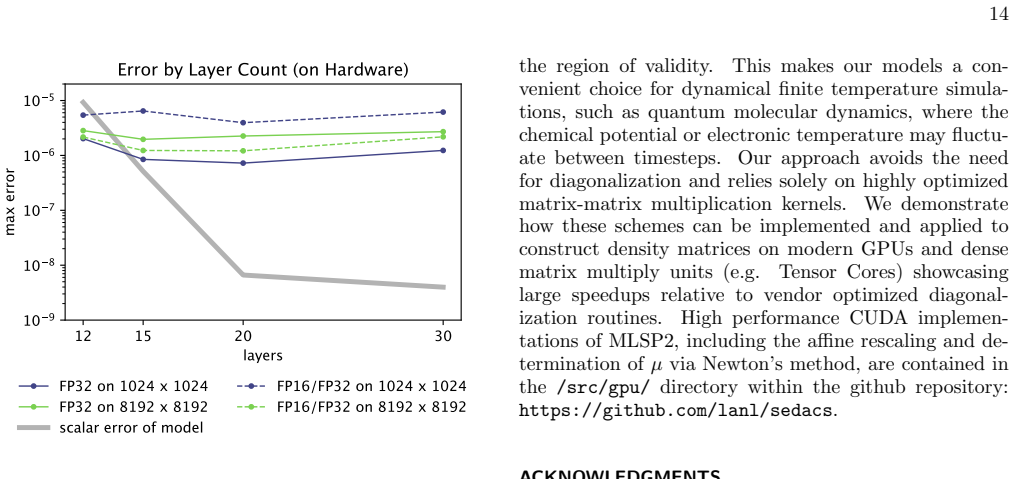
Compute the density matrix for a test Hamiltonian using both the learned expansion and exact diagonalization, then check whether the maximum absolute element-wise difference exceeds a tolerance such as 10 to the minus 4 over a range of temperatures and chemical potentials.
Figures




read the original abstract
We present several finite-temperature recursive Fermi-operator expansion schemes based on the second-order spectral projection (SP2) method. Our approach builds on a previous observation that the electronic structure problem, as formulated through a recursive SP2 expansion, can be mapped onto the architecture of a deep neural network. Using this perspective, we generalize SP2 to finite electronic temperatures and construct machine learning models to determine optimized expansion coefficients. These coefficients are trained for a specified chemical potential and electronic temperature and are not available in closed analytical form. However, by employing an appropriate affine rescaling strategy to the Hamiltonian matrix, we eliminate the need to retrain the model during a simulation if the temperature and chemical potential change. Our approach avoids explicit diagonalization and relies solely on highly optimized matrix-matrix multiplication kernels. Compared to state-of-the-art diagonalization, we achieve an order-of-magnitude speedup in the single-particle finite-temperature density matrix calculation for small and moderately sized matrices on modern GPUs and dense matrix multiply units.
Editorial analysis
A structured set of objections, weighed in public.
Referee Report
Summary. The manuscript introduces machine-learned finite-temperature extensions of the recursive SP2 Fermi-operator expansion method. By framing the expansion as a neural network, optimized coefficients are learned for specific temperatures and chemical potentials. An affine rescaling of the Hamiltonian is proposed to allow reuse of the trained model across different conditions without retraining. The approach relies on matrix-matrix multiplications and is reported to provide an order-of-magnitude speedup compared to diagonalization for small and moderate-sized matrices on GPU hardware.
Significance. Should the accuracy of the rescaled expansions hold under the conditions tested, the work offers a promising route to faster computation of finite-temperature density matrices by exploiting highly optimized linear algebra kernels on modern hardware. This could be particularly impactful for applications requiring repeated evaluations, such as in ab initio molecular dynamics at finite temperature. The neural network mapping provides an interesting conceptual bridge between electronic structure methods and machine learning architectures.
major comments (2)
- [Abstract] Abstract: the central practicality claim that affine rescaling 'eliminates the need to retrain' is load-bearing for the method's utility, yet no quantitative error metrics, worst-case bounds, or cross-condition validation (e.g., density-matrix deviation from exact diagonalization for T, mu outside the training pair) are supplied; without these the order-of-magnitude speedup cannot be assessed as preserving sufficient accuracy.
- [Performance claims] Performance claims section: the reported speedup is paired only with the assertion of 'negligible' error; explicit tables or figures showing both wall-time ratios and Frobenius or spectral-norm errors versus matrix size, hardware, and varied (T, mu) after rescaling are required to demonstrate that the ML approximation remains faithful enough for downstream observables.
minor comments (1)
- [Methods] The notation distinguishing the learned coefficients from the rescaling parameters should be introduced earlier and used consistently to avoid reader confusion in the methods description.
Simulated Author's Rebuttal
We thank the referee for their careful review and constructive feedback on our manuscript. We address the major comments point by point below and have revised the manuscript to include the requested quantitative validations.
read point-by-point responses
-
Referee: [Abstract] Abstract: the central practicality claim that affine rescaling 'eliminates the need to retrain' is load-bearing for the method's utility, yet no quantitative error metrics, worst-case bounds, or cross-condition validation (e.g., density-matrix deviation from exact diagonalization for T, mu outside the training pair) are supplied; without these the order-of-magnitude speedup cannot be assessed as preserving sufficient accuracy.
Authors: We agree with the referee that explicit quantitative validation of the rescaling strategy is crucial for assessing the method's practicality. Although the original manuscript demonstrates the rescaling approach and its conceptual benefits, we have added new results in the revised version, including error metrics (Frobenius norm deviations from exact diagonalization) for several (T, μ) pairs outside the training conditions. These show that the approximation errors remain comparable to those at the trained points, typically below 5×10^{-4}. We also discuss the theoretical justification for the rescaling preserving the expansion accuracy and provide bounds based on the spectral properties. revision: yes
-
Referee: [Performance claims] Performance claims section: the reported speedup is paired only with the assertion of 'negligible' error; explicit tables or figures showing both wall-time ratios and Frobenius or spectral-norm errors versus matrix size, hardware, and varied (T, mu) after rescaling are required to demonstrate that the ML approximation remains faithful enough for downstream observables.
Authors: We acknowledge that more detailed performance data would better support our claims. In the revised manuscript, we have expanded the performance analysis section with explicit tables and additional figures. These include wall-time ratios for matrix sizes ranging from 100 to 2000, on both CPU and GPU hardware, alongside corresponding error norms (Frobenius and spectral) for the density matrices computed with rescaled models at varied temperatures and chemical potentials. The data confirm order-of-magnitude speedups with errors that do not significantly impact typical observables in electronic structure calculations. revision: yes
Circularity Check
No significant circularity; method relies on explicit ML training and architectural speedup
full rationale
The paper presents a practical method that trains ML models to obtain expansion coefficients for a finite-temperature generalization of the SP2 Fermi-operator expansion, then applies an affine rescaling of the Hamiltonian to reuse those coefficients across different (T, μ) values. The central performance claim—an order-of-magnitude speedup versus diagonalization—is attributed to the use of optimized dense matrix-multiplication kernels on GPUs rather than to any fitted quantity. No derivation step equates a claimed prediction or first-principles result to its own inputs by construction; the training process is openly described as fitting, the rescaling is introduced as an empirical engineering device, and accuracy is benchmarked externally against exact diagonalization. Self-citations to prior SP2 work exist but are not load-bearing for the speedup or the rescaling claim, which stands on the reported numerical comparisons.
Axiom & Free-Parameter Ledger
free parameters (1)
- expansion coefficients =
machine-learned for specific T and mu
axioms (1)
- domain assumption The recursive SP2 expansion for the Fermi operator can be mapped onto the architecture of a deep neural network.
Lean theorems connected to this paper
-
IndisputableMonolith/Cost/FunctionalEquation.leanwashburn_uniqueness_aczel; phi_fixed_point echoes?
echoesECHOES: this paper passage has the same mathematical shape or conceptual pattern as the Recognition theorem, but is not a direct formal dependency.
φ^{-1} is a fixed point of the composition of f0(x)=x² with f1(x)=2x-x²... ef'nℓ(ϕ)=(2ϕ)^nℓ... nℓ=ln(β'/4)/ln(2φ^{-1})
-
IndisputableMonolith/Foundation/AlphaCoordinateFixation.leanalpha_pin_under_high_calibration; costAlphaLog_high_calibrated_iff refines?
refinesRelation between the paper passage and the cited Recognition theorem.
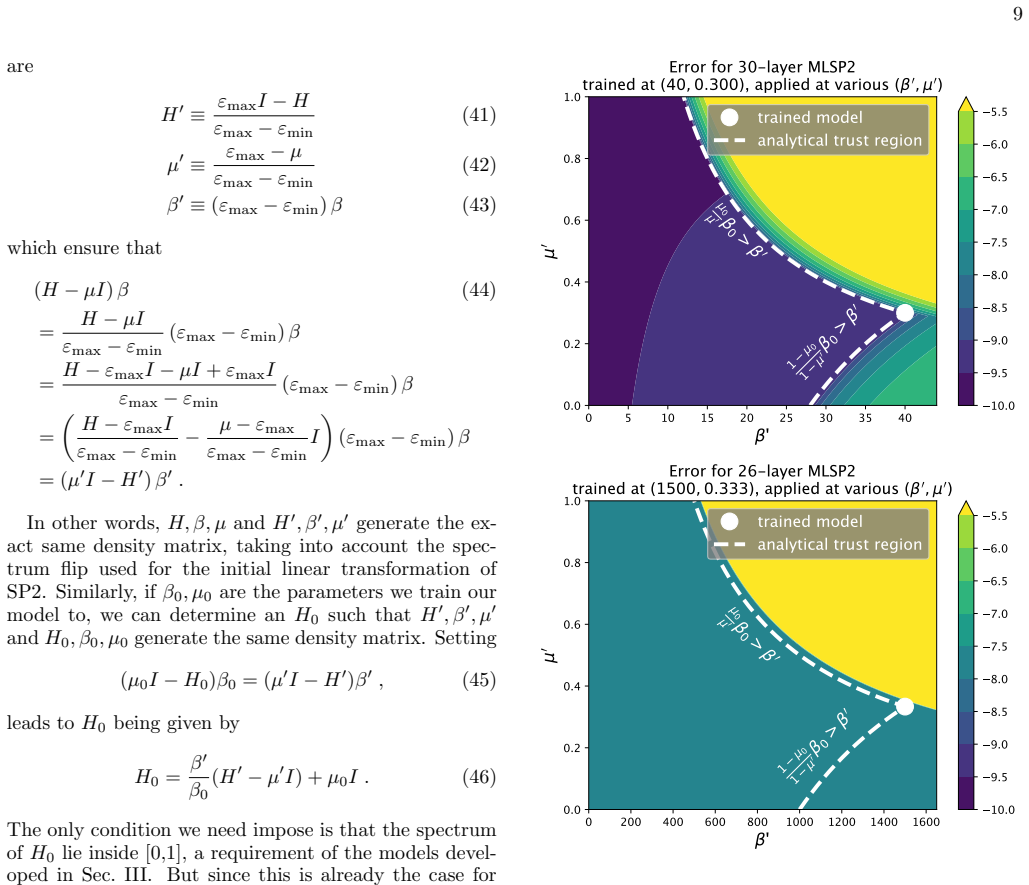
affine rescaling H0= (β'/β0)(H'-μ'I)+μ0 I... region of validity defined by μ0/μ' β0 ≥ β' and (1-μ0)/(1-μ') β0 ≥ β'
What do these tags mean?
- matches
- The paper's claim is directly supported by a theorem in the formal canon.
- supports
- The theorem supports part of the paper's argument, but the paper may add assumptions or extra steps.
- extends
- The paper goes beyond the formal theorem; the theorem is a base layer rather than the whole result.
- uses
- The paper appears to rely on the theorem as machinery.
- contradicts
- The paper's claim conflicts with a theorem or certificate in the canon.
- unclear
- Pith found a possible connection, but the passage is too broad, indirect, or ambiguous to say the theorem truly supports the claim.
Reference graph
Works this paper leans on
-
[1]
34th Annual Symposium on Foundations of Computer Science , crossrefonly = 1, source =
34th Annual Symposium on Foundations of Computer Science , year = 1993, organization =. 34th Annual Symposium on Foundations of Computer Science , crossrefonly = 1, source =
work page 1993
-
[2]
Proceedings of the Sagamore X Conference on Charge, Spin and Momentum Densities , year = 1993, editor =. 1-446 , pages =
work page 1993
-
[3]
Frontiers in High Energy Density Physics , year = 2003, editor =
work page 2003
-
[4]
Graphics Gems , publisher =
-
[5]
IBM Visualization Data Explorer Version 3.1 , organization =
-
[6]
Periodic coordinates used in MondoSCF validation , year = 2004, url =
work page 2004
-
[7]
User's Manual, Math/Library, Fortran Subroutines for Mathematical Applications , organization =
-
[8]
Application of Fast Parallel and Sequential Tree Codes to Computing Three-Dimensional Flows with Vortex Element and Boundary Element Methods , booktitle =
-
[9]
Handbook of Mathematical Functions , publisher =
- [10]
- [11]
- [12]
-
[13]
The International Journal of High Performance Computing Applications , volume=
DGEMM on integer matrix multiplication unit , author=. The International Journal of High Performance Computing Applications , volume=. 2024 , publisher=
work page 2024
-
[14]
A. H. Sameh and J. A. Wisniewsk , title =. SIAM J. Num Anal , year = 1982, volume = 19, number = 6, pages =
work page 1982
-
[15]
A. M. Krezel and G. Wagner and J. Seymour-Ulmer and R. A. Lazarus , journal =
-
[16]
A. V. Knyazev , title =
-
[17]
C. W. Bauschlicher , title =. Chem. Phys. Lett. , year = 1995, volume = 246, pages =
work page 1995
- [18]
-
[19]
L.\ M.\ Pecora and T.\ L.\ Carrol , title =
- [20]
- [21]
-
[22]
W. Z. Liang and R. Baer and C. Saravanan and Y. H. Shao and A. T. Bell and M. Head-Gordon , journal =
-
[23]
Reviews of modern physics , volume=
The kernel polynomial method , author=. Reviews of modern physics , volume=. 2006 , publisher=
work page 2006
-
[24]
H.\ B. Schlegel and J.\ M. Millam and S.\ S. Iyengar and G.\ A. Voth and A.\ D. Daniels and G.E. Scusseria and M.\ J. Frisch , title =
-
[25]
The Journal of Chemical Physics , volume=
A fast, dense Chebyshev solver for electronic structure on GPUs , author=. The Journal of Chemical Physics , volume=. 2023 , publisher=
work page 2023
-
[26]
PeerJ Computer Science , volume=
Numerical behavior of NVIDIA tensor cores , author=. PeerJ Computer Science , volume=. 2021 , publisher=
work page 2021
-
[27]
S.\ S. Iyengar and H.\ B. Schlegel and J.\ M. Millam and G.\ A. Voth and G.E. Scusseria and M.\ J. Frisch , title =
-
[28]
J.M. Millan and V. Bakken and W. Chen and L. Hase and H.\ B. Schlegel , title =
- [29]
- [30]
- [31]
-
[32]
A. M. N. Niklasson and V. Weber and M. Challacombe , title =
-
[33]
A. M. N. Niklasson and M. J. Cawkwell and E. H. Rubensson and E. Rudberg , title =
-
[34]
A. M. N. Niklasson and K. Nemeth and M. Challacombe , title =
- [35]
-
[36]
D. Levin , title =. Intern. J. Computer Math. B , year = 1973, volume = 3, pages =
work page 1973
-
[37]
Francisco Figueirido and Ronald M. Levy and Ruhong Zhou and B.J. Berne , title =. J. Chem. Phys. , year = 1997, volume = 106, pages =
work page 1997
-
[38]
G. S. Tschumper and J. T. Fermann and H. F
-
[39]
H. Takahsi and M. Mori , title =. Publ. RIMS, Kyoto Univ. , year = 1974, volume = 9, pages =
work page 1974
-
[40]
H. Takahsi and M. Mori , title =. Numerische Mathematik , year = 1973, volume = 21, pages =
work page 1973
-
[41]
H.G. Petersen and D. Soelvason and J. W. Perram and E. R. Smith , title =. J. Chem. Phys. , year = 1994, volume = 101, number = 10, pages =
work page 1994
-
[42]
H.G. Petersen and E. R. Smith and D. Soelvason , title =. Proc. Roy. Soc. A , year = 1994, volume = 448, number = 1934, pages =
work page 1994
-
[43]
H.Toda and H. Ono , title =. Kokyuroku RIMS, Kyoto Univ. , year = 1980, number = 401, pages =
work page 1980
- [44]
- [45]
-
[46]
J. D. Power and R. M. Pitzer , title =. Chem. Phys. Letters , year = 1974, volume = 24, number = 4, pages =
work page 1974
-
[47]
J. K. Salmon , title =. Int. J. Super. Appl. , year = 1994, volume = 8, number = 2, pages =
work page 1994
-
[48]
J. L. Whitten , title =. J. Chem. Phys. , year = 1973, volume = 58, number = 10, pages =
work page 1973
-
[49]
New Techniques for evaluating parity conserving and parity violating contact interactions
J. New Techniques for evaluating parity conserving and parity violating contact interactions. , journal =
-
[50]
Joseph O. Hirschfelder and Charles F. Curtiss and R. Byron Bird , title =
-
[51]
L. Laaksonen and P. Pyykk. Fully Numerical. Comp. Phys. Rept. , year = 1986, volume = 4, pages =
work page 1986
-
[52]
Leon van Dommelen and Elke A. Rundensteiner , title =. Journal of Computational Physics , year = 1989, volume = 83, pages =
work page 1989
-
[53]
M. J. Frisch and Benny G. Johnson and P. M. W. Gill and D. J. Fox and R. H. Nobes , title =. Chem. Phys. Lett. , year = 1993, volume = 206, number =
work page 1993
-
[54]
M. J. Frisch and G. W. Trucks and H. B. Schlegel and P. M. W. Gill and B. G. Johnson and M. A. Robb and J. R. Cheeseman and T. Keith and G. A. Petersson and J. A. Montgomery and K. Raghavachari and M. A. Al-Laham and V. G. Zakrzewski and J. V. Ortiz and J. B. Foresman and C. Y. Peng and P. Y. Ayala and W. Chen and M. W. Wong and J. L. Andres and E. S. Rep...
-
[55]
M. J. Frisch and G. W. Trucks and H. B. Schlegel and P. M. W. Gill and B. G. Johnson and M. A. Robb and J. R. Cheeseman and T. Keith and G. A. Petersson and J. A. Montgomery and K. Raghavachari and M. A. Al-Laham and V. G. Zakrzewski and J. V. Ortiz and J. B. Foresman and J. Cioslowski and B. B. Stefanov and A. Nanayakkara and M. Challacombe and C. Y. Pen...
-
[56]
Gaussian 92, Revision D.2 , author =
-
[57]
M. J. Frisch and M. Head-Gordon and G. W. Trucks and J. B. Foresman and H. B. Schlegel, K. Raghavachari and M. Robb and J. S. Binkley and C. Gonzalez and D. J. Defrees and D. J. Fox, R. A. Whiteside and R. Seeger and C. F. Melius and J. Baker and R. L. Martin and L. R. Kahn and J. J. P. Stewart and S. Topiol and J. A. Pople , organization =
-
[58]
Matt Challacombe and Eric Schwegler and C. J. Tymczak and Chee Kwan Gan and Karoly Nemeth and Valery Weber and Anders M. N. Niklasson and Graeme Henkelman , title =
-
[59]
Nicolas Bock and Matt Challacombe and Chee Kwan Gan and Graeme Henkelman and Karoly Nemeth and Anders M. N. Niklasson and Anders Odell and Eric Schwegler and C. J. Tymczak and Valery Weber , title =
-
[60]
E. J. Sanville and et al. , title =
- [61]
-
[62]
Matt Challacombe and
-
[63]
P. O. L. Quantum theory of many-particle systems. Phys. Rev. , year = 1955, volume = 97, number = 6, pages =
work page 1955
-
[64]
P. O. L. Quantum theory of electronic structure of molecules , journal =
-
[65]
R. Lindh and U. Ryu and Y. S. Lee , title =. J. Chem. Phys. , year = 1991, volume = 95, number = 8, pages =
work page 1991
-
[66]
T. Momose and T. Shida , title =. J. Chem. Phys. , year = 1987, volume = 87, number = 5, pages =
work page 1987
-
[67]
T. Momose and T. Shida , title =. J. Chem. Phys. , year = 1988, volume = 88, number = 11, pages =
work page 1988
-
[68]
T. P. Kline and F. K. Brown and S. C. Brown and P. W. Jeffs and K. D. Kopple and L. Mueller , journal =
- [69]
-
[70]
A. C. Genz and A. A. Malik , title =. SIAM J. Num. Anal. , year = 1983, volume = 20, number = 3, pages =
work page 1983
-
[71]
A. C. Genz and A. A. Malik , title =. J. Comp. App. Math , year = 1980, volume = 6, number = 4, pages =
work page 1980
-
[72]
A. C. J. Am. Chem. Soc. , year = 1994, volume = 116, number = 12, pages =
work page 1994
- [73]
-
[74]
A. D. Becke , title =. Phys. Rev. A , year = 1988, volume = 38, number = 6, pages =
work page 1988
-
[75]
A. D. Becke , title =
-
[76]
A. D. Becke , title =. J. Chem. Phys. , year = 1993, volume = 98, pages =
work page 1993
-
[77]
A. D. Becke , journal =
-
[78]
A. D. Booth and F. J. Llewellyn , title =
-
[79]
A. D. Buckingham , editor =. Basic theory of intermolecular forces: Applications to small molecules , publisher =
-
[80]
K. Feng , editor =. Beijing Symposium on Differenctial Geometry and Differential Equations -- Computation of Partial Differential Equations , publisher =
discussion (0)
Sign in with ORCID, Apple, or X to comment. Anyone can read and Pith papers without signing in.