Recognition: no theorem link
Fokker--Planck framework for stochastic octupole moment dynamics in chiral antiferromagnet Mn3Sn
Pith reviewed 2026-05-12 01:08 UTC · model grok-4.3
The pith
A reduced Fokker-Planck model for the octupole moment in Mn3Sn captures full three-sublattice switching and computes ultra-low error probabilities
A machine-rendered reading of the paper's core claim, the machinery that carries it, and where it could break.
Core claim
The central claim is that the stochastic octupole dynamics in Mn3Sn are accurately represented by a Fokker-Planck equation derived from the reduced Landau-Lifshitz-Gilbert dynamics of a single effective octupole moment; this formulation reproduces the switching statistics of the full three-sublattice model while enabling efficient calculation of rare events through a grid-based CUDA solver.
What carries the argument
The Fokker-Planck equation for the probability density of the effective octupole moment orientation, obtained by reducing the three-sublattice Landau-Lifshitz-Gilbert dynamics to a single vector variable.
If this is right
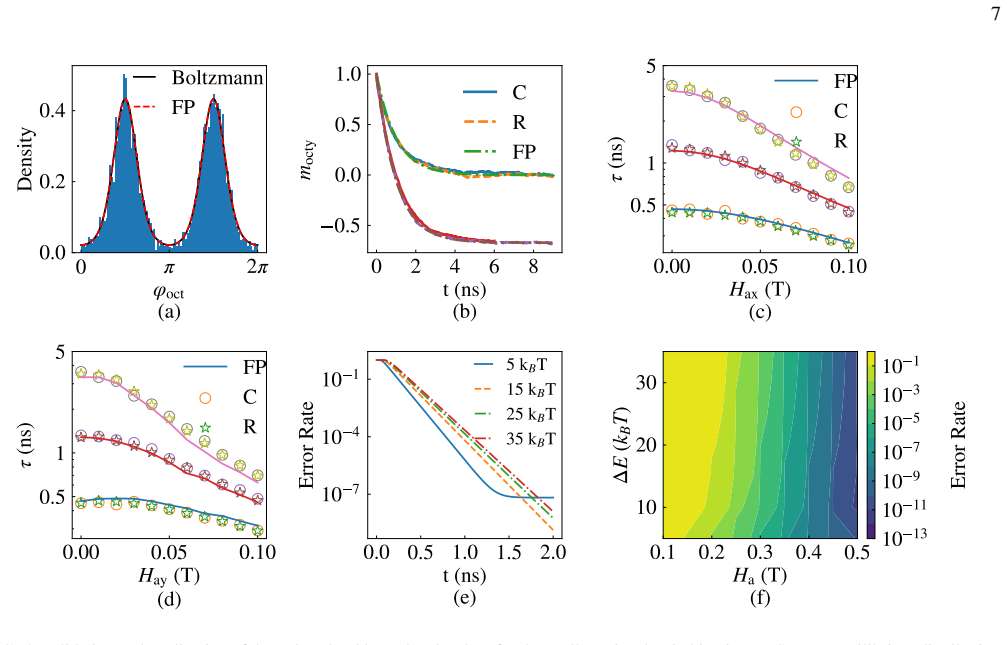
- The reduced model reproduces equilibrium distributions, relaxation trajectories, and mean switching times obtained from the full three-sublattice stochastic simulations.
- The CUDA solver provides access to switching error probabilities orders of magnitude lower than those reachable by direct Monte Carlo sampling.
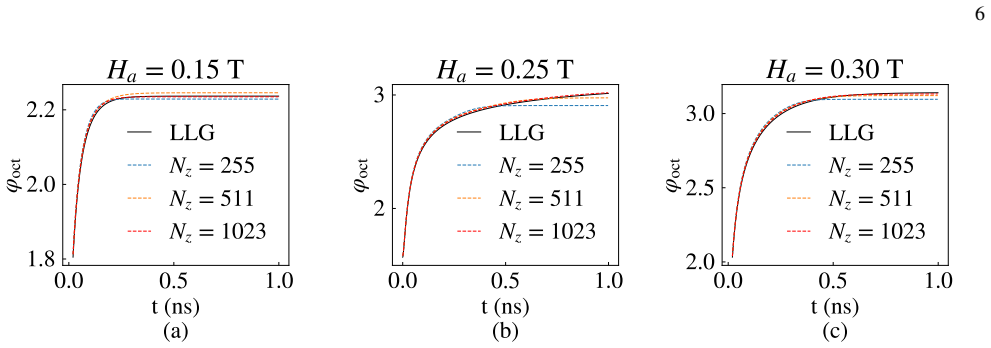
- Out-of-plane grid resolution must be fine because small deviations from the basal plane control the ultrafast rotation of the octupole.
- Thermally assisted field-driven switching can be studied efficiently over wide ranges of temperature and field without exhaustive atomistic sampling.
Where Pith is reading between the lines
- The same reduction-plus-Fokker-Planck strategy could simplify stochastic modeling of other noncollinear antiferromagnets that rely on octupole or higher-order multipole orders.
- Device-level spintronic simulators could adopt the CUDA solver for rapid iteration on switching reliability without repeated full-atomistic runs.
- Experimental measurements of rare switching events in Mn3Sn thin films under controlled out-of-plane fields would provide an independent test of the model's sensitivity to basal-plane deviations.
- Adding explicit out-of-plane anisotropy terms to the reduced equation might further stabilize the grid-resolution dependence observed in the present solver.
Load-bearing premise
The reduction from complete three-sublattice octupole dynamics to a single effective octupole moment remains accurate when ultrafast rotation is driven by very small out-of-plane deviations.
What would settle it
Full three-sublattice Monte Carlo simulations performed at extremely fine out-of-plane discretization and compared directly against the Fokker-Planck switching-time distributions at ultra-low probabilities would confirm or refute the accuracy of the reduced description.
Figures



read the original abstract
We develop a reduced stochastic framework for thermally assisted octupole moment dynamics in Mn3Sn by combining the reduced Landau--Lifshitz--Gilbert (LLG) equation with the Fokker--Planck formalism. The reduced model is benchmarked against the complete three-sublattice octupole dynamics and is shown to capture the essential switching behavior with good accuracy. We then derive the corresponding Fokker--Planck equation, which is implemented and solved via a CUDA-accelerated solver. The analysis shows that the octupole dynamics are highly sensitive to the out-of-plane grid resolution because ultrafast rotation of the octupole is controlled by its very small deviations from the basal plane. The solver is validated against Monte Carlo simulations through equilibrium distributions, relaxation trajectories, and switching times. Finally, we apply the method to thermally assisted field-driven switching and demonstrate efficient access to ultra-low error probabilities beyond the practical reach of direct Monte Carlo simulations.
Editorial analysis
A structured set of objections, weighed in public.
Referee Report
Summary. The manuscript develops a reduced stochastic framework for thermally assisted octupole moment dynamics in Mn3Sn by combining a reduced Landau-Lifshitz-Gilbert equation with the Fokker-Planck formalism. The reduced model is benchmarked against the complete three-sublattice dynamics and shown to capture essential switching behavior with good accuracy. A CUDA-accelerated solver for the derived Fokker-Planck equation is implemented, validated against Monte Carlo simulations via equilibrium distributions, relaxation trajectories, and switching times, and applied to thermally assisted field-driven switching to access ultra-low error probabilities beyond direct Monte Carlo reach. The work highlights sensitivity of the dynamics to out-of-plane grid resolution due to control by small basal-plane deviations.
Significance. If the reduction remains accurate in the small out-of-plane regime, the framework would enable efficient computation of rare switching events and error probabilities in chiral antiferromagnets, which is relevant for antiferromagnetic spintronics applications. The CUDA implementation and direct Monte Carlo validation constitute clear strengths for reproducibility and practical utility.
major comments (1)
- [Abstract] Abstract: the claim that the reduced model 'captures the essential switching behavior with good accuracy' and enables reliable ultra-low error probabilities is load-bearing, yet the abstract itself notes that ultrafast octupole rotation is controlled by very small out-of-plane deviations and that dynamics are highly sensitive to out-of-plane grid resolution. No indication is given that benchmarking trajectories sample or resolve the O(10^{-3}) out-of-plane regime; if the reduction from three-sublattice LLG to a single effective octupole moment was only tested for larger deviations, the agreement on switching times and error rates cannot be guaranteed in the thermally assisted regime of interest.
minor comments (2)
- The manuscript should quantify 'good accuracy' in the benchmarking (e.g., explicit error metrics, maximum deviations in switching times, or overlap integrals between distributions) rather than qualitative statements.
- Explicit values for the out-of-plane grid resolutions tested and the resulting changes in computed switching rates should be reported to substantiate the sensitivity claim.
Simulated Author's Rebuttal
We thank the referee for the careful and constructive review of our manuscript. We address the major comment in detail below and have incorporated clarifications to strengthen the presentation of our validation results.
read point-by-point responses
-
Referee: [Abstract] Abstract: the claim that the reduced model 'captures the essential switching behavior with good accuracy' and enables reliable ultra-low error probabilities is load-bearing, yet the abstract itself notes that ultrafast octupole rotation is controlled by very small out-of-plane deviations and that dynamics are highly sensitive to out-of-plane grid resolution. No indication is given that benchmarking trajectories sample or resolve the O(10^{-3}) out-of-plane regime; if the reduction from three-sublattice LLG to a single effective octupole moment was only tested for larger deviations, the agreement on switching times and error rates cannot be guaranteed in the thermally assisted regime of interest.
Authors: We thank the referee for identifying this important point of clarity. The reduced model is derived by projecting the three-sublattice LLG dynamics onto the octupole moment under the explicit assumption that out-of-plane components remain small (O(10^{-3}) or less), which is the physically relevant regime for thermal activation in Mn3Sn. In the full manuscript, the benchmarking trajectories (Section III) are generated from the complete three-sublattice stochastic LLG and naturally sample out-of-plane deviations down to this scale during switching events; the agreement in switching times and equilibrium distributions is therefore obtained within the regime of interest. To remove any ambiguity, we will revise the abstract to state that benchmarking encompasses the small out-of-plane deviation regime, and we will add a clarifying sentence in the validation subsection specifying the range of out-of-plane angles resolved in the benchmarked trajectories. These changes will make the load-bearing claim more precise without altering the technical content. revision: partial
Circularity Check
No circularity: derivation from LLG to reduced FP is forward and independently validated
full rationale
The paper derives the reduced LLG equation from the complete three-sublattice dynamics, benchmarks the reduction against the full model for switching behavior, derives the Fokker-Planck equation from it, and validates the solver against separate Monte Carlo runs for equilibrium distributions, relaxation trajectories, and switching times. These steps are independent forward computations; no parameter is fitted to a target quantity and then relabeled as a prediction of that same quantity, no self-citation is load-bearing for the central claim, and no equation reduces to its own input by construction. The noted sensitivity to out-of-plane resolution is a numerical observation, not evidence of circularity.
Axiom & Free-Parameter Ledger
Reference graph
Works this paper leans on
-
[1]
Large anomalous Hall effect in a non-collinear antiferromagnet at room temper- ature,
Nakatsuji, Satoru, Kiyohara, Naoki and Higo, Tomoya. “Large anomalous Hall effect in a non-collinear antiferromagnet at room temper- ature,".Nature,527, 212–215 (2015). doi: 10.1038/nature15723. 13
-
[2]
Evidence for magnetic Weyl fermions in a correlated metal,
Kuroda, Ken et al.. “Evidence for magnetic Weyl fermions in a correlated metal,".Nature Materials,16, 1090–1095 (2017). doi: 10.1038/nmat4987
-
[3]
Spintronic devices and applications using noncollinear chiral antiferromagnets,
Shukla, Ankit, Qian, Siyuan and Rakheja, Shaloo. “Spintronic devices and applications using noncollinear chiral antiferromagnets,". Nanoscale Horizons,10, 484–511 (2025)
work page 2025
-
[4]
Magnetic Structure and Weak Ferromagnetism of Mn3Sn Studied by Polarized Neutron Diffraction,
Tomiyoshi, S. and Yamaguchi, Y .. “Magnetic Structure and Weak Ferromagnetism of Mn3Sn Studied by Polarized Neutron Diffraction,". Journal of the Physical Society of Japan,51, 803–810 (1982). doi: 10.1143/JPSJ.51.803
-
[5]
Magnetic excitations in non-collinear antiferromagnetic Weyl semimetal Mn3Sn,
Park, Pyeongjae et al.. “Magnetic excitations in non-collinear antiferromagnetic Weyl semimetal Mn3Sn,".npj Quantum Materials,3, 63 (2018). doi: 10.1038/s41535-018-0137-9
-
[6]
Large anomalous Nernst effect at room temperature in a chiral antiferromagnet,
Ikhlas, Muhammad et al.. “Large anomalous Nernst effect at room temperature in a chiral antiferromagnet,".Nature Physics,13, 1085– 1090 (2017). doi: 10.1038/nphys4181
-
[7]
Cluster multipole theory for anomalous Hall effect in antiferromagnets,
Suzuki, Michi-To, Koretsune, Takashi, Ochi, Masayuki and Arita, Ryotaro. “Cluster multipole theory for anomalous Hall effect in antiferromagnets,".Physical Review B,95, 094406 (2017). doi: 10.1103/PhysRevB.95.094406
-
[9]
Higo, Tomoya et al.. “Large magneto-optical Kerr effect and imaging of magnetic octupole domains in an antiferromagnetic metal,". Nature Photonics,12, 73–78 (2018). doi: 10.1038/s41566-017-0086-z
-
[10]
Magnetic phase dependence of the anomalous Hall effect in Mn3Sn single crystals,
Sung, Nakheon H., Ronning, Filip, Thompson, Joe D. and Bauer, Eric D.. “Magnetic phase dependence of the anomalous Hall effect in Mn3Sn single crystals,".Applied Physics Letters,112, 132406 (2018). doi: 10.1063/1.5021133
-
[11]
All-electrical switching of a topological non-collinear antiferromagnet at room temperature,
Deng, Yongcheng et al.. “All-electrical switching of a topological non-collinear antiferromagnet at room temperature,".National Science Review,10, nwac154 (2023). doi: 10.1093/nsr/nwac154
-
[12]
Xie, Hang et al.. “Magnetization switching in polycrystalline Mn3Sn thin film induced by self-generated spin-polarized current,".Nature Communications,13, 6124 (2022). doi: 10.1038/s41467-022-33345-2
-
[13]
Nihei, Kota et al.. “Temperature dependence of current-induced switching in thin epitaxial films of Mn3Sn: Revealing the dominant role of spin–orbit torque,".Applied Physics Letters,127, 132406 (2025). doi: 10.1063/5.0294438
-
[14]
Impact of strain on the SOT-driven dynamics of thin film Mn3Sn,
Shukla, Ankit, Qian, Siyuan and Rakheja, Shaloo. “Impact of strain on the SOT-driven dynamics of thin film Mn3Sn,".Journal of Applied Physics,135(2024)
work page 2024
-
[15]
Electrical manipulation of a topological antiferromagnetic state,
Tsai, Hanshen et al.. “Electrical manipulation of a topological antiferromagnetic state,".Nature,580, 608–613 (2020). doi: 10.1038/s41586-020-2211-2
-
[16]
Chiral-spin rotation of non-collinear antiferromagnet by spin–orbit torque,
Takeuchi, Yutaro et al.. “Chiral-spin rotation of non-collinear antiferromagnet by spin–orbit torque,".Nature Materials,20, 1364–1370 (2021). doi: 10.1038/s41563-021-01005-3
-
[17]
Matsuda, Takuya, Kanda, Natsuki, Higo, Tomoya, Armitage, N. P., Nakatsuji, Satoru and Matsunaga, Ryusuke. “Room-temperature tera- hertz anomalous Hall effect in Weyl antiferromagnet Mn3Sn thin films,".Nature Communications,11, 909 (2020). doi: 10.1038/s41467- 020-14690-6
-
[19]
Anomalous Nernst and Righi-Leduc Effects in Mn 3Sn: Berry Curvature and Entropy Flow,
Li, Xiaokang et al.. “Anomalous Nernst and Righi-Leduc Effects in Mn 3Sn: Berry Curvature and Entropy Flow,".Physical Review Letters,119, 056601 (2017). doi: 10.1103/PhysRevLett.119.056601
-
[20]
Large anomalous Nernst effect and thermodynamic signatures in the chiral antiferromagnet Mn 3Sn,
Tomita, Tomohiro et al.. “Large anomalous Nernst effect and thermodynamic signatures in the chiral antiferromagnet Mn 3Sn,".Science Advances(2019)
work page 2019
-
[22]
Pulse-width dependence of spin–orbit torque switching in antiferromagnetic Mn 3Sn,
Kobayashi, Y . et al.. “Pulse-width dependence of spin–orbit torque switching in antiferromagnetic Mn 3Sn,".Applied Physics Letters, 122, 122405 (2023). doi: 10.1063/5.013XXXX
-
[23]
Electrically tunable picosecond-scale octupole fluctuations in chiral antiferromagnets,
Konakanchi, Shiva T. et al.. “Electrically tunable picosecond-scale octupole fluctuations in chiral antiferromagnets,".Physical Review Letters,135, 136704 (2025). doi: 10.1103/PhysRevLett.135.136704
-
[24]
Qian, Siyuan, Shukla, Ankit and Rakheja, Shaloo. “Influence of thermal noise on the field-driven dynamics of the non-collinear antifer- romagnet Mn3Sn,".Applied Physics Letters,127, 202408 (2025). doi: 10.1063/5.0XXXXX
-
[25]
Langevin-dynamics study of the dynamical properties of small magnetic particles,
García-Palacios, José L. and Lázaro, Francisco J.. “Langevin-dynamics study of the dynamical properties of small magnetic particles,". Physical Review B,58, 14937–14958 (1998). doi: 10.1103/PhysRevB.58.14937
-
[26]
QUANTUM ESPRESSO: A modular and open -source software project for quantum simulations of materials
Evans, Richard F. L., Fan, Weijia, Chureemart, Phanwadee, Ostler, Thomas A., Ellis, Matthew O. A. and Chantrell, Roy W.. “Atomistic spin model simulations of magnetic nanomaterials,".Journal of Physics: Condensed Matter,26, 103202 (2014). doi: 10.1088/0953- 8984/26/10/103202
-
[27]
Brown, William Fuller. “Thermal fluctuations of a single-domain particle,".Physical Review,130, 1677–1686 (1963). doi: 10.1103/Phys- Rev.130.1677
-
[28]
The Fokker–Planck Equation: Methods of Solution and Applications,
Risken, Hannes. “The Fokker–Planck Equation: Methods of Solution and Applications,". (1989). doi: 10.1007/978-3-642-61544-3
-
[29]
Coffey, William T., Kalmykov, Yuri P. and Waldron, John T.. “The Langevin Equation: With Applications to Stochastic Problems in Physics, Chemistry and Electrical Engineering,". (2012). doi: 10.1142/8195
-
[30]
Materials Data on Mn3Sn by Materials Project,
LBNL Materials Project. “Materials Data on Mn3Sn by Materials Project,". (2020). doi: 10.17188/1197606
-
[31]
VESTA 3 for three-dimensional visualization of crystal, volumetric and morphology data,
Momma, Koichi and Izumi, Fujio. “VESTA 3 for three-dimensional visualization of crystal, volumetric and morphology data,".Applied Crystallography,44, 1272–1276 (2011)
work page 2011
discussion (0)
Sign in with ORCID, Apple, or X to comment. Anyone can read and Pith papers without signing in.