Recognition: no theorem link
Intra-Pair Skew Propagation Graph (ISPG): An Analytical Model for Cascaded Channels
Pith reviewed 2026-05-12 01:51 UTC · model grok-4.3
The pith
A graph-based model called ISPG calculates cumulative intra-pair skew in cascaded high-speed channels by integrating it with S-parameter calculations.
A machine-rendered reading of the paper's core claim, the machinery that carries it, and where it could break.
Core claim
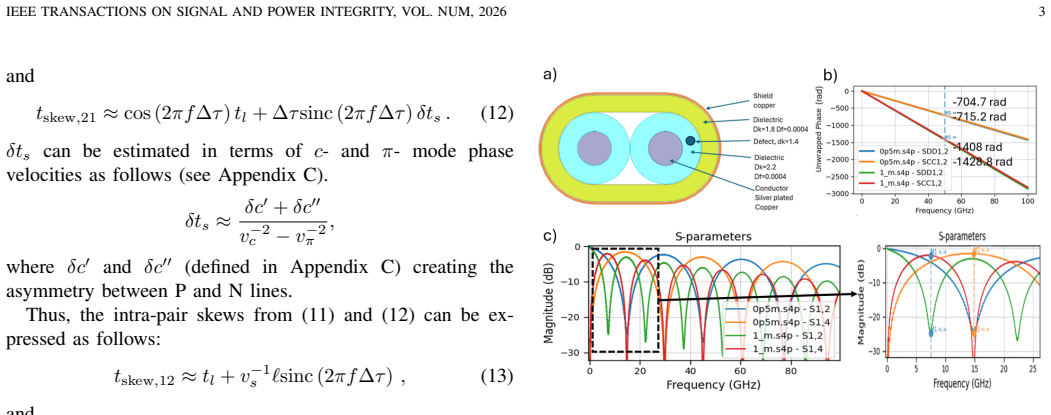
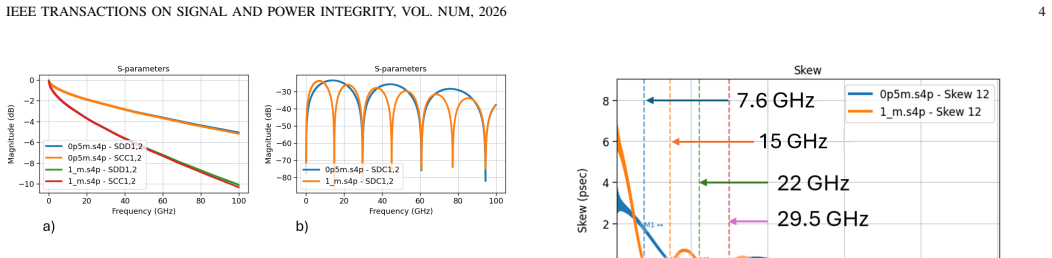
The central discovery is the Intra-pair Skew Propagation Graph (ISPG), a graph-based analytical model that computes cumulative intra-pair skew in cascaded channels. It does this by explicitly incorporating skew into the S-parameter formulations of generic asymmetric coupled transmission lines, allowing for accurate and robust predictions validated on a 2m twinax cable.
What carries the argument
The Intra-pair Skew Propagation Graph (ISPG) is the key mechanism, serving as a graph representation of the channel where skew propagation is modeled segment by segment and combined with S-parameters to yield the overall skew.
Load-bearing premise
Intra-pair skew can be accurately represented and propagated through S-parameter based models of asymmetric coupled lines without significant unmodeled effects or losses.
What would settle it
A physical measurement or detailed simulation of skew in a cascaded asymmetric channel where the observed cumulative skew differs substantially from the value predicted by the ISPG.
Figures



read the original abstract
As data rates scale, intra-pair skew has become a critical bottleneck for high-speed differential signaling. Current analytical models are often limited, while 3D electromagnetic simulations are computationally intensive. This paper presents a comprehensive analytical framework for intra-pair skew in generic asymmetric coupled transmission lines, explicitly integrating skew into S-parameter formulations. We introduce the Intra-pair Skew Propagation Graph (ISPG), a novel graph-based methodology for calculating cumulative skew in complex, cascaded channels. The proposed framework is validated against both S-parameter simulations and empirical measurements of a 2m twinax cable assembly, demonstrating excellent accuracy and robustness for high-speed interconnect design.
Editorial analysis
A structured set of objections, weighed in public.
Referee Report
Summary. The paper claims to develop a comprehensive analytical framework for intra-pair skew in generic asymmetric coupled transmission lines by explicitly integrating skew into S-parameter formulations. It introduces the Intra-pair Skew Propagation Graph (ISPG) as a graph-based method for cumulative skew calculation in cascaded channels. The framework is validated against S-parameter simulations and empirical measurements of a 2m twinax cable assembly, demonstrating excellent accuracy and robustness for high-speed interconnect design.
Significance. Should the model prove accurate across a range of configurations, it would represent a significant advancement in analytical modeling for high-speed differential signaling, offering an efficient alternative to computationally expensive simulations. The ISPG approach could facilitate the design of complex cascaded channels by providing a scalable way to predict skew accumulation.
major comments (2)
- [§5] The validation is performed solely on a single 2m twinax cable assembly (§5). This single case does not sufficiently demonstrate the model's applicability to generic asymmetric coupled lines or complex cascades with varying asymmetry, as the central claim requires. The paper should include additional test cases to verify the assumption of negligible unmodeled interactions such as mode-conversion losses.
- [§3] The integration of intra-pair skew into the S-parameter matrix (§3) is presented without explicit discussion or bounds on potential mode-conversion losses or reflection effects at segment junctions. This assumption is load-bearing for the cumulative propagation in the ISPG model and the claim of linear addition across segments.
minor comments (3)
- The abstract states 'excellent accuracy' without providing specific quantitative measures such as maximum error, RMS deviation, or frequency-dependent plots; these should be added to the results for clarity and to allow assessment of the validation.
- Notation for the nodes and edges in the ISPG (e.g., how skew parameters are assigned to graph elements) could be clarified with an explicit definition table or expanded caption in the model section.
- A small number of references to prior S-parameter skew models appear to be missing in the introduction; adding 2-3 key citations would better contextualize the novelty.
Simulated Author's Rebuttal
We thank the referee for their constructive and detailed feedback on our manuscript. The comments highlight important aspects of validation scope and model assumptions that we will address to strengthen the presentation of the ISPG framework.
read point-by-point responses
-
Referee: The validation is performed solely on a single 2m twinax cable assembly (§5). This single case does not sufficiently demonstrate the model's applicability to generic asymmetric coupled lines or complex cascades with varying asymmetry, as the central claim requires. The paper should include additional test cases to verify the assumption of negligible unmodeled interactions such as mode-conversion losses.
Authors: We agree that the empirical validation in §5 is confined to a single 2m twinax cable assembly and does not yet cover the full range of generic asymmetric coupled lines or multi-segment cascades asserted in the central claims. Although the ISPG derivation in §§3–4 is formulated generally for arbitrary asymmetry and cascading, additional evidence is warranted. In the revised manuscript we will incorporate S-parameter simulation results for at least two further configurations that vary the degree of intra-pair asymmetry and include cascaded segments with different properties. These cases will also quantify the contribution of mode-conversion losses to confirm they remain negligible within the model’s stated operating regime. revision: yes
-
Referee: The integration of intra-pair skew into the S-parameter matrix (§3) is presented without explicit discussion or bounds on potential mode-conversion losses or reflection effects at segment junctions. This assumption is load-bearing for the cumulative propagation in the ISPG model and the claim of linear addition across segments.
Authors: The referee correctly notes that §3 introduces the skew-augmented S-parameter matrix without a dedicated discussion or quantitative bounds on mode-conversion losses and junction reflections. The model implicitly treats these effects as second-order for differential-mode skew accumulation, permitting the linear propagation captured by the ISPG. To make this assumption explicit and verifiable, we will add a short subsection (or paragraph) in the revised §3 that provides first-order bounds on mode-conversion and reflection coefficients at junctions, referencing standard coupled-line discontinuity analysis. This will also state the conditions under which the linear-addition property holds. revision: yes
Circularity Check
No significant circularity in ISPG derivation from S-parameter theory
full rationale
The paper derives the ISPG framework directly from standard S-parameter formulations for asymmetric coupled lines, with explicit integration of intra-pair skew followed by graph-based cumulative propagation across cascaded segments. Validation relies on independent S-parameter simulations and physical measurements of a 2m twinax assembly, providing external benchmarks rather than internal fits. No self-definitional equations, fitted inputs renamed as predictions, or load-bearing self-citations appear in the core chain; the model is presented as an analytical extension of transmission-line theory without reducing to its own inputs by construction.
Axiom & Free-Parameter Ledger
axioms (1)
- standard math S-parameter formulations accurately represent asymmetric coupled transmission lines
invented entities (1)
-
Intra-pair Skew Propagation Graph (ISPG)
no independent evidence
Reference graph
Works this paper leans on
-
[1]
IEEE Transactions on Electromagnetic Compatibility , Year =
Spice equivalent circuit of a two-parallel-wires shielded cable for evaluation of the RF induced Voltages at the terminations , Author =. IEEE Transactions on Electromagnetic Compatibility , Year =. doi:10.1109/TEMC.2004.826887 , ISSN =
-
[2]
New technique to quantify differential P/N glass weave skew for effective system design , Author =. DesignCon , Year =
-
[3]
Effect of time delay skew on differential insertion loss in weak and strong coupled PCB traces , Author =. 2017 IEEE 26th Conference on Electrical Performance of Electronic Packaging and Systems (EPEPS) , Year =
work page 2017
-
[4]
2021 IEEE 25th Workshop on Signal and Power Integrity (SPI) , Year =
Intra-Pair Skew Metric, EIPS (Effective Intra-Pair Skew) , Author =. 2021 IEEE 25th Workshop on Signal and Power Integrity (SPI) , Year =
work page 2021
- [5]
- [6]
-
[7]
Electromagnetic Compatibility (EMC EUROPE), 2012 International Symposium on , Year =
Two-wire shielded cable modeling for the analysis of conducted transient immunity , Author =. Electromagnetic Compatibility (EMC EUROPE), 2012 International Symposium on , Year =. doi:10.1109/EMCEurope.2012.6396760 , ISSN =
-
[8]
IEEE Transactions on Electromagnetic Compatibility , Year =
SPICE-like models for the analysis of the conducted and radiated immunity of shielded cables , Author =. IEEE Transactions on Electromagnetic Compatibility , Year =. doi:10.1109/TEMC.2004.837841 , ISSN =
-
[9]
Fiber weave effect: Modeling, measurements, challenges and its impact on differential insertion loss for weak and strong-coupled differential transmission lines , Author =. DesignCon , Year =
-
[10]
Electromagnetic Compatibility, 2003 IEEE International Symposium on , Year =
Equivalent circuit models for the analysis of coaxial cables immunity , Author =. Electromagnetic Compatibility, 2003 IEEE International Symposium on , Year =. doi:10.1109/ISEMC.2003.1236725 , Keywords =
-
[11]
IEEE Transactions on Electromagnetic Compatibility , Year =
Wideband FrequencyDomain Characterization of FR-4 and Time-Domain Causality , Author =. IEEE Transactions on Electromagnetic Compatibility , Year =
-
[12]
Mathematically De-mystifying Skew Impact on 50G SERDES Link , Author =. DesignCon , Year =
-
[13]
Does skew really degrade SERDES performance? , Author =. DesignCon , Year =
-
[14]
IEEE Transactions on Electromagnetic Compatibility , Year =
Measurement-Based Modeling and Worst-Case Estimation of Crosstalk Inside an Aircraft Cable Connector , Author =. IEEE Transactions on Electromagnetic Compatibility , Year =. doi:10.1109/TEMC.2014.2377012 , ISSN =
-
[15]
White paper, Circuit tree , Year =
Fiber Weave Effect: Practical Impact Analysis and Mitigation Strategies , Author =. White paper, Circuit tree , Year =
-
[16]
The Impact of PCB Laminate Weave on the Electrical Performance of Differential Signaling at Multi-Gigabit Data Rates , Author =. DesignCon , Year =
-
[17]
Additional Trace Losses due to Glass- Weave Periodic Loading , Author =. DesignCon , Year =
-
[18]
Measurement and correlation-based methodology for estimating worst-case skew due to glass weave effect , Author =. EMC symposium , Year =
-
[19]
Effective channel budget technique for high-speed channels due to differential P/N skew , Author =. EMC symposium , Year =
-
[20]
IEEE Transactions on Electromagnetic Compatibility , Year =
Circuit model for bulk current injection test on shielded coaxial cables , Author =. IEEE Transactions on Electromagnetic Compatibility , Year =. doi:10.1109/TEMC.2003.819060 , ISSN =
-
[21]
Analytic Solutions for Periodically Loaded Transmission Line Modeling , Author =. DesignCon , Year =
-
[22]
2014 IEEE International Symposium on Electromagnetic Compatibility (EMC), Raleigh, NC , Year =
Numerical investigation of glass-weave effects on high-speed interconnects in printed circuit board , Author =. 2014 IEEE International Symposium on Electromagnetic Compatibility (EMC), Raleigh, NC , Year =
work page 2014
-
[23]
IEEE Transactions on Electromagnetic Compatibility , Year =
SPICE Models for Prediction of Disturbances Induced by Nonuniform Fields on Shielded Cables , Author =. IEEE Transactions on Electromagnetic Compatibility , Year =. doi:10.1109/TEMC.2010.2045895 , ISSN =
-
[24]
IEEE Transactions on Electromagnetic Compatibility , Year =
SPICE Models to Analyze Radiated and Conducted Susceptibilities of Shielded Coaxial Cables , Author =. IEEE Transactions on Electromagnetic Compatibility , Year =. doi:10.1109/TEMC.2009.2036929 , ISSN =
discussion (0)
Sign in with ORCID, Apple, or X to comment. Anyone can read and Pith papers without signing in.