Recognition: 2 theorem links
· Lean TheoremChannel Geometry Preserving Generative Models for CSI Feedback in MU-MIMO
Pith reviewed 2026-05-12 01:26 UTC · model grok-4.3
The pith
Flow-matching generative models reconstruct CSI to preserve channel geometry, outperforming MMSE in MU-MIMO precoding.
A machine-rendered reading of the paper's core claim, the machinery that carries it, and where it could break.
Core claim
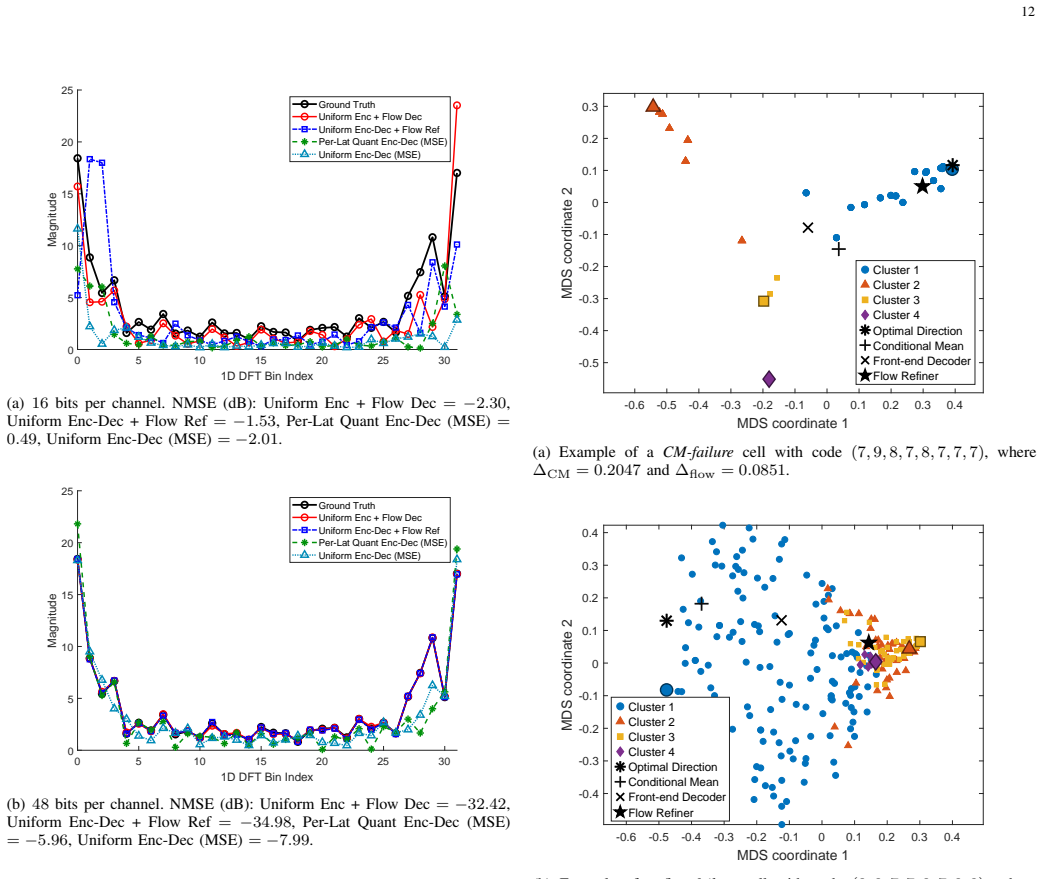
Conventional MMSE-based CSI reconstructions produce centroid-like compromises that fail to preserve the posterior geometry required for inter-user interference suppression. In contrast, the proposed flow-matching generative CSI decoders progressively transform a prior or initial estimate into a reconstruction that stays consistent with the feedback-conditioned channel distribution, thereby maintaining the user orthogonality needed for effective MU-MIMO precoding.
What carries the argument
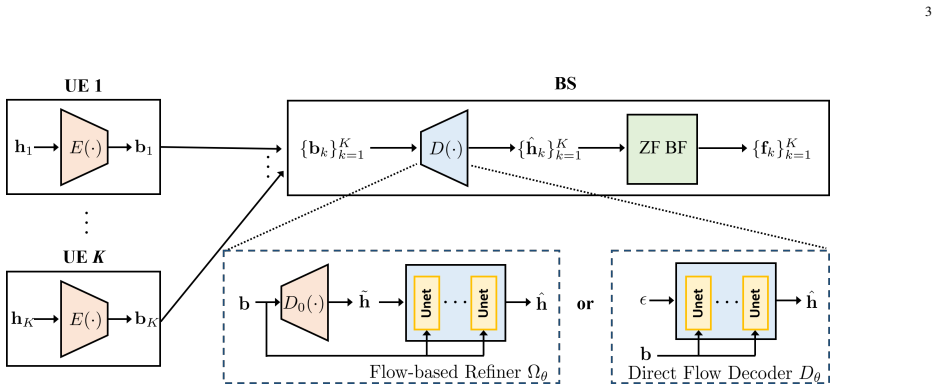
Flow-matching generative CSI decoders that progressively transform either a simple prior or an initial CSI estimate into a reconstruction consistent with the feedback-conditioned channel distribution.
If this is right
- MU-MIMO precoding based on MSE-oriented CSI reconstructions is often suboptimal because such reconstructions fail to maintain user orthogonality.
- Posterior-guided flow reconstruction aligns better with MU-MIMO precoding needs than traditional MMSE-oriented CSI feedback.
- The performance advantage of flow-based methods is especially pronounced in interference-limited and spatially dense regimes.
- Flow-based CSI decoders consistently deliver higher downlink sum rates than MSE-based baselines across the tested FR3 conditions.
Where Pith is reading between the lines
- Similar geometry-preserving reconstruction could apply to other feedback-limited multi-user settings where distribution shape affects separation, such as cell-free MIMO or integrated sensing.
- One could check whether these decoders allow reduced feedback overhead while keeping the same sum-rate target by retraining on varying feedback bit allocations.
- The same progressive transformation idea might combine with other conditional generative families to handle time-varying channels without retraining from scratch.
Load-bearing premise
The flow-matching models accurately capture the true posterior distribution of the CSI from limited feedback without adding artifacts that hurt precoding.
What would settle it
A direct comparison in which downlink sum-rate or user orthogonality metrics of the flow reconstructions fall below those of MMSE reconstructions in interference-limited FR3 scenarios with dense users.
Figures


read the original abstract
Under limited feedback, channel state information (CSI) reconstruction for multiuser multiple-input multiple-output (MU-MIMO) precoding is challenging, since the precoder should provide not only beamforming gain, but also robust suppression of inter-user interference. This paper revisits this classic problem by developing powerful decompression techniques at the base station (BS) that harness modern deep generative models. We propose two novel BS-side flow-matching generative CSI decoders that progressively transform either a simple prior or an initial CSI estimate into a reconstruction consistent with the feedback-conditioned channel distribution. We further show theoretically that conventional minimum mean-squared-error (MMSE)-based reconstructions of CSI often result in centroid-like compromises that fail to preserve the posterior geometry needed for inter-user interference suppression. In other words, MU-MIMO precoding based on MSE-oriented CSI reconstructions can be suboptimal, since such reconstructions frequently fail to maintain user orthogonality. Numerical results in FR3 spectrum show that the proposed flow-based methods consistently outperform MSE-based baselines in downlink sum-rate, with the advantage especially pronounced in interference-limited and spatially dense regimes. These results suggest that posterior-guided flow reconstruction is better aligned with MU-MIMO precoding than traditional MMSE-oriented CSI feedback, since it better preserves the channel geometry needed for user separation.
Editorial analysis
A structured set of objections, weighed in public.
Referee Report
Summary. The paper proposes two flow-matching generative models for CSI reconstruction at the base station from limited feedback in MU-MIMO systems. It argues theoretically that conventional MMSE-based CSI reconstructions produce centroid-like compromises that fail to preserve the posterior channel geometry required for effective inter-user interference suppression during precoding. Numerical experiments in the FR3 spectrum demonstrate that the proposed flow-based decoders achieve higher downlink sum rates than MSE baselines, with larger gains in interference-limited and spatially dense regimes.
Significance. If validated, the work provides a concrete alternative to MSE-centric CSI feedback by aligning reconstruction with the geometry needed for MU-MIMO precoding. The theoretical observation that MMSE solutions can compromise user orthogonality is a useful conceptual contribution, and the empirical gains in FR3 scenarios suggest practical relevance for dense 5G/6G deployments. The use of modern generative models (flow matching) conditioned on feedback is a timely application of recent ML advances to physical-layer problems.
minor comments (3)
- The abstract and introduction would benefit from a brief statement of the precise conditioning mechanism (e.g., how the limited feedback bits are mapped into the flow-matching input) to clarify the interface between the feedback protocol and the generative decoder.
- Section describing the baselines should explicitly list the MSE reconstruction methods used (e.g., whether they include both linear MMSE and any learned MSE-trained networks) so that the performance delta can be attributed unambiguously to geometry preservation rather than model capacity.
- The numerical results section would be strengthened by reporting not only sum-rate but also a direct metric of user orthogonality (e.g., average inner product of reconstructed channels) to link the theoretical claim more tightly to the observed gains.
Simulated Author's Rebuttal
We thank the referee for the positive summary, significance assessment, and recommendation of minor revision. The report accurately reflects the paper's focus on flow-matching generative models for CSI reconstruction in MU-MIMO and the theoretical distinction from MMSE approaches. Since no specific major comments are listed, we interpret the minor revision as addressing presentation, clarity, or minor technical details not detailed here.
Circularity Check
No significant circularity; derivation chain is self-contained
full rationale
The paper advances an independent theoretical argument that MMSE CSI reconstructions produce centroid-like compromises failing to preserve posterior geometry for MU-MIMO interference suppression, then introduces flow-matching generative decoders trained to match the feedback-conditioned channel distribution. Downlink sum-rate gains are measured via external simulation benchmarks against MSE baselines in FR3 scenarios. No load-bearing step reduces by construction to its inputs via self-definition, fitted parameter renamed as prediction, or self-citation chain; the theoretical claim and empirical comparisons stand on separate footing without tautology.
Axiom & Free-Parameter Ledger
free parameters (1)
- flow-matching model parameters
axioms (1)
- domain assumption The feedback provides sufficient information to condition a generative model on the posterior channel distribution.
Lean theorems connected to this paper
-
IndisputableMonolith/Cost/FunctionalEquation.leanwashburn_uniqueness_aczel unclear?
unclearRelation between the paper passage and the cited Recognition theorem.
We propose two novel BS-side flow-matching generative CSI decoders that progressively transform either a simple prior or an initial CSI estimate into a reconstruction consistent with the feedback-conditioned channel distribution... posterior geometry needed for inter-user interference suppression
-
IndisputableMonolith/Foundation/AlexanderDuality.leanalexander_duality_circle_linking unclear?
unclearRelation between the paper passage and the cited Recognition theorem.
Theorem 1 (Posterior-optimal direction for self-alignment)... arg max û^H R(b) û = λ_max
What do these tags mean?
- matches
- The paper's claim is directly supported by a theorem in the formal canon.
- supports
- The theorem supports part of the paper's argument, but the paper may add assumptions or extra steps.
- extends
- The paper goes beyond the formal theorem; the theorem is a base layer rather than the whole result.
- uses
- The paper appears to rely on the theorem as machinery.
- contradicts
- The paper's claim conflicts with a theorem or certificate in the canon.
- unclear
- Pith found a possible connection, but the passage is too broad, indirect, or ambiguous to say the theorem truly supports the claim.
Reference graph
Works this paper leans on
-
[1]
Capacity limits of MIMO channels,
A. Goldsmith, S. Jafar, N. Jindal, and S. Vishwanath, “Capacity limits of MIMO channels,”IEEE J. Sel. Areas Commun., vol. 21, pp. 684–702, Jun. 2003
work page 2003
-
[2]
J. G. Andrews, T. E. Humphreys, and T. Ji, “6G takes shape,”IEEE BITS Inf. Theory Mag., vol. 4, pp. 2–24, Mar. 2025
work page 2025
-
[3]
MIMO broadcast channels with finite-rate feedback,
N. Jindal, “MIMO broadcast channels with finite-rate feedback,”IEEE Trans. Inf. Theory, vol. 52, pp. 5045–5060, Nov. 2006
work page 2006
-
[4]
Overview of deep learning- based CSI feedback in massive MIMO systems,
J. Guo, C.-K. Wen, S. Jin, and G. Y . Li, “Overview of deep learning- based CSI feedback in massive MIMO systems,”IEEE Trans. Commun., vol. 70, pp. 8017–8045, Dec. 2022
work page 2022
-
[5]
A tale of two mobile generations: 5G-Advanced and 6G in 3GPP Release 20,
X. Lin, “A tale of two mobile generations: 5G-Advanced and 6G in 3GPP Release 20,”IEEE Commun. Standards Mag., 2026.to appear
work page 2026
-
[6]
An overview of limited feedback in wireless communi- cation systems,
D. J. Love, R. W. Heath, V . K. N. Lau, D. Gesbert, B. D. Rao, and M. Andrews, “An overview of limited feedback in wireless communi- cation systems,”IEEE J. Sel. Areas Commun., vol. 26, pp. 1341–1365, Oct. 2008
work page 2008
-
[7]
R. W. Heath and A. Lozano,Foundations of MIMO communication. Cambridge, U.K.: Cambridge Univ. Press, 2018
work page 2018
-
[8]
Grassmannian beamforming for multiple-input multiple-output wireless systems,
D. Love, R. Heath, and T. Strohmer, “Grassmannian beamforming for multiple-input multiple-output wireless systems,”IEEE Trans. Inf. Theory, vol. 49, pp. 2735–2747, Oct. 2003
work page 2003
-
[9]
Limited feedback-based block diagonal- ization for the MIMO broadcast channel,
N. Ravindran and N. Jindal, “Limited feedback-based block diagonal- ization for the MIMO broadcast channel,”IEEE J. Sel. Areas Commun., vol. 26, pp. 1473–1482, Oct. 2008
work page 2008
-
[10]
Deep learning for massive MIMO CSI feedback,
C.-K. Wen, W.-T. Shih, and S. Jin, “Deep learning for massive MIMO CSI feedback,”IEEE Wireless Commun. Lett., vol. 7, pp. 748–751, Oct. 2018
work page 2018
-
[11]
Bit-level optimized neural network for multi-antenna channel quantization,
C. Lu, W. Xu, S. Jin, and K. Wang, “Bit-level optimized neural network for multi-antenna channel quantization,”IEEE Wireless Commun. Lett., vol. 9, pp. 87–90, Jan. 2020
work page 2020
-
[12]
J. Guo, C.-K. Wen, S. Jin, and G. Y . Li, “Convolutional neural network- based multiple-rate compressive sensing for massive MIMO CSI feed- back: Design, simulation, and analysis,”IEEE Trans. Wireless Commun., vol. 19, pp. 2827–2840, Apr. 2020
work page 2020
-
[13]
Quantization design for deep learning- based CSI feedback,
M. Yin, S. Han, and C. Yang, “Quantization design for deep learning- based CSI feedback,”IEEE Wireless Commun. Lett., vol. 14, pp. 2411– 2415, Aug. 2025
work page 2025
-
[14]
User- driven adaptive CSI feedback with ordered vector quantization,
V . Rizzello, M. Nerini, M. Joham, B. Clerckx, and W. Utschick, “User- driven adaptive CSI feedback with ordered vector quantization,”IEEE Wireless Commun. Lett., vol. 12, pp. 1956–1960, Nov. 2023
work page 1956
-
[15]
Deep learning for distributed channel feedback and multiuser precoding in FDD massive MIMO,
F. Sohrabi, K. M. Attiah, and W. Yu, “Deep learning for distributed channel feedback and multiuser precoding in FDD massive MIMO,” IEEE Trans. Wireless Commun., vol. 20, pp. 4044–4057, Jul. 2021
work page 2021
-
[16]
Deep learning for multi-user MIMO systems: Joint design of pilot, limited feedback, and precoding,
J. Jang, H. Lee, I.-M. Kim, and I. Lee, “Deep learning for multi-user MIMO systems: Joint design of pilot, limited feedback, and precoding,” IEEE Trans. Commun., vol. 70, pp. 7279–7293, Nov. 2022
work page 2022
-
[17]
End-to-end deep learning for TDD MIMO systems in the 6G upper midbands,
J. Park, F. Sohrabi, A. Ghosh, and J. G. Andrews, “End-to-end deep learning for TDD MIMO systems in the 6G upper midbands,”IEEE Trans. Wireless Commun., vol. 24, pp. 2110–2125, Mar. 2025
work page 2025
-
[18]
L. Zhu, W. Zhu, S. Zhang, S. Cui, and L. Liu, “Scalable transceiver design for multi-user communication in FDD massive MIMO systems via deep learning,”IEEE Trans. Wireless Commun., vol. 25, pp. 7682– 7697, 2026
work page 2026
-
[19]
Learned precoding-oriented CSI feedback in multi-cell multi-user MIMO systems,
F. Carpi, S. Venkatesan, J. Du, H. Viswanathan, S. Garg, and E. Erkip, “Learned precoding-oriented CSI feedback in multi-cell multi-user MIMO systems,”IEEE Trans. Wireless Commun., vol. 25, pp. 2359– 2372, 2026
work page 2026
-
[20]
Precoding-oriented CSI feedback design with mutual information regularized VQ-V AE,
X. Chen, H. Esfahanizadeh, and F. Sohrabi, “Precoding-oriented CSI feedback design with mutual information regularized VQ-V AE,” 2026. [Online]. Available: https://arxiv.org/abs/2602.02508
-
[21]
Generative diffusion models for wireless networks: Fundamental, architecture, and state-of-the-art,
D. Fan, R. Meng, X. Xu, Y . Liu, G. Nan, C. Feng, S. Han, S. Gao, B. Xu, D. Niyato, T. Q. S. Quek, and P. Zhang, “Generative diffusion models for wireless networks: Fundamental, architecture, and state-of-the-art,” IEEE Commun. Surv. Tutor., vol. 28, pp. 5632–5677, 2026
work page 2026
-
[22]
Diffusion- based generative prior for low-complexity MIMO channel estimation,
B. Fesl, M. Baur, F. Strasser, M. Joham, and W. Utschick, “Diffusion- based generative prior for low-complexity MIMO channel estimation,” IEEE Wireless Commun. Lett., vol. 13, pp. 3493–3497, Dec. 2024
work page 2024
-
[23]
Generative diffusion model- based variational inference for MIMO channel estimation,
Z. Chen, H. Shin, and A. Nallanathan, “Generative diffusion model- based variational inference for MIMO channel estimation,”IEEE Trans. Commun., vol. 73, pp. 9254–9269, Oct. 2025
work page 2025
-
[24]
Generative diffusion model- based compression of MIMO CSI,
H. Kim, T. Lee, H. Kim, G. De Veciana, M. A. Arfaoui, A. Koc, P. Pietraski, G. Zhang, and J. Kaewell, “Generative diffusion model- based compression of MIMO CSI,” inProc. IEEE Int. Conf. Commun. (ICC), pp. 6323–6328, 2025
work page 2025
-
[25]
Residual diffusion models for variable-rate joint source–channel coding of MIMO CSI,
S. K. Ankireddy, H. Kim, J. Cho, and H. Kim, “Residual diffusion models for variable-rate joint source–channel coding of MIMO CSI,” IEEE J. Sel. Areas Commun., vol. 44, pp. 3620–3633, 2026
work page 2026
-
[26]
Deep learning for CSI feedback: One-sided model and joint multi-module learning perspectives,
Y . Guo, W. Chen, F. Sun, J. Cheng, M. Matthaiou, and B. Ai, “Deep learning for CSI feedback: One-sided model and joint multi-module learning perspectives,”IEEE Commun. Mag., vol. 63, pp. 90–97, Jul. 2025
work page 2025
-
[27]
Denoising diffusion probabilistic models,
J. Ho, A. Jain, and P. Abbeel, “Denoising diffusion probabilistic models,” inProc. Adv. Neural Inf. Process. Syst. (NeurIPS), vol. 33, pp. 6840– 6851, 2020
work page 2020
-
[28]
Flow matching for generative modeling,
Y . Lipman, R. T. Q. Chen, H. Ben-Hamu, M. Nickel, and M. Le, “Flow matching for generative modeling,” inProc. Int. Conf. Learn. Represent., (ICLR), May 2023
work page 2023
-
[29]
Deep multi-scale video pre- diction beyond mean square error,
M. Mathieu, C. Couprie, and Y . LeCun, “Deep multi-scale video pre- diction beyond mean square error,” inProc. Int. Conf. Learn. Represent. (ICLR), pp. 1–14, May 2016
work page 2016
-
[30]
Context encoders: Feature learning by inpainting,
D. Pathak, P. Krahenbuhl, J. Donahue, T. Darrell, and A. A. Efros, “Context encoders: Feature learning by inpainting,” inProc. IEEE Conf. Comput. Vis. Pattern Recognit. (CVPR), pp. 2536–2544, Jun. 2016
work page 2016
-
[31]
The perception-distortion tradeoff,
Y . Blau and T. Michaeli, “The perception-distortion tradeoff,” inProc. IEEE/CVF Conf. Comput. Vis. Pattern Recognit. (CVPR), pp. 6228– 6237, Jun. 2018
work page 2018
-
[32]
FlowDec: A flow-based full-band general audio codec with high perceptual quality,
S. Welker, M. Le, R. T. Q. Chen, W.-N. Hsu, T. Gerkmann, A. Richard, and Y .-C. Wu, “FlowDec: A flow-based full-band general audio codec with high perceptual quality,” inInt. Conf. Learn. Represent. (ICLR), Apr. 2025
work page 2025
-
[33]
Score-based generative modeling through stochastic differ- ential equations,
Y . Song, J. Sohl-Dickstein, D. P. Kingma, A. Kumar, S. Ermon, and B. Poole, “Score-based generative modeling through stochastic differ- ential equations,” inProc. Int. Conf. Learn. Represent. (ICLR), 2021
work page 2021
-
[34]
S. M. Kay,Fundamentals of Statistical Signal Processing: Estimation Theory. Upper Saddle River, NJ, USA: Prentice-Hall, 1993
work page 1993
-
[35]
QuaDRiGa — Quasi deterministic radio channel generator, user manual and documen- tation,
S. Jaeckel, L. Raschkowski, K. B ¨orner, and L. Thiele, “QuaDRiGa — Quasi deterministic radio channel generator, user manual and documen- tation,” Tech. Rep. v2.8.1, Fraunhofer Heinrich Hertz Institute, 2023
work page 2023
-
[36]
Study on channel model for frequencies from 0.5 to 100 GHz
ETSI, “Study on channel model for frequencies from 0.5 to 100 GHz.” ETSI TR 138 901, V16.1.0, Nov. 2020
work page 2020
-
[37]
Estimating or Propagating Gradients Through Stochastic Neurons for Conditional Computation
Y . Bengio, N. L ´eonard, and A. C. Courville, “Estimating or propagating gradients through stochastic neurons for conditional computation,” 2013. [Online]. Available: http://arxiv.org/abs/1308.3432
work page internal anchor Pith review Pith/arXiv arXiv 2013
discussion (0)
Sign in with ORCID, Apple, or X to comment. Anyone can read and Pith papers without signing in.