Recognition: 2 theorem links
· Lean TheoremEmergent Quantum-Geometric Equivalence of Injection and Shift Currents
Pith reviewed 2026-05-13 07:44 UTC · model grok-4.3
The pith
In materials with linear band dispersion, injection and shift currents are governed by the same quantum-geometric dipole.
A machine-rendered reading of the paper's core claim, the machinery that carries it, and where it could break.
Core claim
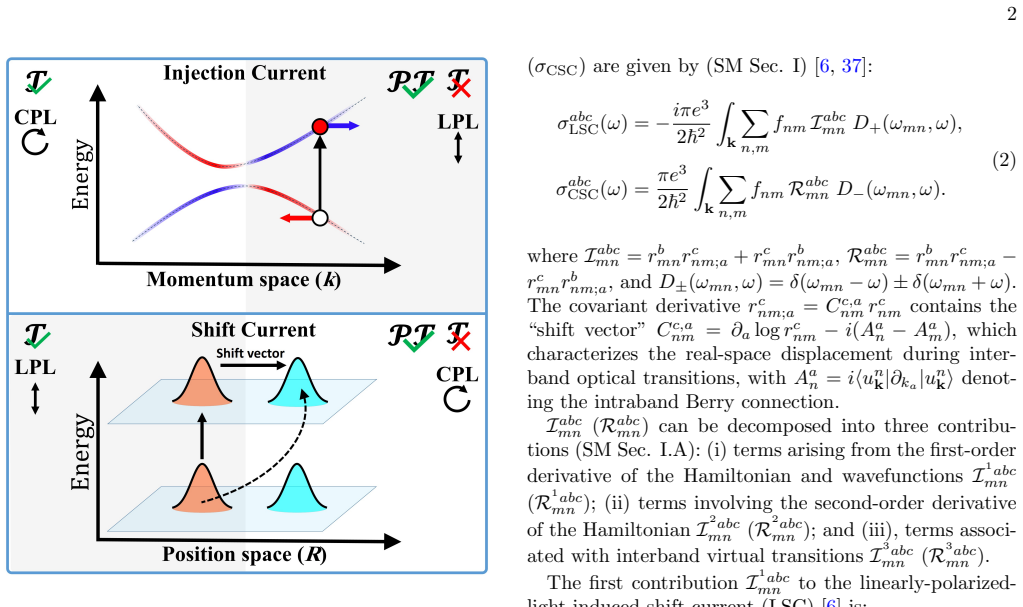
Injection and shift currents are generally regarded as distinct nonlinear optical responses with separate microscopic origins. Here, we uncover a general hidden connection between them through interband Berry-curvature and quantum-metric dipoles. In systems with approximately linear electronic dispersion near the Fermi level and at low photon energies, this relation sharpens into an emergent equivalence, with injection and shift currents governed by the same interband quantum-geometric dipole. This regime is naturally realized in Dirac and Weyl semimetals, as well as in strained graphene, where measurements of injection and shift currents probe a unified geometric property of the electronic波
What carries the argument
The interband quantum-geometric dipole formed from Berry curvature and quantum metric, which controls both currents in the linear-dispersion limit.
Where Pith is reading between the lines
- The same geometric unification might apply to other nonlinear optical responses when bands are linear.
- Optical data on strained graphene could be reanalyzed to extract quantum-metric values directly.
- The equivalence supplies a route to test quantum geometry predictions without needing separate experiments for each current type.
- At higher photon energies the distinction between the two currents should reappear in a quantifiable way.
Load-bearing premise
Electronic dispersion is approximately linear near the Fermi level and photon energies remain low enough for the approximation to hold sharply.
What would settle it
Measuring injection and shift currents in a Weyl semimetal at low photon energy and finding that their magnitudes or scalings with photon energy deviate from the shared dipole prediction.
Figures


read the original abstract
Injection and shift currents are generally regarded as distinct nonlinear optical responses with separate microscopic origins. Here, we uncover a general hidden connection between them through interband Berry-curvature and quantum-metric dipoles. In systems with approximately linear electronic dispersion near the Fermi level and at low photon energies, this relation sharpens into an emergent equivalence, with injection and shift currents governed by the same interband quantum-geometric dipole. This regime is naturally realized in Dirac and Weyl semimetals, as well as in strained graphene, where measurements of injection and shift currents probe a unified geometric property of the electronic wavefunctions rather than distinct dynamical processes. Our results establish a new framework for interpreting nonlinear optical experiments and suggest that quantum geometry may provide a broader organizing principle linking seemingly distinct nonlinear optical responses in solids.
Editorial analysis
A structured set of objections, weighed in public.
Referee Report
Summary. The paper claims a hidden connection between injection and shift currents via interband Berry-curvature and quantum-metric dipoles. In systems with approximately linear electronic dispersion near the Fermi level and at low photon energies, this relation sharpens into an emergent equivalence in which both currents are governed by the same interband quantum-geometric dipole. The regime is realized in Dirac/Weyl semimetals and strained graphene, implying that measurements probe a unified geometric property rather than distinct dynamical processes.
Significance. If the central derivation holds, the result supplies a unifying quantum-geometric framework for two previously distinct nonlinear optical responses, with direct implications for interpreting experiments in topological semimetals. The linkage to standard Berry curvature and quantum metric quantities is a strength; the manuscript does not, however, supply machine-checked proofs or fully reproducible code.
major comments (2)
- [Abstract and §3] Abstract and §3 (linear-dispersion limit): the sharpening to an 'emergent equivalence' is asserted, yet no explicit bound or cancellation identity is derived for corrections arising from quadratic or higher dispersion terms, finite-energy deviations, or interband mixing beyond the dipole approximation; this step is load-bearing for the central claim.
- [§4] §4 (application to Dirac/Weyl semimetals): the equivalence is illustrated under the linear approximation, but the manuscript provides no quantitative estimate of the photon-energy window or doping range in which higher-order k·p corrections remain parametrically small relative to the leading geometric dipole term.
minor comments (2)
- [§2] Notation for the interband quantum-geometric dipole is introduced without a compact defining equation in the main text; a single displayed equation would improve readability.
- [Figure 2] Figure 2 caption does not explicitly state the photon-energy and Fermi-level values used for the numerical comparison of injection and shift currents.
Simulated Author's Rebuttal
We thank the referee for the careful reading of our manuscript and for the constructive comments. The positive assessment of the unifying quantum-geometric framework is appreciated. We address the two major comments below and have revised the manuscript to strengthen the presentation of the linear-dispersion limit and its applicability.
read point-by-point responses
-
Referee: [Abstract and §3] Abstract and §3 (linear-dispersion limit): the sharpening to an 'emergent equivalence' is asserted, yet no explicit bound or cancellation identity is derived for corrections arising from quadratic or higher dispersion terms, finite-energy deviations, or interband mixing beyond the dipole approximation; this step is load-bearing for the central claim.
Authors: We agree that an explicit parametric bound strengthens the central claim. In the revised §3 we now include a systematic expansion of the dispersion to quadratic order and derive the leading correction to the current equivalence. The relative correction scales as (ħω/E_c) where E_c is set by the next-nearest-neighbor hopping or doping energy; interband mixing beyond the dipole approximation enters at the same order. A short cancellation identity for the linear term is also provided, showing that the geometric-dipole contributions to injection and shift currents become identical once quadratic terms are dropped. These additions are summarized in a new paragraph and an accompanying appendix. revision: yes
-
Referee: [§4] §4 (application to Dirac/Weyl semimetals): the equivalence is illustrated under the linear approximation, but the manuscript provides no quantitative estimate of the photon-energy window or doping range in which higher-order k·p corrections remain parametrically small relative to the leading geometric dipole term.
Authors: We acknowledge the value of concrete estimates. The revised §4 now contains order-of-magnitude windows for representative materials (Cd3As2, Na3Bi, and strained graphene). Using published k·p parameters and ARPES data, we estimate that higher-order corrections remain below ~10% for photon energies ħω ≲ 80–120 meV and Fermi energies |E_F| ≲ 50–80 meV, depending on the material. These ranges are illustrated in a new figure panel and justified by explicit scaling arguments. We have also added references to recent nonlinear-optical experiments that fall inside the indicated window. revision: yes
Circularity Check
No significant circularity; derivation from standard quantum-geometric quantities
full rationale
The paper derives a general relation between injection and shift currents via interband Berry-curvature and quantum-metric dipoles, then shows this relation sharpens to equivalence under the stated linear-dispersion and low-energy limit. No step reduces by construction to a fitted parameter, self-defined quantity, or self-citation chain; the central claim rests on explicit manipulation of standard Berry-phase and quantum-metric expressions rather than renaming or tautological re-expression of inputs. The approximation character of the equivalence is an uncontrolled limit rather than a circular reduction, placing any concerns under correctness rather than circularity.
Axiom & Free-Parameter Ledger
axioms (2)
- domain assumption Electronic dispersion is approximately linear near the Fermi level
- domain assumption Photon energies are low
Lean theorems connected to this paper
-
IndisputableMonolith/Foundation/AlexanderDuality.leanalexander_duality_circle_linking unclearIn systems with approximately linear electronic dispersion near the Fermi level and at low photon energies, this relation sharpens into an emergent equivalence, with injection and shift currents governed by the same interband quantum-geometric dipole.
-
IndisputableMonolith/Cost/FunctionalEquation.leanwashburn_uniqueness_aczel unclearσabc_LSC ≈ −1/(2τ ω)(σcba_CIC + σbca_CIC)
Reference graph
Works this paper leans on
-
[1]
J. W. Gibbs,Elementary Principles in Statistical Me- chanics: Developed with Especial Reference to the Ratio- nal Foundations of Thermodynamics(Charles Scribner’s Sons, New York, 1902)
work page 1902
-
[2]
Einstein,Annalen der Physik,17(10), 891 (1905)
A. Einstein,Annalen der Physik,17(10), 891 (1905)
work page 1905
-
[3]
C. M. Will,Theory and Experiment in Gravitational Physics(Cambridge Univ. Press, 2018)
work page 2018
-
[4]
M. Born, E. Wolf,Principles of Optics: Electromagnetic Theory of Propagation, Interference and Diffraction of Light(Elsevier, 2013)
work page 2013
-
[5]
R. W. Boyd,Nonlinear Optics, 4th ed. (Academic Press, 2020)
work page 2020
-
[6]
J. E. Sipe, A. I. Shkrebtii, Second-order optical response in semiconductors.Phys. Rev. B61, 5337 (2000)
work page 2000
-
[7]
T. Kampfrath, K. Tanaka K. A. Nelson, Resonant and nonresonant control over matter and light by intense ter- ahertz transients.Nat. Photonics.7, 680 (2013)
work page 2013
-
[8]
Koppens,et al., Photodetectors based on graphene, other two-dimensional materials and hybrid systems
F. Koppens,et al., Photodetectors based on graphene, other two-dimensional materials and hybrid systems. Nat. Nanotech.9, 780 (2014)
work page 2014
-
[9]
N. Nagaosa, T. Morimoto, Concept of quantum geometry in optoelectronic processes in solids: application to solar cells.Advanced Materials29, 1603345 (2017)
work page 2017
-
[10]
S. Salahuddin, K. Ni, S. Datta, The era of hyper-scaling in electronics.Nat. Electron.1, 442 (2018)
work page 2018
-
[11]
Liu,et al., Semimetals for high-performance photode- tection.Nat
J. Liu,et al., Semimetals for high-performance photode- tection.Nat. Mater.19, 830 (2020)
work page 2020
-
[12]
C. J. Yang,et al., Terahertz control of many-body dy- namics in quantum materials.Nat. Rev. Mater.8, 518 (2023)
work page 2023
-
[13]
J. E. Moore, J. Orenstein, Confinement-induced Berry phase and helicity-dependent photocurrents.Phys. Rev. Lett.105, 026805 (2010)
work page 2010
-
[14]
McIver,et al., Control over topological insulator pho- tocurrents with light polarization.Nat
J. McIver,et al., Control over topological insulator pho- tocurrents with light polarization.Nat. Nanotech.7, 96 (2012)
work page 2012
-
[15]
Orenstein,et al., Topology and symmetry of quantum materials via nonlinear optical responses.Annu
J. Orenstein,et al., Topology and symmetry of quantum materials via nonlinear optical responses.Annu. Rev. Condens. Matter. Phys.12, 247 (2021)
work page 2021
-
[16]
Q. Ma, A. G. Grushin, K. S. Burch, Topology and geom- etry under the nonlinear electromagnetic spotlight.Nat. Mater.20, 1601 (2021)
work page 2021
-
[17]
Bao,et al., Light-induced emergent phenomena in 2D materials and topological materials.Nat
C. Bao,et al., Light-induced emergent phenomena in 2D materials and topological materials.Nat. Rev. Phys.4, 33 (2022)
work page 2022
-
[18]
Ma,et al., Photocurrent as a multiphysics diagnostic of quantum materials.Nat
Q. Ma,et al., Photocurrent as a multiphysics diagnostic of quantum materials.Nat. Rev. Phys.5, 170 (2023)
work page 2023
-
[19]
I. Sodemann, L. Fu, Quantum nonlinear Hall effect in- 6 duced by Berry curvature dipole in time-reversal invari- ant materials.Phys. Rev. Lett.115, 216806 (2015)
work page 2015
-
[20]
K. L. Seyler,et al., Electrical control of second-harmonic generation in a WSe 2 monolayer transistor.Nat. Nan- otechnol.10, 407 (2015)
work page 2015
-
[21]
T. Morimoto, N. Nagaosa, Topological aspects of nonlin- ear excitonic processes in noncentrosymmetric crystals. Sci. Adv.2, e1501524 (2016)
work page 2016
-
[22]
T. Morimoto, S. Zhong, J. Orenstein, J. E. Moore, Semi- classical theory of nonlinear magneto-optical responses with applications to topological Dirac/Weyl semimetals. Phys. Rev. B94, 245121 (2016)
work page 2016
-
[23]
B. M. Fregoso, T. Morimoto, J. E. Moore, Quantita- tive relationship between polarization differences and the zone-averaged shift photocurrent.Phys. Rev. B96, 075421 (2017)
work page 2017
-
[24]
C.-K. Chan, N. H. Lindner, G. Refael, P. A. Lee, Pho- tocurrents in Weyl semimetals.Phys. Rev. B95, 041104 (2017)
work page 2017
-
[25]
L. Wu,et al., Giant anisotropic nonlinear optical re- sponse in transition metal monopnictide Weyl semimet- als.Nature Phys13, 350 (2017)
work page 2017
-
[26]
Ma,et al., Direct optical detection of Weyl fermion chirality in a topological semimetal.Nat
Q. Ma,et al., Direct optical detection of Weyl fermion chirality in a topological semimetal.Nat. Phys.13, 842 (2017)
work page 2017
-
[27]
F. de Juan, A. G. Grushin, T. Morimoto, J. E. Moore, Quantized circular photogalvanic effect in Weyl semimet- als.Nat. Commun.8, 1 (2017)
work page 2017
-
[28]
Chang,et al., Unconventional chiral fermions and large topological Fermi arcs in RhSi.Phys
G. Chang,et al., Unconventional chiral fermions and large topological Fermi arcs in RhSi.Phys. Rev. Lett. 119, 206401 (2017)
work page 2017
-
[29]
SY. Xu,et al., Electrically switchable Berry curvature dipole in the monolayer topological insulator WTe2.Nat. Phys.14, 900 (2018)
work page 2018
-
[30]
Chang,et al., Topological quantum properties of chi- ral crystals.Nat
G. Chang,et al., Topological quantum properties of chi- ral crystals.Nat. Mater.17, 978-985 (2018)
work page 2018
-
[31]
Flicker,et al., Chiral optical response of multifold fermions.Phys
F. Flicker,et al., Chiral optical response of multifold fermions.Phys. Rev. B98, 155145 (2018)
work page 2018
-
[32]
J. Iba˜ nez-Azpiroz, S. S. Tsirkin, I. Souza,Ab initiocalcu- lation of the shift photocurrent by Wannier interpolation. Phys. Rev. B97, 245143 (2018)
work page 2018
-
[33]
Z. Sun,et al., Giant nonreciprocal second-harmonic gen- eration from antiferromagnetic bilayer CrI3.Nature572, 497-501 (2019)
work page 2019
-
[34]
F. de. Juan, Y. Zhang, T. Morimoto, Y. Sun, J. E. Moore, A. G. Grushin, Difference frequency generation in topological semimetals,Phys. Rev. Research2, 012017 (2020)
work page 2020
-
[35]
H. Isobe, S.-Y. Xu, L. Fu, High-frequency rectification via chiral Bloch electrons.Sci. Adv.6, eaay2497 (2020)
work page 2020
- [36]
- [37]
-
[38]
Y. Zhang L. Fu, Terahertz detection based on nonlinear Hall effect without magnetic field.Proc. Natl. Acad. Sci. U.S.A.118, e2100736118 (2021)
work page 2021
-
[39]
Y. Gao D. Xiao, Nonreciprocal directional dichroism in- duced by the quantum metric dipole.Phys. Rev. Lett. 122, 227402 (2019)
work page 2019
-
[40]
A. Gao,et al., Quantum metric nonlinear Hall effect in a topological antiferromagnetic heterostructure.Science 381, 181 (2023)
work page 2023
-
[41]
N. Wang,et al., Quantum-metric-induced nonlinear transport in a topological antiferromagnet.Nature621, 487 (2023)
work page 2023
- [42]
-
[43]
M. Yahyavi,et al., Wave-function-free approach for pre- dicting nonlinear responses in Weyl semimetals.Phys. Rev. Lett.136, 046601 (2026)
work page 2026
-
[44]
K. Tsuzuki, Y. Ishikawa, N. Watanabe, S. Akimoto, Neu- tron diffraction and paramagnetic scattering from a high pressure phase of MnGeO3 (Ilmenite).J. Phys. Soc. Jpn. 37, 1242 (1974)
work page 1974
-
[45]
Xu,et al., High-throughput calculations of magnetic topological materials.Nature586, 702 (2020)
Y. Xu,et al., High-throughput calculations of magnetic topological materials.Nature586, 702 (2020)
work page 2020
-
[46]
G. D. Mahan, Many-Particle Physics, 3rd edn (Springer, New York, 2000)
work page 2000
discussion (0)
Sign in with ORCID, Apple, or X to comment. Anyone can read and Pith papers without signing in.