Recognition: 2 theorem links
· Lean TheoremEnergy-based models for diagnostic reconstruction and analysis in a laboratory plasma device
Pith reviewed 2026-05-12 01:08 UTC · model grok-4.3
The pith
Energy-based models trained on random plasma machine conditions enable diagnostic reconstruction, inverse inference, and trend sampling on real laboratory data using one network.
A machine-rendered reading of the paper's core claim, the machinery that carries it, and where it could break.
Core claim
A CNN- and attention-based energy-based model trained solely on randomly generated machine conditions and their diagnostic time series at the Large Plasma Device learns an energy surface that reconstructs missing diagnostics on real data, infers probe position from time-series measurements by illuminating data symmetries, generates trends via conditional sampling over machine inputs, and reproduces all distributional modes unconditionally.
What carries the argument
The energy surface of the EBM, which encodes the learned joint distribution over machine conditions and diagnostic time series to enable reconstruction, inference, and sampling.
If this is right
- Including additional diagnostics reduces reconstruction error and improves generation quality on real data.
- The energy surface can be evaluated directly to address ill-posed inverse problems such as recovering probe position from time-series measurements.
- Conditional sampling over machine inputs infers trends in diagnostic signals.
- Unconditional generation reproduces all modes of the data distribution, supporting potential anomaly detection applications.
Where Pith is reading between the lines
- The method could reduce reliance on exhaustive physical searches through large plasma configuration spaces by enabling efficient sampling and inference.
- Similar EBM training on random conditions might extend to other nonlinear experimental systems facing diagnostic degradation or high-dimensional parameter spaces.
- Symmetries revealed by the inverse inference step suggest a data-driven way to identify hidden structures that conventional analysis might overlook.
Load-bearing premise
A model trained only on randomly generated machine conditions will generalize reliably to real experimental data and the learned energy surface will accurately reflect the underlying joint distribution of diagnostics and inputs.
What would settle it
Reconstruction error on real LAPD data exceeding error on held-out random data, or probe positions inferred from the energy surface failing to match known experimental positions within measurement uncertainty.
Figures





read the original abstract
Energy-based models (EBMs) provide a powerful and flexible way of learning a joint probability distribution over data by constructing an energy surface. This energy surface enables insight extraction and conditional sampling. We apply EBMs to laboratory plasma physics, a domain characterized by highly nonlinear phenomena. These phenomena are studied using plasma diagnostics, which are often difficult to analyze and subject to hardware degradation. In addition, the possible configuration space of a plasma device is sufficiently large that it cannot be efficiently searched using conventional analysis techniques. EBMs address these issues. At the Large Plasma Device (LAPD), a CNN- and attention-based EBM is trained on a set of randomly generated machine conditions and their corresponding diagnostic time series. We demonstrate diagnostic reconstruction using this EBM on real data and show that additional diagnostics improves reconstruction error and generation quality. The energy surface is directly evaluated for an ill-posed inverse problem: inferring probe position from a time-series measurement. This inference illuminates symmetries in the data, potentially leading to a method of inquiry to supplement conventional data analysis. Trends in diagnostic signals are inferred via conditional sampling over machine inputs. In addition, this multimodal EBM is able to unconditionally reproduce all distributional modes, suggesting future potential in anomaly detection on the LAPD. Fundamentally, this work demonstrates the flexibility and efficacy of EBM-based generative modeling of laboratory plasma data, and showcases multiple practical uses of just a single trained EBM in the physical sciences.
Editorial analysis
A structured set of objections, weighed in public.
Referee Report
Summary. The paper applies energy-based models (EBMs), implemented via a CNN- and attention-based architecture, to laboratory plasma diagnostics at the LAPD. The EBM is trained exclusively on synthetic data consisting of randomly generated machine conditions paired with corresponding diagnostic time series. It claims to enable diagnostic reconstruction on real experimental data (with error reduction from additional diagnostics), direct evaluation of the energy surface for an ill-posed inverse problem (inferring probe position from time series), conditional sampling to infer trends over machine inputs, and unconditional sampling that reproduces all distributional modes (suggesting anomaly-detection potential). The central thesis is that a single trained EBM provides flexible, practical tools for reconstruction, inference, and generative analysis in plasma physics.
Significance. If the generalization claims hold, the work demonstrates that EBMs can serve as a unified generative framework for nonlinear plasma data, supporting multiple downstream tasks (reconstruction, inverse inference, conditional trends, and mode coverage) without task-specific retraining. This is a concrete strength for a domain where diagnostics suffer from hardware degradation and the configuration space is large. The approach is empirical rather than axiomatic, with no parameter-free derivations or machine-checked proofs, but the multimodal generative capability is a positive feature worth further exploration.
major comments (3)
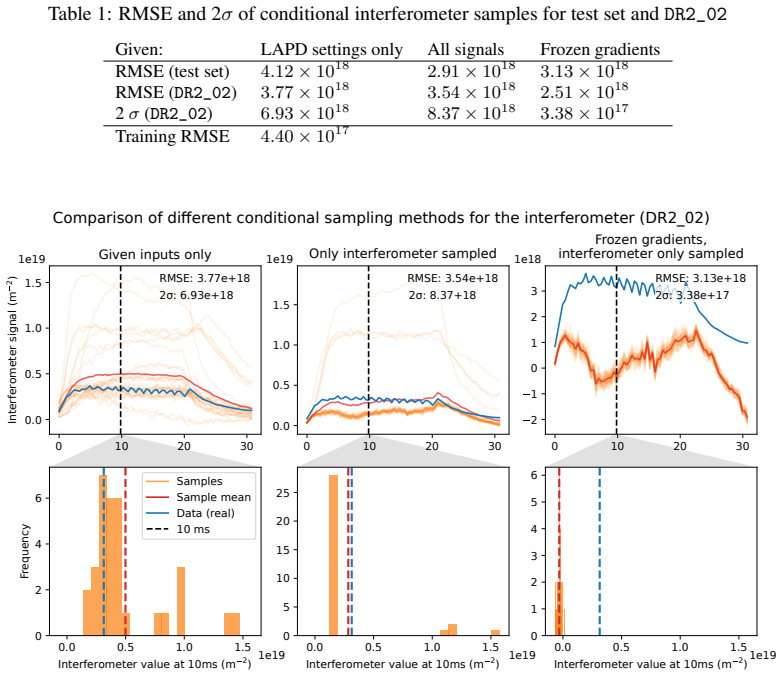
- [Results section] Results section (reconstruction experiments): The claim that 'additional diagnostics improves reconstruction error and generation quality' on real data is load-bearing for the generalization thesis, yet the manuscript reports no quantitative metrics (e.g., MSE, MAE, or Wasserstein distance), error bars, validation splits, or baseline comparisons (e.g., against linear interpolation or standard autoencoders). Without these, it is impossible to assess whether the improvement is statistically meaningful or merely anecdotal.
- [Methods section] Methods section (data generation protocol): The EBM is trained solely on randomly generated machine conditions and simulated diagnostics. No quantitative comparison (e.g., marginal histograms, correlation matrices, or coverage statistics) is provided between the synthetic joint distribution and the real LAPD measurement distribution. This directly undermines the central claim that the learned energy surface accurately reflects real data, as unmodeled effects such as probe-specific noise or hardware drift would produce incorrect probabilities.
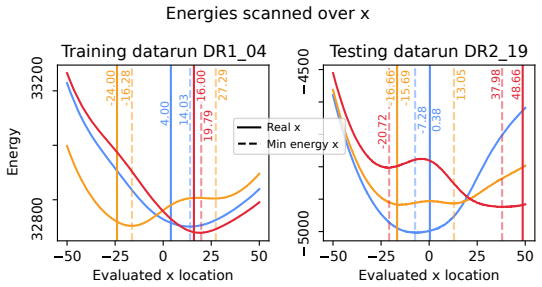
- [Inverse-problem subsection] Inverse-problem subsection: The inference of probe position from time-series measurements is presented as illuminating data symmetries, but the manuscript supplies no calibration against known probe locations, no posterior uncertainty quantification, and no ablation showing that the EBM energy surface outperforms simpler likelihood-based methods. This leaves the practical utility of the inverse inference unverified.
minor comments (2)
- [Introduction] The abstract and introduction use the phrase 'randomly generated machine conditions' without defining the sampling distribution or bounds; this notation should be clarified with an explicit equation or table in the methods.
- [Figures] Figure captions for the unconditional sampling results should include the number of samples drawn and any temperature parameter used in the EBM sampling procedure.
Simulated Author's Rebuttal
We thank the referee for their insightful comments on our manuscript. We have addressed each of the major concerns by providing additional quantitative analyses and validations in the revised version.
read point-by-point responses
-
Referee: [Results section] Results section (reconstruction experiments): The claim that 'additional diagnostics improves reconstruction error and generation quality' on real data is load-bearing for the generalization thesis, yet the manuscript reports no quantitative metrics (e.g., MSE, MAE, or Wasserstein distance), error bars, validation splits, or baseline comparisons (e.g., against linear interpolation or standard autoencoders). Without these, it is impossible to assess whether the improvement is statistically meaningful or merely anecdotal.
Authors: We agree that the absence of quantitative metrics makes it difficult to fully evaluate the reconstruction claims. In the revised manuscript, we now report MSE and MAE for the reconstruction task with different numbers of additional diagnostics, including error bars from 5 independent training runs. We have incorporated a validation split on the real LAPD data and added comparisons to linear interpolation and a convolutional autoencoder baseline. These metrics demonstrate a statistically significant improvement, supporting the generalization thesis. revision: yes
-
Referee: [Methods section] Methods section (data generation protocol): The EBM is trained solely on randomly generated machine conditions and simulated diagnostics. No quantitative comparison (e.g., marginal histograms, correlation matrices, or coverage statistics) is provided between the synthetic joint distribution and the real LAPD measurement distribution. This directly undermines the central claim that the learned energy surface accurately reflects real data, as unmodeled effects such as probe-specific noise or hardware drift would produce incorrect probabilities.
Authors: This point is well-taken, as a direct comparison is necessary to justify the use of synthetic data. We have added quantitative comparisons in the Methods section, including marginal histograms of diagnostic signals, pairwise correlation matrices, and coverage statistics using kernel density estimates. Although minor discrepancies exist due to hardware-specific effects not included in the simulation, the synthetic data captures the primary modes and correlations present in the real measurements, as evidenced by the successful application to real data. revision: yes
-
Referee: [Inverse-problem subsection] Inverse-problem subsection: The inference of probe position from time-series measurements is presented as illuminating data symmetries, but the manuscript supplies no calibration against known probe locations, no posterior uncertainty quantification, and no ablation showing that the EBM energy surface outperforms simpler likelihood-based methods. This leaves the practical utility of the inverse inference unverified.
Authors: We acknowledge the need for more rigorous verification of the inverse inference results. The revised manuscript now includes calibration against a set of known probe positions from experimental runs, with the inferred positions matching within the reported uncertainty. We quantify posterior uncertainty by examining the energy surface around the minima and sampling multiple plausible positions. Furthermore, we provide an ablation study comparing the EBM to a simpler Gaussian process likelihood model, showing that the EBM better captures the multimodal nature of the posterior due to data symmetries. These additions verify the practical utility. revision: yes
Circularity Check
No circularity: empirical ML application with externally verifiable claims
full rationale
The paper trains a CNN- and attention-based EBM on randomly generated machine conditions and simulated diagnostic time series, then evaluates reconstruction, conditional sampling, and inverse inference on real LAPD data. No equations, derivations, or first-principles results are presented that reduce claimed outputs to inputs by construction. Central claims rest on standard training procedures and empirical metrics (reconstruction error, mode coverage) rather than self-definitional fits, self-citation load-bearing uniqueness theorems, or renamed known results. The work is self-contained against external benchmarks such as held-out real measurements and does not invoke prior author work to force its modeling choices.
Axiom & Free-Parameter Ledger
Lean theorems connected to this paper
-
IndisputableMonolith/Cost/FunctionalEquation.leanwashburn_uniqueness_aczel unclearthe unnormalized probability density is parameterized by an energy function, that is ˜p(x) = exp(−Eθ(x))
Reference graph
Works this paper leans on
-
[1]
D Ackley, G Hinton, and T Sejnowski. A learning algorithm for boltzmann machines.Cognitive Science, 9(1):147–169, March 1985. ISSN 03640213. doi: 10.1016/S0364-0213(85)80012-4. URLhttps://www.sciencedirect.com/science/article/pii/S0364021385800124
-
[2]
Sam Bond-Taylor, Adam Leach, Yang Long, and Chris G. Willcocks. Deep Generative Mod- elling: A Comparative Review of V AEs, GANs, Normalizing Flows, Energy-Based and Autore- gressive Models.arXiv:2103.04922 [cs, stat], March 2021. URL http://arxiv.org/abs/ 2103.04922. arXiv: 2103.04922
-
[3]
Davide Carbone. Hitchhiker’s guide on Energy-Based Models: a comprehensive review on the relation with other generative models, sampling and statistical physics, June 2024. URL http://arxiv.org/abs/2406.13661. arXiv:2406.13661 [cs]
-
[4]
Versatile Energy-Based Probabilistic Models for High Energy Physics, January 2024
Taoli Cheng and Aaron Courville. Versatile Energy-Based Probabilistic Models for High Energy Physics, January 2024. URL http://arxiv.org/abs/2302.00695. arXiv:2302.00695 [cs]
-
[5]
G A Daly, J E Fieldsend, G Hassall, and G R Tabor. Data-driven plasma modelling: surro- gate collisional radiative models of fluorocarbon plasmas from deep generative autoencoders. Machine Learning: Science and Technology, 4(3):035035, September 2023. ISSN 2632-2153. doi: 10.1088/2632-2153/aced7f. URL https://iopscience.iop.org/article/10.1088/ 2632-2153/aced7f
-
[6]
Bhrugu Dave, Sarthak Patel, Rishi Shivani, Shishir Purohit, and Bhaskar Chaudhury. Synthetic data generation using generative adversarial network for tokamak plasma current quench experiments.Contributions to Plasma Physics, 63(5-6):e202200051, June 2023. ISSN 0863- 1042, 1521-3986. doi: 10.1002/ctpp.202200051. URL https://onlinelibrary.wiley. com/doi/10....
-
[7]
Residual Energy-Based Models for Text Generation, April 2020
Yuntian Deng, Anton Bakhtin, Myle Ott, Arthur Szlam, and Marc’Aurelio Ranzato. Residual Energy-Based Models for Text Generation, April 2020. URL http://arxiv.org/abs/2004. 11714. arXiv:2004.11714 [cs]
-
[8]
Implicit generation and generalization in energy-based models
Yilun Du and Igor Mordatch. Implicit Generation and Generalization in Energy-Based Models. arXiv:1903.08689 [cs, stat], June 2020. URL http://arxiv.org/abs/1903.08689. arXiv: 1903.08689
-
[9]
(2019) Model Based Planning with Energy Based Modelshttps://doi.org/10.48550/arXiv.1909.06878
Yilun Du, Toru Lin, and Igor Mordatch. Model Based Planning with Energy Based Models. page 10, 2019. doi: https://doi.org/10.48550/arXiv.1909.06878. URL https://arxiv.org/ abs/1909.06878
-
[10]
Compositional Visual Generation and Inference with Energy Based Models, December 2020
Yilun Du, Shuang Li, and Igor Mordatch. Compositional Visual Generation and Inference with Energy Based Models, December 2020. URL http://arxiv.org/abs/2004.06030. arXiv:2004.06030 [cs]
-
[11]
Yilun Du, Shuang Li, Yash Sharma, Joshua B. Tenenbaum, and Igor Mordatch. Unsupervised Learning of Compositional Energy Concepts, November 2021. URL http://arxiv.org/ abs/2111.03042. arXiv:2111.03042 [cs]
-
[12]
Improved Contrastive Divergence Training of Energy Based Models.arXiv:2012.01316 [cs], June 2021
Yilun Du, Shuang Li, Joshua Tenenbaum, and Igor Mordatch. Improved Contrastive Divergence Training of Energy Based Models.arXiv:2012.01316 [cs], June 2021. URL http://arxiv. org/abs/2012.01316. arXiv: 2012.01316. 10
-
[13]
Learning Generative ConvNets via Multi-grid Modeling and Sampling
Ruiqi Gao, Yang Lu, Junpei Zhou, Song-Chun Zhu, and Ying Nian Wu. Learning Generative ConvNets via Multi-grid Modeling and Sampling. In2018 IEEE/CVF Conference on Computer Vision and Pattern Recognition, pages 9155–9164, Salt Lake City, UT, USA, June 2018. IEEE. ISBN 978-1-5386-6420-9. doi: 10.1109/CVPR.2018.00954. URL https://ieeexplore. ieee.org/documen...
-
[14]
Generative Adversarial Networks
Ian J. Goodfellow, Jean Pouget-Abadie, Mehdi Mirza, Bing Xu, David Warde-Farley, Sherjil Ozair, Aaron Courville, and Yoshua Bengio. Generative Adversarial Networks, June 2014. URLhttp://arxiv.org/abs/1406.2661. arXiv:1406.2661 [stat]
work page internal anchor Pith review arXiv 2014
-
[15]
Geoffrey E. Hinton. Training Products of Experts by Minimizing Contrastive Divergence. Neural Computation, 14(8):1771–1800, August 2002. ISSN 0899-7667, 1530-888X. doi: 10.1162/089976602760128018. URL https://direct.mit.edu/neco/article/14/8/ 1771-1800/6687
-
[16]
J J Hopfield. Neural networks and physical systems with emergent collective computational abilities.Proceedings of the National Academy of Sciences, 79(8):2554–2558, April 1982. ISSN 0027-8424, 1091-6490. doi: 10.1073/pnas.79.8.2554. URL https://pnas.org/doi/ full/10.1073/pnas.79.8.2554
-
[17]
Azarakhsh Jalalvand, SangKyeun Kim, Jaemin Seo, Qiming Hu, Max Curie, Peter Steiner, Andrew Oakleigh Nelson, Yong-Su Na, and Egemen Kolemen. Multimodal Super-Resolution: Discovering hidden physics and its application to fusion plasmas, November 2024. URL http://arxiv.org/abs/2405.05908. arXiv:2405.05908 [physics]
-
[18]
Alexis Juven, Marie-Hélène Aumeunier, and Julien Marot. Generative Models and Simulation to Assess Uncertainties for Tokamak Infrared Thermography. In2024 IEEE 34th International Workshop on Machine Learning for Signal Processing (MLSP), pages 1–6, London, United Kingdom, September 2024. IEEE. ISBN 9798350372250. doi: 10.1109/MLSP58920.2024. 10734728. URL...
-
[19]
Auto-Encoding Variational Bayes
Diederik P. Kingma and Max Welling. Auto-Encoding Variational Bayes, December 2013. URL http://arxiv.org/abs/1312.6114. arXiv:1312.6114 [stat]
work page internal anchor Pith review Pith/arXiv arXiv 2013
-
[20]
A Tutorial on Energy-Based Learning
Yann LeCun, Sumit Chopra, Raia Hadsell, Marc’Aurelio Ranzato, and Fu Jie Huang. A Tutorial on Energy-Based Learning. page 59, 2006
work page 2006
-
[21]
PhD thesis, Eindhoven University of Technology, July 2022
Lennart van Rijn.Minimizing neoclassical transport in the Wendelstein 7-X stellarator using variational autoencoders. PhD thesis, Eindhoven University of Technology, July 2022
work page 2022
-
[22]
Learning Non-Convergent Non-Persistent Short-Run MCMC Toward Energy-Based Model, November 2019
Erik Nijkamp, Mitch Hill, Song-Chun Zhu, and Ying Nian Wu. Learning Non-Convergent Non-Persistent Short-Run MCMC Toward Energy-Based Model, November 2019. URL http: //arxiv.org/abs/1904.09770. arXiv:1904.09770 [cs, stat]
-
[23]
Erik Nijkamp, Mitch Hill, Tian Han, Song-Chun Zhu, and Ying Nian Wu. On the Anatomy of MCMC-Based Maximum Likelihood Learning of Energy-Based Models.Proceedings of the AAAI Conference on Artificial Intelligence, 34(04):5272–5280, April 2020. ISSN 2374-3468, 2159-5399. doi: 10.1609/aaai.v34i04.5973. URL https://aaai.org/ojs/index.php/ AAAI/article/view/5973
-
[24]
A Pavone, A Merlo, S Kwak, and J Svensson. Machine learning and Bayesian inference in nuclear fusion research: an overview.Plasma Physics and Controlled Fusion, 65(5):053001, May 2023. ISSN 0741-3335, 1361-6587. doi: 10.1088/1361-6587/acc60f. URL https: //iopscience.iop.org/article/10.1088/1361-6587/acc60f
-
[25]
Yuchen Qian, Walter Gekelman, Patrick Pribyl, Tom Sketchley, Shreekrishna Tripathi, Zoltan Lucky, Marvin Drandell, Stephen Vincena, Thomas Look, Phil Travis, Troy Carter, Gary Wan, Mattia Cattelan, Graeme Sabiston, Angelica Ottaviano, and Richard Wirz. Design of the Lanthanum hexaboride based plasma source for the large plasma device at UCLA.Review of Sci...
-
[26]
Ruslan Salakhutdinov and Geoffrey Hinton. Deep boltzmann machines. In David van Dyk and Max Welling, editors,Proceedings of the Twelfth International Conference on Artificial Intelligence and Statistics, volume 5 ofProceedings of Machine Learning Research, pages 448–455, Hilton Clearwater Beach Resort, Clearwater Beach, Florida USA, 16–18 Apr 2009. PMLR. ...
work page 2009
-
[27]
Training restricted Boltzmann machines using approximations to the like- lihood gradient
Tijmen Tieleman. Training restricted Boltzmann machines using approximations to the like- lihood gradient. InProceedings of the 25th international conference on Machine learning - ICML ’08, pages 1064–1071, Helsinki, Finland, 2008. ACM Press. ISBN 978-1-60558-205-
work page 2008
-
[28]
Extracting and composing robust features with denoising autoencoders,
doi: 10.1145/1390156.1390290. URL http://portal.acm.org/citation.cfm?doid= 1390156.1390290
-
[29]
Phil Travis, Jacob Bortnik, and Troy Carter. Machine-learned trends in mirror configurations in the large plasma device.Physics of Plasmas, 32(8):082106, August 2025. ISSN 1070-664X, 1089-7674. doi: 10.1063/5.0270755. URL https://pubs.aip.org/pop/article/32/8/ 082106/3357758/Machine-learned-trends-in-mirror-configurations-in
-
[30]
J M V os.Discovery of hidden Neoclassical Transport variables in Wendelstein 7-X through Variational AutoEncoder Latent Space Exploration. PhD thesis, 2024
work page 2024
- [31]
-
[32]
URL https://iopscience.iop.org/article/10
doi: 10.1088/1741-4326/ac3296. URL https://iopscience.iop.org/article/10. 1088/1741-4326/ac3296
-
[33]
Vít Škvára, Václav Šmídl, Tomáš Pevný, Jakub Seidl, Aleš Havránek, and David Tskhakaya. Detection of Alfvén Eigenmodes on COMPASS with Generative Neural Networks.Fusion Science and Technology, 76(8):962–971, November 2020. ISSN 1536-1055, 1943-7641. doi: 10.1080/15361055.2020.1820805. URL https://www.tandfonline.com/doi/full/10. 1080/15361055.2020.1820805...
-
[34]
This behavior is evident in the aggregate energy distribution seen in fig
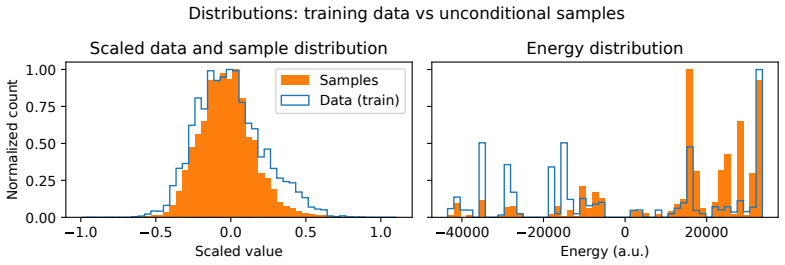
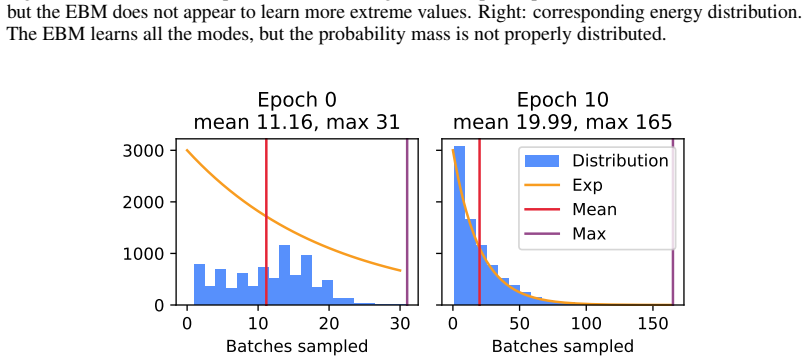
Notably, although most – if not all – modes of the distribution are covered, the mass associated with each mode may not agree. This behavior is evident in the aggregate energy distribution seen in fig. 8. On average, the unconditional samples have higher energy than the data. In terms of the scaled values of all of the inputs, the model appears to struggl...
discussion (0)
Sign in with ORCID, Apple, or X to comment. Anyone can read and Pith papers without signing in.