Recognition: 2 theorem links
· Lean TheoremAnalytical Framework of Airy Beams in Near-Field XL-MIMO: From Ideal Optics to Wireless Reality
Pith reviewed 2026-05-12 01:19 UTC · model grok-4.3
The pith
Analytical framework derives aperture and spacing constraints for distortion-free Airy beams in near-field XL-MIMO.
A machine-rendered reading of the paper's core claim, the machinery that carries it, and where it could break.
Core claim
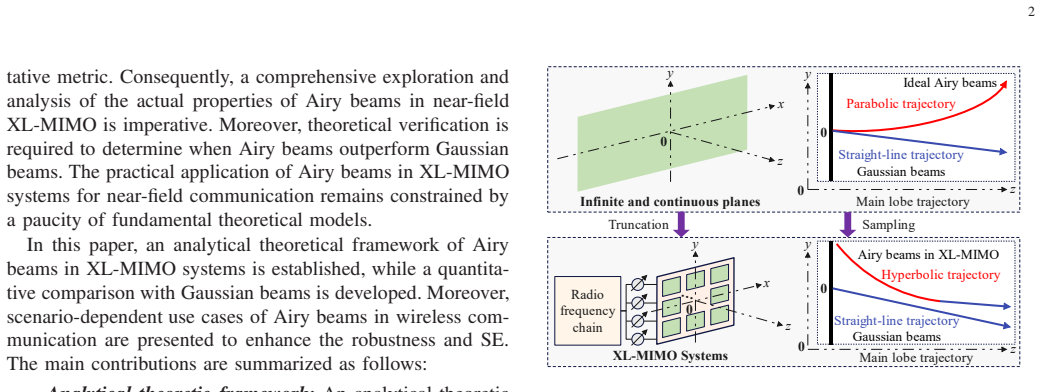
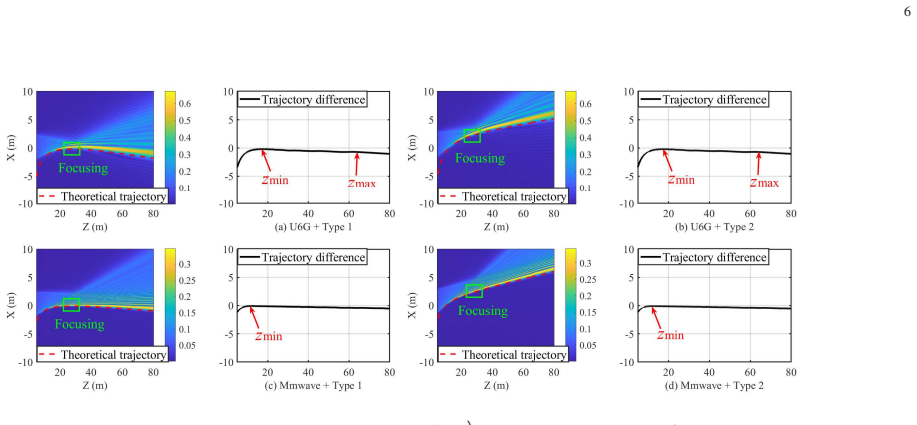
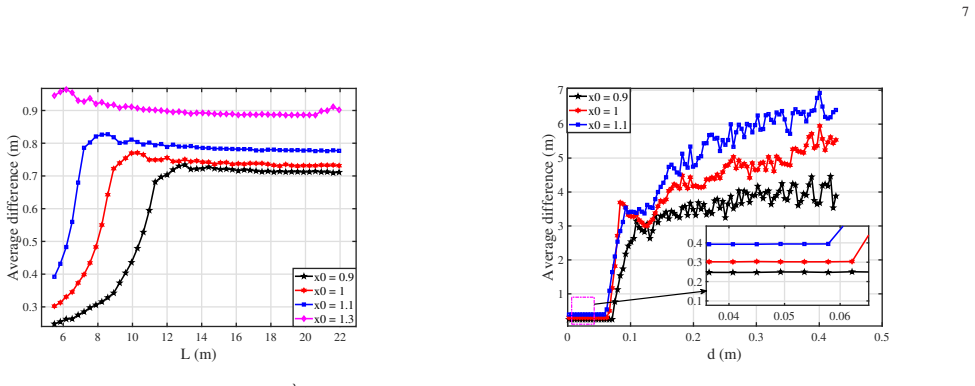
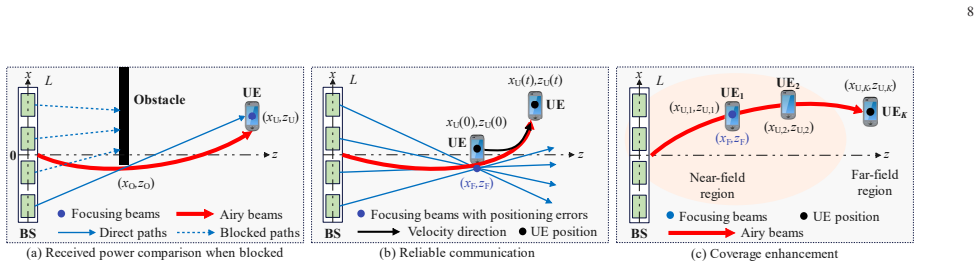
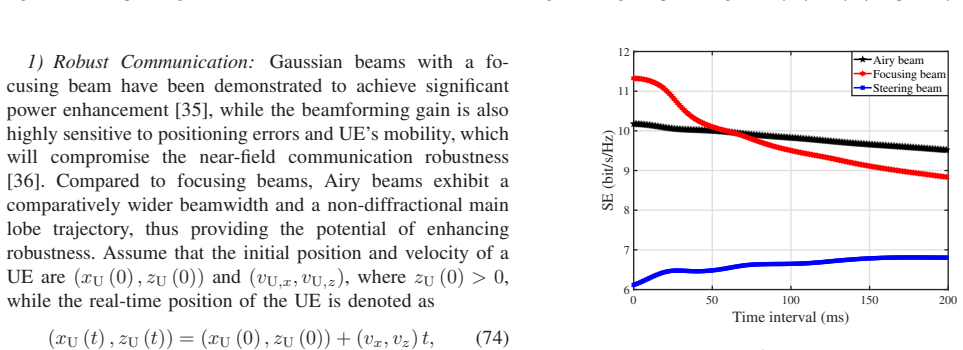
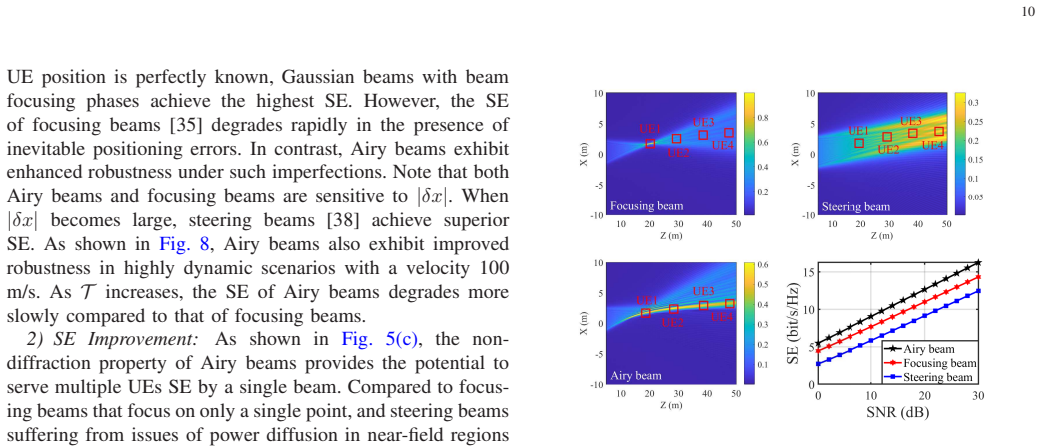
This paper establishes an analytical theoretical framework to explicitly characterize Airy beam propagation in near-field XL-MIMO and derives the constraints on array aperture and antenna spacing to sustain distortion-free main lobe trajectories. Quantitative metrics are developed to rigorously evaluate the performance trade-offs between Airy beams and Gaussian focusing beams, thereby providing systematic guidelines for their deployment in scenario-dependent wireless applications. Numerical results corroborate the proposed analytical theoretical framework of Airy beams in near-field XL-MIMO, and demonstrate the potential to achieve robust communication and spectral efficiency improvement in
What carries the argument
The derived constraints on array aperture and antenna spacing that allow inversion of deviations induced by hybrid precoding and discrete antenna topologies to recover ideal Airy main-lobe trajectories.
Load-bearing premise
Deviations from ideal Airy beams due to hybrid precoding, finite apertures, and discrete antenna topologies can be analytically inverted using explicit constraints on aperture size and antenna spacing.
What would settle it
Measurements or simulations in which the main lobe trajectory deviates from the predicted parabolic path even after applying the derived aperture and spacing constraints would disprove the recovery of ideal Airy behavior.
Figures

read the original abstract
The synthesis of Airy-profiled wavefronts has emerged as a pivotal paradigm for advanced electromagnetic engineering, attributed to their intrinsic non-diffractive propagation, transverse self-acceleration, and structural self-healing properties. While the advent of extremely large-scale multiple-input multiple-output (XL-MIMO) and the elevation in frequency bands for sixth generation wireless systems provide the physical foundation for generating such structured beams, their wireless realization is fundamentally governed by hybrid precoding architectures, finite array apertures, and discrete antenna topologies. These constraints induce significant deviations from ideal optical Airy beam models, necessitating a rigorous re-characterization of Airy beams in practical wireless contexts. Consequently, this paper establishes an analytical theoretical framework to explicitly characterize Airy beam propagation in near-field XL-MIMO and derives the constraints on array aperture and antenna spacing to sustain distortion-free main lobe trajectories. Furthermore, quantitative metrics are developed to rigorously evaluate the performance trade-offs between Airy beams and Gaussian focusing beams, thereby providing systematic guidelines for their deployment in scenario-dependent wireless applications. Numerical results corroborate the proposed analytical theoretical framework of Airy beams in near-field XL-MIMO, and demonstrate the potential to achieve robust communication and spectral efficiency (SE) improvement in certain scenarios.
Editorial analysis
A structured set of objections, weighed in public.
Referee Report
Summary. The paper develops an analytical theoretical framework for characterizing the propagation of Airy beams in near-field XL-MIMO systems, explicitly accounting for the effects of hybrid precoding, finite array apertures, and discrete antenna topologies. It derives closed-form constraints on array aperture size and inter-antenna spacing that preserve distortion-free main-lobe trajectories, introduces quantitative metrics for performance trade-offs versus Gaussian focusing beams, and validates the framework with numerical simulations showing spectral-efficiency gains in selected scenarios.
Significance. If the derivations hold, the work is significant for 6G XL-MIMO design: it supplies the first explicit analytical bridge between ideal optical Airy-beam properties (non-diffraction, self-acceleration, self-healing) and practical wireless constraints, together with scenario-dependent deployment guidelines and reproducible numerical corroboration. The provision of parameter-explicit aperture/spacing constraints and direct quantitative comparisons to Gaussian beams constitutes a concrete, falsifiable contribution.
minor comments (3)
- [Abstract and Section V] The abstract states that 'quantitative metrics are developed' and 'numerical results corroborate' the framework, yet the introduction and results sections would benefit from an explicit table listing the derived aperture/spacing constraints and the exact SE improvement percentages under the tested scenarios.
- [Section II] Notation for the hybrid precoding matrix and the discrete array response vector is introduced without a dedicated nomenclature table; this occasionally forces the reader to cross-reference earlier equations when following the main-lobe trajectory derivation.
- [Section VI] Figure captions for the numerical results (e.g., trajectory plots and SE curves) do not state the carrier frequency, array size, or SNR range used, reducing immediate reproducibility.
Simulated Author's Rebuttal
We thank the referee for the positive assessment of our work and the recommendation for minor revision. The referee's summary accurately reflects the paper's contributions in developing an analytical framework for Airy beam propagation in near-field XL-MIMO systems, including constraints on array aperture and antenna spacing, as well as comparisons to Gaussian beams.
Circularity Check
No significant circularity detected in derivation chain
full rationale
The paper claims to derive an analytical framework characterizing Airy beam propagation under hybrid precoding, finite apertures and discrete arrays in near-field XL-MIMO, then extracts explicit aperture and spacing constraints for undistorted trajectories, with performance metrics versus Gaussian beams and numerical corroboration. No equations, self-citations, or steps are shown that reduce a claimed prediction or first-principles result to a fitted input, self-definition, or prior author result by construction. The central derivation is presented as independent re-characterization from ideal optics, with external numerical validation, satisfying the criteria for a self-contained analysis.
Axiom & Free-Parameter Ledger
Lean theorems connected to this paper
-
IndisputableMonolith/Foundation/AlexanderDuality.leanalexander_duality_circle_linking (D=3 forcing) unclearthe EF on the position (x,z) can be given by ψ_I(x,z) = (1/x0) Ai(−k²/(4z²x₀⁴) − kx/(z x0)) … main lobe trajectory x(z) = −k/(4x₀³)·(1/z) − μ₀ x0/k · z
-
IndisputableMonolith/Foundation/ArithmeticFromLogic.leanembed_injective / LogicNat ≃ Nat unclearconstraints on array aperture and antenna spacing … L ≥ max{…} k/|x₀³| + 2 |3 x₀^{-3}|^{1/3}
Reference graph
Works this paper leans on
-
[1]
Toward extra large-scale MIMO: New channel properties and low-cos t designs,
Y . Han, S. Jin, M. Matthaiou, T. Q. S. Quek, and C. -K. Wen, “ Toward extra large-scale MIMO: New channel properties and low-cos t designs,” IEEE Internet Things J. , vol. 10, no. 6, pp. 14569-14594, Aug. 2023
work page 2023
-
[2]
Prospective multiple antenna technologies for beyo nd 5G,
J. Zhang, E. Bj¨ ornson, M. Matthaiou, D. W. K. Ng, H. Y ang, and D. J. Love, “Prospective multiple antenna technologies for beyo nd 5G,” IEEE J. Sel. Areas Commun. , vol. 38, no. 8, pp. 1637–1660, Aug. 2020
work page 2020
-
[3]
Near-field locali zation and channel reconstruction for ELAA systems,
Z. Lu, Y . Han, S. Jin, and M. Matthaiou, “Near-field locali zation and channel reconstruction for ELAA systems,” IEEE Trans. Wireless Commun., vol. 72, no. 11, pp. 6938-6953, Jul. 2024
work page 2024
-
[4]
AI-enabled near-field communications: User movement prediction and beam trackin g,
M. Zhang, R. Zhong, X. Mu, H. Shin, and Y . Liu, “AI-enabled near-field communications: User movement prediction and beam trackin g,” IEEE Trans. Cogn. Commun. Netw. , vol. 12, pp. 6247-6264, 2026
work page 2026
-
[5]
Visibility region e xploitation for PHY authentication in XL-MIMO systems,
S. Demirci, L. Afeef, and H. Arslan, “Visibility region e xploitation for PHY authentication in XL-MIMO systems,” IEEE Wireless Commun. Lett., vol. 14, no. 1, pp. 43-47, Jan. 2025
work page 2025
-
[6]
Ultrafast Airy beam optical parametric os cillator,
N. A. Chaitanya, S. C. Kumar, A. Aadhi, G. K. Samanta, and M . Ebrahim-Zadeh, “Ultrafast Airy beam optical parametric os cillator,” Sci. Rep., 2016, 6:30701
work page 2016
-
[7]
M ulti- gigahertz, femtosecond Airy beam optical parametric oscil lator pumped at 78 MHz,
A. Aadhi, V . Sharma, N. A. Chaitanya, and G. K. Samanta, “M ulti- gigahertz, femtosecond Airy beam optical parametric oscil lator pumped at 78 MHz,” Sci. Rep. , 2017, 7:43913
work page 2017
-
[8]
Self-focusing effect on the characteristics of Airy beams,
L. Wang, X. Ji, Y . Deng, X. Li, and T. Wang, “Self-focusing effect on the characteristics of Airy beams,” Opt. Commun. , vol. 441, pp. 190–194, 2019
work page 2019
-
[9]
Accelerati ng finite energy Airy beams,
G. A. Siviloglou and D. N. Christodoulides, “Accelerati ng finite energy Airy beams,” Opt. Lett. , vol. 32, no. 8, pp. 979-981, Apr. 2007
work page 2007
-
[10]
Observation of accelerating Airy beams,
G. A. Siviloglou, J. Broky, A. Dogariuand, and D. N. Chri stodoulides, “Observation of accelerating Airy beams,” Phys. Rev. Lett. , 2007, 99: 213901
work page 2007
-
[11]
Airy beams and accelerating waves: An overview of recent advance s,
N. K. Efremidis, Z. Chen, M. Segev, and D. N. Christodoul ides, “Airy beams and accelerating waves: An overview of recent advance s,” Opt., vol. 6, no. 5, pp. 686-701, May 2019
work page 2019
-
[12]
C. Ungaro and A. Liu, “Single-pass cutting of glass with a curved edge using ultrafast curving Bessel beams and oblong Airy beams, ” Opt. Laser Technol., 2021, 144:107398
work page 2021
-
[13]
Curving THz wireless data links around obstacles,
H. Guerboukha, B. Zhao, Z. Fang, E. Knightly, and D. M. Mi ttleman, “Curving THz wireless data links around obstacles,” Commun. Eng., vol. 3, pp. 1–8, 2024
work page 2024
-
[14]
J. Hu et al. “A metasurface-based full-color circular auto-focusing Airy beam transmitter for stable high-speed underwater wir eless optical communications,” Nat. Commun. , Apr. 2024, 15: 2944
work page 2024
-
[15]
D. Inserra and G. Wen, “Demystifying self-healing prop erty of accelerat- ing beams for obstacles circumvention in communication app lications,” in Proc. IEEE PIERS , Jun. 2022, pp. 673–681
work page 2022
-
[16]
Mi crowave Airy beam generation with microstrip patch antenna array,
Z. Y ang, G. Wen, W. Hu, D. Inserra, Y . Huang, and J. Li, “Mi crowave Airy beam generation with microstrip patch antenna array,” IEEE Trans. Antennas Propag., vol. 69, no. 4, pp. 2290-2301, Apr. 2021
work page 2021
-
[17]
Propagation r ange enhancement of truncated airy beam with antenna array at mic rowave frequencies,
Z. Y ang, G. Wen, D. Inserra, and Y . Huang, “Propagation r ange enhancement of truncated airy beam with antenna array at mic rowave frequencies,” in Proc. IEEE IWS , Jul. 2018, pp. 1-3
work page 2018
-
[18]
H. Chen, A. Kludze, and Y . Ghasempour, “A physics-infor med Airy beam learning framework for blockage avoidance in sub-tera hertz wire- less networks,” Nat. Commun. , Aug. 2025, 16: 7387
work page 2025
-
[19]
Terahe rtz wireless data center: Gaussian beam or Airy beam?
W. Zhao, S. Abadal, G. Song, J. Jiang, and C. Han, “Terahe rtz wireless data center: Gaussian beam or Airy beam?” IEEE Trans. Wireless Commun., vol. 25, pp. 7922-7938, 2026
work page 2026
-
[20]
W. Zhao, C. Han, and E. Bj¨ ornson, “Airy beam engineerin g in near- field communications: A tractable closed-form analysis in t he terahertz band,” arXiv: 2603.13866 , Mar. 2026
-
[21]
Breaking near-field communication barriers: Focused, curved, or Airy beamforming?
S. Zhang, B. Di, and L. Song, “Breaking near-field commun ication barriers: Focused, curved, or Airy beamforming?” arXiv: 2604.01704 , Apr. 2026
-
[22]
Specular and vortical Airy beams,
S. N. Khonina, “Specular and vortical Airy beams,” Opt. Commun., vol. 284, no. 19, pp. 4263-4271, 2011
work page 2011
-
[23]
Non- paraxial diffraction analysis of Airy and SAiry beams,
L. Carretero, P . Acebal, S. Blaya, C. Garc´ ıa, and A. Mur ciano, “Non- paraxial diffraction analysis of Airy and SAiry beams,” Opt. Express , vol. 17, no. 25, pp. 22432–22441, 2009
work page 2009
-
[24]
The far-field divergent properties of an Airy beam,
Y . Xu and G. Zhou, “The far-field divergent properties of an Airy beam,” Opt. Laser Technol. , vol. 44, no. 5, pp. 1318–1323, Jul. 2012
work page 2012
-
[25]
Airy bea ms for near- field communications: Fundamentals, potentials, and limit ations,
D. Darsena, F. V erde, M. D. Renzo, and V . Galdi, “Airy bea ms for near- field communications: Fundamentals, potentials, and limit ations,” arXiv: 2508.13714, Aug. 2025
-
[26]
Asymptotic expansions of double and multipl e integrals occurring in diffraction theory,
N. Chako, “Asymptotic expansions of double and multipl e integrals occurring in diffraction theory,” J. Inst. Math. Appl. , vol. 1, no. 4, pp. 372–422, 1965
work page 1965
-
[27]
Analysis of the ne ighborhood of a smooth caustic for true-amplitude one-way wave equatio ns,
N. Bleistein, Y . Zhang, and G. Zhang, “Analysis of the ne ighborhood of a smooth caustic for true-amplitude one-way wave equatio ns,” W ave Motion, vol. 43, no. 4, pp. 323–338, Apr. 2006
work page 2006
-
[28]
Quadrature methods for highly oscillatory singular integrals,
J. Gao, M. Condon, A. Iserles, B. Gilvey, and J. Trevelya n, “Quadrature methods for highly oscillatory singular integrals,” J. Comput. Math., vol. 39, no. 2, pp. 227–260, Mar. 2021
work page 2021
-
[29]
Sauer, Numerical Analysis, 3rd ed
T. Sauer, Numerical Analysis, 3rd ed. London, U.K.: Pea rson, 2025
work page 2025
-
[30]
Euler–Maclaurin expansions without ana lytic derivatives,
B. Fornberg, “Euler–Maclaurin expansions without ana lytic derivatives,” in Porc. R. Soc. A , vol. 476, no. 2241, pp. 20200441, Sept. 2020
work page 2020
-
[31]
Lear ning- based blockage-resilient beam training in near-field terah ertz communi- cations,
C. Wang, Y . Guo, B. Zhao, Y . Wang, W. Chen, and Z. Li, “Lear ning- based blockage-resilient beam training in near-field terah ertz communi- cations,” arXiv: 2510. 25433 , Oct. 2025
work page 2025
-
[32]
Airy beamforming for radiative near-field MU-XL-MIMO: Overcomi ng half- space blockage,
Y . Qin, J. Chen, Z. Jiang, Z. Chen, Y . Huang, and L. Song, “ Airy beamforming for radiative near-field MU-XL-MIMO: Overcomi ng half- space blockage,” arXiv: 2601.09098 , Jan. 2026
-
[33]
ITU-R, Propagation by diffraction, Recommendation IT U-R P .526- 16, International Telecommunication Union, Geneva, Switz erland, Nov. 2025
work page 2025
-
[34]
Interf erence-free transmission for near-field communication with unlimited a ntennas,
Z. Y u, Y . Han, J. Zhang, S. Jin, and M. Matthaiou, “Interf erence-free transmission for near-field communication with unlimited a ntennas,” in Proc. IEEE EuCAP , Apr. 2024, pp. 1-5
work page 2024
-
[35]
Two-stage hier archical beam training for near-field communications,
C. Wu, C. Y ou, Y . Liu, L. Chen, and S. Shi, “Two-stage hier archical beam training for near-field communications,” IEEE Trans. V eh. Tech- nol., vol. 73, no. 2, pp. 2032-2044, Feb. 2024
work page 2032
-
[36]
Sensing-ai ded near-field beam tracking,
P . Gavriilidis and G. C. Alexandropoulos, “Sensing-ai ded near-field beam tracking,” arXiv: 2512.00655 , Nov. 2025
-
[37]
Hybrid nea r-far field channel estimation for holographic MIMO communicatio ns,
S. Y ue, S. Zeng, L. Liu, Y . C. Eldar, and B. Di, “Hybrid nea r-far field channel estimation for holographic MIMO communicatio ns,” IEEE Trans. Wireless Commun. , vol. 23, no. 12, pp. 1–16, Aug. 2024
work page 2024
-
[38]
R. Li, X. Shao, S. Sun, M. Tao, R. Zhang, “IRS aided millim eter- wave sensing and communication: Beam scanning, beam splitt ing, and performance analysis,” IEEE Trans. Wireless Commun. , vol. 23, no. 12, pp. 19713-19727, Dec. 2024
work page 2024
discussion (0)
Sign in with ORCID, Apple, or X to comment. Anyone can read and Pith papers without signing in.