Recognition: 2 theorem links
· Lean TheoremWideband Precoding for U6G XL-MIMO Systems: Beam Squint Boundaries and Channel Slicing
Pith reviewed 2026-05-12 00:50 UTC · model grok-4.3
The pith
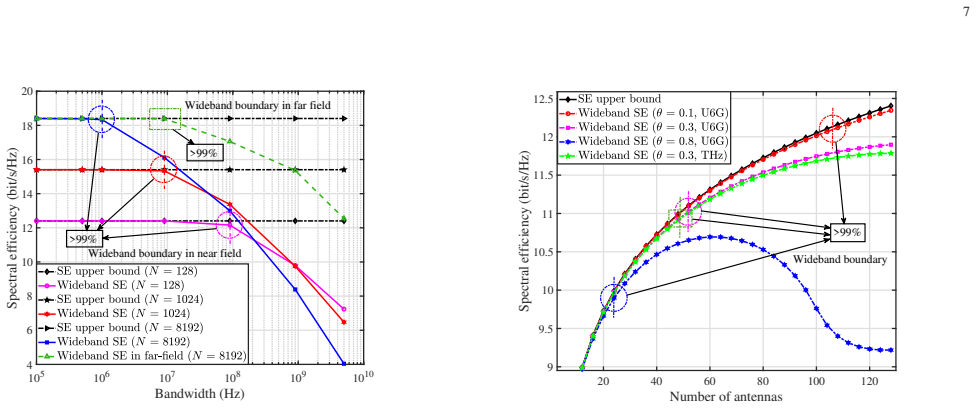
Beam squint remains significant in U6G XL-MIMO systems while near-field effects appear first with growing array size and bandwidth.
A machine-rendered reading of the paper's core claim, the machinery that carries it, and where it could break.
Core claim
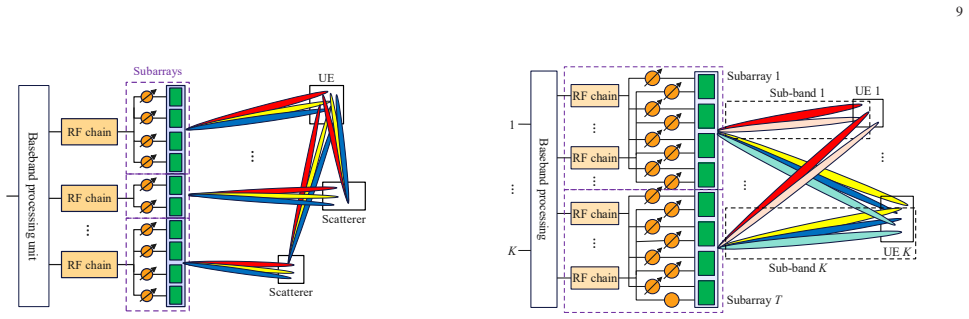
Precise antenna-domain and frequency-domain wideband boundaries are derived from the near-field and far-field perspectives. A channel slicing scheme segments U6G XL-MIMO channels into multiple blocks to mitigate the beam squint effect for each path, using antenna-domain slicing for multipath scenarios and frequency-domain slicing for multiuser scenarios. The beam squint effect remains a significant issue for U6G XL-MIMO systems, the near-field effect invariably precedes the beam squint effect as the array size and the bandwidth increase, and the proposed scheme greatly improves spectral efficiency.
What carries the argument
The derived antenna-domain and frequency-domain boundaries for beam squint, together with the channel slicing scheme that segments the XL-MIMO channel into blocks to reduce squint per path.
If this is right
- The derived boundaries can directly inform the design of wideband precoding for future U6G XL-MIMO deployments.
- Antenna-domain slicing applies to multipath channels to mitigate squint on each path separately.
- Frequency-domain slicing applies to multiuser channels to keep beams aligned across users.
- The slicing approach raises overall spectral efficiency under limited RF chains.
- Beam squint stays pronounced while near-field effects dominate first when arrays and bandwidth grow.
Where Pith is reading between the lines
- Designers could consult the boundaries to choose between near-field modeling and explicit squint compensation without running full simulations for every configuration.
- If the slicing preserves multiuser gains, the same block-wise approach might extend to other wideband large-array systems outside the U6G band.
- Hardware experiments that sweep array size and bandwidth while logging actual spectral efficiency would test whether the analytical boundaries match real propagation.
- Combining the slicing with existing low-complexity beamforming algorithms could further lower the number of required RF chains.
Load-bearing premise
That splitting the channels into blocks by antenna-domain or frequency-domain slicing can reduce beam squint for each path without adding too much overhead or losing multiuser performance gains.
What would settle it
A measurement or simulation in which the proposed slicing scheme produces no meaningful spectral efficiency gain over standard hybrid precoding, or in which the near-field effect does not appear before beam squint as array size and bandwidth are increased.
Figures




read the original abstract
The unconventionally large aperture of extremely large-scale multiple-input multiple-output (XL-MIMO) arrays, in conjunction with the wider bandwidths in the upper-6 GHz (U6G) frequency bands, will very likely lead to non-negligible beam squint effects. In the context of a limited number of radio frequency (RF) chains, and by adopting hybrid precoding, the beams at different subcarriers may point to different positions and compromise the spectral efficiency (SE). Moreover, the existence of \textit{multiple paths} in U6G XL-MIMO channels also entails practical challenges for wideband precoding. It is therefore essential to ascertain whether the beam squint effect is pronounced for U6G XL-MIMO systems and design efficient wideband precoding schemes. To address these challenges, precise antenna-domain and frequency-domain wideband boundaries are derived from the near-field and far-field perspectives, respectively. These boundaries can inform the design of wideband precoding in future system settings. Subsequently, a channel slicing scheme is proposed for wideband precoding. The process involves the segmentation of U6G XL-MIMO channels into multiple blocks, with the objective of mitigating the beam squint effect for each path. The antenna-domain and frequency-domain slicing methods are developed for multipath and multiuser scenarios, respectively. The simulation results prove that the beam squint effect remains a significant issue for U6G XL-MIMO systems, while the near-field effect invariably precedes the beam squint effect as the array size and the bandwidth increase. In addition, the proposed scheme can greatly improve the SE.
Editorial analysis
A structured set of objections, weighed in public.
Referee Report
Summary. The paper derives precise antenna-domain near-field boundaries (using Fresnel approximation) and frequency-domain beam-squint boundaries (using first-order Taylor expansion of the array response) for U6G XL-MIMO systems. It proposes antenna-domain slicing for multipath channels and frequency-domain slicing for multiuser scenarios to segment channels into blocks that mitigate beam squint per path under hybrid precoding with limited RF chains. Simulations are claimed to confirm that beam squint remains significant, that near-field effects invariably precede beam squint with increasing array size and bandwidth, and that the slicing scheme greatly improves spectral efficiency.
Significance. If the boundary derivations hold and the slicing preserves multiuser gains without prohibitive overhead, the work supplies concrete design guidelines for wideband precoding in U6G XL-MIMO, distinguishing regimes where near-field spherical-wave modeling must be prioritized over far-field beam-squint compensation. The explicit separation of antenna- and frequency-domain boundaries from standard channel models is a methodological strength.
major comments (3)
- [Abstract, §III] Abstract and §III: The headline claim that 'the near-field effect invariably precedes the beam squint effect as the array size and the bandwidth increase' is load-bearing for the motivation to prioritize near-field-aware slicing. The boundaries are obtained independently (§III-A Fresnel vs. §III-B first-order Taylor), so the ordering is an empirical observation from the chosen simulation points rather than a general proof. The manuscript should either prove the ordering for all U6G-relevant parameters (carrier 7–10 GHz, bandwidth ~400 MHz, apertures 256–1024) or qualify the claim as holding within the simulated regimes.
- [§IV] §IV (simulation results): The abstract asserts that 'simulations prove' both the precedence and that the scheme 'greatly improve[s] the SE,' yet the text provides no visible details on channel model parameters (number of paths, path-loss exponents, exact array apertures), baseline comparisons (e.g., narrowband hybrid precoding or frequency-flat precoding), or error bars. Without these, the quantitative support for the SE gains and the ordering cannot be verified.
- [§III-C, §IV] §III-C and §IV: The channel-slicing scheme segments paths into blocks to mitigate per-path beam squint. The manuscript should quantify the resulting overhead (additional RF-chain usage or feedback) and demonstrate that multiuser gains are retained after slicing; the current claim that segmentation 'can mitigate beam squint for each path without introducing prohibitive overhead' is asserted but not load-bearingly supported by the presented results.
minor comments (2)
- [§II, §III-A] Notation for the array response vector and the Fresnel approximation distance should be unified between §II and §III-A to avoid reader confusion.
- [Figures in §III] Figure captions for the boundary plots should explicitly state the carrier frequency, bandwidth, and array size used, rather than leaving them implicit.
Simulated Author's Rebuttal
We thank the referee for the constructive and detailed comments. We address each major comment below and indicate the revisions planned for the next version of the manuscript.
read point-by-point responses
-
Referee: [Abstract, §III] The headline claim that 'the near-field effect invariably precedes the beam squint effect as the array size and the bandwidth increase' is load-bearing for the motivation to prioritize near-field-aware slicing. The boundaries are obtained independently (§III-A Fresnel vs. §III-B first-order Taylor), so the ordering is an empirical observation from the chosen simulation points rather than a general proof. The manuscript should either prove the ordering for all U6G-relevant parameters (carrier 7–10 GHz, bandwidth ~400 MHz, apertures 256–1024) or qualify the claim as holding within the simulated regimes.
Authors: We agree that the precedence is an observation obtained by comparing the independently derived antenna-domain (Fresnel) and frequency-domain (first-order Taylor) boundaries at the simulated points, rather than a general analytical proof. In the revised manuscript we will remove the word 'invariably' from the abstract and Section III, and explicitly qualify the statement to hold 'within the U6G parameter regimes examined (carrier frequencies 7–10 GHz, bandwidths up to 400 MHz, and array sizes 256–1024)'. We will also add a short paragraph after the boundary derivations explaining the conditions under which the near-field boundary is reached before the beam-squint boundary for the considered ranges. revision: yes
-
Referee: [§IV] §IV (simulation results): The abstract asserts that 'simulations prove' both the precedence and that the scheme 'greatly improve[s] the SE,' yet the text provides no visible details on channel model parameters (number of paths, path-loss exponents, exact array apertures), baseline comparisons (e.g., narrowband hybrid precoding or frequency-flat precoding), or error bars. Without these, the quantitative support for the SE gains and the ordering cannot be verified.
Authors: We acknowledge that the simulation section would benefit from greater explicitness. In the revision we will expand Section IV with (i) a table listing all channel parameters (number of paths L=4, path-loss exponents, exact array apertures 256/512/1024, carrier and bandwidth values), (ii) explicit description of the two baselines (narrowband hybrid precoding and frequency-flat precoding), and (iii) error bars obtained from 100 independent channel realizations on all SE curves. These additions will make the quantitative claims directly verifiable. revision: yes
-
Referee: [§III-C, §IV] §III-C and §IV: The channel-slicing scheme segments paths into blocks to mitigate per-path beam squint. The manuscript should quantify the resulting overhead (additional RF-chain usage or feedback) and demonstrate that multiuser gains are retained after slicing; the current claim that segmentation 'can mitigate beam squint for each path without introducing prohibitive overhead' is asserted but not load-bearingly supported by the presented results.
Authors: We accept that the overhead and multiuser-gain retention require explicit quantification. In the revised Section III-C we will add an analytical overhead expression (additional RF chains and feedback bits as functions of the number of slices) and a short complexity comparison. In Section IV we will include new multiuser simulations that compare the proposed frequency-domain slicing against the unsliced hybrid precoder, demonstrating that the sum-rate gains from multiuser precoding are largely preserved while beam-squint mitigation is achieved. These results will directly support the 'non-prohibitive overhead' statement. revision: yes
Circularity Check
No significant circularity; boundaries derived from independent standard approximations and validated externally.
full rationale
The antenna-domain near-field boundaries (Section III-A) and frequency-domain beam-squint boundaries (Section III-B) are obtained from the Fresnel approximation and first-order Taylor expansion of the array response vector, respectively—standard, externally established techniques that do not reference the target ordering or the proposed slicing scheme. The headline assertion that near-field effects precede beam squint is presented as an empirical observation from the simulation campaign rather than a mathematical consequence of the derivations. The channel-slicing precoder is constructed from these boundaries and its SE gains are checked against Monte-Carlo simulations that constitute an independent external benchmark. No self-citation chain, fitted-input renaming, or self-definitional reduction appears in the load-bearing steps.
Axiom & Free-Parameter Ledger
axioms (2)
- domain assumption Standard far-field and near-field channel models apply to U6G XL-MIMO
- domain assumption Hybrid precoding with limited RF chains is the operating architecture
Lean theorems connected to this paper
-
IndisputableMonolith/Foundation/RealityFromDistinction.leanreality_from_one_distinction unclear?
unclearRelation between the paper passage and the cited Recognition theorem.
precise antenna-domain and frequency-domain wideband boundaries are derived from the near-field and far-field perspectives... channel slicing scheme... segmentation of U6G XL-MIMO channels into multiple blocks
-
IndisputableMonolith/Foundation/AlexanderDuality.leanalexander_duality_circle_linking unclear?
unclearRelation between the paper passage and the cited Recognition theorem.
Theorem 3: ... near-field effect invariably precedes ... beam squint effect as N increases... ˜N < min{¯Nwn, ¯Nwf}
What do these tags mean?
- matches
- The paper's claim is directly supported by a theorem in the formal canon.
- supports
- The theorem supports part of the paper's argument, but the paper may add assumptions or extra steps.
- extends
- The paper goes beyond the formal theorem; the theorem is a base layer rather than the whole result.
- uses
- The paper appears to rely on the theorem as machinery.
- contradicts
- The paper's claim conflicts with a theorem or certificate in the canon.
- unclear
- Pith found a possible connection, but the passage is too broad, indirect, or ambiguous to say the theorem truly supports the claim.
Reference graph
Works this paper leans on
-
[1]
Prospective multiple antenna technologies for beyo nd 5G,
J. Zhang, E. Bj¨ ornson, M. Matthaiou, D. W. K. Ng, H. Y ang, and D. J. Love, “Prospective multiple antenna technologies for beyo nd 5G,” IEEE J. Sel. Areas Commun. , vol. 38, no. 8, pp. 1637–1660, Aug. 2020
work page 2020
-
[2]
Multi-user m odular XL-MIMO communications: Near-field beam focusing pattern a nd user grouping,
X. Li, Z. Dong, Y . Zeng, S. Jin, and R. Zhang, “Multi-user m odular XL-MIMO communications: Near-field beam focusing pattern a nd user grouping,” IEEE Trans. Wireless Commun. , vol. 23, no. 10, pp. 13766- 13781, Oct. 2024
work page 2024
-
[3]
Toward extra large-scale MIMO: New channel properties and low-cos t designs,
Y . Han, S. Jin, M. Matthaiou, T. Q. S. Quek, and C. -K. Wen, “ Toward extra large-scale MIMO: New channel properties and low-cos t designs,” IEEE Internet Things J. , vol. 10, no. 6, pp. 14569-14594, Aug. 2023
work page 2023
-
[4]
Near-field communi cations for 6G: Fundamentals, challenges, potentials, and future d irections,
M. Cui, Z. Wu, Y . Lu, X. Wei, and L. Dai, “Near-field communi cations for 6G: Fundamentals, challenges, potentials, and future d irections,” IEEE Commun. Mag. , vol. 61, no. 1, pp. 40–46, Jan. 2023
work page 2023
-
[5]
An overview of enhance d massive MIMO with array signal processing techniques,
M. Wang, F. Gao, S. Jin, and H. Lin, “An overview of enhance d massive MIMO with array signal processing techniques,” IEEE J. Sel. Topics Signal Process. , vol. 13, no. 5, pp. 886-901, Sept. 2019
work page 2019
-
[6]
Communicating with extremely large-s cale ar- ray/surface: Unified modeling and performance analysis,
H. Lu and Y . Zeng, “Communicating with extremely large-s cale ar- ray/surface: Unified modeling and performance analysis,” IEEE Trans. Wireless Commun., vol. 21, no. 6, pp. 4039–4053, Jun. 2022
work page 2022
-
[7]
Near-field locali zation and channel reconstruction for ELAA systems,
Z. Lu, Y . Han, S. Jin, and M. Matthaiou, “Near-field locali zation and channel reconstruction for ELAA systems,” IEEE Trans. Wireless Commun., vol. 23, no. 7, pp. 6938-6953, Jul. 2024
work page 2024
-
[8]
Cellular wireless networks in the upper mid-band,
S. Kang, et al. “Cellular wireless networks in the upper mid-band,” IEEE Open J. Commun. Soc. , vol. 5, pp. 2058-2075, Mar. 2024
work page 2058
-
[9]
H. Miao, et al. “Sub-6 GHz to mmWave for 5G-advanced and beyond: Channel measurements, characteristics and impact on syste m perfor- mance,” IEEE J. Sel. Areas Commun. , vol. 41, no. 6, pp. 1945-1960, Jun. 2023
work page 1945
-
[10]
A su rvey of dense multipath and its impact on wireless systems,
S. Jiang, W. Wang, Y . Miao, W. Fan, and A. F. Molisch, “A su rvey of dense multipath and its impact on wireless systems,” IEEE Open J. Antennas Propag., vol. 3, pp. 435-460, Apr. 2022
work page 2022
-
[11]
World Radiocommunication Conference 2023 (WRC- 23),
ITU, “World Radiocommunication Conference 2023 (WRC- 23),” Avail- able: https://www.itu.int/dms pub/itu-r/opb/act/R-ACT -WRC.15-2023- PDF-E.pdf, Dec. 2023
work page 2023
-
[12]
X. Gao, L. Dai, and A. M. Sayeed, “Low RF-complexity tech nologies to enable millimeter-wave MIMO with large antenna array for 5G wireless communications,” IEEE Commun. Mag. , vol. 56, no. 4, pp. 211–217, Apr. 2018
work page 2018
-
[13]
Cell subarra y for XL- MIMO: Undersampling channel estimation exploring spatial geometry,
Z. Lu, Y . Han, S. Jin, J. Zhang, and J. Wang, “Cell subarra y for XL- MIMO: Undersampling channel estimation exploring spatial geometry,” IEEE Trans. Commun. , Jun. 2025, Early Access
work page 2025
-
[14]
Spatial- and frequency- wideband effects in millimeter-wave massive MIMO systems,
B. Wang, F. Gao, S. Jin, H. Lin, and G. Y . Li, “Spatial- and frequency- wideband effects in millimeter-wave massive MIMO systems, ” IEEE Trans. Signal Process. , vol. 66, no. 13, pp. 3393–3406, Jul. 2018
work page 2018
-
[15]
Beamforming technologies for ultra-massive MIMO in terahertz communications,
B. Ning, et al. , “Beamforming technologies for ultra-massive MIMO in terahertz communications,” IEEE Open J. Commun. Soc. , vol. 4, pp. 614-658, Feb. 2023
work page 2023
-
[16]
A n overview of signal processing techniques for terahertz communication s,
H. Sarieddeen, M. -S. Alouini, and T. Y . Al-Naffouri, “A n overview of signal processing techniques for terahertz communication s,” Proc. IEEE, vol. 109, no. 10, pp. 1628–1665, Oct. 2021
work page 2021
-
[17]
Hybrid precoding for wideband millimeter wave MIMO systems in the face of beam squint,
Y . Chen, et al. “Hybrid precoding for wideband millimeter wave MIMO systems in the face of beam squint,” IEEE Trans. Wireless Commun. , vol. 20, no. 3, pp. 1847–1860, Mar. 2021
work page 2021
-
[18]
Beam squint inspi red multiple access technique in massive MIMO systems,
A. B. Kihero, L. Afeef, and H. Arslan, “Beam squint inspi red multiple access technique in massive MIMO systems,” in Proc. IEEE VTC , Sept. 2022, pp. 1-6
work page 2022
-
[19]
Effect of wideband beam squint on codebook design in phased-array wireless systems,
M. Cai, et al. “Effect of wideband beam squint on codebook design in phased-array wireless systems,” in Proc. IEEE GLOBECOM, Dec. 2016, pp. 1–6
work page 2016
-
[20]
Space-time block coding-based beam forming for beam squint compensation,
X. Liu and D. Qiao, “Space-time block coding-based beam forming for beam squint compensation,” IEEE Wireless Commun. Lett. , vol. 8, no. 1, pp. 241–244, Feb. 2019
work page 2019
-
[21]
A novel transceiv er design in wideband massive MIMO for beam squint minimization,
L. Afeef, A. B. Kihero, and H. Arslan, “A novel transceiv er design in wideband massive MIMO for beam squint minimization,” IEEE Trans. Commun., vol. 72, no. 7, pp. 4509-4522, Jul. 2024
work page 2024
-
[22]
Near-field rai nbow: Wideband beam training for XL-MIMO,
M. Cui, L. Dai, Z. Wang, S. Zhou, and N. Ge, “Near-field rai nbow: Wideband beam training for XL-MIMO,” IEEE Trans. Wireless Com- mun., vol. 22, no. 6, pp. 3899-3912, Jun. 2023
work page 2023
-
[23]
Wideband bea mforming for hybrid massive MIMO terahertz communications,
F. Gao, B. Wang, C. Xing, J. An, and G. Y . Li, “Wideband bea mforming for hybrid massive MIMO terahertz communications,” IEEE J. Sel. Areas Commun., vol. 39, no. 6, pp. 1725-1740, Jun. 2021
work page 2021
-
[24]
Delay-phase prec oding for wideband THz massive MIMO,
L. Dai, J. Tan, Z. Chen, and H. V . Poor, “Delay-phase prec oding for wideband THz massive MIMO,” IEEE Trans. Wireless Commun. , vol. 21, no. 9, pp. 7271-7286, Sept. 2022
work page 2022
-
[25]
Ch annel estimation and hybrid combining for wideband terahertz mas sive MIMO systems,
K. Dovelos, M. Matthaiou, H. Q. Ngo, and B. Bellalta, “Ch annel estimation and hybrid combining for wideband terahertz mas sive MIMO systems,” IEEE J. Sel. Areas Commun. , vol. 39, no. 6, pp. 1604-1620, Jun. 2021
work page 2021
-
[26]
Rainbow-link: Beam-align ment-free and grant-free mmW multiple access using true-time-delay arra y,
R. Li, H. Y an, and D. Cabric, “Rainbow-link: Beam-align ment-free and grant-free mmW multiple access using true-time-delay arra y,” IEEE J. Sel. Areas Commun. , vol. 40, no. 5, pp. 1692-1705, May 2022
work page 2022
-
[27]
Near-field wideband beamforming for e xtremely large antenna array,
M. Cui and L. Dai, “Near-field wideband beamforming for e xtremely large antenna array,” IEEE Trans. Wireless Commun. , vol. 23, no. 10, pp. 13110-13124, Oct. 2024
work page 2024
-
[28]
A hybrid true-t ime and phase- delayed approach for millimeter-wave beam steering,
L. Steinweg, C. Carta, and F. Ellinger, “A hybrid true-t ime and phase- delayed approach for millimeter-wave beam steering,” IEEE Trans. Microw. Theory Techn., vol. 70, no. 9, pp. 4318-4327, Sept. 2022
work page 2022
-
[29]
Nea r-field wideband secure communications: An analog beamfocusing ap proach,
Y . Zhang, H. Zhang, S. Xiao, W. Tang, and Y . C. Eldar, “Nea r-field wideband secure communications: An analog beamfocusing ap proach,” IEEE Trans. Signal Process. , vol. 72, pp. 2173-2187, Apr. 2024
work page 2024
-
[30]
Hybrid precod ing for mitigating the beam squint in wideband mmWave MIMO system,
Y . Gao, H. Hu, B. Chen, J. Tian, and S. Lei, “Hybrid precod ing for mitigating the beam squint in wideband mmWave MIMO system,” IEEE Wireless Commun. Lett. , vol. 13, no. 3, pp. 602-606, Mar. 2024
work page 2024
-
[31]
Beam squint in ultra-wideband mmWave systems: RF lens array vs. phase-shifter-based array,
S. -H. Park, et al. “Beam squint in ultra-wideband mmWave systems: RF lens array vs. phase-shifter-based array,” IEEE Wireless Commun. , vol. 30, no. 4, pp. 82-89, Aug. 2023. 15
work page 2023
-
[32]
A wideband generalization of the near-field region of extremely larger phased arrays,
N. Deshpande, et al. “A wideband generalization of the near-field region of extremely larger phased arrays,” IEEE Wireless Commun. Lett. , vol. 12, no. 3, pp. 515-519, Mar. 2023
work page 2023
-
[33]
InFocus: A spatial codi ng technique to mitigate misfocus in near-field LoS beamforming,
N. J. Myers and R. W. Health Jr., “InFocus: A spatial codi ng technique to mitigate misfocus in near-field LoS beamforming,” IEEE Trans. Wireless Commun., vol. 21, no. 4, pp. 2193-2209, Apr. 2022
work page 2022
-
[34]
A primer on near-field beamforming for arrays and reconfigurable intelligent surf aces,
E. Bj¨ ornson, ¨O. T. Demir, and L. Sanguinetti, “A primer on near-field beamforming for arrays and reconfigurable intelligent surf aces,” in Proc. IEEE ASILOMAR , Mar. 2022, pp. 105-112
work page 2022
-
[35]
Effi cient downlink channel reconstruction for FDD multi-antenna sys tems,
Y . Han, T. -H. Hsu, C. -K. Wen, K. -K. Wong, and S. Jin, “Effi cient downlink channel reconstruction for FDD multi-antenna sys tems,” IEEE Trans. Wireless Commun. , vol. 18, no. 6, pp. 3161-3176, Jun. 2019
work page 2019
-
[36]
Low-overhea d separate channel estimation for hybrid XL-RIS-aided MIMO systems,
Z. Lu, Y . Han, J. Wang, J. Zhang, and S. Jin, “Low-overhea d separate channel estimation for hybrid XL-RIS-aided MIMO systems,” IEEE Trans. Commun., vol. 72, no. 11, pp. 7168-7181, Nov. 2024
work page 2024
-
[37]
Wideband beamform ing for near-field communications with circular arrays,
Y . Guo, Y . Zhang, Z. Wang, and Y . Liu, “Wideband beamform ing for near-field communications with circular arrays,” IEEE Trans. Commun. , vol. 23, no. 12, pp. 19065-19082, Dec. 2024
work page 2024
-
[38]
Wideband terahertz communi- cations with AoSA: Beam split aggregation and multiplexing ,
B. Ning, L. Li, W. Chen, and Z. Chen, “Wideband terahertz communi- cations with AoSA: Beam split aggregation and multiplexing ,” in Proc. IEEE GLOBECOM , Dec. 2022, pp. 1709-1714
work page 2022
-
[39]
Wideband communication wi th high- dimensional arrays: New results and transceiver architect ures,
J. H. Brady and A. M. Sayeed, “Wideband communication wi th high- dimensional arrays: New results and transceiver architect ures,” in Proc. IEEE ICC , Jun. 2015, pp. 1042-1047
work page 2015
-
[40]
Beamforming with joint phase and time array: System design, prototyping and performance,
J. Mo, et al. “Beamforming with joint phase and time array: System design, prototyping and performance,” Jan. 2025, arXiv: 2502.00139
discussion (0)
Sign in with ORCID, Apple, or X to comment. Anyone can read and Pith papers without signing in.