Recognition: 2 theorem links
· Lean TheoremPrismNet: Viewing Time Series Through a Multi-Modal Prism for Interpretable Power Load Forecasting
Pith reviewed 2026-05-12 01:05 UTC · model grok-4.3
The pith
PrismNet improves power load forecasting in few-shot scenarios by aligning text, image, and time series data through a guided contrastive learning process.
A machine-rendered reading of the paper's core claim, the machinery that carries it, and where it could break.
Core claim
PrismNet is an interpretable multi-modal framework that first uses a multi-modal augment module to integrate text and image modalities into load time series representations for few-shot capabilities, then applies a Partial Information Decomposition guided multi-modal contrastive learning to achieve domain-specific cross-modal semantic alignment, resulting in better performance and a new view on interpretability as shown in experiments on public datasets.
What carries the argument
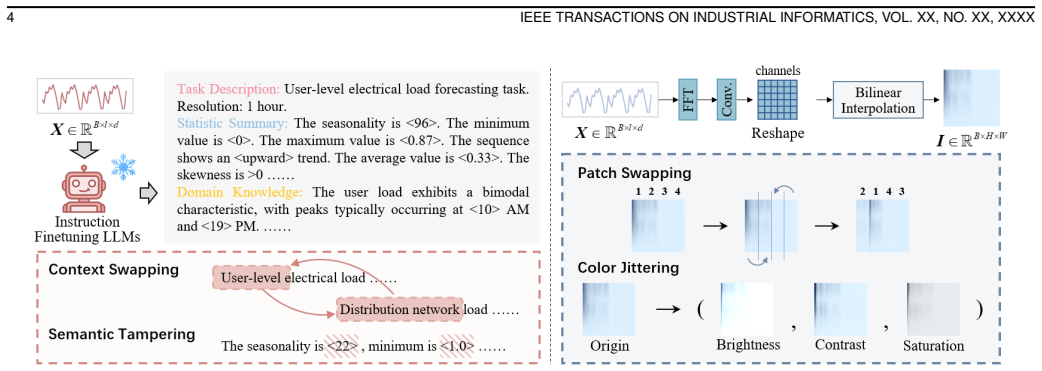
A multi-modal augment module that incorporates text and image data into time series, paired with a contrastive learning mechanism guided by partial information decomposition for semantic alignment.
Load-bearing premise
The assumption that adding text and image data through the new modules, then aligning them with guided contrastive learning, genuinely improves forecasting accuracy and interpretability instead of introducing misleading patterns.
What would settle it
An ablation test on the public datasets that disables the contrastive learning alignment and finds no reduction in few-shot forecasting performance would show the alignment is not driving the claimed gains.
Figures




read the original abstract
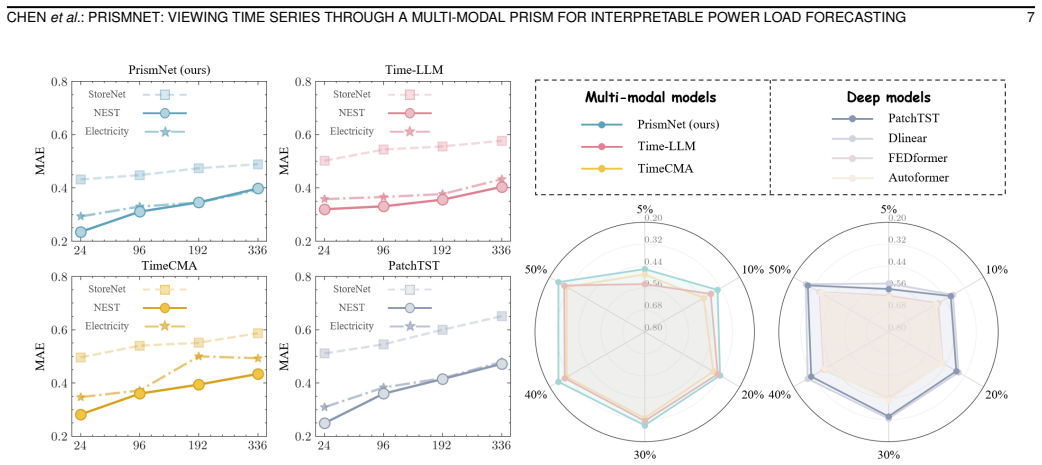
Load forecasting plays a pivotal role in the safe and stable operation of power systems. Conventional deep learning methods often struggle to adapt to few-shot scenarios frequently encountered in industrial applications. Existing multi-modal approaches typically overlook domain-specific cross-modal semantic alignment and lack sufficient mechanism interpretability. To address these challenges, this study proposes PrismNet, an interpretable multi-modal framework for power load forecasting. First, a multi-modal augment module integrates text and image modalities to strengthen load time series representations, empowering the model with few-shot learning capabilities. Subsequently, we design a Partial Information Decomposition (PID) guided multi-modal contrastive learning (CL) mechanism to achieve domain-specific cross-modal semantic alignment. This process elucidates the intrinsic interactions among modalities and offers a new lens for interpretability. Extensive experiments on real-world public datasets demonstrate that PrismNet outperforms strong deep learning and multi-modal baselines, particularly in few-shot settings, while providing a trustworthy and interpretable solution for safety-critical electric load scenarios. Our code is available at https://anonymous.4open.science/r/PrismNet-9DFC.
Editorial analysis
A structured set of objections, weighed in public.
Referee Report
Summary. The manuscript proposes PrismNet, an interpretable multi-modal framework for power load forecasting. It introduces a multi-modal augment module that integrates text and image modalities to enhance time series representations and support few-shot learning. A Partial Information Decomposition (PID) guided multi-modal contrastive learning mechanism is designed to achieve domain-specific cross-modal semantic alignment, which is claimed to elucidate intrinsic interactions among modalities and provide interpretability. Extensive experiments on real-world public datasets are reported to show outperformance over strong deep learning and multi-modal baselines, especially in few-shot settings, positioning the method as a trustworthy solution for safety-critical electric load scenarios. Code is made available via an anonymous repository.
Significance. If the central empirical claims are substantiated through targeted controls, the work could advance interpretable multi-modal forecasting in power systems by showing how information-theoretic decomposition can yield both performance gains in data-scarce regimes and mechanistic insights into modality interactions. The explicit code release is a strength that supports reproducibility and extension by the community.
major comments (2)
- [§4 (Experiments)] §4 (Experiments): The claim that PID-guided contrastive learning produces domain-specific cross-modal semantic alignment that causally drives the few-shot forecasting gains and trustworthy interpretability is load-bearing but not isolated. No ablation studies are reported that replace the PID objective with standard contrastive losses (e.g., InfoNCE) or generic mutual-information objectives while keeping the multi-modal augment module fixed. Without quantitative comparison of the unique/synergistic information terms on held-out data or performance deltas attributable solely to PID, the reported improvements could arise from increased capacity, extra fusion parameters, or data augmentation rather than the claimed alignment mechanism. This directly affects the interpretability and safety-critical assertions.
- [§3.2 (PID-guided CL mechanism)] §3.2 (PID-guided CL mechanism): The interpretability benefit is asserted to arise from PID elucidating 'intrinsic interactions among modalities,' yet the manuscript provides no external validation (e.g., correlation of decomposed information terms with power-system domain knowledge such as weather-load relationships or operational constraints) or checks that these terms remain stable on held-out domain labels. If the alignment objective is optimized on the same data used for evaluation, the reported interpretability risks reducing to a fitted property rather than an independent explanatory lens.
minor comments (1)
- [Abstract] The anonymous code link in the abstract should be replaced with a permanent, citable repository (e.g., Zenodo or GitHub with DOI) upon acceptance to fulfill reproducibility standards.
Simulated Author's Rebuttal
We thank the referee for the detailed and constructive comments, which help clarify the evidentiary requirements for our claims regarding the PID-guided contrastive learning mechanism. We address each major comment below and will incorporate targeted revisions to strengthen the experimental isolation of the PID contribution and the external validation of interpretability.
read point-by-point responses
-
Referee: [§4 (Experiments)] The claim that PID-guided contrastive learning produces domain-specific cross-modal semantic alignment that causally drives the few-shot forecasting gains and trustworthy interpretability is load-bearing but not isolated. No ablation studies are reported that replace the PID objective with standard contrastive losses (e.g., InfoNCE) or generic mutual-information objectives while keeping the multi-modal augment module fixed. Without quantitative comparison of the unique/synergistic information terms on held-out data or performance deltas attributable solely to PID, the reported improvements could arise from increased capacity, extra fusion parameters, or data augmentation rather than the claimed alignment mechanism. This directly affects the interpretability and safety-critical assertions.
Authors: We agree that isolating the specific contribution of the PID objective is necessary to support the causal claims. In the revised manuscript we will add ablation experiments that replace the PID-guided contrastive loss with standard InfoNCE and alternative mutual-information objectives while freezing the multi-modal augment module and all other architectural components. We will report performance deltas on the few-shot forecasting tasks together with quantitative comparisons of the unique, redundant, and synergistic information terms evaluated on held-out data. These additions will allow readers to assess whether the observed gains and alignment properties are attributable to the PID decomposition rather than capacity or augmentation effects. revision: yes
-
Referee: [§3.2 (PID-guided CL mechanism)] The interpretability benefit is asserted to arise from PID elucidating 'intrinsic interactions among modalities,' yet the manuscript provides no external validation (e.g., correlation of decomposed information terms with power-system domain knowledge such as weather-load relationships or operational constraints) or checks that these terms remain stable on held-out domain labels. If the alignment objective is optimized on the same data used for evaluation, the reported interpretability risks reducing to a fitted property rather than an independent explanatory lens.
Authors: We acknowledge that stronger external validation is required to substantiate the interpretability claims. We will augment §3.2 and the experimental section with analyses that correlate the PID-decomposed terms with established power-system domain knowledge (e.g., weather-load relationships extracted from the image and text modalities) and will verify stability of these terms across held-out data splits and domain-specific labels. The contrastive alignment is learned on training data, but all interpretability metrics and correlations will be computed exclusively on validation and test sets to ensure they function as an independent explanatory lens rather than a fitted artifact. revision: yes
Circularity Check
No significant circularity in claimed derivation or results
full rationale
The paper proposes PrismNet with a multi-modal augment module and PID-guided contrastive learning, then reports empirical outperformance on public datasets in few-shot settings. No mathematical derivation chain is presented that reduces a claimed prediction or first-principles result to its inputs by construction. The interpretability is asserted as a property of the PID mechanism itself rather than a derived output equivalent to fitted parameters. No self-citation is load-bearing for the central claims, and no equations or uniqueness theorems are invoked that collapse to prior author work or ansatz. The experimental results stand as independent validation against baselines.
Axiom & Free-Parameter Ledger
axioms (1)
- domain assumption Text and image modalities contain complementary semantic information that can be aligned with time-series load data via contrastive objectives
Lean theorems connected to this paper
-
IndisputableMonolith/Cost/FunctionalEquation.leanwashburn_uniqueness_aczel unclearPID-guided multi-modal contrastive learning ... decomposes information into uniqueness, redundancy, and synergy ... Lrdn = α1 ÎNCE(hX,hT)+... Lsyn=β1 ÎNCE(hF,hX)+...
-
IndisputableMonolith/Foundation/RealityFromDistinction.leanreality_from_one_distinction unclearPrismNet ... interpretable multi-modal framework for power load forecasting
Reference graph
Works this paper leans on
-
[1]
J. Zhong, X. Lei, Z. Shao, and L. Jian, “Value-oriented data-driven approach for electrical load forecasting apt to facilitate vehicle-to-grid scheduling,”IEEE Transactions on Industrial Informatics, 2025
work page 2025
-
[2]
S. Singh, Q. Z. Sheng, E. Benkhelifa, and J. Lloret, “Guest editorial: Energy management, protocols, and security for the next-generation networks and internet of things.”IEEE Trans. Ind. Informatics, vol. 16, no. 5, pp. 3515–3520, 2020
work page 2020
-
[3]
J. C. L ´opez, M. J. Rider, and Q. Wu, “Parsimonious short-term load forecasting for optimal operation planning of electrical distribution systems,”IEEE transactions on power systems, vol. 34, no. 2, pp. 1427– 1437, 2018
work page 2018
-
[4]
Short- term load forecasting with seasonal decomposition using evolution for parameter tuning,
B. A. Høverstad, A. Tidemann, H. Langseth, and P. ¨Ozt¨urk, “Short- term load forecasting with seasonal decomposition using evolution for parameter tuning,”IEEE Transactions on Smart Grid, vol. 6, no. 4, pp. 1904–1913, 2015
work page 1904
-
[5]
Y . Guo, Y . Li, X. Qiao, Z. Zhang, W. Zhou, Y . Mei, J. Lin, Y . Zhou, and Y . Nakanishi, “Bilstm multitask learning-based combined load forecasting considering the loads coupling relationship for multienergy system,”IEEE Transactions on Smart Grid, vol. 13, no. 5, pp. 3481– 3492, 2022
work page 2022
-
[6]
A. Vaswani, N. Shazeer, N. Parmar, J. Uszkoreit, L. Jones, A. N. Gomez, Ł. Kaiser, and I. Polosukhin, “Attention is all you need,”Advances in neural information processing systems, vol. 30, 2017
work page 2017
-
[7]
Autoformer: Decomposition transformers with auto-correlation for long-term series forecasting,
H. Wu, J. Xu, J. Wang, and M. Long, “Autoformer: Decomposition transformers with auto-correlation for long-term series forecasting,” Advances in neural information processing systems, vol. 34, pp. 22 419– 22 430, 2021
work page 2021
-
[8]
Informer: Beyond efficient transformer for long sequence time-series forecasting,
H. Zhou, S. Zhang, J. Peng, S. Zhang, J. Li, H. Xiong, and W. Zhang, “Informer: Beyond efficient transformer for long sequence time-series forecasting,” inProceedings of the AAAI conference on artificial intel- ligence, vol. 35, no. 12, 2021, pp. 11 106–11 115
work page 2021
-
[9]
Fedformer: Frequency enhanced decomposed transformer for long-term series fore- casting,
T. Zhou, Z. Ma, Q. Wen, X. Wang, L. Sun, and R. Jin, “Fedformer: Frequency enhanced decomposed transformer for long-term series fore- casting,” inInternational conference on machine learning. PMLR, 2022, pp. 27 268–27 286
work page 2022
-
[10]
P. Zhao, W. Hu, D. Cao, Z. Zhang, Y . Huang, L. Dai, and Z. Chen, “Probabilistic multienergy load forecasting based on hybrid attention- enabled transformer network and gaussian process-aided residual learn- ing,”IEEE Transactions on Industrial Informatics, vol. 20, no. 6, pp. 8379–8393, 2024
work page 2024
-
[11]
C. Wang, Y . Wang, Z. Ding, and K. Zhang, “Probabilistic multi- energy load forecasting for integrated energy system based on bayesian transformer network,”IEEE Transactions on Smart Grid, vol. 15, no. 2, pp. 1495–1508, 2023
work page 2023
-
[12]
Promptcast: A new prompt-based learning paradigm for time series forecasting,
H. Xue and F. D. Salim, “Promptcast: A new prompt-based learning paradigm for time series forecasting,”IEEE Transactions on Knowledge and Data Engineering, vol. 36, no. 11, pp. 6851–6864, 2023
work page 2023
-
[13]
Trace: Unlocking the potential of llms in time series forecasting for distributed energy resources,
Y . Chen and H. Xie, “Trace: Unlocking the potential of llms in time series forecasting for distributed energy resources,”IEEE Transactions on Artificial Intelligence, 2025
work page 2025
-
[14]
Unitime: A language-empowered unified model for cross-domain time series forecasting,
X. Liu, J. Hu, Y . Li, S. Diao, Y . Liang, B. Hooi, and R. Zimmermann, “Unitime: A language-empowered unified model for cross-domain time series forecasting,” inProceedings of the ACM Web Conference 2024, 2024, pp. 4095–4106
work page 2024
-
[15]
Llm4ts: Aligning pre-trained llms as data-efficient time-series forecasters,
C. Chang, W.-Y . Wang, W.-C. Peng, and T.-F. Chen, “Llm4ts: Aligning pre-trained llms as data-efficient time-series forecasters,”ACM Transac- tions on Intelligent Systems and Technology, vol. 16, no. 3, pp. 1–20, 2025
work page 2025
-
[16]
Time-llm: Time series forecasting by reprogramming large language models,
M. Jin, S. Wang, L. Ma, Z. Chu, J. Y . Zhang, X. Shi, P.-Y . Chen, Y . Liang, Y .-F. Li, S. Panet al., “Time-llm: Time series forecasting by reprogramming large language models,” inThe Twelfth International Conference on Learning Representations, 2024
work page 2024
-
[17]
Visionts: Vi- sual masked autoencoders are free-lunch zero-shot time series forecast- ers,
M. Chen, L. Shen, Z. Li, X. J. Wang, J. Sun, and C. Liu, “Visionts: Vi- sual masked autoencoders are free-lunch zero-shot time series forecast- ers,” inForty-second International Conference on Machine Learning, 2025
work page 2025
-
[18]
Timemixer++: A general time series pattern machine for universal predictive analysis,
S. Wang, J. Li, X. Shi, Z. Ye, B. Mo, W. Lin, S. Ju, Z. Chu, and M. Jin, “Timemixer++: A general time series pattern machine for universal predictive analysis,” inICLR, 2025
work page 2025
-
[19]
Time-vlm: Exploring multimodal vision-language models for augmented time series forecasting,
S. Zhong, W. Ruan, M. Jin, H. Li, Q. Wen, and Y . Liang, “Time-vlm: Exploring multimodal vision-language models for augmented time series forecasting,” inForty-second International Conference on Machine Learning, 2025
work page 2025
-
[20]
A. Graves, “Long short-term memory,”Supervised sequence labelling with recurrent neural networks, pp. 37–45, 2012
work page 2012
-
[21]
Are transformers effective for time series forecasting?
A. Zeng, M. Chen, L. Zhang, and Q. Xu, “Are transformers effective for time series forecasting?” inProceedings of the AAAI conference on artificial intelligence, vol. 37, no. 9, 2023, pp. 11 121–11 128
work page 2023
-
[22]
A time series is worth 64 words: Long-term forecasting with transformers,
Y . Nie, N. H. Nguyen, P. Sinthong, and J. Kalagnanam, “A time series is worth 64 words: Long-term forecasting with transformers,” inThe Eleventh International Conference on Learning Representations, 2023
work page 2023
-
[23]
Y . Huang, H. Guo, E. Tian, and H. Chen, “Day-ahead probabilistic load forecasting: A multi-information fusion and noncrossing quantiles method,”IEEE Transactions on Industrial Informatics, vol. 20, no. 8, pp. 10 520–10 529, 2024
work page 2024
-
[24]
One fits all: Power general time series analysis by pretrained lm,
T. Zhou, P. Niu, L. Sun, R. Jinet al., “One fits all: Power general time series analysis by pretrained lm,”Advances in neural information processing systems, vol. 36, pp. 43 322–43 355, 2023
work page 2023
-
[25]
Timecma: Towards llm-empowered multivariate time series forecasting via cross-modality alignment,
C. Liu, Q. Xu, H. Miao, S. Yang, L. Zhang, C. Long, Z. Li, and R. Zhao, “Timecma: Towards llm-empowered multivariate time series forecasting via cross-modality alignment,” inProceedings of the AAAI Conference on Artificial Intelligence, vol. 39, no. 18, 2025, pp. 18 780–18 788
work page 2025
-
[26]
Nonnegative Decomposition of Multivariate Information
P. L. Williams and R. D. Beer, “Nonnegative decomposition of multi- variate information,”arXiv preprint arXiv:1004.2515, 2010
work page Pith review arXiv 2010
-
[27]
What to align in multimodal contrastive learning?
B. Dufumier, J. C. Navarro, D. Tuia, and J.-P. Thiran, “What to align in multimodal contrastive learning?” inThe Thirteenth International Conference on Learning Representations, 2025
work page 2025
-
[28]
Comprehensive energy demand and usage data for building automation,
P. Heer, C. Derungs, B. Huber, F. B ¨unning, R. Fricker, S. Stoller, and B. Niesen, “Comprehensive energy demand and usage data for building automation,”Scientific Data, vol. 11, no. 1, p. 469, 2024
work page 2024
-
[29]
Comprehen- sive dataset on electrical load profiles for energy community in ireland,
R. Trivedi, M. Bahloul, A. Saif, S. Patra, and S. Khadem, “Comprehen- sive dataset on electrical load profiles for energy community in ireland,” Scientific Data, vol. 11, no. 1, p. 621, 2024. APPENDIX A. Proof for Corollary 1 To prove Corollary 1, we need to establish the following assumption: Fig. A1. PID for a four-variable system.{i, j}represents the s...
work page 2024
discussion (0)
Sign in with ORCID, Apple, or X to comment. Anyone can read and Pith papers without signing in.