Recognition: no theorem link
Post-pulse dipole instability in adiabatic TDDFT: fact or artifact?
Pith reviewed 2026-05-12 01:11 UTC · model grok-4.3
The pith
Adiabatic TDDFT post-pulse dipole growth is a numerical artifact from time propagation
A machine-rendered reading of the paper's core claim, the machinery that carries it, and where it could break.
Core claim
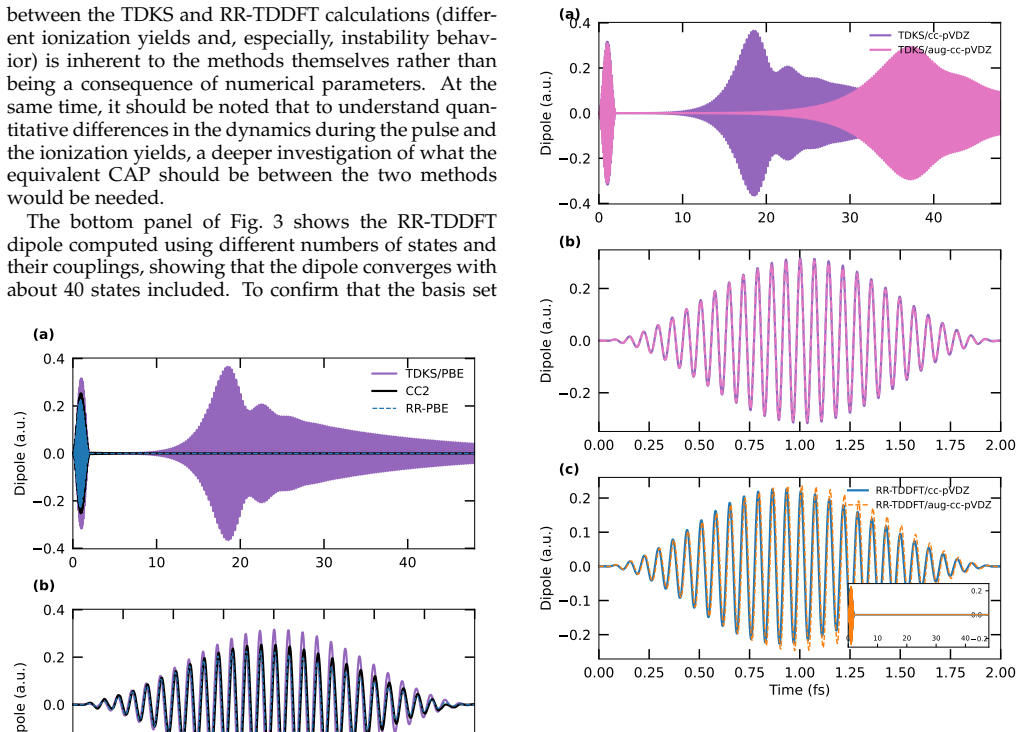
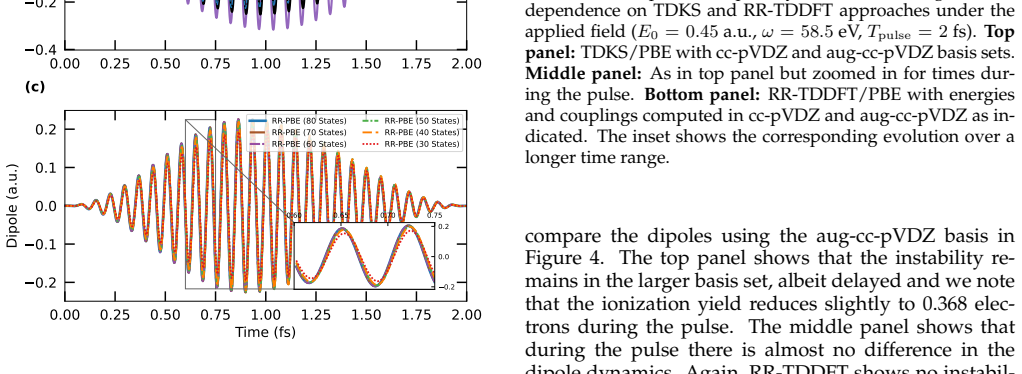
Recent real-time TDDFT calculations have reported an unexpected delayed growth of molecular dipole oscillations some time after an extreme-ultraviolet (XUV) pulse is applied. Numerical and analytical arguments suggest that this instability is an artifact of an incorrect non-linearity introduced by the computational approach: Propagation with an adiabatic exchange-correlation approximation within the time-dependent Kohn-Sham equations tends to amplify initially small and pure sinusoidal oscillations in a system. On the other hand, when this same adiabatic approximation is used within the recent response-reformulated RR-TDDFT, the instability is absent. The absorbing boundary condition plays a
What carries the argument
Adiabatic exchange-correlation approximation inside standard time-dependent Kohn-Sham propagation, which adds a nonlinearity that amplifies small oscillations
If this is right
- The delayed dipole growth after an XUV pulse does not reflect actual molecular dynamics
- RR-TDDFT yields stable results with the same adiabatic functionals that produce instability in standard propagation
- Absorbing boundaries are required for the artifact to develop in the usual TDKS scheme
- Interpretations of long-time post-pulse behavior in real-time TDDFT must account for possible numerical amplification
- The artifact is independent of the particular adiabatic functional chosen
Where Pith is reading between the lines
- Users of real-time TDDFT should cross-check long-time results against RR-TDDFT to detect hidden propagation instabilities
- The finding points to a general need for propagation methods that preserve linearity for small oscillations when adiabatic functionals are employed
- Similar artificial growth may appear in other time-dependent simulations that combine adiabatic approximations with absorbing boundaries
Load-bearing premise
The observed amplification is produced specifically by the combination of the adiabatic approximation and conventional TDKS time stepping rather than by any real physics or by differences in how the two methods treat the same underlying problem
What would settle it
Demonstrating that the same post-pulse dipole growth appears when the adiabatic approximation is used inside RR-TDDFT, or showing analytically that the propagation equations produce no amplification of pure sinusoids
Figures




read the original abstract
Recent real-time TDDFT calculations have reported an unexpected delayed growth of molecular dipole oscillations some time after an extreme-ultraviolet (XUV) pulse is applied. We show that numerical and analytical arguments suggest that this instability is an artifact of an incorrect non-linearity introduced by the computational approach: Propagation with an adiabatic exchange-correlation approximation within the time-dependent Kohn-Sham equations of time-dependent density functional theory (TDDFT) tends to amplify initially small and pure sinusoidal oscillations in a system. On the other hand, when this same adiabatic approximation is used within the recent response-reformulated RR-TDDFT,the instability is absent. The absorbing boundary condition plays a crucial role consistent with our argument. We demonstrate this explicitly on the N2 molecule subject to an XUV pulse, with a range of adiabatic functionals.
Editorial analysis
A structured set of objections, weighed in public.
Referee Report
Summary. The paper claims that the post-pulse dipole instability reported in recent real-time TDDFT simulations is an artifact, not a physical effect. It arises from an incorrect non-linearity introduced when propagating the time-dependent Kohn-Sham equations under an adiabatic exchange-correlation approximation, which amplifies initially small sinusoidal oscillations. In contrast, the same adiabatic approximation implemented in the response-reformulated RR-TDDFT shows no such instability. The absorbing boundary condition is identified as playing a key role. The argument is supported by numerical and analytical considerations and is demonstrated explicitly for the N2 molecule after an XUV pulse using several adiabatic functionals.
Significance. If the central claim is upheld, the result would be useful for the TDDFT community by providing a diagnostic to separate computational artifacts from genuine ultrafast dynamics in real-time simulations. The explicit N2 demonstration with multiple functionals and the contrast to RR-TDDFT offer a practical test that could improve the reliability of adiabatic TDDFT for XUV-driven processes. The work also highlights how boundary conditions interact with the time-propagation scheme, which is relevant for open-system modeling.
major comments (3)
- [Abstract / Methods comparison] Abstract and § on method comparison: The claim that the instability is an artifact of an 'incorrect non-linearity' in standard TDKS propagation (while absent in RR-TDDFT) is load-bearing for the central conclusion. However, the manuscript does not demonstrate that RR-TDDFT is mathematically equivalent to TDKS propagation for the same non-linear adiabatic dynamics beyond the linear-response regime. If the two formulations handle the time-dependent density response differently even under the adiabatic approximation, the absence of instability in RR-TDDFT does not establish that the TDKS amplification is unphysical rather than a valid consequence of one numerical realization. A rigorous equivalence proof or side-by-side derivation of the non-linear terms is required.
- [Analytical arguments section] Section presenting analytical arguments: The abstract states that 'numerical and analytical arguments suggest' the amplification mechanism, yet the full derivations, assumptions, and error analysis are not provided in the visible text. Without these, it is impossible to verify whether the amplification is shown to be a generic consequence of the adiabatic TDKS propagation or whether it depends on specific post-hoc choices (e.g., initial conditions, time-step, or functional details). Please supply the complete analytical derivation, including any linearization steps around the sinusoidal oscillation.
- [N2 results / BC discussion] N2 demonstration section (likely §4): The role of the absorbing boundary condition is stated to be 'crucial' and 'consistent with our argument,' but no quantitative analysis is given of how the BC interacts with the non-linearity or of the instability's dependence on BC parameters. Additional simulations varying the BC strength or comparing with periodic boundaries would strengthen the claim that the instability is tied to the computational approach rather than the physics.
minor comments (2)
- [Numerical setup] Clarify the precise definition of 'pure sinusoidal oscillations' and how they are initialized or detected in the dipole signal; the current description is somewhat vague for reproducibility.
- [Computational details] Ensure all functionals used in the N2 tests are explicitly named with their standard abbreviations and references in the main text or a table.
Simulated Author's Rebuttal
We appreciate the referee's positive assessment of the significance of our work and their recommendation for major revision. We address each major comment below and have made revisions to the manuscript to provide the requested clarifications and additional material.
read point-by-point responses
-
Referee: Abstract and methods comparison: The claim relies on RR-TDDFT being equivalent to TDKS for non-linear adiabatic dynamics, but no demonstration or proof is provided beyond linear response. A rigorous equivalence proof or side-by-side derivation of the non-linear terms is required.
Authors: We thank the referee for this key observation. RR-TDDFT is constructed to reproduce the same adiabatic density response as TDKS. In the revised manuscript we have added a subsection deriving the equivalence explicitly in the linear-response regime and explaining how the self-consistent time-step update in TDKS introduces an artificial non-linear feedback that amplifies sinusoidal modes, while the response-reformulated equations avoid this loop by design. We retain the numerical contrast on N2 with multiple functionals as supporting evidence that the instability is specific to the propagation scheme rather than the underlying physics. A complete non-linear equivalence proof is not provided, as it is not standard in the literature, but the combination of derivation and explicit demonstration addresses the concern. revision: partial
-
Referee: Analytical arguments section: Full derivations, assumptions, and error analysis for the amplification mechanism are not provided. Please supply the complete analytical derivation, including linearization steps around the sinusoidal oscillation.
Authors: We agree that the original presentation was too concise. The revised manuscript now contains a dedicated section with the full analytical derivation. It specifies the assumptions (adiabatic functional depending only on instantaneous density, small-amplitude pure sinusoidal perturbation, and the form of the time-dependent Kohn-Sham Hamiltonian), details the linearization procedure around the oscillation, and includes an error analysis showing that the growth arises generically from the non-linear density-potential coupling term under the adiabatic approximation. The derivation is independent of specific time-step size or functional details within the stated assumptions, as confirmed by our numerical tests. revision: yes
-
Referee: N2 demonstration: No quantitative analysis of how the absorbing boundary condition interacts with the non-linearity or of the instability's dependence on BC parameters. Additional simulations varying the BC strength or comparing with periodic boundaries would strengthen the claim.
Authors: We have carried out the requested additional simulations. The revised N2 section now includes quantitative plots of instability growth rate versus absorbing-boundary strength and a direct comparison with periodic-boundary calculations (where the post-pulse growth is absent). These results demonstrate that the amplification correlates directly with the open-boundary implementation in the TDKS propagator, consistent with the non-linearity argument, and further support that the effect is computational rather than physical. revision: yes
Circularity Check
Derivation self-contained; no reduction to inputs by construction
full rationale
The paper's central argument rests on explicit numerical propagation of the N2 molecule under XUV pulses using multiple adiabatic functionals, combined with analytical observations about amplification of sinusoidal oscillations in TDKS. The absence of instability in RR-TDDFT with identical adiabatic XC is shown directly via the same computational setup and absorbing boundary conditions, providing an independent contrast rather than a definitional equivalence or fitted-parameter prediction. No load-bearing step reduces the artifact conclusion to a self-citation chain, ansatz smuggling, or renaming of prior results; the derivation chain remains externally falsifiable through the reported simulations.
Axiom & Free-Parameter Ledger
axioms (2)
- domain assumption Adiabatic approximation to the exchange-correlation functional is valid for the time-dependent Kohn-Sham propagation
- domain assumption Standard time-propagation schemes in TDKS can introduce non-linear amplification of sinusoidal modes
Reference graph
Works this paper leans on
-
[1]
Basis set We will use the Gaussian basis set cc-pVDZ in all our calculations, except when otherwise noted. The number of many-body states used in the RR-TDDFT calculations shown is 70, however the results are converged with only 40 states for all the cases we consider (this will be explicitly shown later). The excited-to-excited state cou- plings involve ...
-
[2]
Complex Absorbing Potential A key consideration in both the real-space simulation of Ref. [13] or our finite-basis set calculation, is the treat- ment of the ionization continuum: in reality, the part of the electronic wavepacket excited above the ionization threshold will propagate outwards, leaving the system unless driven back by the electric field. To...
-
[3]
[13], the same pulse may lead to different dynamics
Linear response spectrum and XUV pulse considerations Since the details of the electronic structure differ from that used in the real-space grid studies of Refs. [13], the same pulse may lead to different dynamics. Neither the local density approximation with average-density self- interaction correction (ADSIC) functional used in that 3 work, nor the rela...
-
[4]
Computational cost considerations First, we note that while we do not have a numer- ically exact electronic structure reference to compare our TDDFT methods against, we will use the approx- imate coupled-cluster method CC2 as an alternative wavefunction-method reference [50–52], which has of- ten been used to benchmark TDDFT excitation ener- gies [52, 53]...
-
[5]
E. Runge and E. K. U. Gross, Density-functional theory for time-dependent systems, Phys. Rev. Lett.52, 997 (1984)
work page 1984
-
[6]
C. A. Ullrich,Time-dependent density-functional theory: con- cepts and applications(Oxford University Press, 2011)
work page 2011
-
[7]
N. T. Maitra, Perspective: Fundamental aspects of time-dependent density functional theory, The Journal of Chemical Physics144, 220901 (2016), https://doi.org/10.1063/1.4953039
-
[8]
X. Li, N. Govind, C. Isborn, A. E. DePrince III, and K. Lopata, Real-time time-dependent electronic structure theory, Chem. Rev.120, 9951 (2020), pMID: 32813506
work page 2020
-
[9]
S. A. Sato, First-principles calculations for attosecond electron dynamics in solids, Computational Materials Sci- ence194, 110274 (2021)
work page 2021
-
[10]
C. Shepard, R. Zhou, D. C. Yost, Y. Yao, and Y. Kanai, Simulating electronic excitation and dynamics with real- time propagation approach to tddft within plane-wave pseudopotential formulation, J. Chem. Phys.155, 100901 (2021), https://doi.org/10.1063/5.0057587
-
[11]
L. Bhan, C. Covington, and K. Varga, Signatures of atomic structure in subfemtosecond laser-driven electron dy- namics in nanogaps, Phys. Rev. B105, 085416 (2022)
work page 2022
-
[12]
C. A. Ullrich, A snapshot of time-dependent density- functional theory, APL Computational Physics1, 020901 (2025)
work page 2025
-
[13]
L. Lacombe and N. T. Maitra, Non-adiabatic approx- imations in time-dependent density functional theory: progress and prospects, npj Comput. Mater.9, 124 (2023)
work page 2023
-
[14]
M. F. Ciappina, J. A. Perez-Hernandez, A. S. Landsman, W. A. Okell, S. Zherebtsov, B. F ¨org, J. Sch ¨otz, L. Seif- fert, T. Fennel, T. Shaaran, T. Zimmermann, A. Chacon, R. Guichard, A. Za¨ır, J. W. G. Tisch, J. P . Marangos, T. Wit- ting, A. Braun, S. A. Maier, L. Roso, M. Kr ¨uger, P . Hom- melhoff, M. F. Kling, F. Krausz, and M. Lewenstein, At- toseco...
work page 2017
-
[15]
L. Young, K. Ueda, M. G ¨uhr, P . H. Bucksbaum, M. Si- mon, S. Mukamel, N. Rohringer, K. C. Prince, C. Mas- ciovecchio, M. Meyer, A. Rudenko, D. Rolles, C. Bost- edt, M. Fuchs, D. A. Graves, J. Krzywinski, D. A. Reis, B. Rudek, B. Erk, R. Coffee, S. L. K ¨onig, T. Fehenberger, S. H. Southworth, L. F. DiMauro, P . Salen, P . vander Meulen, H. T. Muhammed, ...
work page 2018
-
[16]
P .-G. Reinhard, P . M. Dinh, D. Dundas, E. Suraud, and M. Vincendon, On the stability of hole states in molecules and clusters, Eur. Phys. J. Spec. Top.232, 2095 (2023)
work page 2095
-
[17]
P .-G. Reinhard, D. Dundas, P . M. Dinh, M. Vincendon, and E. Suraud, Unexpected dipole instabilities in small molecules after ultrafast xuv irradiation, Physical Review A107, L020801 (2023)
work page 2023
- [18]
- [19]
-
[20]
P . M. Dinh, P .-G. Reinhard, D. Dundas, D. Hughes, and E. Suraud, Symmetry breaking in TDLDA dynamics of symmetric molecules, Eur. Phys. J. D (2026), in press
work page 2026
-
[21]
D. B. Dar, A. Baranova, and N. T. Maitra, Reformulation of time-dependent density functional theory for nonpertur- bative dynamics: The rabi oscillation problem resolved, Phys. Rev. Lett.133, 096401 (2024)
work page 2024
-
[22]
M. Petersilka, U. J. Gossmann, and E. K. U. Gross, Ex- citation energies from time-dependent density-functional theory, Phys. Rev. Lett.76, 1212 (1996)
work page 1996
-
[23]
M. Casida, Time-dependent density functional response theory for molecules, inRecent Advances in Density Func- tional Methods, Part I, edited by D. Chong (World Scien- tific, Singapore, 1995)
work page 1995
-
[24]
M. E. Casida, Time-dependent density functional re- sponse theory of molecular systems: Theory, compu- tational methods, and functionals, inRecent Develop- ments and Applications of Modern Density Functional Theory, 10 edited by J. M. Seminario (Elsevier, Amsterdam, 1996) p. 391
work page 1996
- [25]
-
[26]
S. M. Parker and F. Furche, Response theory and molec- ular properties, inFrontiers of Quantum Chemistry, edited by M. J. W ´ojcik, H. Nakatsuji, B. Kirtman, and Y. Ozaki (Springer Singapore, Singapore, 2018) pp. 69–86
work page 2018
- [27]
-
[28]
F. Furche, On the density matrix based approach to time- dependent density functional response theory, The Jour- nal of Chemical Physics114, 5982 (2001)
work page 2001
-
[29]
F. Furche and R. Ahlrichs, Adiabatic time-dependent den- sity functional methods for excited state properties, The Journal of Chemical Physics117, 7433 (2002)
work page 2002
-
[30]
A. Baranova and N. T. Maitra, Excited-State Densi- ties from Time-Dependent Density Functional Response Theory, Journal of Chemical Theory and Computation 10.1021/acs.jctc.5c00909 (2025)
-
[31]
D. Ray, A. Baranova, D. B. Dar, and N. T. Maitra, Har- nessing dressed time-dependent density functional the- ory for the nonperturbative regime: Electron dynamics with double excitations, APS Open Sci.1, L000014 (2026)
work page 2026
-
[32]
J. A. Sonk and H. B. Schlegel, TD-CI Simulation of the Electronic Optical Response of Molecules in Intense Fields II: Comparison of DFT Functionals and EOM- CCSD, The Journal of Physical Chemistry A115, 11832 (2011)
work page 2011
-
[33]
B. Mignolet, R. D. Levine, and F. Remacle, Charge mi- gration in the bifunctional PENNA cation induced and probed by ultrafast ionization: A dynamical study, Jour- nal of Physics B: Atomic, Molecular and Optical Physics 47, 124011 (2014)
work page 2014
-
[34]
G. Hermann, V . Pohl, and J. C. Tremblay, An open-source framework for analyzing N-electron dynamics. II. hy- brid density functional theory/Configuration Interaction methodology, J. Comput. Chem.38, 2378 (2017)
work page 2017
-
[35]
E. Coccia and E. Luppi, Time-dependent ab initio ap- proaches for high-harmonic generation spectroscopy, Journal of Physics: Condensed Matter34, 073001 (2021)
work page 2021
-
[36]
T. Knoll and B. G. Levine, Simulating electron dynam- ics with gpu-accelerated real-time tamm–dancoff approx- imation, Journal of Chemical Theory and Computation0, null (0), https://doi.org/10.1021/acs.jctc.6c00129
-
[37]
P . Dinh, M. Vincendon, F. Coppens, E. Suraud, and P .-G. Reinhard, Quantum dissipative dynamics (qdd): A real- time real-space approach to far-off-equilibrium dynamics in finite electron systems, Computer Physics Communi- cations270, 108155 (2022)
work page 2022
-
[38]
D. Dundas, Multielectron effects in high harmonic gen- eration in n2 and benzene: Simulation using a non- adiabatic quantum molecular dynamics approach for laser-molecule interactions, The Journal of Chemical Physics136, 194303 (2012)
work page 2012
-
[39]
TURBOMOLE V7.2 2017, a development of University of Karlsruhe and Forschungszentrum Karlsruhe GmbH, 1989-2007, TURBOMOLE GmbH, since 2007; available fromhttp://www.turbomole.com(2017)
work page 2017
-
[40]
M. Valiev, E. Bylaska, N. Govind, K. Kowalski, T. Straatsma, H. V . Dam, D. Wang, J. Nieplocha, E. Apra, T. Windus, and W. de Jong, Nwchem: A comprehensive and scalable open-source solution for large scale molecu- lar simulations, Computer Physics Communications181, 1477 (2010)
work page 2010
-
[41]
S. M. Parker, S. Roy, and F. Furche, Unphys- ical divergences in response theory, The Jour- nal of Chemical Physics145, 134105 (2016), http://dx.doi.org/10.1063/1.4963749
- [42]
-
[43]
Q. Ou, G. D. Bellchambers, F. Furche, and J. E. Subotnik, First-order derivative couplings between excited states from adiabatic TDDFT response theory, J. Chem. Phys. 142, 064114 (2015)
work page 2015
-
[44]
X. Zhang and J. M. Herbert, Analytic derivative couplings in time-dependent density functional theory: Quadratic response theory versus pseudo-wavefunction approach, J. Chem. Phys.142, 064109 (2015)
work page 2015
-
[45]
S. M. Parker, D. Rappoport, and F. Furche, Quadratic response properties from tddft: Trials and tribulations, Journal of chemical theory and computation14, 807 (2018)
work page 2018
-
[46]
P .-G. Reinhard, P . D. Stevenson, D. Almehed, J. A. Maruhn, and M. R. Strayer, Role of boundary conditions in dynamic studies of nuclear giant resonances and colli- sions, Phys. Rev. E73, 036709 (2006)
work page 2006
- [47]
- [48]
-
[49]
A. S. Durden and H. B. Schlegel, Evaluation of diffuse basis sets for simulations of strong field ionization using time-dependent configuration interaction with a complex absorbing potential, J. Phys. Chem. A129, 3353 (2025)
work page 2025
-
[50]
B. Mignolet, R. D. Levine, and F. Remacle, Localized elec- tron dynamics in attosecond-pulse-excited molecular sys- tems: Probing the time-dependent electron density by sudden photoionization, Phys. Rev. A86, 053429 (2012)
work page 2012
-
[51]
K. Lopata and N. Govind, Near and above ionization electronic excitations with non-hermitian real-time time- dependent density functional theory, Journal of Chemical Theory and Computation9, 4939 (2013), pMID: 26583412, https://doi.org/10.1021/ct400569s
-
[52]
J. P . Perdew, K. Burke, and M. Ernzerhof, Generalized gradient approximation made simple, Phys. Rev. Lett.77, 3865 (1996)
work page 1996
- [53]
-
[54]
O. Christiansen, H. Koch, and P . Jørgensen, The second- order approximate coupled cluster singles and doubles model cc2, Chemical Physics Letters243, 409 (1995)
work page 1995
-
[55]
K. Hald, C. H ¨attig, D. L. Yeager, and P . Jørgensen, Linear response cc2 triplet excitation energies, Chemical Physics 11 Letters328, 291 (2000)
work page 2000
-
[56]
M. R. Silva-Junior, M. Schreiber, S. P . A. Sauer, and W. Thiel, Benchmarks for electronically excited states: Time-dependent density functional theory and density functional theory based multireference configura- tion interaction, The Journal of Chemical Physics 129, 104103 (2008), https://pubs.aip.org/aip/jcp/article- pdf/doi/10.1063/1.2973541/11068680/...
-
[57]
A. D. Laurent and D. Jacquemin, Td-dft benchmarks: A review, International Jour- nal of Quantum Chemistry113, 2019 (2013), https://onlinelibrary.wiley.com/doi/pdf/10.1002/qua.24438
-
[58]
C. Adamo and V . Barone, Toward reliable density func- tional methods without adjustable parameters: The pbe0 model, The Journal of Chemical Physics110, 6158 (1999)
work page 1999
-
[59]
J. Sun, A. Ruzsinszky, and J. P . Perdew, Strongly con- strained and appropriately normed semilocal density functional, Phys. Rev. Lett.115, 036402 (2015)
work page 2015
-
[60]
J. W. Furness, A. D. Kaplan, J. Ning, J. P . Perdew, and J. Sun, Accurate and numerically efficient r2scan meta- generalized gradient approximation, The Journal of Phys- ical Chemistry Letters11, 8208 (2020), pMID: 32876454, https://doi.org/10.1021/acs.jpclett.0c02405
-
[61]
A. D. McLACHLAN and M. A. BALL, Time-dependent hartree—fock theory for molecules, Rev. Mod. Phys.36, 844 (1964)
work page 1964
-
[62]
J. I. Fuks, N. Helbig, I. Tokatly, and A. Rubio, Non- linear phenomena in time-dependent density-functional theory: What rabi oscillations can teach us, Phys. Rev. B 84, 075107 (2011)
work page 2011
-
[63]
J. I. Fuks, K. Luo, E. D. Sandoval, and N. T. Maitra, Time- resolved spectroscopy in time-dependent density func- tional theory: An exact condition, Phys. Rev. Lett.114, 183002 (2015)
work page 2015
-
[64]
K. Luo, J. I. Fuks, and N. T. Maitra, Studies of spu- riously shifting resonances in time-dependent density functional theory, The Journal of Chemical Physics145, 044101 (2016), http://dx.doi.org/10.1063/1.4955447
-
[65]
E. W. Draeger, X. Andrade, J. A. Gunnels, A. Bhatele, A. Schleife, and A. A. Correa, Massively parallel first- principles simulation of electron dynamics in materials, J. Parallel Distrib. Comput.106, 205 (2017)
work page 2017
-
[66]
I. Schelter and S. K ¨ummel, Accurate evaluation of real- time density functional theory providing access to chal- lenging electron dynamics, J. Chem. Theory Comput.14, 1910 (2018), https://doi.org/10.1021/acs.jctc.7b01013
-
[67]
H. O. Wijewardane and C. A. Ullrich, Real-time electron dynamics with exact-exchange time-dependent density- functional theory, Phys. Rev. Lett.100, 056404 (2008)
work page 2008
-
[68]
S. Raghunathan and M. Nest, Critical examination of ex- plicitly time-dependent density functional theory for co- herent control of dipole switching, J. Chem. Theory and Comput.7, 2492 (2011)
work page 2011
-
[69]
S. Raghunathan and M. Nest, The lack of resonance prob- lem in coherent control with real-time time-dependent density functional theory, J. Chem. Theory and Comput. 8, 806 (2012)
work page 2012
-
[70]
S. Raghunathan and M. Nest, Coherent control and time- dependent density functional theory: Towards creation of wave packets by ultrashort laser pulses, J. Chem. Phys 136, 064104 (2012)
work page 2012
-
[71]
B. F. Habenicht, N. P . Tani, M. R. Provorse, and C. M. Is- born, J. Chem. Phys.141, 184112 (2014)
work page 2014
-
[72]
E. E. Quashie, B. C. Saha, X. Andrade, and A. A. Correa, Self-interaction effects on charge-transfer collisions, Phys- ical Review A95, 042517 (2017)
work page 2017
-
[73]
C.-Z. Gao, J. Wang, F. Wang, and F.-S. Zhang, Theoretical study on collision dynamics of h+ + ch4 at low energies, The Journal of Chemical Physics140, 054308 (2014)
work page 2014
-
[74]
C.-Z. Gao, P . M. Dinh, P .-G. Reinhard, and E. Suraud, To- wards the analysis of attosecond dynamics in complex systems, Phys. Chem. Chem. Phys.19, 19784 (2017)
work page 2017
-
[75]
E. V . Bostr ¨om, A. Mikkelsen, C. Verdozzi, E. Per- fetto, and G. Stefanucci, Charge separation in donor–c60 complexes with real-time green functions: The impor- tance of nonlocal correlations, Nano Lett.18, 785 (2018), https://doi.org/10.1021/acs.nanolett.7b03995
-
[76]
J. Krumland, A. M. Valencia, S. Pittalis, C. A. Rozzi, and C. Cocchi, Understanding real-time time-dependent density-functional theory simulations of ultrafast laser- induced dynamics in organic molecules, J. Chem. Phys. 153, 054106 (2020)
work page 2020
-
[77]
C. M. Isborn and X. Li, Modeling the doubly excited state with time-dependent Hartree–Fock and density func- tional theories, J. Chem. Phys.129, 204107 (2008)
work page 2008
-
[78]
D. Dar, S. Roy, and N. T. Maitra, Curing the divergence in time-dependent density functional quadratic response theory, The Journal of Physical Chemistry Letters14, 3186 (2023). 12
work page 2023
discussion (0)
Sign in with ORCID, Apple, or X to comment. Anyone can read and Pith papers without signing in.