Recognition: 2 theorem links
· Lean TheoremPath-Level Radio Map-Aided Fast and Robust Channel Estimation for Pilot-Starved MIMO-OFDM Systems
Pith reviewed 2026-05-12 02:57 UTC · model grok-4.3
The pith
Radio maps pre-identify multipath support to reduce MIMO-OFDM channel estimation from a three-dimensional search to one dimension per path.
A machine-rendered reading of the paper's core claim, the machinery that carries it, and where it could break.
Core claim
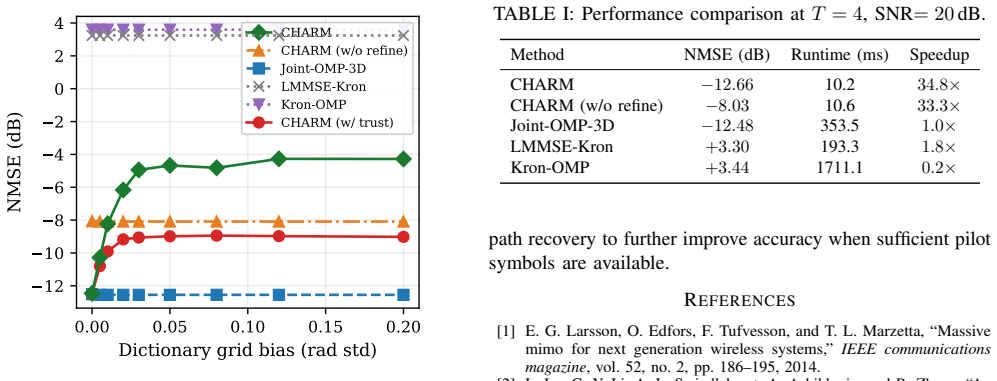
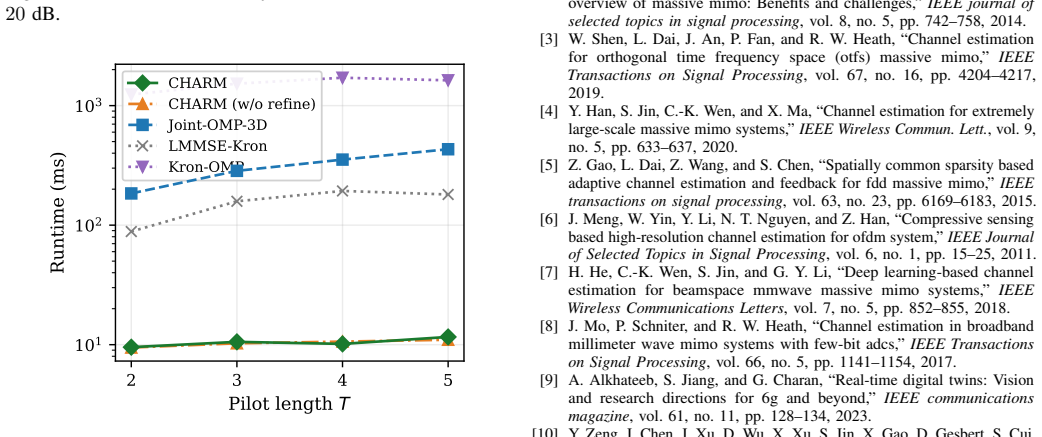
The framework extracts an angular-delay power spectrum prior from path-level radio maps offline. The prior identifies the joint angle-of-arrival and delay support of the dominant multipath components. This reduces the online estimation to a one-dimensional angle-of-departure search per path. A trust-region constraint is further introduced to prevent sub-grid refinement from diverging under dictionary mismatch. Simulation results show that this achieves accuracy comparable to three-dimensional joint orthogonal matching pursuit (OMP) with 34.8× speedup at pilot length T ≤ 4, and that the trust-region variant degrades by only 3.7 dB under severe dictionary mismatch of 0.2 rad standard deviation
What carries the argument
Angular-delay power spectrum (ADPS) prior extracted from path-level radio maps, used to identify joint AoA and delay support of dominant paths, reducing online estimation to 1D AoD search per path, with trust-region constraint for robustness.
If this is right
- Enables accurate estimation with very short pilot sequences (T ≤ 4).
- Delivers 34.8× computational speedup compared to three-dimensional joint OMP.
- Limits performance degradation to 3.7 dB under 0.2 rad dictionary mismatch instead of 8.2 dB.
- Suitable for real-time applications in pilot-starved massive MIMO-OFDM systems where radio maps are pre-available.
Where Pith is reading between the lines
- Environmental priors like radio maps could be adapted to other sparse recovery problems in wireless systems to reduce online compute.
- The 1D-per-path reduction suggests similar map-aided approaches might accelerate beamforming or localization tasks that rely on the same angular-delay structure.
- Periodic map updates would be needed in highly dynamic scenes to keep the prior accurate and preserve the reported speedups.
Load-bearing premise
Path-level radio maps exist and supply an accurate angular-delay power spectrum prior that correctly identifies the joint angle-of-arrival and delay support of the dominant multipath components.
What would settle it
Run channel estimation on a dataset where the radio map-derived ADPS prior mismatches the true channel support by more than 0.2 rad standard deviation and measure whether the error exceeds that of standard 3D joint OMP.
Figures


read the original abstract
Accurate channel estimation in massive multiple-input multiple-output orthogonal frequency division multiplexing (MIMO-OFDM) systems is challenging when the number of pilot symbols is much smaller than the number of transmit antennas. Conventional compressed sensing methods perform a three-dimensional search over the angle-of-arrival, angle-of-departure, and delay domains, which incurs high computational cost. In this paper, we propose CHARM (channel estimation with angular-delay radio map), a framework that extracts an angular-delay power spectrum (ADPS) prior from path-level radio maps. The ADPS identifies the joint angle-of-arrival and delay support of the dominant multipath components offline, reducing the online estimation to a one-dimensional angle-of-departure search per path. A trust-region constraint is further introduced to prevent sub-grid refinement from diverging under dictionary mismatch. Simulation results show that CHARM achieves accuracy comparable to three-dimensional joint orthogonal matching pursuit (OMP) with $34.8\times$ speedup at pilot length $T \leq 4$, and that the trust-region variant degrades by only 3.7~dB under severe dictionary mismatch of 0.2~rad standard deviation, compared with 8.2~dB without the constraint.
Editorial analysis
A structured set of objections, weighed in public.
Referee Report
Summary. The manuscript proposes CHARM, a channel estimation framework for pilot-starved massive MIMO-OFDM systems. It extracts an angular-delay power spectrum (ADPS) prior from path-level radio maps to identify the joint AoA-delay support of dominant multipath components offline, reducing online estimation to a 1D AoD search per path. A trust-region constraint is added to regularize sub-grid refinement under dictionary mismatch. Simulations claim CHARM achieves accuracy comparable to 3D joint OMP with 34.8× speedup at T ≤ 4, and the trust-region variant degrades by only 3.7 dB under 0.2 rad mismatch versus 8.2 dB without the constraint.
Significance. If the radio-map priors reliably identify the correct joint AoA-delay support, the approach offers a substantial reduction in computational complexity for compressed-sensing-based channel estimation in massive MIMO, potentially enabling real-time operation under severe pilot constraints. The trust-region mechanism is a practical addition for robustness. The work connects radio mapping with sparse recovery techniques and could influence practical system design if the priors prove obtainable and accurate in deployment.
major comments (3)
- [Abstract] Abstract: The reported performance metrics (34.8× speedup and 3.7 dB vs. 8.2 dB degradation) are presented without any description of the channel models used, the exact construction of the angle/delay dictionaries, the number of Monte-Carlo trials, or error-bar reporting. These omissions make it impossible to assess reproducibility or statistical reliability of the central claims.
- [Proposed method] Proposed method (description of ADPS extraction and 1D reduction): The speedup and accuracy advantage over 3D OMP rest entirely on the assumption that the offline ADPS prior correctly identifies the joint AoA-delay support of the dominant paths. No quantitative analysis, sensitivity study, or simulation of support-identification error rates (e.g., missed or spurious paths) is provided; an erroneous support set would cause the subsequent 1D AoD search to operate on incorrect atoms and erase the reported gains.
- [Simulation results] Simulation results: The trust-region constraint is shown to limit degradation under dictionary mismatch, but the evaluation only perturbs the dictionary after the support has already been fixed by the (presumably perfect) radio-map prior. There is no corresponding experiment that injects realistic map-derived support errors and measures the resulting NMSE, which is the load-bearing assumption for the entire framework.
minor comments (2)
- [Notation] Notation for the ADPS prior and the trust-region radius should be introduced with explicit mathematical definitions rather than descriptive text only.
- [Introduction] The abstract and introduction would benefit from a brief statement of the assumed availability and accuracy of path-level radio maps in practical deployments.
Simulated Author's Rebuttal
We thank the referee for the constructive and detailed feedback on our manuscript. We address each major comment below with clarifications and commit to specific revisions that strengthen the presentation of our results and assumptions.
read point-by-point responses
-
Referee: [Abstract] Abstract: The reported performance metrics (34.8× speedup and 3.7 dB vs. 8.2 dB degradation) are presented without any description of the channel models used, the exact construction of the angle/delay dictionaries, the number of Monte-Carlo trials, or error-bar reporting. These omissions make it impossible to assess reproducibility or statistical reliability of the central claims.
Authors: We agree that the abstract would benefit from additional context to support reproducibility. In the revised manuscript we will expand the abstract with a concise description of the key simulation parameters, including the channel model, dictionary grid resolutions, number of Monte-Carlo trials, and the reporting of averaged results with error bars. revision: yes
-
Referee: [Proposed method] Proposed method (description of ADPS extraction and 1D reduction): The speedup and accuracy advantage over 3D OMP rest entirely on the assumption that the offline ADPS prior correctly identifies the joint AoA-delay support of the dominant paths. No quantitative analysis, sensitivity study, or simulation of support-identification error rates (e.g., missed or spurious paths) is provided; an erroneous support set would cause the subsequent 1D AoD search to operate on incorrect atoms and erase the reported gains.
Authors: The CHARM framework is predicated on the availability of accurate ADPS priors from path-level radio maps, which enable the reduction from 3D to 1D search. The current manuscript focuses on the online estimation algorithm and trust-region refinement under this assumption rather than on modeling radio-map inaccuracies. We acknowledge that a sensitivity study would strengthen the claims and will add a new subsection with simulations that inject support identification errors (missed and spurious paths) and quantify their effect on NMSE and speedup. revision: yes
-
Referee: [Simulation results] Simulation results: The trust-region constraint is shown to limit degradation under dictionary mismatch, but the evaluation only perturbs the dictionary after the support has already been fixed by the (presumably perfect) radio-map prior. There is no corresponding experiment that injects realistic map-derived support errors and measures the resulting NMSE, which is the load-bearing assumption for the entire framework.
Authors: The presented experiments isolate the benefit of the trust-region constraint under dictionary mismatch while holding support fixed, in order to clearly demonstrate its regularization effect. We agree that evaluating performance under imperfect support is essential for practical relevance. In the revised manuscript we will add corresponding experiments that introduce realistic support errors derived from the radio-map prior and report the resulting NMSE for both the baseline and trust-region variants of CHARM. revision: yes
Circularity Check
No significant circularity; derivation relies on external radio-map priors and independent simulation benchmarks
full rationale
The paper's core reduction—from 3D joint OMP to 1D AoD search per path—is achieved by importing an ADPS support set from offline path-level radio maps, which is an external input rather than a quantity fitted or defined from the online estimation data. Simulation results comparing NMSE and runtime to 3D OMP are reported under controlled mismatch conditions and do not reduce to tautological reuse of the same fitted parameters. No self-citations, ansatzes, or uniqueness theorems from prior author work are invoked to justify the central claims, and the trust-region constraint is a standard regularization step whose effect is quantified separately. The method is therefore self-contained against external benchmarks.
Axiom & Free-Parameter Ledger
axioms (1)
- domain assumption Path-level radio maps exist and supply an accurate angular-delay power spectrum prior that correctly identifies the joint angle-of-arrival and delay support of the dominant multipath components.
Lean theorems connected to this paper
-
IndisputableMonolith/Foundation/RealityFromDistinction.leanreality_from_one_distinction unclearThe ADPS identifies the joint angle-of-arrival and delay support of the dominant multipath components offline, reducing the online estimation to a one-dimensional angle-of-departure search per path.
-
IndisputableMonolith/Cost/FunctionalEquation.leanwashburn_uniqueness_aczel unclearA trust-region constraint is further introduced to prevent sub-grid refinement from diverging under dictionary mismatch.
Reference graph
Works this paper leans on
-
[1]
Massive mimo for next generation wireless systems,
E. G. Larsson, O. Edfors, F. Tufvesson, and T. L. Marzetta, “Massive mimo for next generation wireless systems,”IEEE communications magazine, vol. 52, no. 2, pp. 186–195, 2014
work page 2014
-
[2]
An overview of massive mimo: Benefits and challenges,
L. Lu, G. Y . Li, A. L. Swindlehurst, A. Ashikhmin, and R. Zhang, “An overview of massive mimo: Benefits and challenges,”IEEE journal of selected topics in signal processing, vol. 8, no. 5, pp. 742–758, 2014
work page 2014
-
[3]
Channel estimation for orthogonal time frequency space (otfs) massive mimo,
W. Shen, L. Dai, J. An, P. Fan, and R. W. Heath, “Channel estimation for orthogonal time frequency space (otfs) massive mimo,”IEEE Transactions on Signal Processing, vol. 67, no. 16, pp. 4204–4217, 2019
work page 2019
-
[4]
Channel estimation for extremely large-scale massive mimo systems,
Y . Han, S. Jin, C.-K. Wen, and X. Ma, “Channel estimation for extremely large-scale massive mimo systems,”IEEE Wireless Commun. Lett., vol. 9, no. 5, pp. 633–637, 2020
work page 2020
-
[5]
Spatially common sparsity based adaptive channel estimation and feedback for fdd massive mimo,
Z. Gao, L. Dai, Z. Wang, and S. Chen, “Spatially common sparsity based adaptive channel estimation and feedback for fdd massive mimo,”IEEE transactions on signal processing, vol. 63, no. 23, pp. 6169–6183, 2015
work page 2015
-
[6]
Compressive sensing based high-resolution channel estimation for ofdm system,
J. Meng, W. Yin, Y . Li, N. T. Nguyen, and Z. Han, “Compressive sensing based high-resolution channel estimation for ofdm system,”IEEE Journal of Selected Topics in Signal Processing, vol. 6, no. 1, pp. 15–25, 2011
work page 2011
-
[7]
Deep learning-based channel estimation for beamspace mmwave massive mimo systems,
H. He, C.-K. Wen, S. Jin, and G. Y . Li, “Deep learning-based channel estimation for beamspace mmwave massive mimo systems,”IEEE Wireless Communications Letters, vol. 7, no. 5, pp. 852–855, 2018
work page 2018
-
[8]
Channel estimation in broadband millimeter wave mimo systems with few-bit adcs,
J. Mo, P. Schniter, and R. W. Heath, “Channel estimation in broadband millimeter wave mimo systems with few-bit adcs,”IEEE Transactions on Signal Processing, vol. 66, no. 5, pp. 1141–1154, 2017
work page 2017
-
[9]
Real-time digital twins: Vision and research directions for 6g and beyond,
A. Alkhateeb, S. Jiang, and G. Charan, “Real-time digital twins: Vision and research directions for 6g and beyond,”IEEE communications magazine, vol. 61, no. 11, pp. 128–134, 2023
work page 2023
-
[10]
A tutorial on environment-aware communications via channel knowledge map for 6G,
Y . Zeng, J. Chen, J. Xu, D. Wu, X. Xu, S. Jin, X. Gao, D. Gesbert, S. Cui, and R. Zhang, “A tutorial on environment-aware communications via channel knowledge map for 6G,”IEEE Commun. Surveys Tuts., vol. 26, no. 3, pp. 1478–1519, 2024
work page 2024
-
[11]
X. Wang, K. Tao, N. Cheng, Z. Yin, Z. Li, Y . Zhang, and X. Shen, “RadioDiff: An effective generative diffusion model for sampling- free dynamic radio map construction,”Ieee Trans. Cognit. Commun. Networking, Early Access, pp. 1–13, 2024
work page 2024
-
[12]
X. Wang, Q. Zhang, N. Cheng, R. Sun, Z. Li, S. Cui, and X. Shen, “Radiodiff-k2: Helmholtz equation informed generative diffusion model for multi-path aware radio map construction,”IEEE J. Sel. Areas Commun., vol. 44, pp. 2318–2333, 2026
work page 2026
-
[13]
RadioUNet: Fast radio map estimation with convolutional neural networks,
R. Levie, C ¸. Yapar, G. Kutyniok, and G. Caire, “RadioUNet: Fast radio map estimation with convolutional neural networks,”IEEE Trans. Wireless Commun., vol. 20, no. 6, pp. 4001–4015, 2021
work page 2021
-
[14]
Toward environment-aware 6G communications via channel knowledge map,
Y . Zeng and X. Xu, “Toward environment-aware 6G communications via channel knowledge map,”Ieee Wireless Commun., vol. 28, no. 3, pp. 84–91, 2021
work page 2021
-
[15]
A Tutorial on Learning-Based Radio Map Construction: Data, Paradigms, and Physics-Awareness
X. Wang, Y . Pan, and N. Cheng, “A tutorial on learning-based radio map construction: Data, paradigms, and physics-awarenes,”arXiv preprint arXiv:2603.17499, 2026
work page internal anchor Pith review Pith/arXiv arXiv 2026
-
[16]
Digital twin based beam prediction: Can we train in the digital world and deploy in reality?
S. Jiang and A. Alkhateeb, “Digital twin based beam prediction: Can we train in the digital world and deploy in reality?” in2023 IEEE International Conference on Communications Workshops (ICC Workshops). IEEE, 2023, pp. 36–41
work page 2023
-
[17]
MIMO channel estimation method using ray-tracing propagation model,
S. Oh and N.-H. Myung, “MIMO channel estimation method using ray-tracing propagation model,”Electronics Lett., vol. 40, no. 21, p. 1, 2004
work page 2004
discussion (0)
Sign in with ORCID, Apple, or X to comment. Anyone can read and Pith papers without signing in.