Recognition: 2 theorem links
· Lean TheoremCoupling magma-ocean and atmospheres in spectral retrievals of sub-Neptunes
Pith reviewed 2026-05-12 00:54 UTC · model grok-4.3
The pith
Embedding coupled magma-atmosphere models in Bayesian retrievals constrains sub-Neptune magma oxidation state and volatiles from spectra.
A machine-rendered reading of the paper's core claim, the machinery that carries it, and where it could break.
Core claim
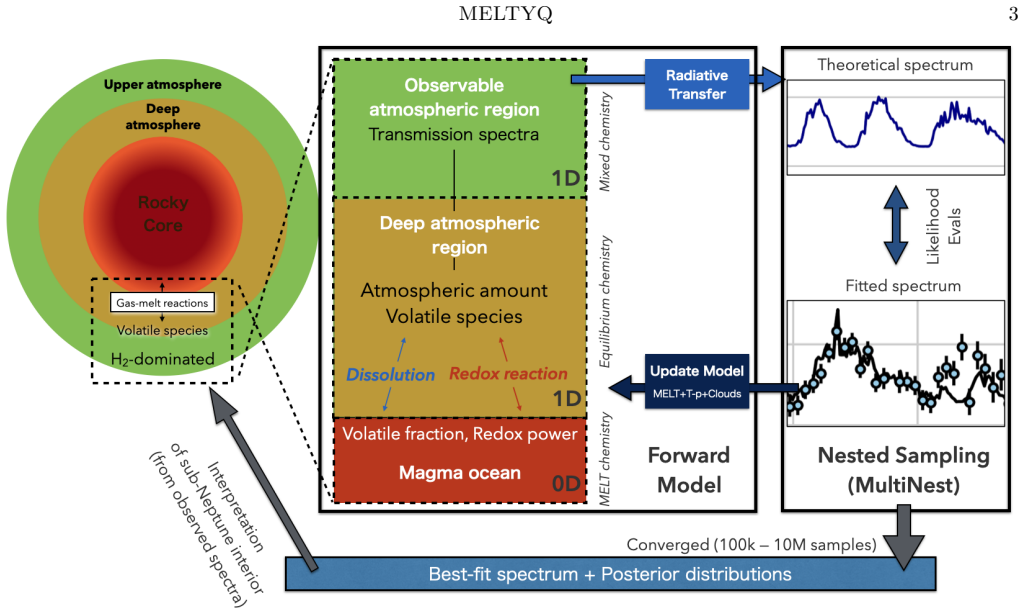
MELTYQ embeds a magma-atmosphere equilibrium model, which includes solubility of H/O/C/N species in the melt and redox reactions, inside a Bayesian spectral retrieval scheme. This allows retrieval of the magma redox state and volatile content from transmission spectra. Validation on simulated data shows the parameters are recoverable under favorable conditions, while application to K2-18 b and TOI-270 d demonstrates that the coupled model can reproduce observed spectra, although free retrievals remain statistically preferred and certain features like the 4.5 micron absorption are not fully captured.
What carries the argument
MELTYQ, the retrieval framework that couples a magma-atmosphere chemical equilibrium model (solubility plus redox) to Bayesian inference on transmission spectra.
If this is right
- Magma redox state becomes a retrievable parameter from spectra under favorable observational conditions.
- Volatile inventory of the magma ocean can be constrained alongside atmospheric properties.
- Degeneracies between atmospheric and interior parameters can be quantitatively mapped.
- The method establishes a direct pathway from observed spectra to magma composition in sub-Neptunes.
Where Pith is reading between the lines
- Higher-precision spectra expected from continued JWST observations could reduce the current statistical preference for free retrievals and tighten magma constraints.
- The framework supplies a concrete testbed for checking whether equilibrium assumptions hold across a larger sample of sub-Neptunes.
- If the coupling is confirmed, the approach could be extended to include additional chemical species or modest departures from equilibrium to broaden its use.
Load-bearing premise
The atmosphere remains in chemical equilibrium with an underlying magma ocean through solubility of key species and redox reactions that the model accurately captures.
What would settle it
Transmission spectra of a sub-Neptune that cannot be fit by any equilibrium-coupled model but require atmospheric compositions outside the range allowed by magma solubility and redox balance.
Figures




read the original abstract
Recent high-precision atmospheric observations with JWST is enabling detailed characterization of sub-Neptune atmospheres and motivating efforts to understand and constrain their interiors. Theoretical studies suggest that sub-Neptunes possibly host hydrogen-dominated atmospheres that are chemically coupled with an underlying magma ocean. However, a quantitative retrieval framework directly linking atmospheric spectra to magma ocean properties has yet to be established. Here we introduce MELTYQ, a coupled magma-atmosphere retrieval framework that links transmission spectra to the oxidation state and volatile inventory of underlying magma oceans. MELTYQ combines a magma-atmosphere equilibrium model, which includes the solubility of H-/O-/C-/N-bearing species in the melt and redox reactions, with a Bayesian spectral retrieval scheme. Using simulated retrieval tests, we validate the approach and show that magma redox state and volatile content can be constrained under favorable observational conditions. As a proof of concept, we apply MELTYQ to JWST transmission spectra of the benchmark sub-Neptunes K2-18 b and TOI-270 d. We find that coupled magma-atmosphere retrievals are generally capable of reproducing the observed spectra of these planets. However, we identify several key limitations in the current framework. Specifically: more flexible free-retrieval approaches remain statistically preferred; the CO/CO$_2$ absorption feature near 4.5 $\mu$m for TOI-270 d is not fully captured; and a number of underlying model assumptions may not be strictly valid. Nevertheless, embedding coupled magma-atmosphere models directly within Bayesian retrievals enables quantitative assessment of degeneracies and sensitivities, establishing a pathway for directly connecting atmospheric spectra to magma composition in this underexplored exoplanet regime.
Editorial analysis
A structured set of objections, weighed in public.
Referee Report
Summary. The paper introduces MELTYQ, a Bayesian retrieval framework that embeds a magma-ocean equilibrium chemistry model (solubility of H/O/C/N species plus redox reactions) directly into spectral retrievals. It validates the approach on simulated transmission spectra, showing that magma oxidation state and volatile inventory can be recovered under favorable conditions, then applies it as a proof-of-concept to JWST data for K2-18 b and TOI-270 d. The authors report that coupled retrievals can reproduce the observed spectra but note that unconstrained free-retrieval models are statistically preferred and that the 4.5 μm CO/CO₂ feature in TOI-270 d is not fully captured.
Significance. If the equilibrium coupling can be shown to fit real data at least as well as free retrievals while still yielding informative constraints on magma properties, the framework would enable quantitative exploration of atmosphere-interior degeneracies and provide a concrete pathway from transmission spectra to magma redox state and volatile budgets. The simulated retrieval tests constitute a clear methodological strength, demonstrating recoverability when the forward model is correct.
major comments (3)
- [Application to JWST spectra of TOI-270 d] In the proof-of-concept application to TOI-270 d, the MELTYQ model does not reproduce the CO/CO₂ absorption feature near 4.5 μm while free-retrieval models do; this mismatch indicates that the assumed equilibrium solubility and redox coupling omits processes required by the data, directly undermining the claim that the framework establishes a reliable link between spectra and magma composition.
- [Statistical comparison with free retrievals] Free-retrieval approaches remain statistically preferred over MELTYQ for both K2-18 b and TOI-270 d. Because the central claim rests on the coupled model enabling quantitative assessment of degeneracies, the consistent statistical disfavoring shows that the additional equilibrium constraints are not justified by current observations and weakens the pathway argument.
- [Discussion of model limitations] The paper acknowledges that several underlying model assumptions (chemical equilibrium, no clouds, fixed redox buffering) may not be strictly valid, yet provides no sensitivity tests quantifying how violations propagate into the retrieved magma oxidation state and volatile inventory; this is load-bearing for any claim that magma parameters can be meaningfully constrained.
minor comments (1)
- [Abstract] The abstract contains a subject-verb agreement error: 'Recent high-precision atmospheric observations with JWST is enabling' should read 'are enabling'.
Simulated Author's Rebuttal
We thank the referee for their detailed and constructive report. We address each major comment below with clarifications and indicate where revisions will be made to improve the manuscript.
read point-by-point responses
-
Referee: [Application to JWST spectra of TOI-270 d] In the proof-of-concept application to TOI-270 d, the MELTYQ model does not reproduce the CO/CO₂ absorption feature near 4.5 μm while free-retrieval models do; this mismatch indicates that the assumed equilibrium solubility and redox coupling omits processes required by the data, directly undermining the claim that the framework establishes a reliable link between spectra and magma composition.
Authors: We agree that the 4.5 μm feature is not fully reproduced and have already highlighted this in the abstract and discussion as a key limitation. The framework's purpose is to enable quantitative evaluation of such mismatches and the resulting degeneracies between atmospheric and magma parameters, rather than to assert that equilibrium models fit all current data. This mismatch usefully demonstrates where additional physics (e.g., disequilibrium chemistry) must be incorporated. We will revise the text to more explicitly position the results as identifying the boundaries of the current assumptions, thereby reinforcing rather than undermining the pathway to linking spectra with magma properties. revision: partial
-
Referee: [Statistical comparison with free retrievals] Free-retrieval approaches remain statistically preferred over MELTYQ for both K2-18 b and TOI-270 d. Because the central claim rests on the coupled model enabling quantitative assessment of degeneracies, the consistent statistical disfavoring shows that the additional equilibrium constraints are not justified by current observations and weakens the pathway argument.
Authors: The manuscript already states that free retrievals are statistically preferred. The core contribution is not superior fit statistics but the ability to retrieve physically motivated magma oxidation states and volatile inventories while directly quantifying how equilibrium constraints affect the posterior and degeneracy structure. Even when disfavored, the coupled model yields informative bounds on magma parameters that can be compared to theoretical predictions. We will expand the discussion to include explicit posterior constraints on magma properties and their sensitivity to the data, clarifying the framework's value for future observations with higher precision. revision: partial
-
Referee: [Discussion of model limitations] The paper acknowledges that several underlying model assumptions (chemical equilibrium, no clouds, fixed redox buffering) may not be strictly valid, yet provides no sensitivity tests quantifying how violations propagate into the retrieved magma oxidation state and volatile inventory; this is load-bearing for any claim that magma parameters can be meaningfully constrained.
Authors: This criticism is fair. Although the assumptions are discussed, we did not include quantitative sensitivity tests in the submitted version. We will add such tests (varying equilibrium assumptions, cloud inclusion, and redox buffering) and report their impact on the retrieved magma oxidation state and volatile inventory. These results will be incorporated into the revised manuscript to demonstrate the robustness of the constraints. revision: yes
Circularity Check
MELTYQ retrieval framework combines independent equilibrium chemistry and Bayesian methods with no reduction to self-fitted inputs or self-citation chains
full rationale
The paper introduces a coupled retrieval code (MELTYQ) that embeds an existing magma-atmosphere equilibrium solver (solubility + redox) inside a standard Bayesian spectral retrieval pipeline. Validation uses simulated spectra generated from the same forward model, which is the expected and non-circular use of a forward model for testing recoverability. Application to real JWST data for K2-18 b and TOI-270 d shows that the coupled model is statistically disfavored relative to free retrievals and fails to reproduce the 4.5 μm feature, which the authors explicitly report as a limitation rather than a success. No equation or result is shown to be equivalent to its own inputs by construction, no parameter is fitted on a subset and then relabeled a prediction, and no load-bearing premise rests on a self-citation whose content is itself unverified. The central claim is simply that the framework exists and can be used to quantify degeneracies; this is a methodological contribution whose validity does not collapse into tautology.
Axiom & Free-Parameter Ledger
free parameters (2)
- magma oxidation state
- volatile inventory
axioms (2)
- domain assumption Chemical equilibrium governs exchanges between magma ocean and atmosphere
- domain assumption Solubility laws for H-/O-/C-/N-bearing species in silicate melt are known and applicable
Lean theorems connected to this paper
-
IndisputableMonolith/Foundation/RealityFromDistinction.leanreality_from_one_distinction unclearMELTYQ combines a magma-atmosphere equilibrium model, which includes the solubility of H-/O-/C-/N-bearing species in the melt and redox reactions, with a Bayesian spectral retrieval scheme.
-
IndisputableMonolith/Cost/FunctionalEquation.leanwashburn_uniqueness_aczel unclearThe partition-ing of the H-/C-/O-/N-bearing species at the magma-atmosphere interface is governed by dissolution and re-dox reactions.
Reference graph
Works this paper leans on
-
[1]
Exploring the Ability of Hubble Space Telescope WFC3 G141 to Uncover Trends in Populations of Exoplanet Atmospheres through a Homogeneous Transmission Survey of 70 Gaseous Planets. , keywords =. doi:10.3847/1538-4365/ac9f1a , archivePrefix =. 2211.00649 , primaryClass =
-
[2]
Toward Atmospheric Retrievals of Panchromatic Light Curves: EXPLOR-ing Generalized Inversion Techniques for Transiting Exoplanets with JWST and Ariel. , keywords =. doi:10.3847/1538-3881/ad3032 , archivePrefix =. 2403.02244 , primaryClass =
-
[3]
JWST NIRISS Transmission Spectrum of K2-18 b , url=
Madhusudhan, Nikku , year=. JWST NIRISS Transmission Spectrum of K2-18 b , url=. doi:10.17605/OSF.IO/36DJH , publisher=
-
[4]
JWST MIRI Transmission Spectrum of K2-18 b , url=
Madhusudhan, Nikku , year=. JWST MIRI Transmission Spectrum of K2-18 b , url=
-
[5]
JWST NIRSpec Transmission Spectrum of TOI-270 d , url=
Madhusudhan, Nikku , year=. JWST NIRSpec Transmission Spectrum of TOI-270 d , url=
-
[6]
JWST reveals a water-rich world in the temperate sub-Neptune K2-18 b , url=
Hu, Renyu , year=. JWST reveals a water-rich world in the temperate sub-Neptune K2-18 b , url=. doi:10.17605/OSF.IO/HPU8G , publisher=
-
[7]
Industrial & Engineering Chemistry Research , volume =
Posada, Alberto and Manousiouthakis, Vasilios , title =. Industrial & Engineering Chemistry Research , volume =. 2005 , doi =
work page 2005
-
[8]
Scientific Reports , year = 2020, month = jul, volume =
Mantle redox state drives outgassing chemistry and atmospheric composition of rocky planets. Scientific Reports , year = 2020, month = jul, volume =. doi:10.1038/s41598-020-67751-7 , adsurl =
-
[9]
YunMa: Enabling Spectral Retrievals of Exoplanetary Clouds. , keywords =. doi:10.3847/1538-4357/acf8ca , archivePrefix =. 2301.13708 , primaryClass =
-
[10]
Photochemically produced SO _ 2 in the atmosphere of WASP-39b. , keywords =. doi:10.1038/s41586-023-05902-2 , archivePrefix =. 2211.10490 , primaryClass =
-
[11]
Competing chemical signatures in the atmosphere of TOI-270 d: Inference of sulfur and carbon chemistry. , keywords =. doi:10.1051/0004-6361/202555194 , archivePrefix =. 2504.13039 , primaryClass =
-
[12]
Development of a C/H/O/N/S chemical network: Experimental benchmark, application to exoplanets, and identification of key C/S coupling pathways. , keywords =. doi:10.1051/0004-6361/202555595 , archivePrefix =. 2505.12152 , primaryClass =
-
[13]
Journal of Petrology , year = 2002, month = jun, volume =
The Sulfide Capacity and the Sulfur Content at Sulfide Saturation of Silicate Melts at 1400degreesC and 1 bar. Journal of Petrology , year = 2002, month = jun, volume =. doi:10.1093/petrology/43.6.1049 , adsurl =
-
[14]
Contributions to Mineralogy and Petrology , keywords =
Sulfur oxidation state and solubility in silicate melts. Contributions to Mineralogy and Petrology , keywords =. doi:10.1007/s00410-023-02033-9 , adsurl =
-
[15]
Kunz, O. and Wagner, W. , title =. Journal of Chemical & Engineering Data , volume =. 2012 , doi =
work page 2012
-
[16]
Beckmüller, R. and Thol, M. and Bell, I. H. and Lemmon, E. W. and Span, R. , title =. Journal of Physical and Chemical Reference Data , volume =. 2021 , month =. doi:10.1063/5.0040533 , url =
-
[17]
, year = 2006, month = may, volume =
Equation of state of the H _ 2 O, CO _ 2 , and H _ 2 O-CO _ 2 systems up to 10 GPa and 2573.15 K: Molecular dynamics simulations with ab initio potential surface. , year = 2006, month = may, volume =. doi:10.1016/j.gca.2006.02.009 , adsurl =
-
[18]
Denbigh, K. G. , title =. 1981 , publisher =
work page 1981
-
[19]
The Effects of Non-ideal Mixing in Planetary Magma Oceans and Atmospheres. , keywords =. doi:10.3847/1538-4357/ae434d , archivePrefix =. 2602.05917 , primaryClass =
-
[20]
Phase Equilibria of Sub-Neptunes and Super-Earths. , keywords =. doi:10.3847/PSJ/ad8c40 , archivePrefix =. 2408.11321 , primaryClass =
-
[21]
Applied Spectroscopy , year = 2004, month = dec, volume =
Gas-Phase Databases for Quantitative Infrared Spectroscopy. Applied Spectroscopy , year = 2004, month = dec, volume =. doi:10.1366/0003702042641281 , adsurl =
-
[22]
I.E. Gordon and L.S. Rothman and R.J. Hargreaves and F.M. Gomez and T. Bertin and C. Hill and R.V. Kochanov and Y. Tan and P. Wcisło and V. Yu. Makhnev and P.F. Bernath and M. Birk and V. Boudon and A. Campargue and A. Coustenis and B.J. Drouin and R.R. Gamache and J.T. Hodges and D. Jacquemart and E.J. Mlawer and A.V. Nikitin and V.I. Perevalov and M. Ro...
-
[23]
Redox Hysteresis of Super-Earth Exoplanets from Magma Ocean Circulation. , keywords =. doi:10.3847/2041-8213/ac0146 , archivePrefix =. 2105.11208 , primaryClass =
- [24]
-
[25]
Geochemistry, Geophysics, Geosystems , keywords =
The mean composition of ocean ridge basalts. Geochemistry, Geophysics, Geosystems , keywords =. doi:10.1029/2012GC004334 , adsurl =
-
[26]
Contribution of the Core to the Thermal Evolution of Sub-Neptunes. , keywords =. doi:10.3847/1538-4357/aaef33 , archivePrefix =. 1811.02588 , primaryClass =
-
[27]
Re-analysis of ten hot-Jupiter atmospheres with disequilibrium chemistry retrieval. , keywords =. doi:10.1051/0004-6361/202453518 , archivePrefix =. 2506.12806 , primaryClass =
-
[28]
Indication of disequilibrium chemistry for HD 209458b and WASP-39b
Implementation of disequilibrium chemistry to spectral retrieval code ARCiS and application to 16 exoplanet transmission spectra. Indication of disequilibrium chemistry for HD 209458b and WASP-39b. , keywords =. doi:10.1051/0004-6361/202141548 , archivePrefix =. 2110.13443 , primaryClass =
-
[29]
and Rocchetto, Marco and Yurchenko, Sergei N
Chubb, Katy L. and Rocchetto, Marco and Yurchenko, Sergei N. and Min, Michiel and Waldmann, Ingo and Barstow, Joanna K. and Mollière, Paul and Al-Refaie, Ahmed F. and Phillips, Mark W. and Tennyson, Jonathan , year=. The ExoMolOP database: Cross sections and k-tables for molecules of interest in high-temperature exoplanet atmospheres , volume=. doi:10.105...
-
[30]
Jonathan Tennyson and Sergei N. Yurchenko and Ahmed F. Al-Refaie and Emma J. Barton and Katy L. Chubb and Phillip A. Coles and S. Diamantopoulou and Maire N. Gorman and Christian Hill and Aden Z. Lam and Lorenzo Lodi and Laura K. McKemmish and Yueqi Na and Alec Owens and Oleg L. Polyansky and Tom Rivlin and Clara Sousa-Silva and Daniel S. Underwood and An...
-
[31]
S. N. Yurchenko and D. S. Amundsen AND J. Tennyson and I P Waldmann , title =. A&A , volume =. doi:10.1051/0004-6361/201731026 , year=
-
[32]
The Astrophysical Journal Supplement Series , volume=
Rovibrational line lists for nine isotopologues of the CO molecule in the X 1 + ground electronic state , author=. The Astrophysical Journal Supplement Series , volume=. 2015 , publisher=
work page 2015
-
[33]
Yurchenko, S N and Mellor, Thomas M and Freedman, Richard S and Tennyson, J , year=. ExoMol line lists – XXXIX. Ro-vibrational molecular line list for CO2 , volume=. Monthly Notices of the Royal Astronomical Society , publisher=. doi:10.1093/mnras/staa1874 , number=
-
[34]
Monthly Notices of the Royal Astronomical Society , volume=
ExoMol molecular line lists XXX: a complete high-accuracy line list for water , author=. Monthly Notices of the Royal Astronomical Society , volume=. 2018 , publisher=
work page 2018
-
[35]
Yurchenko, S. N. and Barber, R. J. and Tennyson, J. , year=. A variationally computed line list for hot NH3 , volume=. Monthly Notices of the Royal Astronomical Society , publisher=. doi:10.1111/j.1365-2966.2011.18261.x , number=
-
[36]
The Journal of Physical Chemistry A , volume=
Collision-induced absorption by H2 pairs: From hundreds to thousands of kelvin , author=. The Journal of Physical Chemistry A , volume=. 2011 , publisher=
work page 2011
-
[37]
The Astrophysical Journal Supplement Series , volume=
Hydrogen dimers in giant-planet infrared spectra , author=. The Astrophysical Journal Supplement Series , volume=. 2018 , publisher=
work page 2018
-
[38]
The Journal of chemical physics , volume=
Infrared absorption by collisional H2--He complexes at temperatures up to 9000 K and frequencies from 0 to 20 000 cm- 1 , author=. The Journal of chemical physics , volume=. 2012 , publisher=
work page 2012
- [39]
-
[40]
Quenching of Carbon Monoxide and Methane in the Atmospheres of Cool Brown Dwarfs and Hot Jupiters. , keywords =. doi:10.1088/0004-637X/738/1/72 , archivePrefix =. 1106.3525 , primaryClass =
-
[41]
Disequilibrium Carbon, Oxygen, and Nitrogen Chemistry in the Atmospheres of HD 189733b and HD 209458b. , keywords =. doi:10.1088/0004-637X/737/1/15 , archivePrefix =. 1102.0063 , primaryClass =
-
[42]
A chemical model for the atmosphere of hot Jupiters. , keywords =. doi:10.1051/0004-6361/201219310 , archivePrefix =. 1208.0560 , primaryClass =
-
[43]
The Intrinsic Temperature and Radiative-Convective Boundary Depth in the Atmospheres of Hot Jupiters. , keywords =. doi:10.3847/2041-8213/ab43d0 , archivePrefix =. 1907.07777 , primaryClass =
-
[44]
A cool runaway greenhouse without surface magma ocean. , keywords =. doi:10.1038/s41586-023-06258-3 , archivePrefix =. 2311.08444 , primaryClass =
-
[45]
Journal of Physical and Chemical Reference Data , year = 2023, month = mar, volume =
A Reference Equation of State with an Associating Term for the Thermodynamic Properties of Ammonia. Journal of Physical and Chemical Reference Data , year = 2023, month = mar, volume =. doi:10.1063/5.0128269 , adsurl =
-
[46]
Diversity of Low-mass Planet Atmospheres in the C─H─O─N─S─Cl System with Interior Dissolution, Nonideality, and Condensation: Application to TRAPPIST-1e and Sub-Neptunes. , keywords =. doi:10.3847/1538-4357/ae1479 , archivePrefix =. 2507.00499 , primaryClass =
-
[47]
Chemical Equilibrium between Cores, Mantles, and Atmospheres of Super-Earths and Sub-Neptunes and Implications for Their Compositions, Interiors, and Evolution. , keywords =. doi:10.3847/PSJ/ac68e6 , archivePrefix =. 2107.10405 , primaryClass =
-
[48]
A 3D picture of moist-convection inhibition in hydrogen-rich atmospheres: Implications for K2-18 b. , keywords =. doi:10.1051/0004-6361/202348928 , archivePrefix =. 2401.06608 , primaryClass =
-
[49]
3D Modeling of Moist Convective Inhibition in Idealized Sub-Neptune Atmospheres. , keywords =. doi:10.3847/1538-4357/ae147c , archivePrefix =. 2409.18217 , primaryClass =
-
[50]
Condensation-inhibited convection in hydrogen-rich atmospheres . Stability against double-diffusive processes and thermal profiles for Jupiter, Saturn, Uranus, and Neptune. , keywords =. doi:10.1051/0004-6361/201629140 , archivePrefix =. 1610.05506 , primaryClass =
-
[51]
Differentiation, the Exception, Not the Rule: Evidence for Full Miscibility in Sub-Neptune Interiors. , keywords =. doi:10.3847/PSJ/ae1012 , archivePrefix =. 2507.00947 , primaryClass =
-
[52]
Convective inhibition with an ocean. I. Supercritical cores on sub-Neptunes/super-Earths. , keywords =. doi:10.1051/0004-6361/202243359 , archivePrefix =. 2207.04708 , primaryClass =
-
[53]
Redefining interiors and envelopes: hydrogen─silicate miscibility and its consequences for the structure and evolution of sub-Neptunes. , keywords =. doi:10.1093/mnras/staf1940 , archivePrefix =. 2509.13320 , primaryClass =
-
[54]
RAS Techniques and Instruments , year = 2024, month = jan, volume =
On the difficulties of obtaining absolute transit depths with HST WFC3: KELT-11 b, an example. RAS Techniques and Instruments , year = 2024, month = jan, volume =. doi:10.1093/rasti/rzae023 , adsurl =
-
[55]
PyMultiNest: Python interface for MultiNest
-
[56]
MULTINEST: an efficient and robust Bayesian inference tool for cosmology and particle physics. , keywords =. doi:10.1111/j.1365-2966.2009.14548.x , archivePrefix =. 0809.3437 , primaryClass =
-
[57]
Cloud and haze parameterization in atmospheric retrievals: Insights from Titan's Cassini data and JWST observations of hot Jupiters. , keywords =. doi:10.1051/0004-6361/202453186 , archivePrefix =. 2505.18715 , primaryClass =
-
[58]
Atmospheric Retrieval Analysis of the Directly Imaged Exoplanet HR 8799b. , keywords =. doi:10.1088/0004-637X/778/2/97 , archivePrefix =. 1307.1404 , primaryClass =
-
[59]
The importance of p T profile complexity
Knobs and dials of retrieving JWST transmission spectra: I. The importance of p T profile complexity. , keywords =. doi:10.1051/0004-6361/202451845 , archivePrefix =. 2409.09127 , primaryClass =
-
[60]
New chemical scheme for studying carbon-rich exoplanet atmospheres. , keywords =. doi:10.1051/0004-6361/201425311 , archivePrefix =. 1502.03567 , primaryClass =
-
[61]
Quantified Estimation of Molecular Detections across Different Classes of Neptunian Atmospheres Using Cross-correlation Spectroscopy: Prospects for Future Extremely Large Telescopes with High-resolution Spectrographs. , keywords =. doi:10.3847/1538-4365/adbf05 , archivePrefix =. 2503.01142 , primaryClass =
-
[62]
JWST COMPASS: Insights into the Systematic Noise Properties of NIRSpec/G395H From a Uniform Reanalysis of Seven Transmission Spectra. arXiv e-prints , keywords =. doi:10.48550/arXiv.2511.18196 , archivePrefix =. 2511.18196 , primaryClass =
-
[63]
The theory of transmission spectra revisited: a semi-analytical method for interpreting WFC3 data and an unresolved challenge. , keywords =. doi:10.1093/mnras/stx1453 , archivePrefix =. 1702.02051 , primaryClass =
-
[64]
Iron-w \"u stite revisited: A revised calibration accounting for variable stoichiometry and the effects of pressure. , keywords =. doi:10.1016/j.gca.2021.08.039 , adsurl =
-
[65]
, year = 1991, month = jun, volume =
The pressure and temperature dependence of carbon dioxide solubility in tholeiitic basalt melts. , year = 1991, month = jun, volume =. doi:10.1016/0016-7037(91)90130-W , adsurl =
-
[66]
, year = 2013, month = aug, volume =
Solubility of CH _ 4 in a synthetic basaltic melt, with applications to atmosphere-magma ocean-core partitioning of volatiles and to the evolution of the Martian atmosphere. , year = 2013, month = aug, volume =. doi:10.1016/j.gca.2013.03.028 , adsurl =
-
[67]
Magma ocean interactions can explain JWST observations of the sub-Neptune TOI-270 d. arXiv e-prints , keywords =. doi:10.48550/arXiv.2510.07367 , archivePrefix =. 2510.07367 , primaryClass =
-
[68]
Atmospheric C/O Ratios of Sub-Neptunes with Magma Oceans: Homemade rather than Inherited. , keywords =. doi:10.3847/2041-8213/adf185 , archivePrefix =. 2504.20450 , primaryClass =
-
[69]
Monosilane Worlds: Sub-Neptunes with Atmospheres Shaped by Reduced Magma Oceans. , keywords =. doi:10.3847/1538-4357/add3fe , archivePrefix =. 2505.03200 , primaryClass =
-
[70]
The importance of silicate vapour in determining the structure, radii, and envelope mass fractions of sub-Neptunes. , keywords =. doi:10.1093/mnras/stac1732 , archivePrefix =. 2201.04299 , primaryClass =
-
[71]
DIXON, JACQUELINE EABY and STOLPER, EDWARD M. and HOLLOWAY, JOHN R. , title =. Journal of Petrology , volume =. 1995 , month =. doi:10.1093/oxfordjournals.petrology.a037267 , url =
-
[72]
American Mineralogist , year = 2002, month = nov, volume =
A combined rapid-quench and H2-membrane setup for internally heated pressure vessels: Description and application for water solubility in basaltic melts. American Mineralogist , year = 2002, month = nov, volume =. doi:10.2138/am-2002-11-1222 , adsurl =
-
[73]
Frontiers in Earth Science , keywords =
The distribution of volatile elements during rocky planet formation. Frontiers in Earth Science , keywords =. doi:10.3389/feart.2023.1159412 , archivePrefix =. 2311.18262 , primaryClass =
-
[74]
Ascent and eruption of basaltic magma on the earth and moon. , keywords =. doi:10.1029/JB086iB04p02971 , adsurl =
-
[75]
2023, SSRv, 219, 51, doi: 10.1007/s11214-023-00995-7
Magma Ocean, Water, and the Early Atmosphere of Venus. , keywords =. doi:10.1007/s11214-023-00995-7 , adsurl =
-
[76]
Solubility of water in lunar basalt at low pH _ 2 O. , keywords =. doi:10.1016/j.gca.2016.12.026 , adsurl =
-
[77]
Earth and Planetary Science Letters , keywords =
Solubility of water in peridotite liquids and the prevalence of steam atmospheres on rocky planets. Earth and Planetary Science Letters , keywords =. doi:10.1016/j.epsl.2022.117894 , archivePrefix =. 2211.13344 , primaryClass =
-
[78]
Retention of Water in Terrestrial Magma Oceans and Carbon-rich Early Atmospheres. , keywords =. doi:10.3847/PSJ/ac5fb1 , archivePrefix =. 2110.08029 , primaryClass =
-
[79]
Atmospheric Chemistry for Astrophysicists: A Self-consistent Formalism and Analytical Solutions for Arbitrary C/O. , keywords =. doi:10.3847/0004-637X/816/2/96 , archivePrefix =. 1506.05501 , primaryClass =
-
[80]
Impact of oxygen fugacity on the atmospheric structure and emission spectra of ultra-hot rocky exoplanets. , keywords =. doi:10.1051/0004-6361/202450546 , archivePrefix =. 2408.16548 , primaryClass =
discussion (0)
Sign in with ORCID, Apple, or X to comment. Anyone can read and Pith papers without signing in.