Recognition: 2 theorem links
· Lean TheoremFidelity Where it Matters: Site-Specific Nonuniform Refinement for Wireless Digital Twins
Pith reviewed 2026-05-12 01:53 UTC · model grok-4.3
The pith
Only a small number of buildings require detailed modeling to create high-fidelity wireless digital twins for urban wireless tasks.
A machine-rendered reading of the paper's core claim, the machinery that carries it, and where it could break.
Core claim
In this work, a task-oriented nonuniform refinement framework is developed to maximize wireless task fidelity under limited resources for WDTs. For the case of building geometry in urban areas, the ellipsoid-guided selective refinement algorithm is introduced. It estimates refinement priorities for each building from a low-fidelity WDT by considering relevance to both LoS and NLoS paths. Simulations confirm that this method improves radio-map fidelity and preserves beamforming effectiveness through refinement of only a small subset of buildings.
What carries the argument
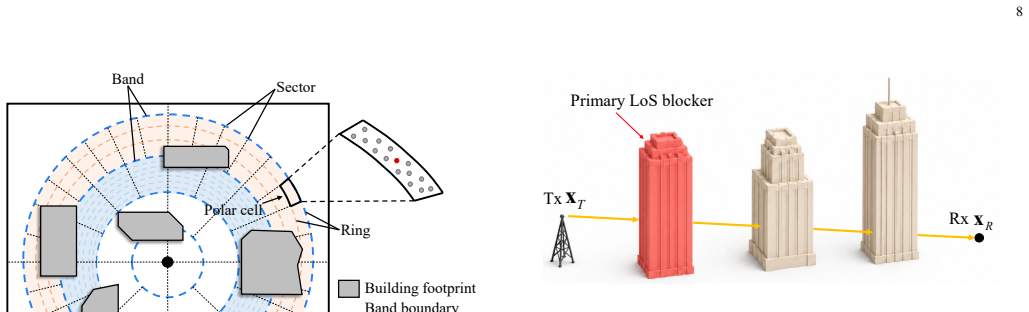
The ellipsoid-guided selective refinement (EGSR) algorithm, which determines building refinement priorities based on their estimated influence on signal propagation paths using a low-fidelity twin.
If this is right
- High task performance is achievable with far less data acquisition and computation for geometry modeling.
- Radio-map fidelity improves substantially with selective updates to key buildings.
- Beamforming remains effective even when most buildings stay at low fidelity.
- Large-scale urban WDTs become more practical to maintain over time.
- The nonuniform allocation principle applies to other WDT components beyond buildings.
Where Pith is reading between the lines
- This ranking approach could be applied to prioritize updates when environments change over time, such as new constructions.
- Similar selective methods might benefit other simulation-heavy fields like autonomous driving or climate modeling where full fidelity is expensive.
- Integrating real measurement data into the priority estimation could further improve the accuracy of selections.
Load-bearing premise
Individual buildings have distinct and predictable effects on wireless paths that allow accurate priority ranking from a low-fidelity digital twin.
What would settle it
An experiment in which the fidelity gains from EGSR-selected buildings are compared against those from an equal number of randomly chosen buildings or buildings selected by a different metric, using the same simulation setups.
Figures





read the original abstract
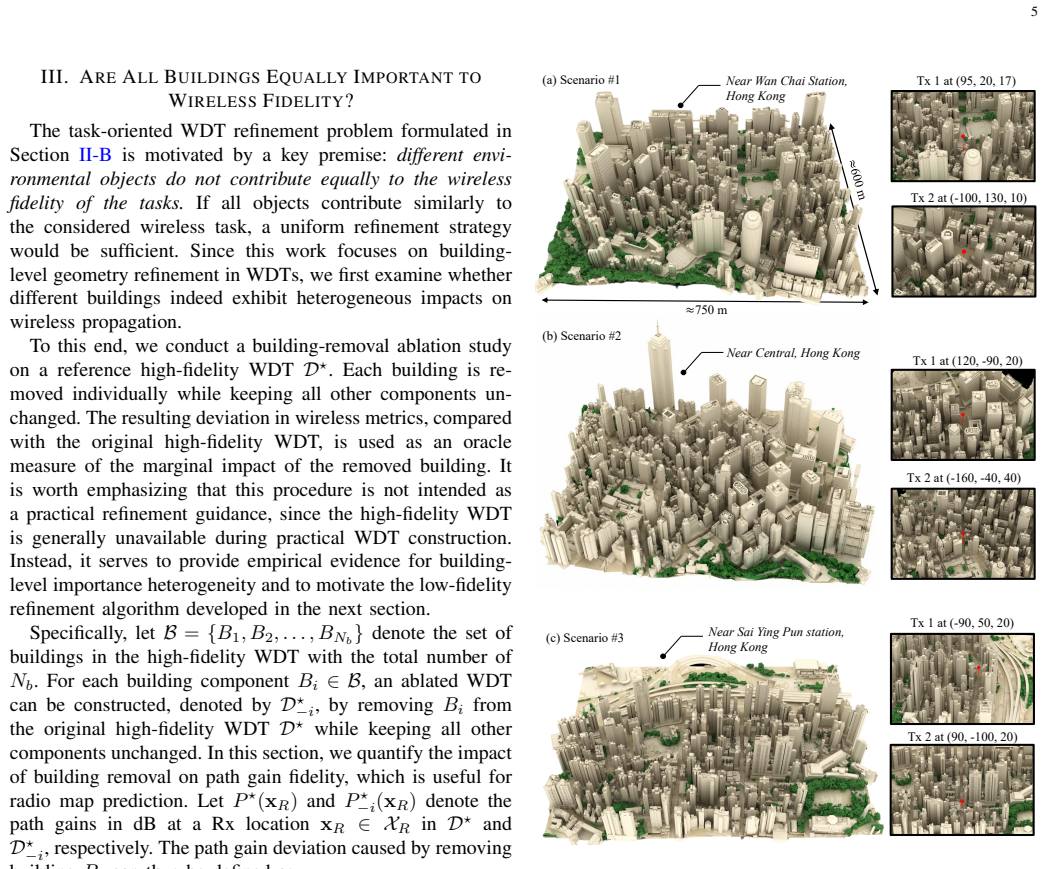
Wireless digital twins (WDTs) enable site-specific learning, management, and evaluation in wireless networks. However, constructing and maintaining a high-fidelity WDT over large-scale complex environments can be prohibitively expensive, especially in terms of data acquisition, geometric reconstruction, storage, and ray tracing. To address this issue, a task-oriented nonuniform refinement framework for WDTs is proposed, where limited resources are selectively allocated to the WDT components that matter most to wireless fidelity. Specifically, a unified refinement framework is first developed, which maximizes task-level fidelity under resource constraints through fine-grained component-wise fidelity allocation. This framework is then instantiated for building-level geometry refinement in urban WDTs. It is found that different buildings exhibit highly heterogeneous impacts on wireless fidelity. Motivated by this observation, an ellipsoid-guided selective refinement algorithm (EGSR) is proposed. By jointly considering the relevance of each building to both line-of-sight (LoS) and non-line-of-sight (NLoS) propagation paths, its refinement priority can be estimated using only a low-fidelity WDT. Simulations across multiple urban scenarios show that EGSR can substantially improve radio-map fidelity and preserve beamforming effectiveness by refining only a small subset of buildings. These results demonstrate the potential of task-oriented fidelity allocation as a scalable principle for constructing efficient and performance-aware WDTs, thereby facilitating reliable site-specific learning and optimization.
Editorial analysis
A structured set of objections, weighed in public.
Referee Report
Summary. The manuscript proposes a task-oriented nonuniform refinement framework for wireless digital twins (WDTs) to allocate limited resources selectively to the components that matter most for wireless fidelity. A unified framework is first developed to maximize task-level fidelity under resource constraints via fine-grained component-wise allocation. This is instantiated for building-level geometry refinement in urban WDTs, where an ellipsoid-guided selective refinement (EGSR) algorithm prioritizes buildings by jointly considering their relevance to LoS and NLoS propagation paths, with priorities estimated from a low-fidelity WDT. Simulations across multiple urban scenarios are reported to show that EGSR substantially improves radio-map fidelity and preserves beamforming effectiveness while refining only a small subset of buildings.
Significance. If the results hold under detailed validation, the work provides a practical principle for scalable WDT construction by demonstrating that selective, task-oriented fidelity allocation can achieve high performance with reduced costs in data acquisition, reconstruction, and ray tracing. This could enable more efficient site-specific wireless network learning and optimization in complex environments.
major comments (2)
- [Abstract] Abstract: The central claim that EGSR yields substantial radio-map fidelity improvements and preserves beamforming effectiveness is supported only by a high-level statement of simulation results across urban scenarios. No quantitative metrics, baselines, error bars, experimental setup details, or data exclusion criteria are provided, leaving the magnitude, statistical significance, and reproducibility of the gains unverifiable and load-bearing for the paper's contribution.
- [EGSR algorithm description] Section describing the EGSR algorithm and its motivation: The claim that refinement priority for each building can be accurately estimated using only a low-fidelity WDT by jointly considering LoS and NLoS paths rests on the untested assumption of highly heterogeneous building impacts. Without sensitivity analysis, ablation on the low-fidelity approximation error, or explicit comparison to full-fidelity priority ranking, it is unclear whether this estimation step introduces ranking errors that undermine the nonuniform refinement gains.
minor comments (2)
- The manuscript would benefit from a dedicated table in the simulation section summarizing the urban scenarios, key parameters (e.g., carrier frequency, building counts), and all reported metrics with confidence intervals.
- Notation for the unified refinement framework (e.g., the fidelity allocation variables) should be introduced with explicit mathematical definitions before the EGSR instantiation to improve readability.
Simulated Author's Rebuttal
We thank the referee for the constructive comments, which highlight opportunities to strengthen the verifiability of our claims and the validation of the EGSR algorithm. We address each major comment below and commit to revisions that enhance the manuscript without misrepresenting our existing results.
read point-by-point responses
-
Referee: [Abstract] Abstract: The central claim that EGSR yields substantial radio-map fidelity improvements and preserves beamforming effectiveness is supported only by a high-level statement of simulation results across urban scenarios. No quantitative metrics, baselines, error bars, experimental setup details, or data exclusion criteria are provided, leaving the magnitude, statistical significance, and reproducibility of the gains unverifiable and load-bearing for the paper's contribution.
Authors: We agree that the abstract, in its current form, relies on qualitative descriptors and would be improved by incorporating specific quantitative outcomes already obtained in our simulations. In the revised manuscript we will update the abstract to report key metrics such as the magnitude of radio-map fidelity gains and the small fraction of buildings refined, while referencing the urban scenarios and baselines used. We will also clarify that all simulated scenarios were retained with no data exclusion applied, and point readers to the detailed experimental setups, error information, and statistical reporting in the main text. revision: yes
-
Referee: [EGSR algorithm description] Section describing the EGSR algorithm and its motivation: The claim that refinement priority for each building can be accurately estimated using only a low-fidelity WDT by jointly considering LoS and NLoS paths rests on the untested assumption of highly heterogeneous building impacts. Without sensitivity analysis, ablation on the low-fidelity approximation error, or explicit comparison to full-fidelity priority ranking, it is unclear whether this estimation step introduces ranking errors that undermine the nonuniform refinement gains.
Authors: The manuscript already shows, via simulation results across multiple urban scenarios, that buildings exert highly heterogeneous effects on wireless fidelity; this heterogeneity is what motivates the selective refinement strategy. We nevertheless recognize that explicit validation of the low-fidelity priority estimator would increase confidence in the approach. Accordingly, we will add a sensitivity analysis on the effect of low-fidelity model accuracy, an ablation study isolating the impact of approximation error, and a direct side-by-side comparison of building priority rankings produced by low-fidelity versus full-fidelity models. These additions will quantify any ranking discrepancies and demonstrate that they do not materially reduce the observed gains of EGSR. revision: yes
Circularity Check
No significant circularity detected
full rationale
The paper develops a task-oriented nonuniform refinement framework by maximizing task-level fidelity under resource constraints, then instantiates it for building-level geometry via the EGSR algorithm. This algorithm estimates refinement priorities from low-fidelity WDT data by jointly considering relevance to LoS and NLoS propagation paths, which follows directly from standard wireless propagation principles rather than any self-referential definition or fitted parameter. The central claims rest on simulation results across multiple urban scenarios that provide external validation of radio-map fidelity gains, with no equations or steps reducing by construction to the inputs. No load-bearing self-citations, uniqueness theorems, or ansatzes are invoked that would collapse the derivation into its own premises.
Axiom & Free-Parameter Ledger
axioms (2)
- domain assumption Different buildings exhibit highly heterogeneous impacts on wireless fidelity
- domain assumption Refinement priority can be estimated from a low-fidelity WDT using LoS and NLoS path relevance
invented entities (1)
-
EGSR algorithm
no independent evidence
Lean theorems connected to this paper
-
IndisputableMonolith/Cost/FunctionalEquation.leanwashburn_uniqueness_aczel unclear?
unclearRelation between the paper passage and the cited Recognition theorem.
unified task-oriented nonuniform refinement framework... ellipsoid-guided selective refinement algorithm (EGSR)... propagation-relevance ellipsoid Ω_Δ(x_T,x_R)
-
IndisputableMonolith/Foundation/AlexanderDuality.leanalexander_duality_circle_linking unclear?
unclearRelation between the paper passage and the cited Recognition theorem.
building-removal ablation study... heterogeneous impacts on wireless fidelity
What do these tags mean?
- matches
- The paper's claim is directly supported by a theorem in the formal canon.
- supports
- The theorem supports part of the paper's argument, but the paper may add assumptions or extra steps.
- extends
- The paper goes beyond the formal theorem; the theorem is a base layer rather than the whole result.
- uses
- The paper appears to rely on the theorem as machinery.
- contradicts
- The paper's claim conflicts with a theorem or certificate in the canon.
- unclear
- Pith found a possible connection, but the passage is too broad, indirect, or ambiguous to say the theorem truly supports the claim.
Reference graph
Works this paper leans on
-
[1]
Wireless network digital twin for 6G: Generative AI as a key enabler,
Z. Tao, W. Xu, Y . Huang, X. Wang, and X. You, “Wireless network digital twin for 6G: Generative AI as a key enabler,”IEEE Wireless Commun., vol. 31, no. 4, pp. 24-31, Aug. 2024
work page 2024
-
[2]
Deep learning for security in digital twins of cooperative intelligent transportation systems,
Z. Lv, Y . Li, H. Feng, and H. Lv, “Deep learning for security in digital twins of cooperative intelligent transportation systems,”IEEE Trans. Intell. Transp. Syst., vol. 23, no. 9, pp. 16666-16675, Sep. 2022
work page 2022
-
[3]
Digital twin empowered wireless healthcare monitoring for smart home,
J. Chen,et al., “Digital twin empowered wireless healthcare monitoring for smart home,”IEEE J. Sel. Areas Commun., vol. 41, no. 11, pp. 3662- 3676, Nov. 2023
work page 2023
-
[4]
A digital twin based industrial automation and control system security architecture,
C. Gehrmann and M. Gunnarsson, “A digital twin based industrial automation and control system security architecture,”IEEE Trans. Ind. Inform., vol. 16, no. 1, pp. 669-680, Jan. 2020
work page 2020
-
[5]
Real-time digital twins: Vision and research directions for 6G and beyond,
A. Alkhateeb, S. Jiang and G. Charan, “Real-time digital twins: Vision and research directions for 6G and beyond,”IEEE Commun. Mag., vol. 61, no. 11, pp. 128-134, Nov. 2023
work page 2023
-
[6]
Digital twin of wireless systems: Overview, taxonomy, challenges, and opportunities,
L. U. Khan, Z. Han, W. Saad, E. Hossain, M. Guizani and C. S. Hong, “Digital twin of wireless systems: Overview, taxonomy, challenges, and opportunities,”IEEE Commun. Surv. Tutorials., vol. 24, no. 4, pp. 2230- 2254, Aug. 2022
work page 2022
-
[7]
Generative site-specific beamforming for next-generation spatial intelligence,
Z. Wang, Z. Zhou, C. J. Zhao, and Y . Liu, “Generative site-specific beamforming for next-generation spatial intelligence,”arXiv preprint arXiv:2601.02301, Jan. 2026
-
[8]
Beam-brainstorm: A generative site- specific beamforming approach,
Z. Zhou, Z. Wang, and Y . Liu, “Beam-brainstorm: A generative site- specific beamforming approach,”arXiv preprint arXiv:2601.02219, Jan. 2026
-
[9]
UrbanMIMOMap: A ray- traced MIMO CSI dataset with precoding-aware maps and benchmarks,
H. Jia, X. Wang, N. Cheng, R. Sun, and C. Li, “UrbanMIMOMap: A ray- traced MIMO CSI dataset with precoding-aware maps and benchmarks,” arXiv preprint arXiv:2509.06270, Sep. 2025
-
[10]
DeepTelecom: A digital-twin deep learning dataset for channel and MIMO applications,
B. Wang,et al., “DeepTelecom: A digital-twin deep learning dataset for channel and MIMO applications,”arXiv preprint arXiv:2508.14507, Aug. 2025
-
[11]
6G digital twin networks: From theory to practice,
X. Lin, L. Kundu, C. Dick, E. Obiodu, T. Mostak and M. Flaxman, “6G digital twin networks: From theory to practice,”IEEE Commun. Mag., vol. 61, no. 11, pp. 72-78, Nov. 2023
work page 2023
-
[12]
Digital twin network: Concepts and reference architecture,
IETF, “Digital twin network: Concepts and reference architecture,” Internet-Draft in Internet Research Task Force, 2022
work page 2022
-
[13]
X. Fang,et al., “Sensing-communication-computing-control closed-loop optimization for 6G digital twin-empowered robotic systems,”IEEE J. Sel. Areas Commun., vol. 43, no. 10, pp. 3330-3346, Oct. 2025
work page 2025
-
[14]
Digital twin aided massive MIMO CSI feedback: Exploring the impact of twinning fidelity,
H. Luo, S. Jiang, S. R. Khosravirad, and A. Alkhatee, “Digital twin aided massive MIMO CSI feedback: Exploring the impact of twinning fidelity,”IEEE Trans. Commun., vol. 73, no. 12, pp. 15909-15925, Dec. 2025
work page 2025
-
[15]
DeepMIMO: A Generic Deep Learning Dataset for Millimeter Wave and Massive MIMO Applications
A. Alkhateeb, “DeepMIMO: A generic deep learning dataset for millimeter wave and massive MIMO applications,”arXiv preprint arXiv:1902.06435, 2019
work page Pith review arXiv 1902
- [16]
-
[17]
ChannelGPT: A large model to generate digital twin chan- nel for 6G environment intelligence,
L. Yu,et al., “ChannelGPT: A large model to generate digital twin chan- nel for 6G environment intelligence,”arXiv preprint arXiv:2410.13379, 2024
-
[18]
X. Gong,et al., “Digital twin of channel: Diffusion model for sensing- assisted statistical channel state information generation,”IEEE Trans. Wireless Commun., vol. 24, no. 5, pp. 3805-3821, May. 2025
work page 2025
-
[19]
A Denoising Diffusion Probabilistic Model-Based Digital Twinning of ISAC MIMO Channel,
J. Zhang, S. Xu, Z. Zhang, C. Li and L. Yang, “A Denoising Diffusion Probabilistic Model-Based Digital Twinning of ISAC MIMO Channel,” IEEE Internet Things J., vol. 12, no. 15, pp. 29121-29134, Aug. 2025
work page 2025
-
[20]
Digital twin based beam prediction: Can we train in the digital world and deploy in reality?,
S. Jiang and A. Alkhateeb, “Digital twin based beam prediction: Can we train in the digital world and deploy in reality?,” in2023 IEEE Int. Conf. Commun. Workshops (ICC Workshops), 2023, pp. 36-41
work page 2023
-
[21]
Y . Cai,et al., “Digital twin channel-aided CSI prediction: An environment-based subspace extraction approach for achieving low over- head and high robustness,”arXiv preprint arXiv:2508.05142, 2025
-
[22]
M. Belgiovine, C. Dick and K. Chowdhury, “Better together: Leveraging multiple digital twins for deployment optimization of airborne base stations,”IEEE Trans. Mob. Comput., vol. 25, no. 3, pp. 3920-3935, Mar. 2026
work page 2026
-
[23]
¨O. L. Karakelle, S. Kayraklık, ˙I. H ¨okelek, A. G ¨orc ¸in, and H. Yanikomeroglu, “Ray tracing-enabled digital twin for RIS phase opti- mization: Implementation and experimental validation,”arxiv preprint arXiv:2604.17929, 2026
work page internal anchor Pith review Pith/arXiv arXiv 2026
-
[24]
Digital twin aided RIS communication: Robust beamforming and interference management,
S. Alikhani and A. Alkhateeb, “Digital twin aided RIS communication: Robust beamforming and interference management,”2024 IEEE Veh. Technol. Conf. (VTC2024-Fall), 2024, pp. 1-6
work page 2024
-
[25]
J. Zhang, S. Xu, C. Li, Y . Huang and L. Yang, “Efficient beam selection for ISAC in cell-free massive MIMO via digital twin-assisted deep reinforcement learning,”IEEE Trans. Wireless Commun., vol. 25, pp. 9875-9890, Jan. 2026
work page 2026
-
[26]
Optimizing codebook design in mmWave massive MIMO using digital twin-assisted DRL,
Y . Fang, S. Xu, P. Fang, J. Zhang, Y . Huang and L. Yang, “Optimizing codebook design in mmWave massive MIMO using digital twin-assisted DRL,”IEEE Trans. Veh. Technol., vol. 74, no. 12, pp. 19053-19069, Dec. 2025
work page 2025
-
[27]
T. Shui, J. Hu, K. Yang, H. Kang, H. Rui and B. Wang, “Cell- free networking for integrated data and energy transfer: Digital twin based double parameterized DQN for energy sustainability,”IEEE Trans. Wireless Commun., vol. 22, no. 11, pp. 8035-8049, Nov. 2023
work page 2023
-
[28]
Y . Cui, T. Lv, W. Ni and A. Jamalipour, “Digital twin-aided learning for managing reconfigurable intelligent surface-assisted, uplink, user-centric cell-free systems,”IEEE J. Sel. Areas Commun., vol. 41, no. 10, pp. 3175-3190, Oct. 2023
work page 2023
-
[29]
AI-powered digital twins for robotic control in 5G-enabled industrial automation,
T. M. Ho, K. -K. Nguyen and M. Cheriet, “AI-powered digital twins for robotic control in 5G-enabled industrial automation,”IEEE J. Sel. Areas Commun., vol. 43, no. 10, pp. 3347-3361, Oct. 2025
work page 2025
-
[30]
Calibrating wire- less ray tracing for digital twinning using local phase error estimates,
C. Ruah, O. Simeone, J. Hoydis and B. Al-Hashimi, “Calibrating wire- less ray tracing for digital twinning using local phase error estimates,”, IEEE Trans. Mach. Learn. Commun. Netw., vol. 2, pp. 1193-1215, Aug. 2024
work page 2024
-
[31]
Wireless Digital Twin Calibration: Refining DFT-Domain Channel Information
H. Luo, S. R. Khosravirad, and A. Alkhateeb, “Wireless digital twin calibration: Refining DFT-domain channel information,”arXiv preprint arXiv:2603.16126, Mar. 2026
work page internal anchor Pith review Pith/arXiv arXiv 2026
-
[32]
C. Ding and I. W. -H. Ho, “Digital-twin-enabled city-model-aware deep learning for dynamic channel estimation in urban vehicular environ- ments,”IEEE Trans. Green Commun. Netw., vol. 6, no. 3, pp. 1604-1612, Sep. 2022
work page 2022
-
[33]
F. A. Aoudia,et al., “Sionna RT: Technical report,”arXiv preprint arXiv:2504.21719, 2025
-
[34]
B. Braden, “The surveyor’s area formula,”Coll. Math. J., vol. 17, no. 4, pp. 326-337, Sep. 1986
work page 1986
-
[35]
Screened Poisson surface reconstruction,
M. Kazhdan and H. Hoppe, “Screened Poisson surface reconstruction,” ACM Trans. Graph., vol. 32, no. 3, p. 29, Jan. 2013
work page 2013
discussion (0)
Sign in with ORCID, Apple, or X to comment. Anyone can read and Pith papers without signing in.