Recognition: 2 theorem links
· Lean TheoremDisentangling coherent structures and the origin of swirl-switching
Pith reviewed 2026-05-12 01:20 UTC · model grok-4.3
The pith
Swirl-switching modes in bent pipes arise from distinct mechanisms in the bend versus downstream, rather than a single universal instability.
A machine-rendered reading of the paper's core claim, the machinery that carries it, and where it could break.
Core claim
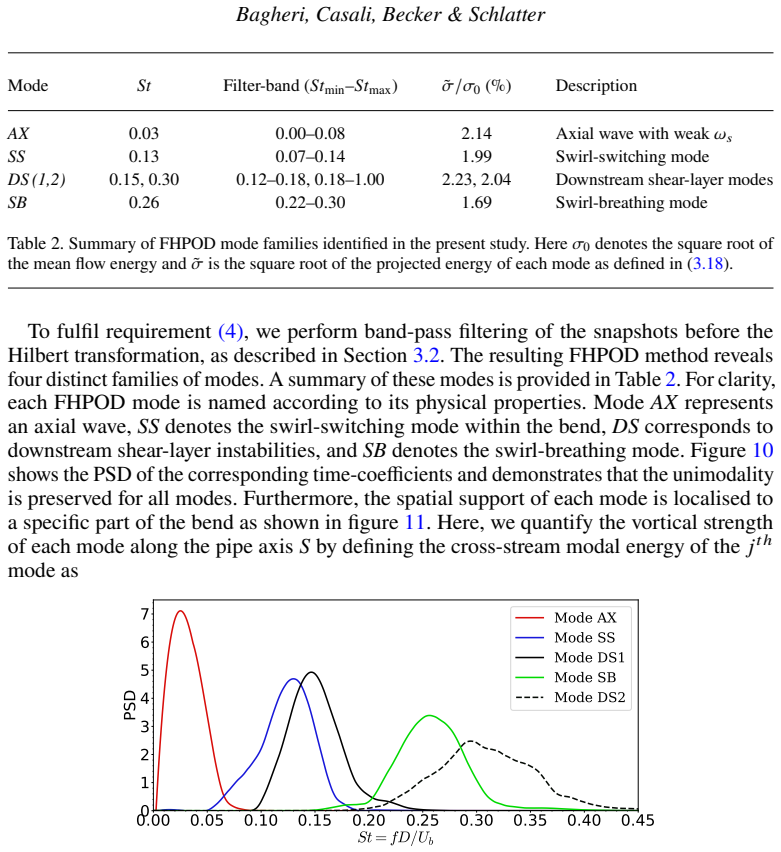
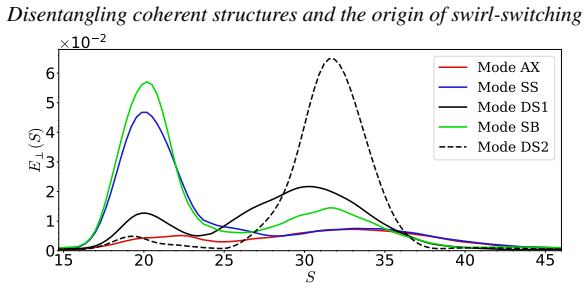
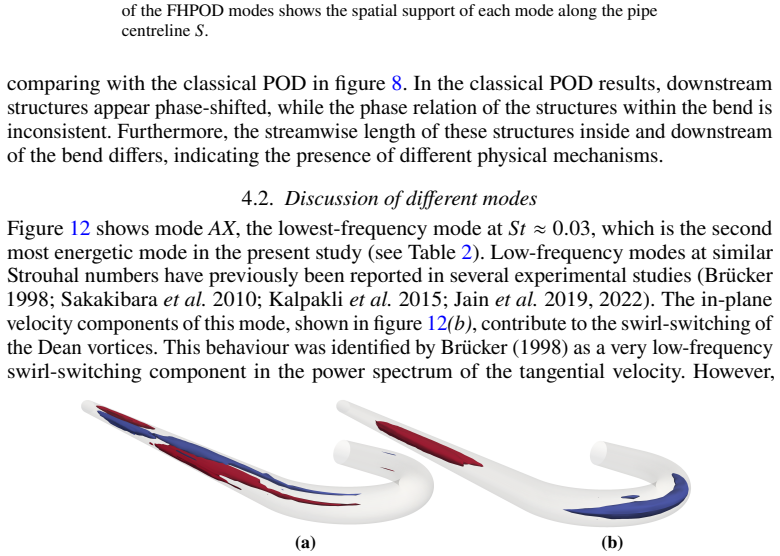
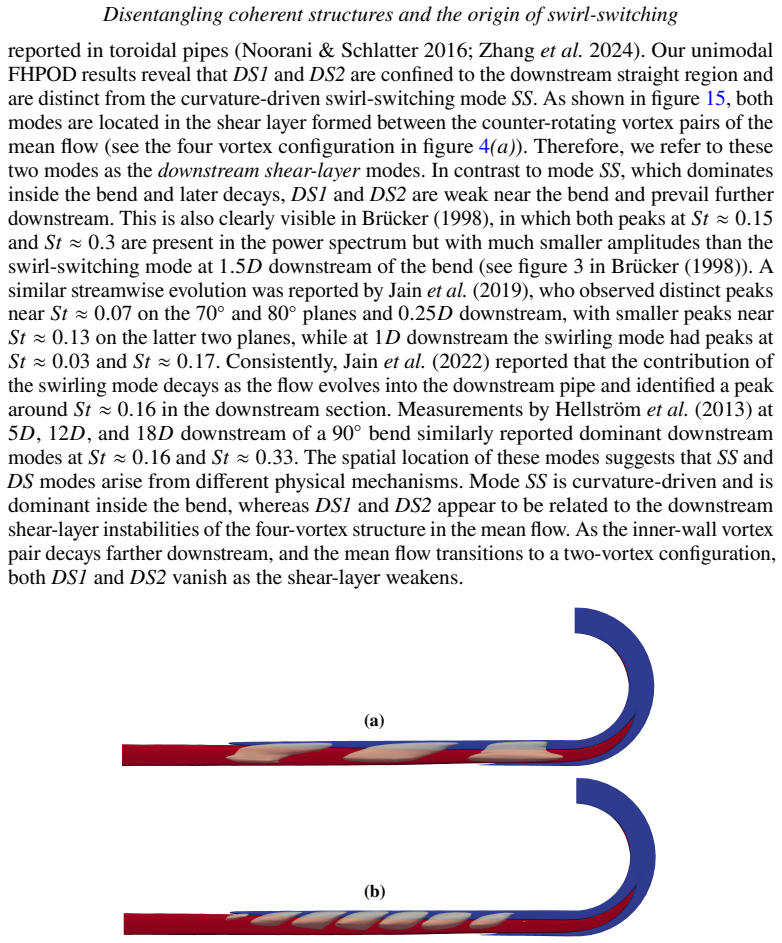
The filtered Hilbert POD (FHPOD) applied to DNS of flow in a 180° bend at Re_D=10,000 separates four distinct mode families. A swirl-switching mode at Strouhal number 0.13 is localized in the curved section. Local linear stability analysis on the cross-sectional mean flow finds unstable eigenmodes at matching wavenumbers and frequencies, supporting that the phenomenon is an intrinsic instability of the curved-pipe flow excited by incoming turbulence but not caused by it. Downstream modes link to local shear layers of the modified base flow.
What carries the argument
Filtered Hilbert POD (FHPOD), which combines the Hilbert transform with band-pass filtering to prevent mode mixing in classical POD decompositions of turbulent flows.
If this is right
- Previous interpretations of a single swirl-switching instability throughout the pipe are incorrect.
- The bend swirl-switching can be analyzed and potentially controlled via stability theory of the mean flow.
- Downstream coherent structures are independent and tied to post-bend shear layers.
- Modal decompositions of similar flows should use filtering to avoid distributing one structure over multiple modes.
Where Pith is reading between the lines
- This separation technique may resolve mode-mixing issues in other complex turbulent flows like jets or wakes.
- It suggests targeted interventions in pipe bends could damp the local instability without affecting downstream dynamics.
- The approach enables parameter-free identification of instability origins in geometry-driven flows.
Load-bearing premise
The band-pass filter bands and the local linear stability analysis on the mean cross-sectional flow correctly isolate the global nonlinear structures without artifacts from filtering choices or non-local turbulent effects.
What would settle it
A simulation of the bent pipe with laminar inlet conditions would show whether the swirl-switching mode still appears at the same frequency and location, or if its presence requires upstream turbulence.
Figures









read the original abstract
Modal decomposition of turbulent flows using classical proper orthogonal decomposition (POD) often suffers from mode mixing, in which a distinct coherent structure may be distributed over several POD modes. We propose a decomposition method based on the Hilbert transform and band-pass filtering to address this issue (filtered Hilbert POD -- FHPOD). We apply this approach to the turbulent flow through a 180 bent pipe at $Re_D=10,000$ (based on bulk velocity ($U_b$) and pipe diameter ($D$)) and curvature $\gamma=0.2$, simulated using direct numerical simulation. The FHPOD results in four distinct mode families, including a swirl-switching mode at Strouhal number of 0.13 localised in the curved section. Our novel modal decomposition shows that the modes observed in the bend and downstream correspond to distinct physical mechanisms rather than to a single universal swirl-switching instability throughout the pipe, as previous work implied. To further examine the origin of the swirl-switching mode, we perform a local stability analysis of the cross-sectional mean flow along the bend. We find unstable eigenmodes at the same streamwise wavenumber and within the same range of Strouhal numbers as the swirl-switching mode found in the modal decomposition. The result supports the interpretation that the swirl-switching phenomenon is an intrinsic instability of the curved-pipe flow that can be excited and potentially enhanced by incoming turbulent structures, but is ultimately not caused by them. Finally, we also establish a link of the downstream modes to the local shear layers of the modified base flow, highlighting the different nature of these modes.
Editorial analysis
A structured set of objections, weighed in public.
Referee Report
Summary. The manuscript introduces filtered Hilbert POD (FHPOD), which combines band-pass filtering and the Hilbert transform to reduce mode mixing in classical POD. Applied to DNS data of turbulent flow in a 180° bent pipe (Re_D = 10,000, γ = 0.2), FHPOD yields four distinct mode families. One family is a swirl-switching mode localized in the bend at St ≈ 0.13. The authors perform local linear stability analysis on the time-averaged cross-sectional velocity profiles and report unstable eigenmodes whose Strouhal numbers and streamwise wavenumbers match those of the FHPOD swirl-switching mode. They conclude that the bend and downstream modes arise from separate physical mechanisms and that swirl-switching is an intrinsic instability of the curved-pipe mean flow that can be excited by turbulence but is not caused by it.
Significance. If the FHPOD separation proves robust and the local stability results remain valid under the parallel-flow approximation, the work would provide concrete evidence that swirl-switching is not a single universal mechanism throughout the pipe and would supply a practical tool for disentangling coherent structures in flows with overlapping scales. The direct frequency/wavenumber match between data-driven modes and linear eigenmodes is a clear strength that supplies an external check on the decomposition. The result also highlights the utility of combining modal analysis with stability theory in curved-wall turbulence.
major comments (3)
- [FHPOD method description] The band-pass filter cutoffs that define the four FHPOD mode families are free parameters. The manuscript does not report a sensitivity study showing that the separation into distinct bend and downstream families, or the isolation of the St = 0.13 swirl-switching mode, remains qualitatively unchanged under reasonable variations of these cutoffs. Because the central claim rests on this separation, quantitative robustness metrics are required.
- [Local stability analysis] Local linear stability analysis is performed on the cross-sectional mean flow under the parallel-flow assumption. In a strongly developing curved pipe with γ = 0.2 the base flow varies rapidly in the streamwise direction; non-parallel effects, convective transport, and possible global-mode selection are therefore expected. The manuscript should quantify the streamwise development length relative to the wavelength of the unstable eigenmodes and discuss whether the observed frequency/wavenumber match survives a non-parallel or weakly non-parallel formulation.
- [Downstream mode discussion] The claim that the downstream modes are linked to local shear layers of the modified base flow is supported only by visual inspection of the mode shapes. A quantitative comparison (e.g., overlap integrals or energy budgets between the FHPOD modes and the shear-layer eigenmodes) would strengthen the assertion that these modes are mechanistically distinct from the bend swirl-switching family.
minor comments (2)
- [Abstract] The abstract states that the swirl-switching mode is 'localised in the curved section' while the stability analysis is performed 'along the bend.' Clarify whether the eigenmode comparison is performed at a single station or integrated over the bend length.
- [Introduction] Notation for the curvature parameter γ and the Strouhal number definition should be stated explicitly once in the main text even if they are standard in the field.
Simulated Author's Rebuttal
We thank the referee for the constructive and positive report. The comments highlight important aspects of robustness and interpretation that we address below. We have revised the manuscript to incorporate additional analyses and discussions as detailed in the point-by-point responses.
read point-by-point responses
-
Referee: [FHPOD method description] The band-pass filter cutoffs that define the four FHPOD mode families are free parameters. The manuscript does not report a sensitivity study showing that the separation into distinct bend and downstream families, or the isolation of the St = 0.13 swirl-switching mode, remains qualitatively unchanged under reasonable variations of these cutoffs. Because the central claim rests on this separation, quantitative robustness metrics are required.
Authors: We agree that the band-pass cutoffs are parameters whose influence should be quantified. The cutoffs were chosen to align with distinct peaks in the frequency spectra of the classical POD modes, separating the low-frequency swirl-switching content from higher-frequency structures. In the revised manuscript we have added a sensitivity study in which the cutoffs are varied by ±10 % and ±20 % around the nominal values. The separation into four mode families and the isolation of the St ≈ 0.13 mode remain qualitatively unchanged; quantitative metrics (mode-shape overlap integrals and energy fractions) are reported and show variations below 8 %. This analysis is included as a new appendix. revision: yes
-
Referee: [Local stability analysis] Local linear stability analysis is performed on the cross-sectional mean flow under the parallel-flow assumption. In a strongly developing curved pipe with γ = 0.2 the base flow varies rapidly in the streamwise direction; non-parallel effects, convective transport, and possible global-mode selection are therefore expected. The manuscript should quantify the streamwise development length relative to the wavelength of the unstable eigenmodes and discuss whether the observed frequency/wavenumber match survives a non-parallel or weakly non-parallel formulation.
Authors: The parallel-flow assumption is indeed an approximation. In the revised manuscript we quantify the streamwise development by computing the streamwise gradient of the mean velocity profiles along the bend. The characteristic wavelength of the unstable eigenmodes (k ≈ 2–3) corresponds to roughly 2–3D, while the mean-flow profiles change appreciably over 5–8D. This scale separation supports the local approximation over one wavelength. We have added a dedicated paragraph discussing the limitations of the parallel-flow assumption, the expected magnitude of non-parallel corrections, and the fact that a global stability analysis lies beyond the present scope. The reported frequency/wavenumber agreement with the FHPOD modes is retained as supporting evidence under the stated approximation. revision: yes
-
Referee: [Downstream mode discussion] The claim that the downstream modes are linked to local shear layers of the modified base flow is supported only by visual inspection of the mode shapes. A quantitative comparison (e.g., overlap integrals or energy budgets between the FHPOD modes and the shear-layer eigenmodes) would strengthen the assertion that these modes are mechanistically distinct from the bend swirl-switching family.
Authors: While the spatial alignment of the downstream FHPOD modes with the shear layers of the modified base flow is visually evident, we acknowledge that quantitative metrics strengthen the mechanistic interpretation. In the revised manuscript we have computed overlap integrals between the FHPOD downstream modes and the eigenmodes obtained from local stability analysis of the shear-layer profiles extracted at the same streamwise stations. These integrals exceed 0.75 for the dominant downstream family, confirming the association. The integrals are now reported together with the mode-shape comparisons, reinforcing the distinction from the bend swirl-switching family. revision: yes
Circularity Check
No significant circularity; derivation chain is self-contained
full rationale
The paper proposes a new FHPOD method (Hilbert transform plus band-pass filtering) and applies it to DNS data of bent-pipe flow, yielding four mode families with a swirl-switching structure at St=0.13 localized to the bend. It then performs an independent local linear stability analysis directly on the time-averaged cross-sectional mean velocity profiles extracted from the same DNS. Unstable eigenmodes are reported at matching streamwise wavenumber and Strouhal range. This match is not equivalent to the input by construction: the stability calculation uses only the mean flow field and the parallel-flow assumption; it does not incorporate the filtered POD modes, the chosen filter bands, or the Hilbert phase information. The claim that bend and downstream modes represent distinct mechanisms follows from the separation produced by the proposed decomposition, while the intrinsic-instability interpretation is supported by the external stability result rather than by re-deriving the observed frequency. No self-citations of prior author work are invoked as load-bearing uniqueness theorems, no parameters are fitted to a data subset and then relabeled as predictions, and no known empirical pattern is merely renamed. The parallel-flow assumption and filter robustness are questions of correctness and sensitivity, not circularity.
Axiom & Free-Parameter Ledger
free parameters (1)
- band-pass filter cutoffs
axioms (2)
- standard math Incompressible Navier-Stokes equations govern the flow
- domain assumption Local linear stability analysis on the time-averaged cross-sectional flow can identify the origin of observed global coherent structures
Reference graph
Works this paper leans on
-
[1]
Vectors, tensors and the basic equations of fluid mechanics , author =
-
[2]
Bagheri, E. and Becker, S. and Schlatter, P. , title =. Journal of Fluid Mechanics , year =
-
[3]
Journal of Computational Physics , volume =
Spurious modes in Spectral Collocation Methods with Two Non-periodic Directions , author =. Journal of Computational Physics , volume =
- [4]
-
[5]
Berger, S. A. and Talbot, L. and Yao, L.-S. , title =. Annual Review of Fluid Mechanics , year =
-
[6]
Bilde, K. G. and S. Decay of secondary motion downstream bends in turbulent pipe flows , journal =. 2023 , volume =
work page 2023
-
[7]
Elements of Fluid Dynamics , author =
-
[8]
Laminar flow and linear stability in helical pipes , author =. 2025 , Date-Added =
work page 2025
-
[9]
Camarri, S. and Trip, R. and Fransson, J. H. M. , title =. Journal of Fluid Mechanics , year =
-
[10]
Carlsson, C. and Alenius, E. and Fuchs, L. , title =. Physics of Fluids , year =
-
[11]
Journal of Fluid Mechanics , volume =
Modal instability of the flow in a toroidal pipe , author =. Journal of Fluid Mechanics , volume =. 2016 , publisher =
work page 2016
-
[12]
International Journal of Heat and Fluid Flow , volume =
Characterisation of the steady, laminar incompressible flow in toroidal pipes covering the entire curvature range , author =. International Journal of Heat and Fluid Flow , volume =. 2017 , publisher =
work page 2017
-
[13]
Spectral Methods: Fundamentals in Single Domains , author =
-
[14]
Experimental Thermal and Fluid Science , volume =
An experimental investigation regarding the laminar to turbulent flow transition in helically coiled pipes , author =. Experimental Thermal and Fluid Science , volume =. 2006 , publisher =
work page 2006
-
[15]
Br. A time-recording. Proceedings of the Eighth International Symposium on Flow Visualization (ISFV8) , address =
-
[16]
Hydrodynamic Stability , author =
-
[17]
Dean, W. R. , title =. The London, Edinburgh, and Dublin Philosophical Magazine and Journal of Science , year =
- [18]
-
[19]
Duggleby, A. and Ball, K. S. and Paul, M. R. and Fischer, P. F. , title =. Journal of Turbulence , year =
-
[20]
El Khoury, G. K. and Schlatter, P. and Noorani, A. and Fischer, P. F. and Brethouwer, G. and Johansson, A. V. , title =. Flow, Turbulence and Combustion , year =
-
[21]
Emerson, B. and Lieuwen, T. C. and Juniper, M. P. , title =. Journal of Fluid Mechanics , year =
-
[22]
Fischer, P. F. and Lottes, J. W. and Kerkemeier, S. G. , title =. 2008 , howpublished =
work page 2008
-
[23]
Physical Review Fluids , volume =
Instability of steady flows in helical pipes , author =. Physical Review Fluids , volume =. 2020 , publisher =
work page 2020
-
[24]
Fluid Dynamics Research , volume =
A comparative study on instability of steady flows in helical pipes , author =. Fluid Dynamics Research , volume =. 2020 , publisher =
work page 2020
-
[25]
Gudmundsson, K. and Colonius, T. , title =. Journal of Fluid Mechanics , year =
-
[26]
Mathematical and Numerical Modeling of 1-D and 2-D Consolidation , author =
-
[27]
Journal of Fluid Mechanics , volume =
On the effect of torsion on a helical pipe flow , author =. Journal of Fluid Mechanics , volume =. 1982 , publisher =
work page 1982
-
[28]
He, X. and Apte, S. V. and Karra, S. K. and Do. An. Physics of Fluids , year =
-
[29]
Turbulent pipe flow downstream of a 90 ^
Hellstr. Turbulent pipe flow downstream of a 90 ^. Journal of Fluid Mechanics , year =
-
[30]
Hufnagel, L. and Canton, J. and. The three-dimensional structure of swirl-switching in bent pipe flow , journal =. 2018 , volume =
work page 2018
-
[31]
International Journal for Numerical Methods in Fluids , volume =
H. International Journal for Numerical Methods in Fluids , volume =. 1999 , publisher =
work page 1999
-
[32]
International Journal of Heat and Fluid Flow , volume =
Influence of curvature and torsion on turbulent flow in helically coiled pipes , author =. International Journal of Heat and Fluid Flow , volume =. 2000 , doi =
work page 2000
-
[33]
Jain, A. and Ewing, D. and Ching, C. Y. , title =. Experimental Thermal and Fluid Science , year =
-
[34]
Jain, A. and Ewing, D. and Ching, C. Y. , title =. International Journal of Heat and Fluid Flow , year =
-
[35]
Neko: A modern, portable, and scalable framework for high-fidelity computational fluid dynamics , author =. Computers & Fluids , volume =. 2024 , publisher =
work page 2024
- [36]
-
[37]
Juniper, M. P. and Pier, B. , title =. European Journal of Mechanics -- B/Fluids , year =
-
[38]
Kalpakli, A. and. Turbulent pipe flow downstream a 90 ^. International Journal of Heat and Fluid Flow , year =
-
[39]
Kalpakli, A. and. Experiments in Fluids , year =
-
[40]
Kalpakli, A. and Sattarzadeh, S. S. and. Combined hot-wire and. Journal of Visualization , year =
-
[41]
Journal of Fluid Mechanics , volume =
Pressure-driven flows in helical pipes: bounds on flow rate and friction factor , author =. Journal of Fluid Mechanics , volume =. 2020 , publisher =
work page 2020
-
[42]
Lupi, V. and Canton, J. and Schlatter, P. , title =. International Journal of Heat and Fluid Flow , year =
-
[43]
Lupi, V. and Massaro, D. and Peplinski, A. and Schlatter, P. , title =. Physical Review Fluids , year =
-
[44]
Lupi, V. and Canton, J. and Rinaldi, E. and. Modal stability analysis of toroidal pipe flow approaching zero curvature , journal =. 2024 , volume =
work page 2024
-
[45]
Lupi, V. and. Direct Numerical Simulations of Turbulent Flow in Helical Pipes , booktitle =
-
[46]
Shapes of Pipes , author =
-
[47]
Li, X.-B. and Demange, S. and Chen, G. and Wang, J.-B. and Liang, X.-F. and Schmidt, O. T. and Oberleithner, K. , title =. Journal of Fluid Mechanics , year =
-
[48]
Massaro, D. and Lupi, V. and Peplinski, A. and Schlatter, P. , title =. Physical Review Fluids , year =
-
[49]
Massaro, D. and Peplinski, A. and Schlatter, P. , title =. Journal of Fluid Mechanics , year =
-
[50]
Mettot, C. and Sipp, D. and B. Quasi-laminar stability and sensitivity analyses for turbulent flows: Prediction of low-frequency unsteadiness and passive control , journal =. 2014 , volume =
work page 2014
-
[51]
Evolution of turbulence characteristics from straight to curved pipes , journal =. 2013 , issn =. doi:https://doi.org/10.1016/j.ijheatfluidflow.2013.03.005 , author =
-
[52]
Noorani, A. and Schlatter, P. , title =. International Journal of Heat and Fluid Flow , year =
-
[53]
Oberleithner, K. and Sieber, M. and Nayeri, C. N. and Paschereit, C. O. and Petz, C. and Hege, H.-C. and Noack, B. R. and Wygnanski, I. , title =. Journal of Fluid Mechanics , year =
-
[54]
Oberleithner, K. and Paschereit, C. O. and Wygnanski, I. , title =. Journal of Fluid Mechanics , year =
-
[55]
Differential Geometry and its Applications , author =
-
[56]
Poletto, R. and Craft, T. and Revell, A. , title =. Flow, Turbulence and Combustion , year =
-
[57]
Turbulent Flows , author =
-
[58]
Kriegseis, J. and Kinzel, M. and Nobach, H. , title =. Proceedings of ISPIV 2021 , year =
work page 2021
-
[59]
Perez, A. and Rezaeiravesh, S. and Markidis, S. and Schlatter, P. , title =. 2025 , howpublished =. doi:10.2139/ssrn.5380203 , url =
-
[60]
Qadri, J. and Paschereit, C. O. and Oberleithner, K. , title =. European Journal of Mechanics -- B/Fluids , year =
-
[61]
Raiola, M. and Kriegseis, J. , title =. AIAA AVIATION 2024 Forum , year =
work page 2024
-
[62]
XXIX. An experimental investigation of the circumstances which determine whether the motion of water shall be direct or sinuous, and of the law of resistance in parallel channels , author =. Philosophical Transactions of the Royal Society of London , number =. 1883 , publisher =
-
[63]
Raiola, M. and Kriegseis, J. , title =. arXiv preprint arXiv:2507.02487 , year =
work page internal anchor Pith review Pith/arXiv arXiv
-
[64]
Rodr. A study of linear wavepacket models for subsonic turbulent jets using local eigenmode decomposition of. European Journal of Mechanics -- B/Fluids , year =
-
[65]
Large-eddy simulations of 90 ^
R. Large-eddy simulations of 90 ^. Journal of Turbulence , year =
-
[66]
Large-eddy simulation of low-frequency oscillations of the
R. Large-eddy simulation of low-frequency oscillations of the. Physics of Fluids , year =
-
[67]
Sakakibara, J. and Sonobe, R. and Goto, H. and Tezuka, H. and Tada, H. and Tezuka, K. , title =. 14th International Symposium on Flow Visualization (ISFV14) , address =. 2010 , pages =
work page 2010
- [68]
-
[69]
Siconolfi, L. and Citro, V. and Giannetti, F. and Camarri, S. and Luchini, P. , title =. Journal of Fluid Mechanics , year =
-
[70]
Schmid, P. and Henningson, D. , year =. Stability and Transition in Shear Flows , publisher =
- [71]
-
[72]
Sudo, K. and Sumida, M. and Hibara, H. , title =. Experiments in Fluids , year =
-
[73]
Tammisola, O. and Juniper, M. P. , title =. Journal of Fluid Mechanics , year =
-
[74]
Takahashi, H. and Shwin, S. and Hamdani, A. and Fujisawa, N. and Kikura, H. , title =. Journal of Flow Control, Measurement & Visualization , year =
-
[75]
Taylor, G. I. , title =. Proceedings of the Royal Society of London. Series A , year =
-
[76]
Tirunagari, S. and Kaario, O. and Vuorinen, V. and Larmi, M. , title =. CSI Journal of Computing , year =
-
[77]
Tunstall, M. J. and Harvey, J. K. , title =. Journal of Fluid Mechanics , year =
-
[78]
van Doorne, C. W. H. and Westerweel, J. , title =. Experiments in Fluids , year =
-
[79]
Vashisth, S. and Kumar, V. and Nigam, K. D. P. , title =. Industrial & Engineering Chemistry Research , year =
-
[80]
Veenman, M. P. B. , title =. 2004 , volume =
work page 2004
discussion (0)
Sign in with ORCID, Apple, or X to comment. Anyone can read and Pith papers without signing in.