Recognition: 2 theorem links
· Lean TheoremA Closer Look on the Influence of Constraints Upon the Optimization of the Nonadditive Entropic Functional S_{q}
Pith reviewed 2026-05-12 01:56 UTC · model grok-4.3
The pith
Only three specific choices of the constraint parameter yield q-exponential distributions when maximizing the nonadditive entropy S_q.
A machine-rendered reading of the paper's core claim, the machinery that carries it, and where it could break.
Core claim
Sufficient conditions are derived for the existence, strict positivity, and uniqueness of the solutions to the optimization of S_q under normalization and the generalized constraint summing p_i to the q' times e_i over summing p_i to the q'. A theorem supplies the closed-form solution. The optimizing distributions are proved to be of q-exponential form if and only if q' takes the values 1, q, or 2-q. The Clausius-like relation defines an effective temperature T_{q,q'} such that one over T equals the partial of S_q over U, and the Helmholtz-like energy follows as U minus T times S_q, grounding the zeroth principle. For the linear constraint q' equals 1 with q in (0,1) the third law holds, the
What carries the argument
The generalized mean-energy constraint with exponent q', which reduces to the standard linear or q-weighted forms only for particular q' and forces the optimizer into q-exponential shape precisely for those values.
If this is right
- The effective temperature T_{q,q'} satisfies the zeroth law of thermodynamics for all admissible q and q'.
- The linear constraint q' equals 1 with q in (0,1) preserves the third law of thermodynamics.
- The same linear-constraint case describes classical many-body systems whose interactions have arbitrary range.
- The linear-constraint case reproduces key features of low-dimensional nonlinear maps at the edge of chaos.
Where Pith is reading between the lines
- The uniqueness theorem suggests that any observed deviation from q-exponential statistics in a system governed by S_q would indicate a nonstandard choice of constraint rather than a failure of the entropy itself.
- The effective-temperature construction could be used to define consistent thermodynamic relations in simulations of long-range interacting particles or in time-series analysis of chaotic maps.
- Extensions of the same optimization analysis might apply to other nonadditive entropies or to constraints that incorporate additional observables beyond energy.
Load-bearing premise
That the physically appropriate constraint for the systems of interest is the one in which the energies are averaged with weights p_i to the power q' rather than some other weighting.
What would settle it
Explicit calculation of the optimizing distribution for any q' outside the set {1, q, 2-q} that nevertheless produces a q-exponential form.
Figures

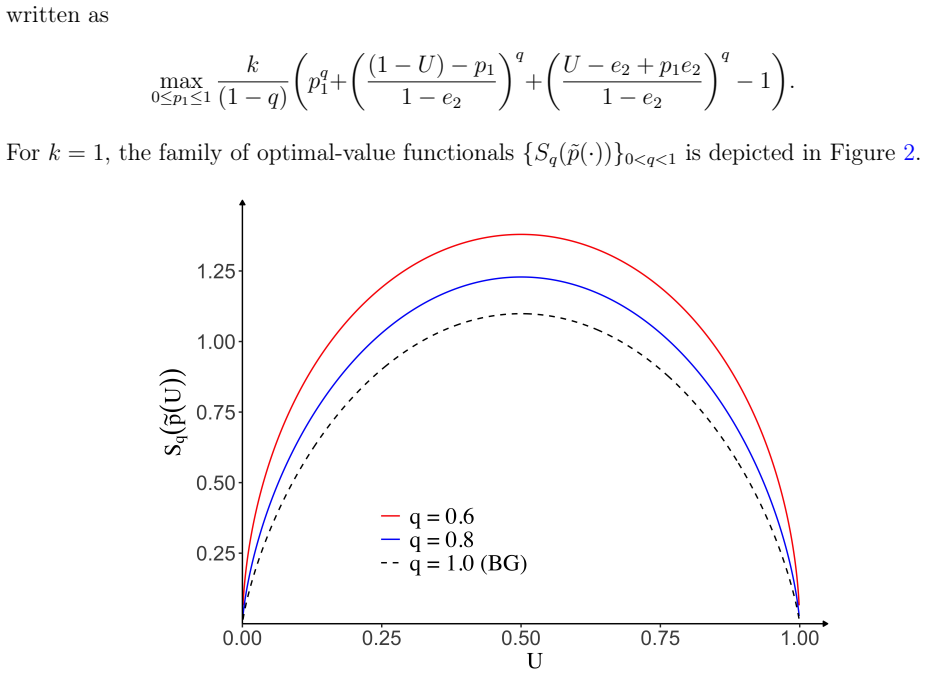


read the original abstract
The thermal-equilibrium canonical distribution is currently obtained by maximizing the Boltzmann-Gibbs-von Neumann-Shannon entropy $S_{BG}(p)=k\sum^{W}_{i=1}p_{i}\ln 1/p_{i}$ constrained to $\sum^{W}_{i=1}p_{i}=1$ and $\sum^{W}_{i=1}p_{i}\,e_{i}=U$, $e_{1}\leq\ldots\leq e_{W}$ being the energies of the $W$ possible states and $U\in[e_{1},e_{W}]$ their mean value. We revisit a generalized version of this optimization problem grounded in the nonadditive entropy $S_{q}(p)=k\,(\sum^{W}_{i=1}p_{i}^{q}-1)/(1-q)$ (frequently, though not necessarily, $q\in(0,1)$; $S_1=S_{BG}$), and the constraint $\sum^{W}_{i=1} p_{i}^{q^{\prime}}e_{i} / \sum^{W}_{i=1}p_{i}^{q^{\prime}}=U$, $q^{\prime}>0$. Sufficient conditions for existence, strict positivity, and uniqueness of solutions are derived, along with a theorem that enables their closed-form calculation. We apply these results to deepen the understanding of the two standard cases in the literature ($q^{\prime}=1$ and $q^{\prime}=q$), as well as of a new one ($q^{\prime}=2-q$). We prove that these standard cases are the only ones yielding optimizing probability distributions of $q$-exponential form. Furthermore, we define an effective temperature $T_{q,q^{\prime}}$ through a Clausius-like relation $1/T_{q,q^{\prime}}=\partial S_{q} / \partial U$ and derive a Helmholtz-like energy $F_{q,q^{\prime}}=U-T_{q,q^{\prime}}S_{q}$, with the former grounding the validity of the $0^{th}$ Principle of Thermodynamics within this generalized statistical mechanics. Finally, we show that the case with a linear constraint (i.e., $q^{\prime}=1$) with $q\in(0,1)$ (i) preserves the Third Law of Thermodynamics; (ii) can be used to model classical many-body Hamiltonian systems with arbitrarily-ranged interactions; and (iii) resembles features of low-dimensional nonlinear dynamical systems at the edge of chaos.
Editorial analysis
A structured set of objections, weighed in public.
Referee Report
Summary. The manuscript generalizes the maximization of the nonadditive entropy S_q(p) = k (sum p_i^q - 1)/(1-q) subject to the q'-dependent constraint (sum p_i^{q'} e_i / sum p_i^{q'}) = U. It derives sufficient conditions for existence, strict positivity, and uniqueness of the optimizing probabilities, states a theorem enabling closed-form solutions, proves that only the cases q'=1, q, and 2-q produce q-exponential distributions, defines an effective temperature via 1/T_{q,q'} = partial S_q / partial U and a Helmholtz-like free energy F_{q,q'} = U - T_{q,q'} S_q, and shows that the linear-constraint case (q'=1) with q in (0,1) preserves the Third Law, models classical many-body systems with arbitrary-range interactions, and exhibits features akin to low-dimensional nonlinear dynamics at the edge of chaos.
Significance. If the stated conditions, uniqueness proof, and thermodynamic derivations hold, the work supplies a rigorous mathematical characterization of the optimization problem for S_q that clarifies which constraints produce q-exponentials and grounds thermodynamic relations (including the 0th Principle) within this framework. The explicit treatment of the three standard cases and the listed physical implications for q'=1 constitute a useful consolidation of results in nonextensive statistical mechanics.
minor comments (2)
- [Abstract] The abstract refers to 'a theorem that enables their closed-form calculation' without indicating its location or key equation in the main text; adding an explicit forward reference would improve readability.
- [Thermodynamic derivations] Notation for the effective temperature T_{q,q'} and free energy F_{q,q'} is introduced via the Clausius-like relation; a brief remark on the domain of U over which the partial derivative is well-defined would aid clarity.
Simulated Author's Rebuttal
We thank the referee for the positive evaluation and recommendation of minor revision. The referee's summary correctly reflects the scope and results of our manuscript on the optimization of S_q under generalized constraints.
Circularity Check
Derivation is self-contained mathematical proof
full rationale
The paper's core consists of explicit Lagrange-multiplier optimization of S_q under the q'-constraint, derivation of sufficient conditions for existence/positivity/uniqueness via convexity arguments, a closed-form theorem, and a direct proof that only q'=1, q, 2-q yield q-exponential maximizers. Thermodynamic quantities are defined by the standard variational relation 1/T=∂S/∂U and F=U-TS; listed properties follow algebraically from the resulting expressions. No load-bearing step reduces to a fitted parameter, self-citation chain, or ansatz smuggled from prior work; all central claims are internally verified by the presented equations and proofs.
Axiom & Free-Parameter Ledger
free parameters (2)
- q
- q'
axioms (2)
- standard math Lagrange multipliers yield the correct stationary points for the constrained optimization of S_q.
- domain assumption The nonadditive entropy S_q is the relevant functional for systems outside the Boltzmann-Gibbs regime.
Lean theorems connected to this paper
-
IndisputableMonolith/Cost/FunctionalEquation.leanwashburn_uniqueness_aczel; Jcost uniqueness contradicts?
contradictsCONTRADICTS: the theorem conflicts with this paper passage, or marks a claim that would need revision before publication.
We prove that these standard cases are the only ones yielding optimizing probability distributions of q-exponential form... 1/T_{q,q'} = ∂S_q/∂U ... F_{q,q'} = U − T_{q,q'} S_q
-
IndisputableMonolith/Foundation/ArithmeticFromLogic.leanLogicNat recovery; Peano axioms from Law of Logic unclear?
unclearRelation between the paper passage and the cited Recognition theorem.
Theorem 1... for q ∈ (0,1) and q' = 1, there is a unique and strictly positive solution
What do these tags mean?
- matches
- The paper's claim is directly supported by a theorem in the formal canon.
- supports
- The theorem supports part of the paper's argument, but the paper may add assumptions or extra steps.
- extends
- The paper goes beyond the formal theorem; the theorem is a base layer rather than the whole result.
- uses
- The paper appears to rely on the theorem as machinery.
- contradicts
- The paper's claim conflicts with a theorem or certificate in the canon.
- unclear
- Pith found a possible connection, but the passage is too broad, indirect, or ambiguous to say the theorem truly supports the claim.
Reference graph
Works this paper leans on
-
[1]
PossibleGeneralizationofBoltzmann-GibbsStatistics
1L. Boltzmann, Sitzungsberichte, K. Akademie der Wissenschaften in Wien66, 275 (1872). 2L. Boltzmann, Sitzungsberichte, K. Akademie der Wissenschaften in Wien75, 67 (1877). 3J. W. Gibbs,Elementary principles in statistical mechanics – developed with especial reference to the rational foundation of thermodynamics(C. Scribner’s Sons, New York, 1902). 4C.Tsa...
discussion (0)
Sign in with ORCID, Apple, or X to comment. Anyone can read and Pith papers without signing in.