Recognition: 2 theorem links
· Lean TheoremData-driven Symbolic Closure for Turbulence Modeling in the Lattice Boltzmann Framework
Pith reviewed 2026-05-12 01:20 UTC · model grok-4.3
The pith
A symbolic expression discovered from DNS data of two flows serves as a subgrid closure in Lattice Boltzmann turbulence modeling.
A machine-rendered reading of the paper's core claim, the machinery that carries it, and where it could break.
Core claim
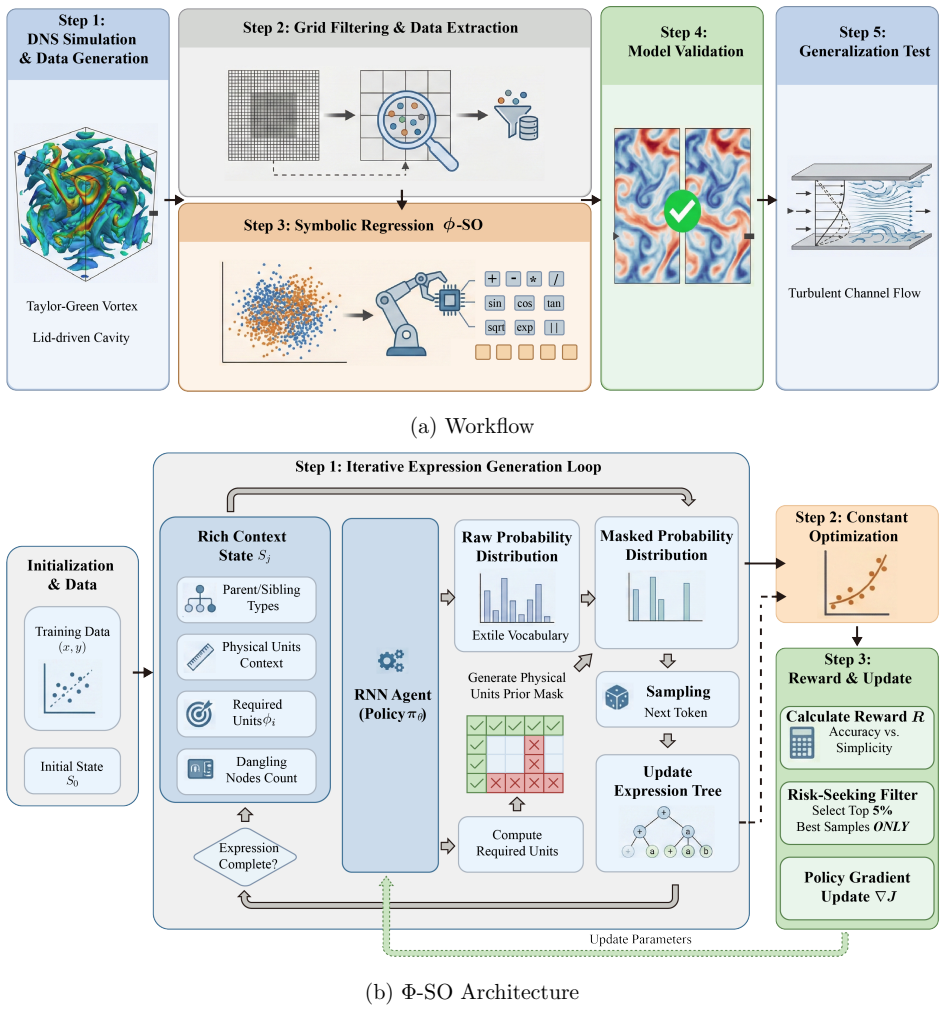
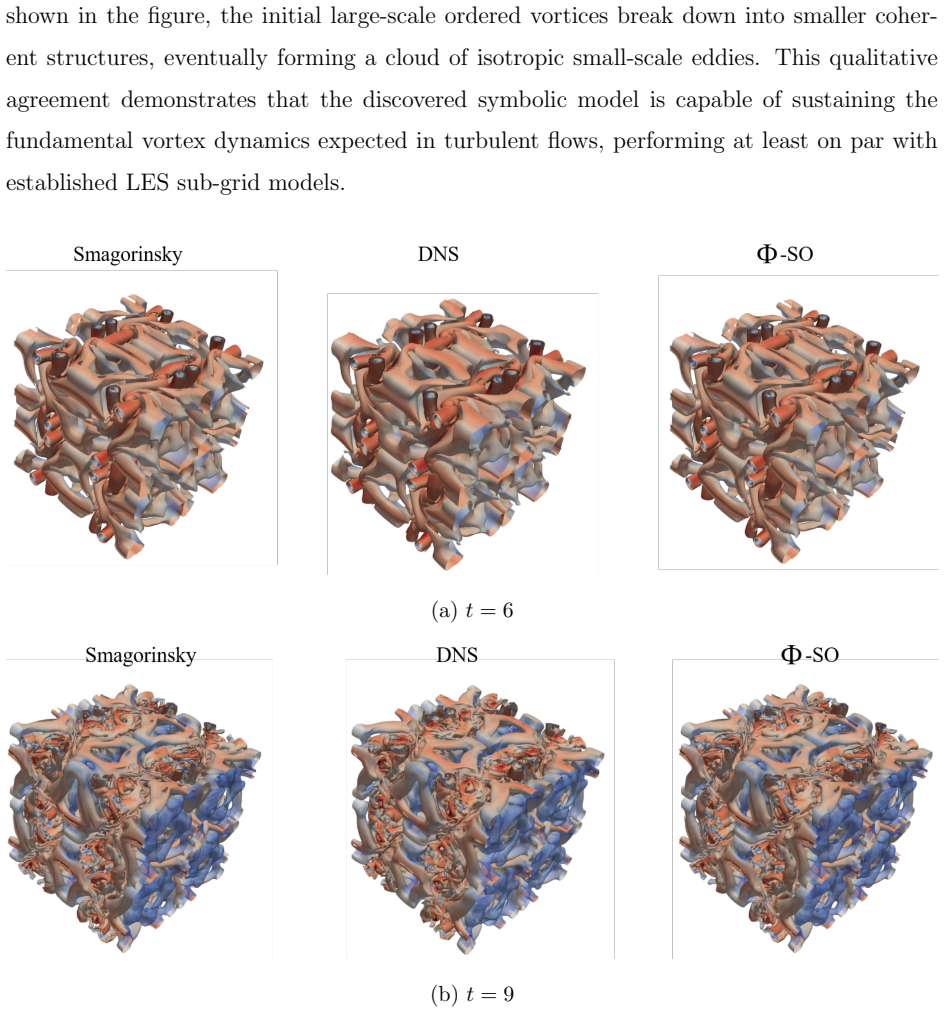
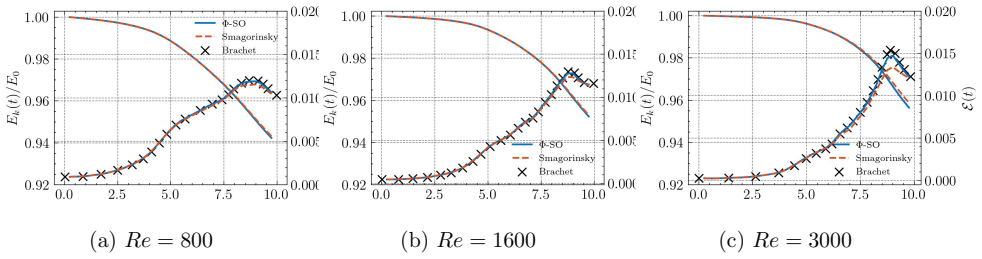
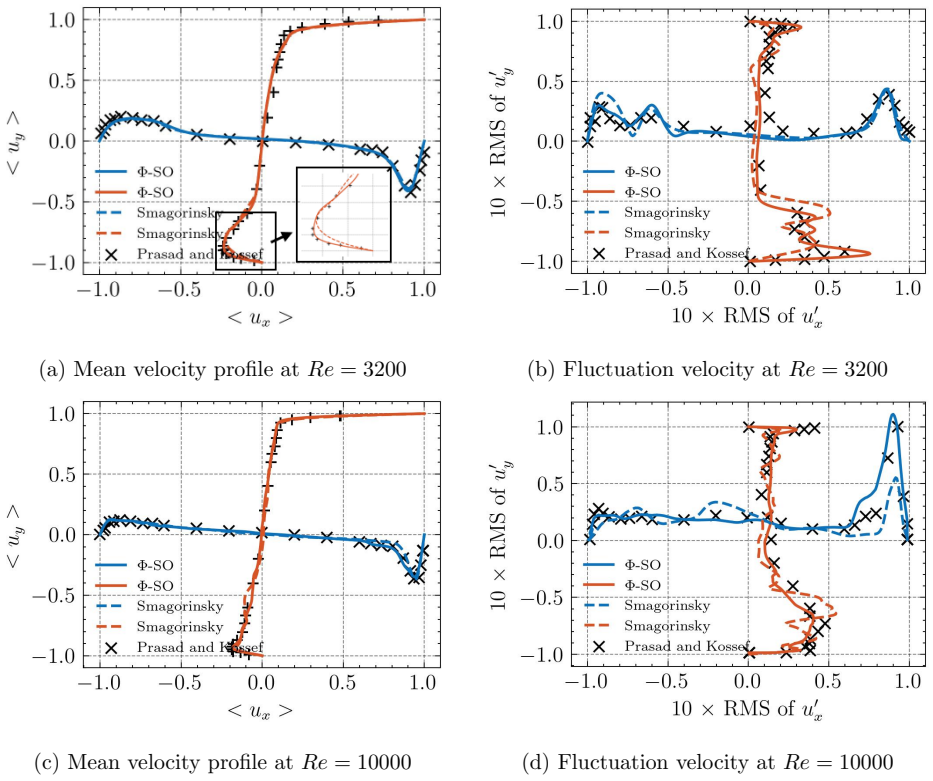
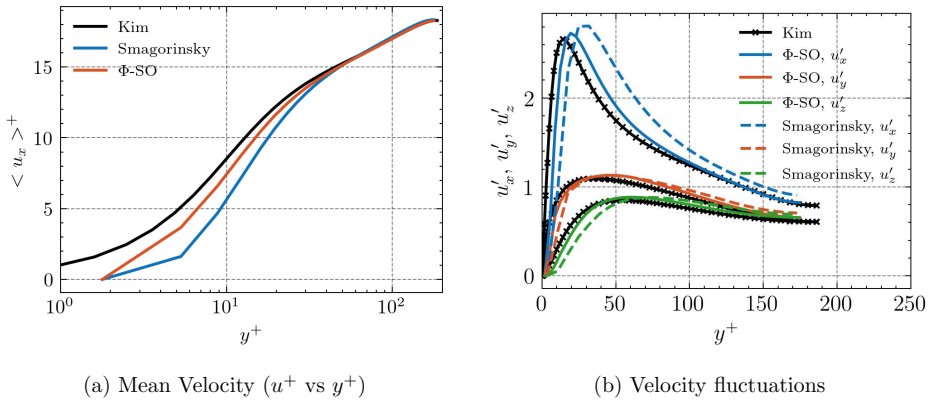
By feeding DNS data from Taylor-Green Vortex and Lid-Driven Cavity flows into Physical Symbolic Optimization, the authors obtain an explicit subgrid-scale stress closure for the Lattice Boltzmann Method. Virtual dimensional analysis and nonlinear tensor invariants are enforced during the search, producing a highly nonlinear function of strain-rate and rotation-rate invariants. In numerical tests this closure reproduces kinetic-energy dissipation peaks more faithfully than the Smagorinsky model, resolves secondary corner vortices, and transfers without modification to turbulent channel flow at Re_tau = 180.
What carries the argument
The explicit symbolic closure expression obtained through constrained symbolic optimization; it replaces the algebraic subgrid-scale term inside the Lattice Boltzmann collision operator.
If this is right
- The model reproduces kinetic energy dissipation rate peaks more accurately than the standard Smagorinsky closure in the tested configurations.
- Secondary corner vortices appear more clearly resolved in lid-driven cavity simulations.
- The closure transfers directly to wall-bounded channel flow at Re_tau = 180 with no added damping functions.
- Nonlinear dependence on both strain-rate and rotation-rate invariants emerges automatically from the data-driven search.
Where Pith is reading between the lines
- The same constrained symbolic search could be repeated on datasets from other numerical schemes to produce compatible closures for finite-volume or finite-element solvers.
- The explicit nonlinear form supplies a concrete candidate for analytic improvement of existing subgrid models in traditional computational fluid dynamics.
- Further zero-shot tests on flows with separation or transition would clarify the range over which the discovered expression remains valid.
Load-bearing premise
That an expression fitted only to Taylor-Green Vortex and lid-driven cavity data encodes turbulent physics general enough to apply unchanged to wall-bounded channel flow.
What would settle it
Applying the same symbolic closure to direct numerical simulation data of a third turbulent regime, such as decaying homogeneous isotropic turbulence, and verifying whether the predicted dissipation rate spectrum deviates systematically from the reference solution.
Figures

read the original abstract
Turbulence modeling within the Lattice Boltzmann Method (LBM) framework has long relied on traditional algebraic sub-grid scale (SGS) models, which often suffer from over-dissipation and lack of spatial selectivity near solid boundaries. In this work, we utilize Physical Symbolic Optimization (Phi-SO) to discover explicit analytical closures from high-fidelity DNS datasets of Taylor-Green Vortex (TGV) and Lid-Driven Cavity (LDC) flows. Central to our methodology is the integration of virtual dimensional analysis and non-linear tensor invariants, a strategy that enforces physical scaling laws directly within the symbolic search process. The resulting model exhibits a highly non-linear dependency on both strain-rate and rotation-rate invariants. Numerical validations confirm that this symbolic closure outperforms the standard Smagorinsky approach in capturing kinetic energy dissipation rate peaks and resolving delicate secondary corner vortices. Furthermore, the model exhibits robust zero-shot generalization to wall-bounded turbulent channel flow (Re_tau = 180) without the aid of any supplemental wall-damping corrections. This work highlights the potential of symbolic regression to uncover robust, interpretable physical laws for the next generation of intelligent computational fluid dynamics solvers.
Editorial analysis
A structured set of objections, weighed in public.
Referee Report
Summary. The manuscript proposes a data-driven method using Physical Symbolic Optimization (Phi-SO) to derive explicit symbolic sub-grid-scale (SGS) closures for turbulence modeling within the Lattice Boltzmann framework. The approach trains on DNS data from Taylor-Green Vortex (TGV) and lid-driven cavity (LDC) flows, incorporating virtual dimensional analysis and non-linear tensor invariants of strain-rate and rotation-rate tensors. It claims that the resulting highly non-linear closure outperforms the standard Smagorinsky model in capturing kinetic energy dissipation peaks and secondary vortices in the training flows, and exhibits robust zero-shot generalization to wall-bounded turbulent channel flow at Re_tau=180 without any wall-damping functions or retuning.
Significance. If the discovered symbolic expression proves to be both accurate and sufficiently universal, the work would demonstrate a viable path toward interpretable, physics-constrained algebraic closures that avoid ad-hoc damping corrections common in traditional SGS models. This could improve predictive fidelity in LBM-based simulations of complex geometries while maintaining computational efficiency, provided the zero-shot transfer is substantiated beyond the specific test case.
major comments (3)
- [Abstract and §4] Abstract and §4 (numerical validations): The central claim of outperformance and 'robust zero-shot generalization' to channel flow is asserted without providing the explicit symbolic expression discovered by Phi-SO, quantitative error metrics (e.g., integrated dissipation rate errors or vortex strength comparisons), or details on how post-hoc coefficient choices were avoided. This prevents independent verification of whether the data support the stated superiority over Smagorinsky.
- [§3] §3 (symbolic regression methodology): The integration of virtual dimensional analysis and non-linear invariants is described, but no a-priori analysis of the resulting expression's limiting behavior (near-wall asymptotics, high-Re scaling, or behavior under sustained shear production) is supplied. Without this, the assumption that invariants learned from TGV (homogeneous decaying) and LDC (transitional wall-bounded) encode Re- and geometry-independent physics remains untested, directly bearing on the zero-shot channel-flow claim.
- [§4] §4 (channel flow results): The reported numerical validations for Re_tau=180 channel flow constitute the sole evidence for generalization, yet the manuscript provides no comparison of SGS stress tensor components or energy spectra against DNS, nor any sensitivity study to the training dataset composition. This leaves open the possibility that the expression overfits patterns specific to TGV/LDC rather than capturing universal physics.
minor comments (2)
- [Abstract] The abstract refers to 'highly non-linear dependency' but does not quantify the degree of non-linearity or compare it to existing invariant-based models (e.g., those of Lund & Novikov).
- [Results figures] Figure captions and legends in the results section should explicitly state the grid resolution, filter width, and exact definition of the dissipation rate used for comparisons.
Simulated Author's Rebuttal
We thank the referee for their constructive and detailed comments, which have helped us strengthen the clarity and verifiability of the manuscript. We address each major comment below and have incorporated revisions to provide the requested details and analyses.
read point-by-point responses
-
Referee: [Abstract and §4] Abstract and §4 (numerical validations): The central claim of outperformance and 'robust zero-shot generalization' to channel flow is asserted without providing the explicit symbolic expression discovered by Phi-SO, quantitative error metrics (e.g., integrated dissipation rate errors or vortex strength comparisons), or details on how post-hoc coefficient choices were avoided. This prevents independent verification of whether the data support the stated superiority over Smagorinsky.
Authors: We agree that the explicit symbolic expression and quantitative metrics are essential for independent verification. In the revised manuscript, we now present the full symbolic expression discovered by Phi-SO in §4. We have also added quantitative error metrics, including relative errors in the integrated kinetic energy dissipation rate and comparisons of secondary vortex strengths for the TGV and LDC cases. The Phi-SO procedure embeds physical constraints and optimization directly in the symbolic search, eliminating the need for post-hoc coefficient tuning beyond the invariant basis. revision: yes
-
Referee: [§3] §3 (symbolic regression methodology): The integration of virtual dimensional analysis and non-linear invariants is described, but no a-priori analysis of the resulting expression's limiting behavior (near-wall asymptotics, high-Re scaling, or behavior under sustained shear production) is supplied. Without this, the assumption that invariants learned from TGV (homogeneous decaying) and LDC (transitional wall-bounded) encode Re- and geometry-independent physics remains untested, directly bearing on the zero-shot channel-flow claim.
Authors: The non-linear invariants were selected precisely because they are coordinate-invariant and dimensionally consistent by construction via virtual dimensional analysis. We acknowledge the benefit of explicit limiting-case analysis. The revised §3 now includes an a-priori examination demonstrating that the discovered expression recovers the expected near-wall asymptotic scaling of the SGS stress (∼ y^3) and reduces to a Smagorinsky-like form in the high-Re inertial range under sustained shear, thereby supporting the physical generality underlying the zero-shot transfer. revision: yes
-
Referee: [§4] §4 (channel flow results): The reported numerical validations for Re_tau=180 channel flow constitute the sole evidence for generalization, yet the manuscript provides no comparison of SGS stress tensor components or energy spectra against DNS, nor any sensitivity study to the training dataset composition. This leaves open the possibility that the expression overfits patterns specific to TGV/LDC rather than capturing universal physics.
Authors: We have expanded §4 to include direct comparisons of the SGS stress tensor components (particularly the off-diagonal shear component) and the turbulent kinetic energy spectra against the DNS reference for the Re_tau=180 channel. In addition, a sensitivity study was performed by retraining Phi-SO on TGV-only and LDC-only subsets; the leading non-linear terms remain stable across these ablations, indicating that the expression captures shared physics rather than dataset-specific artifacts. revision: yes
Circularity Check
No significant circularity in data-driven symbolic regression pipeline
full rationale
The paper explicitly employs Physical Symbolic Optimization (Phi-SO) to discover a closure by fitting to external DNS data from Taylor-Green Vortex and lid-driven cavity flows, then performs numerical validation and zero-shot testing on separate turbulent channel flow DNS at Re_tau=180. This constitutes a standard train/test split on independent external benchmarks rather than any first-principles derivation that reduces to its own inputs by construction. No self-definitional equivalences, fitted quantities renamed as predictions, load-bearing self-citations, or smuggled ansatzes are present in the described methodology. The central claims rest on out-of-sample numerical evidence against held-out DNS, satisfying the criteria for a self-contained, non-circular result.
Axiom & Free-Parameter Ledger
free parameters (1)
- coefficients inside the discovered symbolic expression
axioms (2)
- domain assumption Virtual dimensional analysis and non-linear tensor invariants enforce physical consistency during the symbolic search
- domain assumption The discovered expression constitutes a valid sub-grid-scale closure for the LBM collision operator
Lean theorems connected to this paper
-
IndisputableMonolith/Cost/FunctionalEquation.leanwashburn_uniqueness_aczel unclearτturb = 0.26Δ² A·B^{0.5}/D with A=1.03 II_Ω² + …, B=A(1+0.04 II_Ω/II_S), … fractional powers and 20+ fitted coefficients
Reference graph
Works this paper leans on
-
[1]
Kummerl\"ander, Adrian and Bingert, Tim and Bukreev, Fedor and Czelusniak, Luiz Eduardo and Dapelo, Davide and Hafen, Nicolas and Heinzelmann, Marc and Ito, Shota and Jeberger, Julius and Kusumaatmaja, Halim and Marquardt, Jan E. and Rennick, Michael and Pertzel, Tim and Prinz, Frantiek and Sadric, Martin and Schecher, Maximilian and Simonis, Stephan and ...
-
[2]
Recovery of the Navier-Stokes equations using a lattice-gas Boltzmann method , author =. Phys. Rev. A , volume =. 1992 , month =. doi:10.1103/PhysRevA.45.R5339 , url =
-
[3]
Y. H. Qian and D. D'Humières and P. Lallemand , title =. 1992 , month =. doi:10.1209/0295-5075/17/6/001 , url =
-
[4]
Brachet, Marc E. and Meiron, Daniel I. and Orszag, Steven A. and Nickel, B. G. and Morf, Rudolf H. and Frisch, Uriel , year=. Small-scale structure of the Taylor–Green vortex , volume=. doi:10.1017/S0022112083001159 , journal=
-
[5]
Prasad, Ajay K. and Koseff, Jeffrey R. , title =. Physics of Fluids , year =
-
[6]
Tenachi, Wassim and Ibata, Rodrigo and Diakogiannis, Foivos I. , title =. 2023 , month =. doi:10.3847/1538-4357/ad014c , url =
-
[7]
LES of turbulent square jet flow using an MRT lattice Boltzmann model , journal =. 2006 , note =. doi:https://doi.org/10.1016/j.compfluid.2005.04.009 , url =
-
[8]
Journal of Turbulence , volume =
Zhenhua Xia and Yipeng Shi and Yu Chen and Moran Wang and Shiyi Chen , title =. Journal of Turbulence , volume =. 2015 , publisher =
work page 2015
-
[9]
J. Smagorinsky , title =. Monthly Weather Review , volume =. 1963 , pages=
work page 1963
-
[10]
Large-Eddy Simulation of smooth and rough channel flows using a one-dimensional stochastic wall model , journal =. 2021 , issn =. doi:https://doi.org/10.1016/j.compfluid.2021.105135 , url =
-
[11]
Ryu, Sungmin and Iaccarino, Gianluca , title =. Physics of Fluids , volume =. 2014 , month =
work page 2014
-
[12]
Bou-Zeid, Elie and Meneveau, Charles and Parlange, Marc , title =. Physics of Fluids , volume =. 2005 , month =
work page 2005
-
[13]
Nicoud, F. and Ducros, F. , title =. Flow, Turbulence and Combustion , year =
-
[14]
Vreman, A. W. , title =. Physics of Fluids , volume =. 2004 , month =
work page 2004
-
[15]
Nicoud, Franck and Toda, Hubert Baya and Cabrit, Olivier and Bose, Sanjeeb and Lee, Jungil , title =. Physics of Fluids , volume =. 2011 , month =
work page 2011
-
[16]
Turbulence Modeling in the Age of Data
Duraisamy, Karthik and Iaccarino, Gianluca and Xiao, Heng. Turbulence Modeling in the Age of Data. Annual Review of Fluid Mechanics. 2019. doi:https://doi.org/10.1146/annurev-fluid-010518-040547
-
[17]
Maulik, R. and San, O. and Rasheed, A. and Vedula, P. , year=. Subgrid modelling for two-dimensional turbulence using neural networks , volume=. doi:10.1017/jfm.2018.770 , journal=
-
[18]
Taghizadeh, Salar and Witherden, Freddie D. and Hassan, Yassin A. and Girimaji, Sharath S. , title =. Physics of Fluids , volume =. 2021 , month =
work page 2021
-
[19]
Super-resolution reconstruction of turbulent flows with machine learning , volume=
Fukami, Kai and Fukagata, Koji and Taira, Kunihiko , year=. Super-resolution reconstruction of turbulent flows with machine learning , volume=. doi:10.1017/jfm.2019.238 , journal=
-
[20]
Generalizable physics-constrained modeling using learning and inference assisted by feature-space engineering , author =. Phys. Rev. Fluids , volume =. 2021 , month =
work page 2021
-
[21]
Ensemble Kalman method for learning turbulence models from indirect observation data , volume=
Zhang, Xin-Lei and Xiao, Heng and Luo, Xiaodong and He, Guowei , year=. Ensemble Kalman method for learning turbulence models from indirect observation data , volume=. doi:10.1017/jfm.2022.744 , journal=
-
[22]
Steven L. Brunton and Joshua L. Proctor and J. Nathan Kutz , title =. Proceedings of the National Academy of Sciences , volume =
-
[23]
Liao, Hui and Sun, Xuxiang and Liu, Yilang and Zhang, Weiwei , title =. Physics of Fluids , volume =. 2025 , month =
work page 2025
-
[24]
Reissmann, M. and Fang, Y. and Ooi, A. S. H. and Sandberg, R. D. , title =. Physics of Fluids , volume =. 2025 , month =
work page 2025
-
[25]
Schmelzer, M. and Dwight, R.P. and Cinnella, P. , title =. Flow Turbulence Combust , year =
-
[26]
S. B. Pope , title =
-
[27]
J. H. Ferziger and M. Peric and Robert L. Street , title =
-
[28]
P. Moin and K. Mahesh , title =. Annual Review of Fluid Mechanics. 1998 , volume =
work page 1998
-
[29]
P. R. Spalart , title =. International Journal of Heat and Fluid Flow , year =
- [30]
- [31]
discussion (0)
Sign in with ORCID, Apple, or X to comment. Anyone can read and Pith papers without signing in.