Recognition: 3 theorem links
· Lean TheoremLate-Time Cosmic Acceleration in Ricci-Gauss-Bonnet Gravity via Gradient Descent Optimization
Pith reviewed 2026-05-12 01:16 UTC · model grok-4.3
The pith
A parametrized f(R,G) gravity model fitted via gradient descent to CC and Pantheon+ data produces late-time acceleration with quintessence behavior.
A machine-rendered reading of the paper's core claim, the machinery that carries it, and where it could break.
Core claim
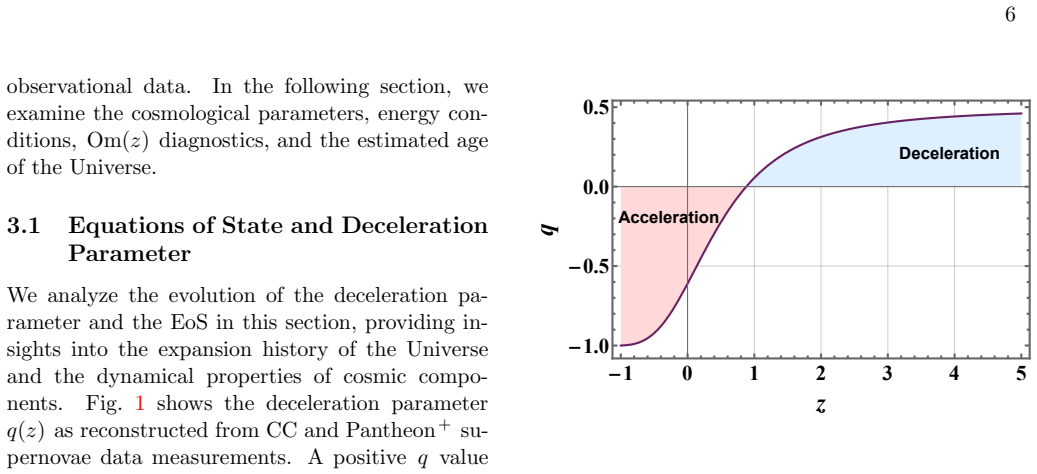
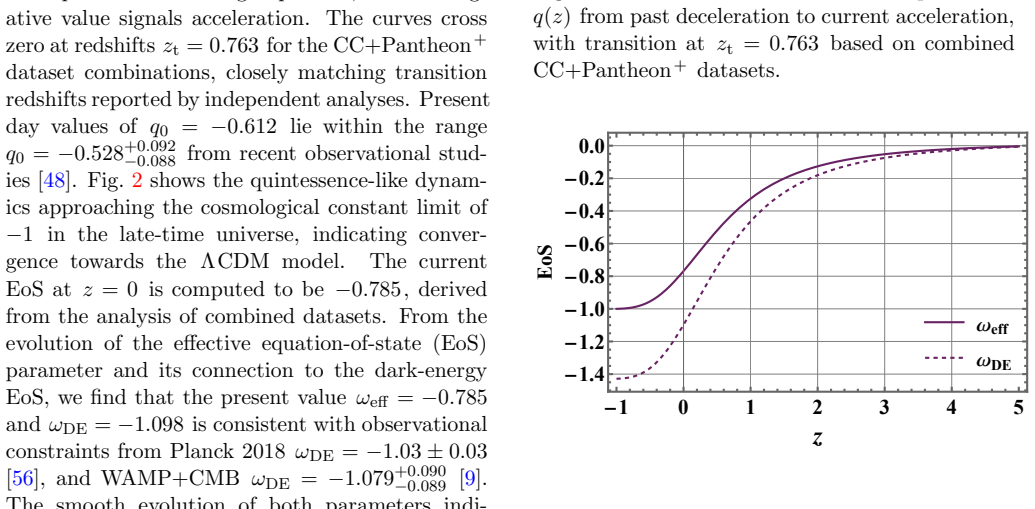
Within the f(R,G) gravity framework a proposed parametrization scheme reduces the model to a form that gradient descent can constrain using the combined Cosmic Chronometer and Pantheon+ datasets. The resulting best-fit cosmology shows the deceleration parameter transitioning from positive to negative values, the equation-of-state parameter remaining greater than -1, violation of the strong energy condition together with satisfaction of the weak and null conditions, and an Om(z) diagnostic that distinguishes the model from LambdaCDM while indicating quintessence-dominated future evolution, with the estimated age of the universe in agreement with astrophysical measurements.
What carries the argument
The parametrization scheme for f(R,G) that renders the field equations tractable for gradient descent optimization against CC and Pantheon+ constraints.
If this is right
- The best-fit model predicts quintessence-like behavior rather than phantom or constant dark energy for the future expansion.
- The Om(z) diagnostic can be used to observationally separate this gravity framework from the standard cosmological constant scenario.
- Energy conditions remain physically acceptable while permitting the observed acceleration.
- The derived age of the universe aligns with independent astrophysical determinations.
Where Pith is reading between the lines
- Similar parametrization-plus-optimization methods could be applied to other modified gravity theories when fitting to expanded observational catalogs.
- More precise future measurements of w(z) and Om(z) from upcoming surveys would provide direct tests of the quintessence prediction.
Load-bearing premise
The specific parametrization of f(R,G) is assumed to be general enough to capture the relevant physics solely on the basis of its ability to fit the data.
What would settle it
Future high-precision measurements that find the equation-of-state parameter crossing below -1 at low redshift or that show the Om(z) diagnostic evolving identically to LambdaCDM would falsify the claimed distinction and consistency of the model.
Figures


read the original abstract
We study the late-time evolution of the Universe within the f(R,G) gravity framework, where R is the Ricci scalar and G is the Gauss-Bonnet term. To make the model tractable, we propose a parametrization scheme and determine its parameters using Gradient Descent, with constraints coming from the latest Cosmic Chronometer (CC) and Pantheon+ supernova data. Key cosmological indicators, namely the deceleration parameter q and the equation-of-state parameter w, show a clear transition from past deceleration to the present accelerated expansion. Interestingly, the equation-of-state parameter w remains above the phantom divide, indicating quintessence-like behavior consistent with current observations. Energy-condition analysis further supports this framework: the strong energy condition is violated, consistent with models allowing cosmic acceleration, whereas both the weak and null energy conditions remain satisfied. To test consistency, we also apply the Om(z) diagnostic, which distinguishes this model from the standard cosmological constant scenario and indicates a quintessence-dominated future evolution. Using the best-fit values, we estimate the age of the Universe, obtaining good agreement with independent astrophysical measurements. Overall, the results suggest that f(R,G) gravity provides a viable and self-consistent explanation for late-time cosmic acceleration when constrained using the combined CC and Pantheon+ datasets.
Editorial analysis
A structured set of objections, weighed in public.
Referee Report
Summary. The manuscript studies late-time cosmic acceleration in f(R,G) gravity by introducing a parametrization for f(R,G) to render the model tractable. Parameters are optimized via gradient descent using combined Cosmic Chronometer (CC) and Pantheon+ supernova data. Derived quantities include the deceleration parameter q(z), equation-of-state w(z), Om(z) diagnostic, energy conditions (SEC violated, WEC/NEC satisfied), and Universe age, all indicating a transition to acceleration with quintessence-like behavior (w > -1) and consistency with observations, leading to the claim that f(R,G) gravity provides a viable explanation.
Significance. If the parametrization were derived from the general action or shown to be representative of the broader f(R,G) class, and if the gradient-descent fit included full uncertainty propagation and independent validation, the work would supply a concrete, data-constrained modified-gravity example satisfying standard cosmological diagnostics. The explicit use of latest CC+Pantheon+ datasets and multiple cross-checks (q, w, Om, energy conditions, age) is a positive feature. In its current form, however, the ad-hoc parametrization limits the result to a phenomenological illustration rather than a general demonstration of f(R,G) viability.
major comments (2)
- [Section introducing the parametrization scheme (likely §2–3)] The parametrization scheme (introduced to make the model tractable) is presented without derivation from the general f(R,G) field equations, without comparison to other functional forms in the literature, and without checks against theoretical requirements such as stability or absence of ghosts. All subsequent results—q(z), w(z), Om(z), energy conditions, and age—follow directly from the gradient-descent best-fit of this single choice, rendering the central claim of viability dependent on an unmotivated ansatz.
- [Results and diagnostics sections (likely §4–5)] The diagnostics (q(z), w(z) > −1, Om(z) indicating quintessence, energy-condition satisfaction, and age consistency) are computed from the same best-fit parameters obtained by fitting to CC+Pantheon+ data. This makes the reported consistency checks restatements of the fit rather than independent tests, weakening the claim that the model explains acceleration beyond the data used to constrain it.
minor comments (2)
- [Fitting procedure subsection] Clarify whether the gradient-descent procedure includes regularization, learning-rate scheduling, or multiple random initializations to guard against local minima; report the final loss value and parameter uncertainties explicitly.
- [Figures showing q(z), w(z), Om(z)] Add error bands (from the fit covariance or bootstrap) to all plotted quantities (q(z), w(z), Om(z)) so readers can assess whether the reported behaviors remain significant within uncertainties.
Simulated Author's Rebuttal
We thank the referee for the insightful comments on our manuscript. We address each major comment below and indicate the revisions we will make to strengthen the presentation of our results.
read point-by-point responses
-
Referee: [Section introducing the parametrization scheme (likely §2–3)] The parametrization scheme (introduced to make the model tractable) is presented without derivation from the general f(R,G) field equations, without comparison to other functional forms in the literature, and without checks against theoretical requirements such as stability or absence of ghosts. All subsequent results—q(z), w(z), Om(z), energy conditions, and age—follow directly from the gradient-descent best-fit of this single choice, rendering the central claim of viability dependent on an unmotivated ansatz.
Authors: We agree that the parametrization is chosen for tractability, as solving the general f(R,G) equations is challenging. This is a standard practice in exploring modified gravity models phenomenologically. In the revised version, we will provide additional motivation for the specific form, including why it captures the essential dynamics for late-time acceleration, and add comparisons to other f(R,G) parametrizations in the literature. We will also include a discussion on the stability of the model and absence of ghosts based on the best-fit parameters. However, a complete derivation from the general action is not feasible as it would require specifying the full functional form a priori, which defeats the purpose of the data-driven approach. Thus, we will revise the manuscript to explicitly state the phenomenological nature of the study. revision: partial
-
Referee: [Results and diagnostics sections (likely §4–5)] The diagnostics (q(z), w(z) > −1, Om(z) indicating quintessence, energy-condition satisfaction, and age consistency) are computed from the same best-fit parameters obtained by fitting to CC+Pantheon+ data. This makes the reported consistency checks restatements of the fit rather than independent tests, weakening the claim that the model explains acceleration beyond the data used to constrain it.
Authors: While the parameters are indeed determined from the CC and Pantheon+ datasets, the diagnostics provide valuable physical insights and cross-validations. The equation of state w(z) > -1 confirms quintessence behavior consistent with observations, the Om(z) diagnostic is a model-independent test that shows deviation from ΛCDM, and the age of the Universe is compared against independent measurements from astrophysics. The energy conditions are theoretical requirements that the model must satisfy for physical viability. In the revised manuscript, we will better distinguish between the data-constrained parameters and the derived quantities, emphasizing how these diagnostics test the model's consistency with broader cosmological principles beyond the fitting data alone. We will also discuss potential future validations with additional datasets. revision: yes
Circularity Check
Fitted parametrization yields derived cosmological indicators by construction
specific steps
-
fitted input called prediction
[Abstract]
"To make the model tractable, we propose a parametrization scheme and determine its parameters using Gradient Descent, with constraints coming from the latest Cosmic Chronometer (CC) and Pantheon+ supernova data. Key cosmological indicators, namely the deceleration parameter q and the equation-of-state parameter w, show a clear transition from past deceleration to the present accelerated expansion."
Parameters are optimized directly to the same datasets that encode the observed acceleration; q and w are then obtained by substituting the best-fit values into the model's Friedmann equations, so the reported transition is a restatement of the fit success rather than a prediction.
-
fitted input called prediction
[Abstract]
"To test consistency, we also apply the Om(z) diagnostic, which distinguishes this model from the standard cosmological constant scenario and indicates a quintessence-dominated future evolution. Using the best-fit values, we estimate the age of the Universe, obtaining good agreement with independent astrophysical measurements."
Om(z) and the age are evaluated on the identical best-fit parameter set obtained from CC+Pantheon+; any distinction from ΛCDM or age agreement is therefore a direct output of the data-constrained model, not an independent test.
full rationale
The paper proposes an ad-hoc parametrization of f(R,G) 'to make the model tractable,' fits its free parameters to CC+Pantheon+ data via gradient descent, and then computes q(z), w(z), Om(z), energy conditions, and age from the best-fit solution. These quantities are direct algebraic consequences of the fitted Hubble evolution, so the reported transition to acceleration, quintessence behavior, and consistency checks are statistically forced by the data fit rather than independent first-principles results. The age comparison offers limited external anchoring, preventing a higher score.
Axiom & Free-Parameter Ledger
free parameters (1)
- parametrization parameters
axioms (2)
- domain assumption FLRW metric and standard cosmological assumptions for late-time evolution
- ad hoc to paper Validity and generality of the chosen parametrization for f(R,G)
Lean theorems connected to this paper
-
IndisputableMonolith/Cost/FunctionalEquationwashburn_uniqueness_aczel contradicts?
contradictsCONTRADICTS: the theorem conflicts with this paper passage, or marks a claim that would need revision before publication.
To make the model tractable, we propose a parametrization scheme... f(R,G)=R+αR²+βG²... Gradient Descent... best-fit α=0.562±0.045, β=1.3±0.141
-
IndisputableMonolith/Foundation/RealityFromDistinctionreality_from_one_distinction unclear?
unclearRelation between the paper passage and the cited Recognition theorem.
The action... f(R,G)... Gauss-Bonnet term G... field equations (4)... FLRW reduction (6)
-
IndisputableMonolith/Foundation/AlexanderDualityalexander_duality_circle_linking unclear?
unclearRelation between the paper passage and the cited Recognition theorem.
Om(z) diagnostic... quintessence-like... energy conditions... SEC violated
What do these tags mean?
- matches
- The paper's claim is directly supported by a theorem in the formal canon.
- supports
- The theorem supports part of the paper's argument, but the paper may add assumptions or extra steps.
- extends
- The paper goes beyond the formal theorem; the theorem is a base layer rather than the whole result.
- uses
- The paper appears to rely on the theorem as machinery.
- contradicts
- The paper's claim conflicts with a theorem or certificate in the canon.
- unclear
- Pith found a possible connection, but the passage is too broad, indirect, or ambiguous to say the theorem truly supports the claim.
Reference graph
Works this paper leans on
-
[1]
DESI 2024 VI: cosmological constraints from the measurements of baryon acoustic oscillations,
A. Adame, J. Aguilar, S. Ahlen,et al., “DESI 2024 VI: cosmological constraints from the measurements of baryon acoustic oscillations,”J. Cosmol. Astropart. Phys. 2025(2025) 021
work page 2024
-
[2]
Testing f(R)-gravity models with DESI DR2 2025-BAO and other cosmological data,
F. Plaza and L. Kraiselburd, “Testing f(R)-gravity models with DESI DR2 2025-BAO and other cosmological data,” Phys. Rev. D112(2025) 023554
work page 2025
-
[3]
Expansion-history preferences of DESI DR2 and external data,
P. Bansal and D. Huterer, “Expansion-history preferences of DESI DR2 and external data,” Phys. Rev. D112(2025) 023528
work page 2025
-
[4]
H. Chaudhary, S. Capozziello, S. Praharaj, “Is the ΛCDM model in crisis?,”J. High Energy Astrophys.50(2026) 100507
work page 2026
-
[5]
Late-time acceleration and structure formation in interactingα-attractor dark energy models,
L.K. Duchaniya, B. Mishra, G. Otalora and M. Gonzalez-Espinoza, “Late-time acceleration and structure formation in interactingα-attractor dark energy models,” J. Cosmol. Astropart. Phys.12(2025) 010
work page 2025
-
[6]
D. N. Spergel, L. Verde, H. V. Peiriset al., “First year wilkinson microwave anisotropy probe (WMAP) observations: Determination of cosmological parameters,”Astrophys. J. Supp. Ser.148(2003) 175
work page 2003
-
[7]
Nine-year Wilkison Microwave Anisotropy Probe (WMAP) Observations: Cosmological Parameter Results,
G. Hinshaw, D. Larson, E. Komatsu,et al., “Nine-year Wilkison Microwave Anisotropy Probe (WMAP) Observations: Cosmological Parameter Results,”Astrophys. J. Supp. Ser. 208(2013) 19
work page 2013
-
[8]
S. Alam, M. Ata, S. Bailey,et al., “The clustering of galaxies in the completed 10 SDSS-III Baryon Oscillation Spectroscopic Survey: cosmological analysis of the DR12 galaxy sample,”Mon. Not. Roy. Astron. Soc. 470(2017) 2617
work page 2017
-
[9]
D. J. Eisenstein, I. Zehavi, D. W. Hogg,et al., “Detection of the Baryon Acoustic Peak in the Large-Scale Correlation Function of SDSS Luminous Red Galaxies,”Astrophys. J. 633(2005) 560
work page 2005
-
[10]
Introduction to Modified Gravity and Gravitational Alternative for Dark Energy,
S. Nojiri and S. D. Odintsov, “Introduction to Modified Gravity and Gravitational Alternative for Dark Energy,”Int. J. Geom. Methods Mod. Phys.04(2007) 115
work page 2007
-
[11]
T. P. Sotiriou and V. Faraoni, “f(R) Theories Of Gravity,”Rev. Mod. Phys.82 (2010) 451
work page 2010
-
[12]
Modified teleparallel gravity: Inflation without inflaton,
R. Ferraro and F. Fiorini, “Modified teleparallel gravity: Inflation without inflaton,”Phys. Rev. D75(2007) 084031
work page 2007
-
[13]
Coincident general relativity,
J. B. Jim´ enez, L. Heisenberg, and T. Koivisto, “Coincident general relativity,” Phys. Rev. D98(2018) 044048
work page 2018
-
[14]
L. Heisenberg, “Review onf(Q) Gravity,” Phys. Rep.1066(2023) 1
work page 2023
- [15]
-
[16]
Phenomenology of dark energy: general features of large-scale perturbations,
L. P´ erenon, F. Piazza, C. Marinoniet al., “Phenomenology of dark energy: general features of large-scale perturbations,”J. Cosmol. Astropart. Phys.2015(2015) 029
work page 2015
-
[17]
S. M. Carroll, “The Cosmological Constant,” Living Rev. Rel.4(2001) 1
work page 2001
- [18]
-
[19]
Is cosmic speed-up due to new gravitational physics?,
S. M. Carroll, V. Duvvuri, M. Troddenet al., “Is cosmic speed-up due to new gravitational physics?,”Phys. Rev. D70(2004) 043528
work page 2004
-
[20]
Unified cosmic history in modified gravity: fromF(R) theory to Lorentz non-invariant models,
S. Nojiri and S. D. Odintsov, “Unified cosmic history in modified gravity: fromF(R) theory to Lorentz non-invariant models,” Phys. Rep.505(2011) 59
work page 2011
-
[21]
Modified Gauss-Bonnet theory as gravitational alternative for dark energy,
S. Nojiri and S. D. Odintsov, “Modified Gauss-Bonnet theory as gravitational alternative for dark energy,”Phys. Lett. B 631(2005) 1
work page 2005
-
[22]
Dark energy in modified Gauss-Bonnet gravity: Late-time acceleration and the hierarchy problem,
G. Cognola, E. Elizalde, S. Nojiriet al., “Dark energy in modified Gauss-Bonnet gravity: Late-time acceleration and the hierarchy problem,”Phys. Rev. D73(2006) 084007
work page 2006
-
[23]
Cosmology in modifiedf(G) gravity: a late-time cosmic phenomena,
S. V. Lohakare, S. Niyogi, and B. Mishra, “Cosmology in modifiedf(G) gravity: a late-time cosmic phenomena,”Mon. Not. R. Astron. Soc.535(2024) 1136
work page 2024
-
[24]
The Fate of the Universe Evolution in the Quadratic Form of Ricci–Gauss–Bonnet Cosmology,
S. V. Lohakare, F. Tello-Ortiz, B. Mishraet al., “The Fate of the Universe Evolution in the Quadratic Form of Ricci–Gauss–Bonnet Cosmology,”Gravit. Cosmol.29(2023) 443
work page 2023
-
[25]
A new type of isotropic cosmological models without singularity,
A. Starobinsky, “A new type of isotropic cosmological models without singularity,” Phys. Lett. B91(1980) 99
work page 1980
-
[26]
Observational constraints on Gauss-Bonnet cosmology,
M. Benetti, S. S. da Costa, S. Capozzielloet al., “Observational constraints on Gauss-Bonnet cosmology,”Int. J. Mod. Phys. D27(2018) 1850084
work page 2018
-
[27]
Tracing the cosmic history by Gauss-Bonnet gravity,
I. de Martino, M. De Laurentis, and S. Capozziello, “Tracing the cosmic history by Gauss-Bonnet gravity,”Phys. Rev. D102 (2020) 063508
work page 2020
-
[28]
Noether symmetry approach in Gauss-Bonnet Cosmology,
S. Capozziello, M. De Laurentis, and S. D. Odintsov, “Noether symmetry approach in Gauss-Bonnet Cosmology,”Mod. Phys. Lett. A29(2014) 1450164
work page 2014
-
[29]
New insights from GW170817 in the dynamical system analysis of Einstein Gauss–Bonnet gravity,
K. F. Dialektopoulos, J. L. Said, and Z. Oikonomopoulou, “New insights from GW170817 in the dynamical system analysis of Einstein Gauss–Bonnet gravity,”Phys. Dark Univ.42(2023) 101350
work page 2023
-
[30]
Stability analysis for cosmological models inf(R) gravity using dynamical system analysis,
P. Shah and G. C. Samanta, “Stability analysis for cosmological models inf(R) gravity using dynamical system analysis,” Eur. Phys. J. C79(2019) 414
work page 2019
-
[31]
P. Bessa, M. Campista, and A. Bernui, “Observational constraints on Starobinsky f(R) cosmology from cosmic expansion and 11 structure growth data,”Eur. Phys. J. C82 (2022) 506
work page 2022
-
[32]
Dynamical analysis in regularized 4D Einstein-Gauss-Bonnet gravity with non-minimak coupling,
B. Bayarsaikhan, S. Khimphun, P. Rithyet al., “Dynamical analysis in regularized 4D Einstein-Gauss-Bonnet gravity with non-minimak coupling,”Eur. Phys. J. C83 (2023) 238
work page 2023
-
[33]
Cosmological model with time varying deceleration parameter inF(R,G) gravity,
S. V. Lohakare, S. K. Tripathy, and B. Mishra, “Cosmological model with time varying deceleration parameter inF(R,G) gravity,”Phys. Scr.96(2021) 125039
work page 2021
-
[34]
Unveiling the Universe with emerging cosmological probes,
M. Moresco, L. Amati, L. Amendolaet al., “Unveiling the Universe with emerging cosmological probes,”Living Rev. Relativ.25 (2022) 6
work page 2022
-
[35]
The Pantheon+ analysis: cosmological constraints,
D. Brout, D. Scolnic, B. Popovicet al., “The Pantheon+ analysis: cosmological constraints,”Astrophys. J.938(2022) 110
work page 2022
-
[36]
Cosmological inflation in F(R,G) gravity,
M. De Laurentis, M. Paolella, and S. Capozziello, “Cosmological inflation in F(R,G) gravity,”Phys. Rev. D91(2015) 083531
work page 2015
-
[37]
Spherically symmetric solution ofF(R,G) gravity at low energy,
B. Wu and B.-Q. Ma, “Spherically symmetric solution ofF(R,G) gravity at low energy,” Phys. Rev. D92(2015) 044012
work page 2015
-
[38]
Dynamical analysis onF(R,G) cosmology,
S. S. da Costa, F. V. Roig, J. S. Alcanizet al., “Dynamical analysis onF(R,G) cosmology,”Class. Quant. Grav.35(2018) 075013
work page 2018
-
[39]
Dynamics of inflation and dark energy from F(R,G) gravity,
S. Odintsov, V. Oikonomou, and S. Banerjee, “Dynamics of inflation and dark energy from F(R,G) gravity,”Nuclear Phys. B938 (2019) 935
work page 2019
-
[40]
The role of cosmological constant inF(R,G) gravity,
A. K. Sanyal and C. Sarkar, “The role of cosmological constant inF(R,G) gravity,” Class. Quant. Grav.37(2020) 055010
work page 2020
-
[41]
Observational constrainedF(R,G) gravity cosmological model and the dynamical system analysis,
S. V. Lohakare, K. Rathore, and B. Mishra, “Observational constrainedF(R,G) gravity cosmological model and the dynamical system analysis,”Class. Quant. Grav.40 (2023) 215009
work page 2023
-
[42]
Analyzing the geometrical and dynamical parameters of modified Teleparallel-Gauss–Bonnet model,
S. V. Lohakare, B. Mishra, S. K. Mauryaet al., “Analyzing the geometrical and dynamical parameters of modified Teleparallel-Gauss–Bonnet model,”Phys. Dark Univ.39(2023) 101164
work page 2023
-
[43]
A duality connecting neural network and cosmological dynamics,
S. Krippendorf and M. Spannowsky, “A duality connecting neural network and cosmological dynamics,”Mach. Learn. Sci. Tech.3(2022) 035011
work page 2022
-
[44]
Observational Cosmology with Artificial Neural Networks,
J. de Dios Rojas Olvera, I. G´ omez-Vargas, J.A. V´ azquez, “Observational Cosmology with Artificial Neural Networks,”Universe8 (2022) 120
work page 2022
-
[45]
Gradient descent algorithm to search for periodicN-body orbits,
A. Anandam, “Gradient descent algorithm to search for periodicN-body orbits,”New Astron.100(2023) 101991
work page 2023
-
[46]
Cosmographic analysis of the equation of state of the universe through pad´ e approximations,
C. Gruber, O. Luongo, “Cosmographic analysis of the equation of state of the universe through pad´ e approximations,” Phys. Rev. D89(2014) 103506
work page 2014
-
[47]
The Large Scale Structure of Space-Time,
S. W. Hawking and G. Ellis, “The Large Scale Structure of Space-Time,”Cambridge University Press(1973)
work page 1973
-
[48]
A Relativist’s Toolkit: The Mathematics of Black Hole Mechanics,
E. Poisson, “A Relativist’s Toolkit: The Mathematics of Black Hole Mechanics,” Cambridge University Press(2004)
work page 2004
-
[49]
Energy conditions inf(R) gravity,
J. Santos, J. S. Alcaniz, M. J. Rebou¸ caset al., “Energy conditions inf(R) gravity,” Phys. Rev. D76(2007) 083513
work page 2007
-
[50]
The Raychaudhuri equations: A brief review,
S. Kar and S. Sengupta, “The Raychaudhuri equations: A brief review,”Pramana69 (2007) 49
work page 2007
-
[51]
Twilight for the energy conditions?,
C. Barcel´ o and M. Visser, “Twilight for the energy conditions?,”Int. J. Mod. Phys. D11 (2002) 1553
work page 2002
-
[52]
General relativistic energy conditions: The Hubble expansion in the epoch of galaxy formation,
M. Visser, “General relativistic energy conditions: The Hubble expansion in the epoch of galaxy formation,”Phys. Rev. D56 (1997) 7578
work page 1997
-
[53]
The Chemical Composition and Age of the Metal-poor Halo Star BD +17o3248,
J. J. Cowan, C. Sneden, S. Burles, et. al., “The Chemical Composition and Age of the Metal-poor Halo Star BD +17o3248,” Astrophy. J.572(2002) 861. 12
work page 2002
-
[54]
Planck 2018 results: Overview and the cosmological legacy of Planck,
N. Aghanim, Y. Akrami, F. Arroja, et. al., “Planck 2018 results: Overview and the cosmological legacy of Planck,”Astron. Astrophys.641(2020) A1
work page 2018
discussion (0)
Sign in with ORCID, Apple, or X to comment. Anyone can read and Pith papers without signing in.