Recognition: 2 theorem links
· Lean TheoremViscoelastic control of acoustic particle migration and trapping in microchannels
Pith reviewed 2026-05-12 02:22 UTC · model grok-4.3
The pith
Viscoelastic fluids reduce the critical particle size for acoustic trapping in microchannels below Newtonian limits.
A machine-rendered reading of the paper's core claim, the machinery that carries it, and where it could break.
Core claim
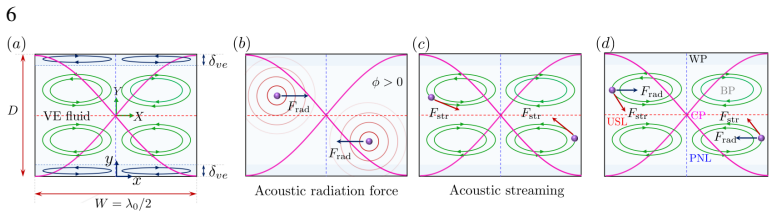
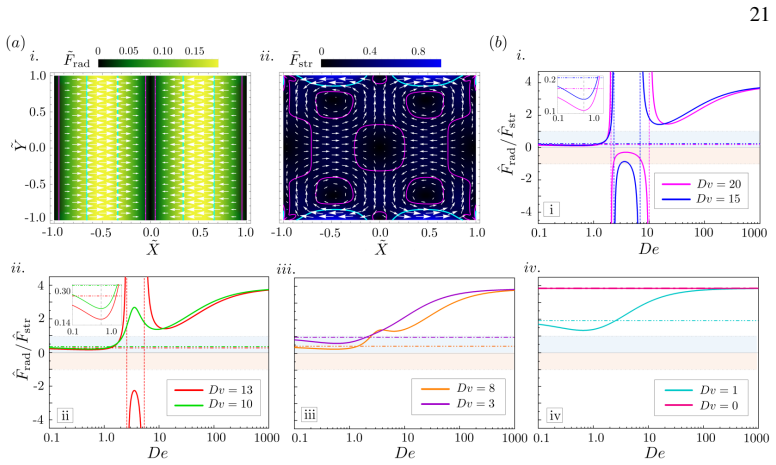
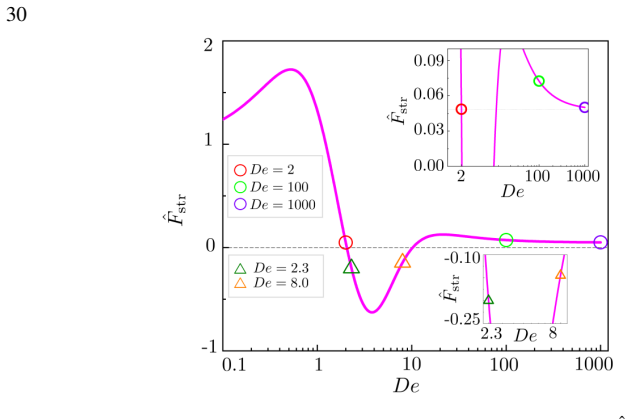
In an ultrasonically actuated microchannel filled with an Oldroyd-B fluid, the steady streaming and acoustic radiation forces compete to set particle trajectories, with the transition size between streaming-dominated and radiation-dominated regimes becoming a decreasing function of the Deborah number De at fixed viscous diffusion number Dv; above a threshold De the critical radius falls below its Newtonian value, enabling effective trapping and migration of submicron particles.
What carries the argument
Perturbation expansion of the Oldroyd-B constitutive equations to compute oscillatory flow and steady streaming, combined with a semi-analytical acoustic radiation force model that enters the particle force balance to determine equilibrium locations as functions of De and Dv.
If this is right
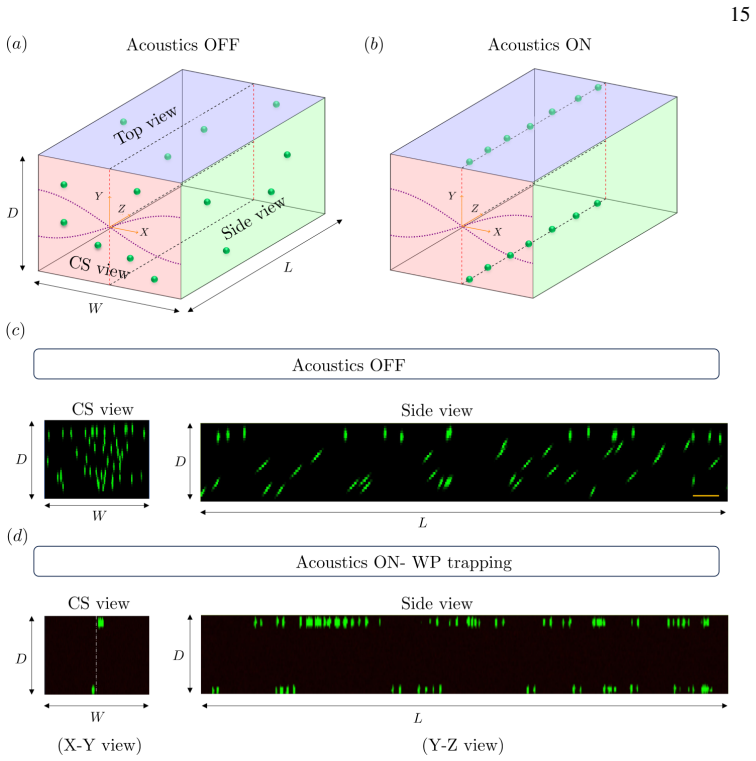
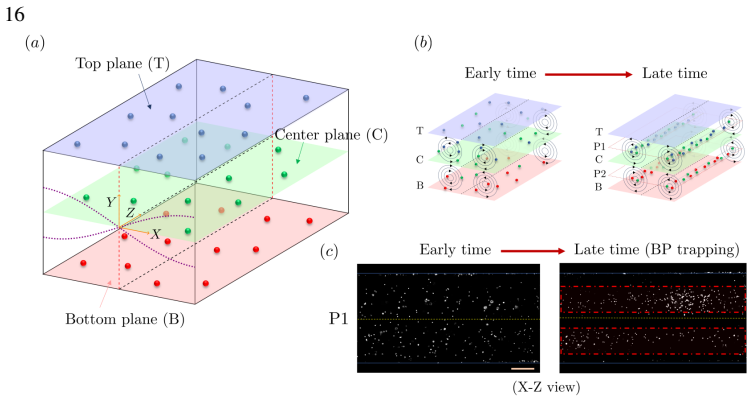
- At high Dv, raising De moves equilibrium trapping from the bulk region successively to the channel wall, pressure nodal line, channel center, or ultrasound symmetry line.
- The critical particle size for radiation dominance decreases with De, becoming significantly smaller than the Newtonian value.
- Particle trajectories are controlled primarily by the two dimensionless groups De and Dv.
- Viscoelasticity supplies new tunable mechanisms for migration and trapping that are absent in Newtonian acoustofluidics.
Where Pith is reading between the lines
- Viscoelastic sample media could be used directly in acoustofluidic chips to manipulate submicron biological particles without dilution or stronger transducers.
- The De–Dv parameter map supplies a design rule for choosing polymer concentration or frequency to place traps at desired positions for a given particle size.
- Similar reductions in critical size may occur in other viscoelastic or shear-thinning fluids, suggesting broader non-Newtonian acoustofluidic applications.
Load-bearing premise
The perturbation solution of the Oldroyd-B equations together with the semi-analytical radiation force model accurately captures the steady streaming flows and the net force balance on particles inside the microchannel geometry.
What would settle it
An experiment in which the measured critical particle radius or the observed trapping location remains unchanged as the fluid relaxation time (hence Deborah number) is increased at fixed viscous diffusion number would falsify the predicted dependence.
Figures






read the original abstract
Particle migration and trapping in ultrasonically actuated microscale flows arise from the competition between acoustic radiation forces and streaming-induced drag. While these mechanisms are well understood in Newtonian fluids, the role of fluid viscoelasticity in governing particle dynamics remains largely unexplored. Here, we investigate particle transport and trapping in a viscoelastic fluid within an ultrasonically excited microchannel under the combined action of acoustic streaming and radiation forces. Using a perturbation framework, we solve the continuity, momentum and constitutive equations for an Oldroyd-B fluid to obtain the oscillatory acoustic field and the resulting steady streaming flows in the bulk and near-wall boundary layers. Acoustic radiation forces, incorporated through a semi-analytical model, drives particle migration, while streaming-induced drag can oppose, alter or suppress trapping. We show that particle trajectories and equilibrium trapping locations are governed primarily by the Deborah number ($De$) and viscous diffusion number ($Dv$). At high $Dv$, increasing $De$ shifts the trapping location from the bulk region to the channel wall, pressure nodal line, channel centre or ultrasound symmetry line. We further determine the critical particle size governing the transition between radiation-dominated and streaming-dominated regimes as a function of $De$ and $Dv$. The critical particle size can become significantly smaller than that in a Newtonian fluid, enabling effective manipulation of submicron particles and overcoming a key limitation of conventional acoustofluidics. These results demonstrate how viscoelasticity fundamentally modifies acoustophoretic transport and establish new mechanisms for tunable particle migration and trapping in complex fluids.
Editorial analysis
A structured set of objections, weighed in public.
Referee Report
Summary. The paper develops a perturbation solution for the Oldroyd-B constitutive equations in an ultrasonically actuated microchannel to obtain the oscillatory acoustic field and steady streaming flows. It then couples these to a semi-analytical (Newtonian-derived) acoustic radiation force model to predict particle trajectories, equilibrium trapping locations, and the critical particle radius separating radiation-dominated and streaming-dominated regimes as functions of the Deborah number De and viscous diffusion number Dv. The central claim is that increasing De at fixed Dv can shift trapping locations and substantially reduce the critical particle size relative to Newtonian fluids, enabling submicron particle manipulation.
Significance. If the hybrid fluid–force model is accurate, the work identifies a new viscoelastic mechanism for lowering the size threshold in acoustophoretic trapping, which would be a notable advance for handling submicron particles in complex fluids. The parametric exploration of De and Dv and the boundary-layer treatment of streaming are technically interesting contributions, but the absence of any validation data or full derivation details limits immediate impact.
major comments (2)
- [Acoustic radiation force incorporation and particle force balance] The acoustic radiation force is incorporated via a semi-analytical model taken from the Newtonian literature (Gor'kov-type or equivalent). No re-derivation of the time-averaged Maxwell stress or particle–fluid interaction terms is provided under the Oldroyd-B constitutive relation. This omission is load-bearing for the headline result that the critical radius decreases significantly with De, because any De-dependent correction to the force integral would alter the radiation-versus-streaming balance precisely in the regime De ≳ 1 where the reduction is claimed.
- [Results on critical particle size and trapping locations] The manuscript provides no experimental validation, numerical benchmarks, or comparison against fully resolved simulations for either the streaming velocity field or the predicted critical particle sizes. Without such checks, it is impossible to assess whether the perturbation framework plus the hybrid force model quantitatively captures the steady-state particle equilibrium.
minor comments (2)
- The abstract and text refer to “semi-analytical model” for radiation forces without citing the specific Newtonian expression or stating the assumptions under which it remains valid for viscoelastic fluids.
- Notation for the viscous diffusion number Dv should be defined explicitly at first use and distinguished from the usual viscous penetration depth scaling.
Simulated Author's Rebuttal
We thank the referee for the careful and constructive review of our manuscript. The comments highlight important aspects of our modeling approach and the need for clarity on its assumptions. We address each major comment below and have made targeted revisions to improve the manuscript, including additional discussion of model limitations and expanded benchmarking against known limits.
read point-by-point responses
-
Referee: The acoustic radiation force is incorporated via a semi-analytical model taken from the Newtonian literature (Gor'kov-type or equivalent). No re-derivation of the time-averaged Maxwell stress or particle–fluid interaction terms is provided under the Oldroyd-B constitutive relation. This omission is load-bearing for the headline result that the critical radius decreases significantly with De, because any De-dependent correction to the force integral would alter the radiation-versus-streaming balance precisely in the regime De ≳ 1 where the reduction is claimed.
Authors: We acknowledge that the acoustic radiation force is implemented using the established Newtonian Gor'kov framework applied to the viscoelastic acoustic fields obtained from our perturbation solution. A complete re-derivation of the time-averaged force including Oldroyd-B stress contributions to the particle-fluid interaction would require a separate asymptotic analysis of the scattered field around the particle and is outside the scope of the present work, which centers on the modification of the background flow by viscoelasticity. In the regime of interest (particle radius much smaller than the acoustic wavelength), the leading-order radiation force is governed by the far-field oscillatory pressure and velocity, which are directly provided by our Oldroyd-B solution. The reported reduction in critical radius with increasing De arises principally from the viscoelastic enhancement of the steady streaming velocity (and thus the opposing drag), rather than from changes to the radiation force itself. We have added a dedicated paragraph in the revised manuscript justifying this hybrid modeling choice, discussing its expected validity for De ≲ O(1), and explicitly noting that De-dependent corrections to the force could be explored in future extensions. revision: partial
-
Referee: The manuscript provides no experimental validation, numerical benchmarks, or comparison against fully resolved simulations for either the streaming velocity field or the predicted critical particle sizes. Without such checks, it is impossible to assess whether the perturbation framework plus the hybrid force model quantitatively captures the steady-state particle equilibrium.
Authors: We agree that quantitative validation against experiments or fully resolved simulations would increase confidence in the predicted critical sizes and equilibrium locations. The present study is a theoretical investigation that derives a perturbation solution for the Oldroyd-B acoustic and streaming fields and couples it to an existing radiation-force expression. We have benchmarked the model by recovering the Newtonian (De = 0) limits for both the streaming velocity and the critical radius, as well as by verifying consistency with known asymptotic expressions for boundary-layer streaming. These checks are reported in the results and discussion sections. We have expanded the manuscript with additional analytical comparisons and a clearer statement of the model's assumptions and range of applicability. Full experimental validation or direct numerical simulations of the coupled viscoelastic-particle problem lie beyond the scope of this work and are identified as directions for future research. revision: partial
Circularity Check
No significant circularity in derivation chain
full rationale
The paper solves the Oldroyd-B continuity, momentum and constitutive equations via a perturbation expansion to obtain the oscillatory acoustic field and steady streaming velocity (bulk and boundary layers). Particle motion is then obtained by balancing this streaming drag against a semi-analytical radiation force taken from the Newtonian literature. The critical particle size is computed directly from that force balance as a function of the independent dimensionless groups De and Dv; no parameter is fitted to the target quantity and then re-used as a prediction. No self-citation is invoked as a uniqueness theorem or load-bearing premise, and the radiation-force model is not re-derived inside the paper, so the result is not equivalent to its inputs by construction. The derivation remains self-contained against external benchmarks.
Axiom & Free-Parameter Ledger
axioms (2)
- domain assumption Oldroyd-B constitutive relation for viscoelastic fluid
- domain assumption Semi-analytical model for acoustic radiation force
Lean theorems connected to this paper
-
IndisputableMonolith/Foundation/RealityFromDistinction.leanreality_from_one_distinction unclearUsing a perturbation framework, we solve the continuity, momentum and constitutive equations for an Oldroyd-B fluid... critical particle size ac = sqrt(6ν/ω * Ξ/Φve * χd * |Cs|)
-
IndisputableMonolith/Cost/FunctionalEquation.leanwashburn_uniqueness_aczel unclearDeborah number De=τ/tac and viscous diffusion number Dv=νp/νs govern trapping regimes
Reference graph
Works this paper leans on
-
[1]
Free Flow Acoustophoresis: Microfluidic-Based Mode of Particle and Cell Separation , volume =
Petersson, Filip and Åberg, Lena and Sw\". Free Flow Acoustophoresis: Microfluidic-Based Mode of Particle and Cell Separation , volume =. Analytical Chemistry , publisher =. 2007 , month = June, pages =. doi:10.1021/ac070444e , number =
-
[2]
Sajeesh, P. and Sen, Ashis Kumar , year =. Particle separation and sorting in microfluidic devices: a review , volume =. Microfluidics and Nanofluidics , publisher =. doi:10.1007/s10404-013-1291-9 , number =
-
[3]
On the acoustic radiation pressure on spheres , journal =
King , doi =. On the acoustic radiation pressure on spheres , journal =. 1934 , month = nov, publisher =
work page 1934
-
[4]
Soviet Physics Doklady , year = 1962, month = mar, volume =
On the Forces Acting on a Small Particle in an Acoustical Field in an Ideal Fluid. Soviet Physics Doklady , year = 1962, month = mar, volume =
work page 1962
-
[5]
Philosophical Transactions of the Royal Society of London , number=
On the circulation of air observed in Kundt’s tubes, and on some allied acoustical problems , author=. Philosophical Transactions of the Royal Society of London , number=. 1884 , publisher=
-
[6]
Acoustofluidics 14: Applications of acoustic streaming in microfluidic devices , volume =
Wiklund, Martin and Green, Roy and Ohlin, Mathias , year =. Acoustofluidics 14: Applications of acoustic streaming in microfluidic devices , volume =. Lab on a Chip , publisher =. doi:10.1039/c2lc40203c , number =
-
[7]
Acoustofluidics 8: Applications of acoustophoresis in continuous flow microsystems , volume =
Lenshof, Andreas and Magnusson, Cecilia and Laurell, Thomas , year =. Acoustofluidics 8: Applications of acoustophoresis in continuous flow microsystems , volume =. Lab on a Chip , publisher =. doi:10.1039/c2lc21256k , number =
-
[8]
Hahn, Philipp and Leibacher, Ivo and Baasch, Thierry and Dual, Jurg. Numerical simulation of acoustofluidic manipulation by radiation forces and acoustic streaming for complex particles. Lab Chip
-
[9]
Hammarstr\". Seed particle-enabled acoustic trapping of bacteria and nanoparticles in continuous flow systems , volume =. Lab on a Chip , publisher =. 2012 , pages =. doi:10.1039/c2lc40697g , number =
-
[10]
Acoustofluidics 20: Applications in acoustic trapping , volume =
Evander, Mikael and Nilsson, Johan , year =. Acoustofluidics 20: Applications in acoustic trapping , volume =. Lab on a Chip , publisher =. doi:10.1039/c2lc40999b , number =
-
[11]
Faraday, Michael , year =. XVII. On a peculiar class of acoustical figures; and on certain forms assumed by groups of particles upon vibrating elastic surfaces , ISSN =. Philosophical Transactions of the Royal Society of London , publisher =. doi:10.1098/rstl.1831.0018 , number =
-
[12]
Longitudinal vibrations and acoustic figures in cylindrical columns of liquids , author=. Ann. Phys. Chem , volume=
-
[13]
Sujith, T. and Malik, L. and Sen, A.K. , year =. Fluid viscoelasticity affects ultrasound force field-induced particle transport , volume =. doi:10.1017/jfm.2024.965 , journal =
-
[14]
Malik, L. and Nath, A. and Nandy, S. and Laurell, T. and Sen, A. K. , doi =. Physical Review E , keywords =
-
[15]
Doinikov, AlexanderA. and Gerlt, Michael S. and Dual, J\". Acoustic Radiation Forces Produced by Sharp-Edge Structures in Microfluidic Systems , volume =. Physical Review Letters , publisher =. doi:10.1103/physrevlett.124.154501 , number =
-
[16]
and Fankhauser, Jonas and Dual, J\"
Doinikov, Alexander A. and Fankhauser, Jonas and Dual, J\". Nonlinear dynamics of a solid particle in an acoustically excited viscoelastic fluid. I. Acoustic streaming , volume =. Physical Review E , publisher =. doi:10.1103/physreve.104.065107 , number =
-
[17]
and Fankhauser, Jonas and Dual, J\"
Doinikov, Alexander A. and Fankhauser, Jonas and Dual, J\". Nonlinear dynamics of a solid particle in an acoustically excited viscoelastic fluid. II. Acoustic radiation force , volume =. Physical Review E , publisher =. doi:10.1103/physreve.104.065108 , number =
-
[18]
Vargas, C. and Campos-Silva, I. and Méndez, F. and Arcos, J. and Bautista, O. , year =. Acoustic streaming in Maxwell fluids generated by standing waves in two-dimensional microchannels , volume =. doi:10.1017/jfm.2021.1116 , journal =
-
[19]
Fluid viscoelasticity controls acoustic streaming via shear waves , author=. 2026 , eprint=
work page 2026
-
[20]
Proceedings of the Royal Society of London
On the formulation of rheological equations of state , author=. Proceedings of the Royal Society of London. Series A. Mathematical and Physical Sciences , volume=. 1950 , publisher=
work page 1950
-
[21]
Acoustic streaming , author=. Physical acoustics , volume=. 1965 , publisher=
work page 1965
-
[22]
Lee, Chun P. and Wang, Taylor G. , year =. Outer acoustic streaming , volume =. The Journal of the Acoustical Society of America , publisher =. doi:10.1121/1.400079 , number =
-
[23]
Muller, P. B. and Rossi, M. and Marín, Á. G. and Barnkob, R. and Augustsson, P. and Laurell, T. and K\". Ultrasound-induced acoustophoretic motion of microparticles in three dimensions , volume =. Physical Review E , publisher =. doi:10.1103/physreve.88.023006 , number =
-
[24]
Wu, Heng and Wang, Mengmeng and Li, Maoyuan and Jin, Gang , year =. Longitudinal ultrasound measurements of polyethylene oxide across dilute to concentrated aqueous solutions , volume =. doi:10.1016/j.polymer.2024.127470 , journal =
-
[25]
Wu, Heng and Huang, Xiaodong and Liang, Xianrong and Wang, Mengmeng and Jin, Gang , year =. Influence of viscoelasticity on ultrasonic propagation in poly(ethylene oxide) aqueous solution , volume =. Journal of Physics D: Applied Physics , publisher =. doi:10.1088/1361-6463/acb8c5 , number =
-
[26]
Milliken, William J. and Powell, Robert L. , year =. Finite-amplitude ultrasonic measurements of polyethylene oxide and polyacrylamide solutions , volume =. The Journal of the Acoustical Society of America , publisher =. doi:10.1121/1.400313 , number =
-
[27]
and Metaxas, Athena and Bates, Frank S
Morozova, Svetlana and Schmidt, Peter W. and Metaxas, Athena and Bates, Frank S. and Lodge, Timothy P. and Dutcher, Cari S. , year =. Extensional Flow Behavior of Methylcellulose Solutions Containing Fibrils , volume =. ACS Macro Letters , publisher =. doi:10.1021/acsmacrolett.8b00042 , number =
-
[28]
Nakagawa, Daiki and Saiki, Erika and Horikawa, Yoshiki and Shikata, Toshiyuki , year =. Rigid Rod-like Viscoelastic Behaviors of Methyl Cellulose Samples with a Wide Range of Molar Masses Dissolved in Aqueous Solutions , volume =. Molecules , publisher =. doi:10.3390/molecules29020466 , number =
-
[29]
B\". Shear rheology of methyl cellulose based solutions for cell mechanical measurements at high shear rates , volume =. Soft Matter , publisher =. 2023 , pages =. doi:10.1039/d2sm01515c , number =
-
[30]
Thurston, G.B. , doi =. Biophysical Journal , mendeley-groups =
-
[31]
Pan, Weichun and Filobelo, Luis and Pham, Ngoc D. Q. and Galkin, Oleg and Uzunova, Veselina V. and Vekilov, Peter G. , year =. Viscoelasticity in Homogeneous Protein Solutions , volume =. Physical Review Letters , publisher =. doi:10.1103/physrevlett.102.058101 , number =
discussion (0)
Sign in with ORCID, Apple, or X to comment. Anyone can read and Pith papers without signing in.