Recognition: no theorem link
Physics-Informed Neural PDE Solvers via Spatio-Temporal MeanFlow
Pith reviewed 2026-05-12 03:48 UTC · model grok-4.3
The pith
Replacing the generative velocity field with the physical PDE operator and extending the mean constraint to space and time creates a unified neural solver for both evolving and stationary equations.
A machine-rendered reading of the paper's core claim, the machinery that carries it, and where it could break.
Core claim
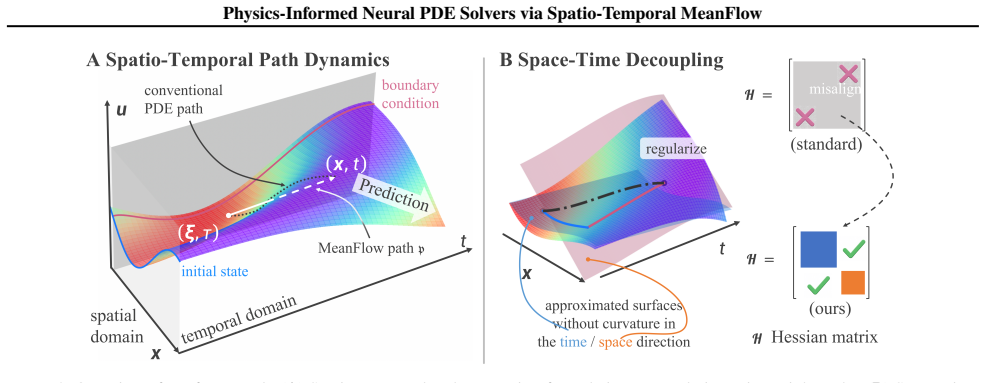
By substituting the generative velocity field with the physical PDE operator, we transform multi-step numerical integration into an efficient prediction with a freely controllable integration length. Crucially, we extend the original MeanFlow constraint from the temporal to the spatio-temporal domain, coupling time evolution with spatial consistency. This yields a unified framework naturally accommodating both time-dependent and stationary PDEs.
What carries the argument
Spatio-Temporal MeanFlow, obtained by replacing the generative velocity with the PDE operator and extending the integral constraint over space and time to predict finite-interval state evolution in one step.
If this is right
- Multi-step numerical integration reduces to a single forward pass whose length can be chosen freely at inference time.
- The same trained model handles both time-dependent evolution and stationary problems without separate formulations.
- The integral constraint produces strong generalization to out-of-distribution initial conditions and varying spatial resolutions.
- Inference becomes faster than repeated-step baselines while maintaining or improving accuracy on benchmark problems.
Where Pith is reading between the lines
- The controllable interval length may allow error-driven adaptive stepping during simulation without retraining.
- Conservation properties could be tested by checking whether the integral constraint better preserves invariants than residual-only losses over long horizons.
- The continuous formulation might extend to parameter-dependent or stochastic PDEs by treating parameters as additional input dimensions.
Load-bearing premise
Substituting the PDE operator for the generative velocity field and extending the mean constraint to the full spatio-temporal domain preserves the integral properties and numerical stability of the original method for arbitrary PDEs.
What would settle it
Demonstration that the method produces unstable or inaccurate long-term trajectories on a stiff nonlinear PDE such as the Kuramoto-Sivashinsky equation when the integration interval is increased beyond the training range.
Figures



read the original abstract
Deep learning paradigms, such as PINNs and neural operators, have significantly advanced the solving of PDEs. However, they often struggle to capture the continuous integral nature of physical systems, relying either on pointwise residuals that ignore the integral perspective or on pre-discretized temporal grids. Drawing inspiration from MeanFlow, a continuous-time integrator recently developed to efficiently solve generative ODEs, we introduce Spatio-Temporal MeanFlow, which functions as a novel PDE solver learning the finite-interval evolution of physical states. By substituting the generative velocity field with the physical PDE operator, we transform multi-step numerical integration into an efficient prediction with a freely controllable integration length. Crucially, we extend the original MeanFlow constraint from the temporal to the spatio-temporal domain, coupling time evolution with spatial consistency. This yields a unified framework naturally accommodating both time-dependent and stationary PDEs. Comprehensive experiments on benchmarks demonstrate that our approach achieves superior accuracy and inference efficiency over representative baselines. Furthermore, the proposed integral constraint enables excellent generalization to out-of-distribution initial conditions and varying spatial resolutions.
Editorial analysis
A structured set of objections, weighed in public.
Referee Report
Summary. The manuscript proposes Spatio-Temporal MeanFlow, a physics-informed neural PDE solver obtained by substituting the generative velocity field of the original MeanFlow ODE with the physical PDE operator F(u) and extending the temporal MeanFlow constraint to a spatio-temporal version. This substitution is claimed to convert multi-step numerical integration into a single efficient prediction whose integration length is freely controllable, while the spatio-temporal coupling yields a unified framework for both time-dependent and stationary PDEs. Experiments on standard benchmarks are reported to show superior accuracy and inference speed relative to PINNs and neural operators, together with strong generalization to out-of-distribution initial conditions and varying spatial resolutions.
Significance. If the substitution is shown to preserve the integral identity and numerical stability for general PDE operators, the approach would constitute a meaningful advance: it supplies an integral-constraint formulation that respects the continuous-time evolution of physical systems without requiring pre-discretized temporal grids. The controllable integration length and unified treatment of evolutionary and stationary problems could improve long-horizon accuracy and resolution flexibility in neural PDE solvers.
major comments (2)
- [§3] §3 (Spatio-Temporal MeanFlow construction): the central substitution of the generative velocity v by the PDE operator F(u) is asserted to preserve the MeanFlow integral identity and yield a valid finite-interval integrator, yet no theorem, derivation, or set of regularity conditions on F is supplied. For nonlinear, stiff, or only weakly Lipschitz operators the contractivity or Lipschitz assumptions implicit in the original MeanFlow analysis need not hold; without such justification the claim that the spatio-temporal extension remains consistent for arbitrary PDEs is unsupported and load-bearing for the unified-framework assertion.
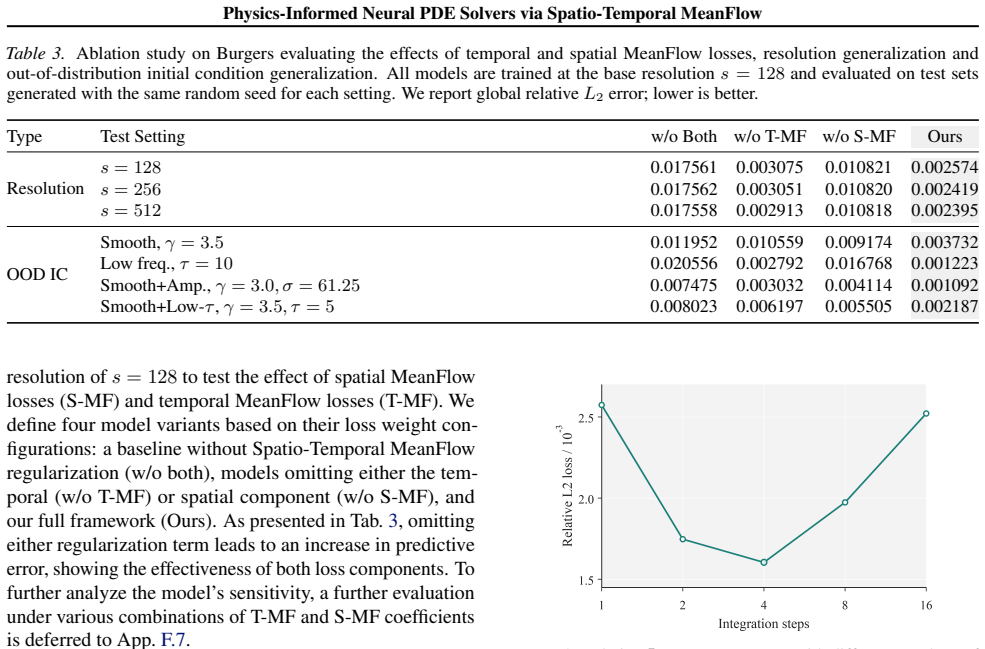
- [§4] §4 (Experiments): the reported accuracy and generalization gains are presented without an accompanying error-growth analysis versus integration length or ablation on PDE operators that violate the regularity assumptions required by the substitution (e.g., stiff reaction-diffusion or hyperbolic systems). Table 1 and Figure 3 therefore do not yet isolate whether the observed improvements stem from the integral constraint or from other architectural choices.
minor comments (2)
- [Abstract, §2] The abstract and §2 should explicitly cite the original MeanFlow reference and clarify which of its integral identities are being extended.
- [§3] Notation for the spatio-temporal constraint (Eq. (7) or equivalent) should be introduced with a clear statement of the domain of integration and the precise form of the mean operator.
Simulated Author's Rebuttal
We thank the referee for the detailed and constructive report. The two major comments identify genuine gaps in the current manuscript regarding theoretical justification and experimental validation. We address each point below and will incorporate revisions to strengthen the paper.
read point-by-point responses
-
Referee: [§3] §3 (Spatio-Temporal MeanFlow construction): the central substitution of the generative velocity v by the PDE operator F(u) is asserted to preserve the MeanFlow integral identity and yield a valid finite-interval integrator, yet no theorem, derivation, or set of regularity conditions on F is supplied. For nonlinear, stiff, or only weakly Lipschitz operators the contractivity or Lipschitz assumptions implicit in the original MeanFlow analysis need not hold; without such justification the claim that the spatio-temporal extension remains consistent for arbitrary PDEs is unsupported and load-bearing for the unified-framework assertion.
Authors: We agree that a formal derivation was missing. The substitution follows directly from the fundamental theorem of calculus: if u satisfies ∂u/∂t = F(u), then u(T) − u(0) = ∫_0^T F(u(t)) dt, which is precisely the MeanFlow integral identity with velocity replaced by the PDE operator. This identity holds whenever a solution exists, independent of Lipschitz constants. However, we acknowledge the manuscript provided no explicit derivation or regularity discussion. In the revision we will add a dedicated subsection in §3 that (i) derives the identity from the PDE, (ii) states the minimal assumption of local existence of solutions in appropriate Sobolev spaces, and (iii) notes that the integral constraint remains well-defined even for stiff or weakly Lipschitz operators (though uniqueness may require additional regularization). We will also clarify that the unified treatment of evolutionary and stationary problems follows by setting the time derivative to zero in the stationary case, without relying on contractivity. revision: yes
-
Referee: [§4] §4 (Experiments): the reported accuracy and generalization gains are presented without an accompanying error-growth analysis versus integration length or ablation on PDE operators that violate the regularity assumptions required by the substitution (e.g., stiff reaction-diffusion or hyperbolic systems). Table 1 and Figure 3 therefore do not yet isolate whether the observed improvements stem from the integral constraint or from other architectural choices.
Authors: We concur that the current experiments do not fully isolate the contribution of the integral constraint or test the method on operators that may violate strong regularity. In the revised manuscript we will add: (1) an error-growth plot showing L2 error versus controllable integration length for the Navier–Stokes and reaction-diffusion benchmarks; (2) new experiments on a stiff reaction-diffusion system (e.g., Allen–Cahn with large reaction coefficient) and a hyperbolic system (e.g., inviscid Burgers or linear wave equation); (3) an ablation that removes the spatio-temporal integral constraint while keeping the network architecture fixed, thereby isolating its effect. These additions will directly address whether gains arise from the MeanFlow-style constraint or from other design choices. revision: yes
Circularity Check
No circularity: derivation extends external MeanFlow without self-referential reduction
full rationale
The paper draws inspiration from an external MeanFlow reference for continuous-time integration and proposes a substitution of the velocity field with the PDE operator plus a spatio-temporal extension of the constraint. No quoted equations or steps in the abstract or description reduce the claimed integral properties, stability, or performance to a fitted parameter, self-definition, or self-citation chain by construction. The central construction is presented as an independent adaptation with external benchmarks, satisfying the criteria for a self-contained derivation against external references.
Axiom & Free-Parameter Ledger
axioms (1)
- domain assumption The MeanFlow constraint can be extended to the spatio-temporal domain while preserving its integral properties when the generative velocity field is replaced by a physical PDE operator.
Reference graph
Works this paper leans on
-
[1]
High-dimensional partial differential equations in science and engineering , author=. 2007 , publisher=
work page 2007
-
[3]
International Journal of Applied Mathematics , volume=
ADVANCED NUMERICAL METHODS FOR SOLVING NONLINEAR PARTIAL DIFFERENTIAL EQUATIONS IN FLUID MECHANICS: APPLICATIONS IN AEROSPACE ENGINEERING , author=. International Journal of Applied Mathematics , volume=
-
[4]
Proceedings of the 40th International Conference on Machine Learning (
Consistency models , author=. Proceedings of the 40th International Conference on Machine Learning (. 2023 , month=
work page 2023
-
[8]
ACM computing surveys , volume=
Diffusion models: A comprehensive survey of methods and applications , author=. ACM computing surveys , volume=. 2023 , publisher=
work page 2023
-
[9]
IEEE Transactions on Pattern Analysis and Machine Intelligence , volume=
Diffusion models in vision: A survey , author=. IEEE Transactions on Pattern Analysis and Machine Intelligence , volume=. 2023 , publisher=
work page 2023
-
[10]
Nonlinear and stochastic phenomena: The grand challenge for partial differential equations , author=. SIAM review , volume=. 1991 , publisher=
work page 1991
-
[11]
Numerical solution of partial differential equations by the finite element method , author=. 2009 , publisher=
work page 2009
-
[12]
Boundary element methods with applications to nonlinear problems , author=. 2010 , publisher=
work page 2010
-
[13]
Isogeometric analysis: toward integration of
Cottrell, J Austin and Hughes, Thomas JR and Bazilevs, Yuri , year=. Isogeometric analysis: toward integration of
-
[14]
Journal of Scientific Computing , volume=
Scientific machine learning through physics--informed neural networks: Where we are and what’s next , author=. Journal of Scientific Computing , volume=. 2022 , publisher=
work page 2022
-
[15]
Improved physics-informed neural network in mitigating gradient-related failures , author=. Neurocomputing , volume=. 2025 , publisher=
work page 2025
-
[17]
Rahman, Md Ashiqur and Ross, Zachary E and Azizzadenesheli, Kamyar , journal=
-
[19]
Wang, Sifan and Yu, Xinling and Perdikaris, Paris , journal=. When and why. 2022 , publisher=
work page 2022
-
[20]
SIAM Journal on Scientific Computing , volume=
Understanding and mitigating gradient flow pathologies in physics-informed neural networks , author=. SIAM Journal on Scientific Computing , volume=. 2021 , publisher=
work page 2021
-
[21]
Advances in Neural Information Processing Systems , volume=
Characterizing possible failure modes in physics-informed neural networks , author=. Advances in Neural Information Processing Systems , volume=
-
[23]
Advances in neural information processing systems , volume=
Choose a transformer: Fourier or galerkin , author=. Advances in neural information processing systems , volume=
-
[24]
Fourier neural operator with learned deformations for
Li, Zongyi and Huang, Daniel Zhengyu and Liu, Burigede and Anandkumar, Anima , journal=. Fourier neural operator with learned deformations for
-
[25]
Advances in Neural Information Processing Systems , volume=
Multipole graph neural operator for parametric partial differential equations , author=. Advances in Neural Information Processing Systems , volume=
-
[27]
SIAM Journal on Scientific Computing , volume=
Cocogen: Physically consistent and conditioned score-based generative models for forward and inverse problems , author=. SIAM Journal on Scientific Computing , volume=. 2025 , publisher=
work page 2025
-
[28]
Xianglong Hou and Xinquan Huang and Paris Perdikaris , booktitle=. 2026 , url=
work page 2026
-
[29]
Kim, Taehun and Kwon, Seulhee and Kim, Yong-Hyuk , journal=. From Numerical Models to. 2025 , publisher=
work page 2025
-
[30]
Lightweight Geometric Adaptation for Training Physics-Informed Neural Networks
Lightweight Geometric Adaptation for Training Physics-Informed Neural Networks , author=. arXiv preprint arXiv:2604.15392 , year=
work page internal anchor Pith review Pith/arXiv arXiv
-
[31]
ACM/IMS Journal of Data Science , volume=
Physics-informed neural operator for learning partial differential equations , author=. ACM/IMS Journal of Data Science , volume=. 2024 , publisher=
work page 2024
-
[33]
Proceedings of the IEEE Conference on Computer Vision and Pattern Recognition , pages=
Multi-task learning using uncertainty to weigh losses for scene geometry and semantics , author=. Proceedings of the IEEE Conference on Computer Vision and Pattern Recognition , pages=
-
[35]
Journal of Computational physics , volume=
Physics-informed neural networks: A deep learning framework for solving forward and inverse problems involving nonlinear partial differential equations , author=. Journal of Computational physics , volume=. 2019 , publisher=
work page 2019
-
[36]
Huang, Jiahe and Yang, Guandao and Wang, Zichen and Park, Jeong Joon , journal=
-
[37]
On conditional diffusion models for
Shysheya, Aliaksandra and Diaconu, Cristiana and Bergamin, Federico and Perdikaris, Paris and Hern. On conditional diffusion models for. Advances in Neural Information Processing Systems , volume=
-
[38]
Baldan, Giacomo and Liu, Qiang and Guardone, Alberto and Thuerey, Nils , journal=. Flow matching meets
-
[39]
Li, Zijie and Zhou, Anthony and Farimani, Amir Barati , journal=. Generative latent neural
-
[40]
The Fourteenth International Conference on Learning Representations , year=
Physics vs Distributions: Pareto Optimal Flow Matching with Physics Constraints , author=. The Fourteenth International Conference on Learning Representations , year=
-
[43]
Rectified flows for fast multiscale fluid flow modeling
Armegioiu, V., Ramic, Y., and Mishra, S. Rectified flows for fast multiscale fluid flow modeling. arXiv preprint arXiv:2506.03111, 2025
-
[44]
Flow matching meets PDE s: A unified framework for physics-constrained generation
Baldan, G., Liu, Q., Guardone, A., and Thuerey, N. Flow matching meets PDE s: A unified framework for physics-constrained generation. arXiv preprint arXiv:2506.08604, 2025
-
[45]
Physics vs distributions: Pareto optimal flow matching with physics constraints
Baldan, G., Liu, Q., Guardone, A., and Thuerey, N. Physics vs distributions: Pareto optimal flow matching with physics constraints. In The Fourteenth International Conference on Learning Representations, 2026. URL https://openreview.net/forum?id=tAf1KI3d4X
work page 2026
-
[46]
Bandrauk, A. D., Delfour, M. C., and Le Bris, C. High-dimensional partial differential equations in science and engineering, volume 41. American Mathematical Soc., 2007
work page 2007
-
[47]
Choose a transformer: Fourier or galerkin
Cao, S. Choose a transformer: Fourier or galerkin. Advances in neural information processing systems, 34: 0 24924--24940, 2021
work page 2021
-
[48]
Croitoru, F.-A., Hondru, V., Ionescu, R. T., and Shah, M. Diffusion models in vision: A survey. IEEE Transactions on Pattern Analysis and Machine Intelligence, 45 0 (9): 0 10850--10869, 2023
work page 2023
-
[49]
S., Giampaolo, F., Rozza, G., Raissi, M., and Piccialli, F
Cuomo, S., Di Cola, V. S., Giampaolo, F., Rozza, G., Raissi, M., and Piccialli, F. Scientific machine learning through physics--informed neural networks: Where we are and what’s next. Journal of Scientific Computing, 92 0 (3): 0 88, 2022
work page 2022
-
[50]
Mean Flows for One-step Generative Modeling
Geng, Z., Deng, M., Bai, X., Kolter, J. Z., and He, K. Mean flows for one-step generative modeling. arXiv preprint arXiv:2505.13447, 2025
work page internal anchor Pith review Pith/arXiv arXiv 2025
-
[51]
Nonlinear and stochastic phenomena: The grand challenge for partial differential equations
Glimm, J. Nonlinear and stochastic phenomena: The grand challenge for partial differential equations. SIAM review, 33 0 (4): 0 626--643, 1991
work page 1991
-
[52]
CFO : Learning continuous-time PDE dynamics via flow-matched neural operators
Hou, X., Huang, X., and Perdikaris, P. CFO : Learning continuous-time PDE dynamics via flow-matched neural operators. In The Fourteenth International Conference on Learning Representations, 2026. URL https://openreview.net/forum?id=IQhaeSzyup
work page 2026
-
[53]
Huang, J., Yang, G., Wang, Z., and Park, J. J. DiffusionPDE : Generative PDE -solving under partial observation. Advances in Neural Information Processing Systems, 37: 0 130291--130323, 2024
work page 2024
-
[54]
Solving partial differential equations with point source based on physics-informed neural networks
Huang, X., Liu, H., Shi, B., Wang, Z., Yang, K., Li, Y., Weng, B., Wang, M., Chu, H., Zhou, J., et al. Solving partial differential equations with point source based on physics-informed neural networks. arXiv preprint arXiv:2111.01394, 2021
-
[55]
Jacobsen, C., Zhuang, Y., and Duraisamy, K. Cocogen: Physically consistent and conditioned score-based generative models for forward and inverse problems. SIAM Journal on Scientific Computing, 47 0 (2): 0 C399--C425, 2025
work page 2025
-
[56]
Multi-task learning using uncertainty to weigh losses for scene geometry and semantics
Kendall, A., Gal, Y., and Cipolla, R. Multi-task learning using uncertainty to weigh losses for scene geometry and semantics. In Proceedings of the IEEE Conference on Computer Vision and Pattern Recognition, pp.\ 7482--7491, 2018
work page 2018
-
[57]
Kingma, D. P. and Ba, J. Adam: A method for stochastic optimization. arXiv preprint arXiv:1412.6980, 2014
work page internal anchor Pith review Pith/arXiv arXiv 2014
-
[58]
Krishnapriyan, A., Gholami, A., Zhe, S., Kirby, R., and Mahoney, M. W. Characterizing possible failure modes in physics-informed neural networks. Advances in Neural Information Processing Systems, 34: 0 26548--26560, 2021
work page 2021
-
[59]
Fourier Neural Operator for Parametric Partial Differential Equations
Li, Z., Kovachki, N., Azizzadenesheli, K., Liu, B., Bhattacharya, K., Stuart, A., and Anandkumar, A. Fourier neural operator for parametric partial differential equations. arXiv preprint arXiv:2010.08895, 2020 a
work page internal anchor Pith review Pith/arXiv arXiv 2010
-
[60]
Multipole graph neural operator for parametric partial differential equations
Li, Z., Kovachki, N., Azizzadenesheli, K., Liu, B., Stuart, A., Bhattacharya, K., and Anandkumar, A. Multipole graph neural operator for parametric partial differential equations. Advances in Neural Information Processing Systems, 33: 0 6755--6766, 2020 b
work page 2020
-
[61]
Z., Liu, B., and Anandkumar, A
Li, Z., Huang, D. Z., Liu, B., and Anandkumar, A. Fourier neural operator with learned deformations for PDE s on general geometries. Journal of Machine Learning Research, 24 0 (388): 0 1--26, 2023
work page 2023
-
[62]
Physics-informed neural operator for learning partial differential equations
Li, Z., Zheng, H., Kovachki, N., Jin, D., Chen, H., Liu, B., Azizzadenesheli, K., and Anandkumar, A. Physics-informed neural operator for learning partial differential equations. ACM/IMS Journal of Data Science, 1 0 (3): 0 1--27, 2024
work page 2024
-
[63]
Flow Matching for Generative Modeling
Lipman, Y., Chen, R. T., Ben-Hamu, H., Nickel, M., and Le, M. Flow matching for generative modeling. arXiv preprint arXiv:2210.02747, 2022
work page internal anchor Pith review Pith/arXiv arXiv 2022
-
[64]
Flow Straight and Fast: Learning to Generate and Transfer Data with Rectified Flow
Liu, X., Gong, C., and Liu, Q. Flow straight and fast: Learning to generate and transfer data with rectified flow. arXiv preprint arXiv:2209.03003, 2022
work page internal anchor Pith review Pith/arXiv arXiv 2022
-
[65]
Lu, L., Jin, P., and Karniadakis, G. E. Deeponet: Learning nonlinear operators for identifying differential equations based on the universal approximation theorem of operators. arXiv preprint arXiv:1910.03193, 2019
work page internal anchor Pith review arXiv 1910
-
[66]
Luo, C. Understanding diffusion models: A unified perspective. arXiv preprint arXiv:2208.11970, 2022
-
[67]
Madhavi, M. Advanced numerical methods for solving nonlinear partial differential equations in fluid mechanics: Applications in aerospace engineering. International Journal of Applied Mathematics, 38 0 (3s): 0 140--152, 2025
work page 2025
-
[68]
Improved physics-informed neural network in mitigating gradient-related failures
Niu, P., Guo, J., Chen, Y., Zhou, Y., Feng, M., and Shi, Y. Improved physics-informed neural network in mitigating gradient-related failures. Neurocomputing, 638: 0 130167, 2025
work page 2025
-
[69]
U-no: U-shaped neural operators.arXiv preprint arXiv:2204.11127, 2022
Rahman, M. A., Ross, Z. E., and Azizzadenesheli, K. U-NO : U-shaped neural operators. arXiv preprint arXiv:2204.11127, 2022
-
[70]
Raissi, M., Perdikaris, P., and Karniadakis, G. E. Physics-informed neural networks: A deep learning framework for solving forward and inverse problems involving nonlinear partial differential equations. Journal of Computational physics, 378: 0 686--707, 2019
work page 2019
-
[71]
Song, Y., Dhariwal, P., Chen, M., and Sutskever, I. Consistency models. In Proceedings of the 40th International Conference on Machine Learning ( ICML ) , volume 202 of Proceedings of Machine Learning Research. PMLR, July 2023. URL https://proceedings.mlr.press/v202/song23i.html. Poster. Submission Number 2703
work page 2023
-
[72]
arXiv preprint arXiv:2205.02191 , year=
Tripura, T. and Chakraborty, S. Wavelet neural operator: A neural operator for parametric partial differential equations. arXiv preprint arXiv:2205.02191, 2022
-
[73]
Understanding and mitigating gradient flow pathologies in physics-informed neural networks
Wang, S., Teng, Y., and Perdikaris, P. Understanding and mitigating gradient flow pathologies in physics-informed neural networks. SIAM Journal on Scientific Computing, 43 0 (5): 0 A3055--A3081, 2021
work page 2021
-
[74]
When and why PINN s fail to train: A neural tangent kernel perspective
Wang, S., Yu, X., and Perdikaris, P. When and why PINN s fail to train: A neural tangent kernel perspective. Journal of Computational Physics, 449: 0 110768, 2022
work page 2022
-
[75]
H., Sankaran, S., Wang, H., Pappas, G
Wang, S., Seidman, J. H., Sankaran, S., Wang, H., Pappas, G. J., and Perdikaris, P. Cvit: Continuous vision transformer for operator learning. arXiv preprint arXiv:2405.13998, 2024
-
[76]
Diffusion models: A comprehensive survey of methods and applications
Yang, L., Zhang, Z., Song, Y., Hong, S., Xu, R., Zhao, Y., Zhang, W., Cui, B., and Yang, M.-H. Diffusion models: A comprehensive survey of methods and applications. ACM computing surveys, 56 0 (4): 0 1--39, 2023
work page 2023
-
[77]
Zhang, Y. and Zou, D. Physics-informed distillation of diffusion models for pde-constrained generation. arXiv preprint arXiv:2505.22391, 2025
discussion (0)
Sign in with ORCID, Apple, or X to comment. Anyone can read and Pith papers without signing in.