Recognition: 2 theorem links
· Lean TheoremImpact of the non-canonical approach to the exact solution of the ideal one-dimensional electron gas confined with an anisotropic quantum wire of oscillator-shaped profile
Pith reviewed 2026-05-12 02:36 UTC · model grok-4.3
The pith
Exact wavefunctions and energy spectrum for a one-dimensional electron gas in an anisotropic oscillator quantum wire are obtained when the effective mass varies with radial distance.
A machine-rendered reading of the paper's core claim, the machinery that carries it, and where it could break.
Core claim
The position-dependent-mass Schrödinger equation for an anisotropic quantum wire with oscillator-shaped confining potential admits exact solutions in both the canonical and non-canonical formulations. The radial wavefunctions are expressed in terms of Laguerre polynomials and produce a discrete energy spectrum; the non-canonical angular solutions are written with Gegenbauer polynomials for even and odd parity states.
What carries the argument
The radial dependence chosen for the effective electron mass, paired with the oscillator-shaped potential, which together separate the Schrödinger equation and reduce its radial and angular parts to equations solved by Laguerre and Gegenbauer polynomials.
If this is right
- The discrete energy levels supply exact predictions for optical absorption lines in such confined electron gases.
- Standard constant-mass results are recovered by taking the appropriate limit of the mass-variation parameter.
- Even and odd angular states are cleanly separated by the Gegenbauer polynomials in the non-canonical case.
- Special values of the mass-variation parameter map onto known exactly solvable one-dimensional problems.
Where Pith is reading between the lines
- The same functional pairing of mass profile and potential might be tested numerically in two or three dimensions to see how far the exact solvability extends.
- These closed forms could serve as benchmarks for approximate methods applied to more general position-dependent-mass problems in quantum devices.
- The model offers a concrete way to study how radial mass gradients affect degeneracy and parity selection rules in wire-like nanostructures.
Load-bearing premise
The effective mass must vary with radial distance in a specific functional form that exactly cancels the extra terms generated by the position dependence and permits closed-form solutions in known special functions.
What would settle it
A direct numerical integration of the position-dependent-mass Schrödinger equation for the same oscillator potential and mass profile that produces energies or wavefunction nodes differing from the Laguerre-Gegenbauer formulas would falsify the exact solvability claim.
Figures



read the original abstract
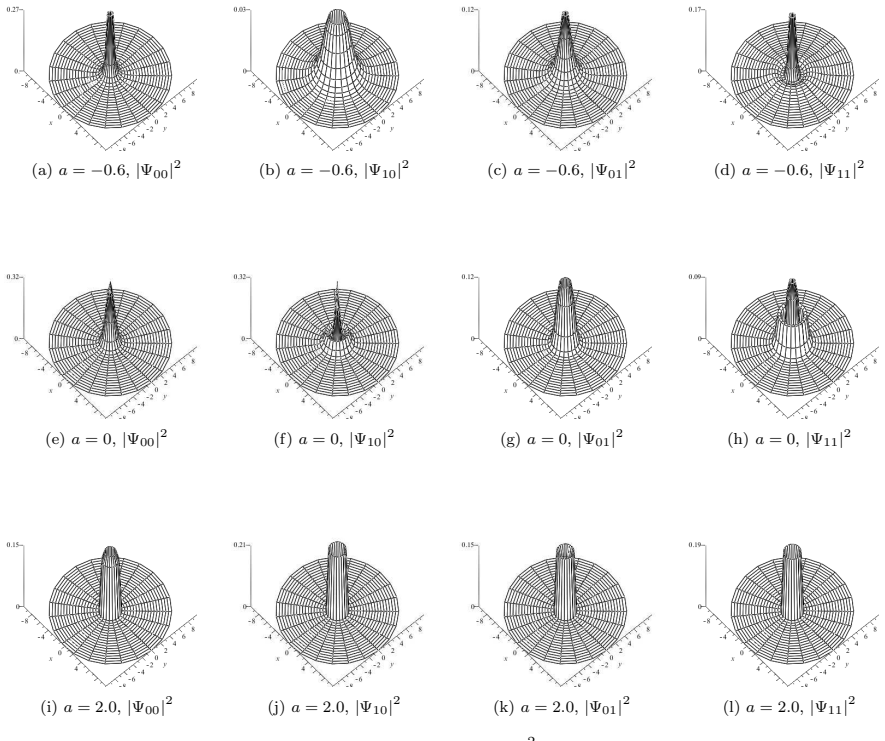
We study an exactly solvable model that can be interpreted as an ideal one-dimensional electron gas confined with an anisotropic quantum wire potential of oscillator-shaped profile. The homogeneous nature of the quantum wire is broken by the introduction of the effective electron mass, which changes with radial distance. We solve the problem described both within the canonical and the non-canonical approach. Analytical expressions of the wavefunctions of the stationary states for both cases in terms of the Laguerre polynomials are obtained, as well as the discrete energy spectrum related to these wavefunctions. Additionally, an exact solution to the angular position part of the position-dependent mass Schr\"odinger equation within the non-canonical approach leads to the angular-part wavefunctions of the even and odd states expressed through the Gegenbauer polynomials. Possible limit relations and special cases are studied too.
Editorial analysis
A structured set of objections, weighed in public.
Referee Report
Summary. The paper claims to construct an exactly solvable model of an ideal one-dimensional electron gas confined in an anisotropic quantum wire with an oscillator-shaped profile, where the effective electron mass varies radially. It derives closed-form wavefunctions for the stationary states in terms of Laguerre polynomials along with the discrete energy spectrum, for both the canonical and non-canonical orderings of the position-dependent-mass Schrödinger equation. For the non-canonical case, the angular wavefunctions of even and odd states are obtained in terms of Gegenbauer polynomials, with additional analysis of limit relations and special cases.
Significance. If the derivations hold, this work contributes to the literature on exactly solvable position-dependent mass systems by furnishing explicit analytical expressions for a physically motivated confining potential paired with a chosen radial mass profile. The closed-form solutions in Laguerre and Gegenbauer polynomials constitute a clear strength, permitting direct inspection of the eigenstates and spectrum without numerical approximation. The side-by-side treatment of canonical versus non-canonical orderings directly addresses the impact of the kinetic-term ambiguity, which is a standard but nontrivial feature of such models.
minor comments (3)
- The abstract states that analytical expressions are obtained, but the manuscript should ensure the explicit functional form chosen for the radial mass m(r) (paired with the oscillator potential) is displayed prominently in the model-definition section so that the reduction to the Laguerre equation can be followed step by step.
- Clarify early in the text how the system, described as a one-dimensional electron gas, incorporates radial and angular degrees of freedom; a short paragraph on the effective dimensionality after confinement would remove potential reader confusion.
- The discussion of limit relations and special cases is mentioned in the abstract; verify that each case is accompanied by the corresponding limiting expressions for the energy levels and wavefunctions.
Simulated Author's Rebuttal
We thank the referee for the careful reading of our manuscript and the positive assessment. We are pleased that the exact solvability via Laguerre and Gegenbauer polynomials, the explicit energy spectrum, and the direct comparison of canonical versus non-canonical orderings are recognized as contributions. The recommendation for minor revision is noted; we will prepare a revised version incorporating any editorial or minor clarifications.
Circularity Check
No significant circularity
full rationale
The paper constructs an exactly solvable model by choosing a specific radial position-dependent mass m(r) paired with an oscillator-shaped confining potential, allowing direct analytical solution of the Schrödinger equation in terms of Laguerre polynomials (radial) and Gegenbauer polynomials (angular). The wavefunctions and discrete energy spectrum are obtained by standard separation of variables and substitution into the resulting ordinary differential equations, without any parameter fitting, self-referential definitions, or load-bearing self-citations. This is a conventional mathematical-physics technique for generating closed-form integrable cases; the derivation chain is self-contained and does not reduce to its inputs by construction.
Axiom & Free-Parameter Ledger
free parameters (1)
- radial mass variation parameters
axioms (1)
- domain assumption The position-dependent mass Schrödinger equation admits exact solutions in terms of Laguerre and Gegenbauer polynomials for the chosen oscillator-shaped potential and mass profile.
Lean theorems connected to this paper
-
IndisputableMonolith/Cost/FunctionalEquation.leanwashburn_uniqueness_aczel unclear?
unclearRelation between the paper passage and the cited Recognition theorem.
Analytical expressions of the wavefunctions ... in terms of the Laguerre polynomials ... angular-part wavefunctions ... through the Gegenbauer polynomials.
-
IndisputableMonolith/Foundation/RealityFromDistinction.leanreality_from_one_distinction unclear?
unclearRelation between the paper passage and the cited Recognition theorem.
non-canonical approach ... Wigner ... para-Bose
What do these tags mean?
- matches
- The paper's claim is directly supported by a theorem in the formal canon.
- supports
- The theorem supports part of the paper's argument, but the paper may add assumptions or extra steps.
- extends
- The paper goes beyond the formal theorem; the theorem is a base layer rather than the whole result.
- uses
- The paper appears to rely on the theorem as machinery.
- contradicts
- The paper's claim conflicts with a theorem or certificate in the canon.
- unclear
- Pith found a possible connection, but the passage is too broad, indirect, or ambiguous to say the theorem truly supports the claim.
Reference graph
Works this paper leans on
-
[1]
K. Barnham and D. Vvedensky. Low-Dimensional Semiconductor Structures: Fundamentals and Device Applications. Cambridge University Press, 2001
work page 2001
-
[2]
H. Kunz. The one-dimensional classical electron gas. Annals of Physics , 85(2):303–335, 1974
work page 1974
-
[3]
B. J. van Wees, H. van Houten, C. W. J. Beenakker, J. G. Williamso n, L. P. Kouwenhoven, D. van der Marel, and C. T. Foxon. Quantized conductance of point contacts in a two-dimensional electron gas. Phys. Rev. Lett. , 60:848–850, Feb 1988
work page 1988
-
[4]
One-dimensional transport a nd the quantisation of the ballistic resistance
D A Wharam, T J Thornton, R Newbury, M Pepper, H Ahmed, J E F Fr ost, D G Hasko, D C Peacock, D A Ritchie, and G A C Jones. One-dimensional transport a nd the quantisation of the ballistic resistance. Journal of Physics C: Solid State Physics , 21(8):L209, mar 1988
work page 1988
-
[5]
Dresselhaus and Phaedon Avouris
Mildred S. Dresselhaus and Phaedon Avouris. Carbon Nanotubes: Synthesis, Structure, Properties, and Applications. Springer Berlin Heidelberg, Berlin, Heidelberg, 2001
work page 2001
- [6]
-
[7]
Yaroslav Tserkovnyak, Bertrand I. Halperin, Ophir M. Auslaend er, and Amir Yacoby. Finite-size effects in tunneling between parallel quantum wires. Phys. Rev. Lett. , 89:136805, Sep 2002
work page 2002
-
[8]
P. Havu, M. J. Puska, R. M. Nieminen, and V. Havu. Electron tran sport through quantum wires and point contacts. Phys. Rev. B , 70:233308, Dec 2004
work page 2004
-
[9]
H. Steinberg, O. M. Auslaender, A. Yacoby, J. Qian, G. A. Fiete, Y. Tserkovnyak, B. I. Halperin, K. W. Baldwin, L. N. Pfeiffer, and K. W. West. Localization transition in a ballistic quantum wire. Phys. Rev. B , 73:113307, Mar 2006
work page 2006
-
[10]
Electron tunneling into a quantum wire in the fabry-p´ erot regime
Stefano Pugnetti, Fabrizio Dolcini, Dario Bercioux, and Hermann Grabert. Electron tunneling into a quantum wire in the fabry-p´ erot regime. Phys. Rev. B , 79:035121, Jan 2009
work page 2009
-
[11]
A. D. G¨ u¸ cl¨ u, C. J. Umrigar, Hong Jiang, and Harold U. Baranger. Localization in an inhomogeneous quantum wire. Phys. Rev. B , 80:201302, Nov 2009
work page 2009
-
[12]
E. T. Owen and C. H. W. Barnes. Ground-state electronic stru cture of quasi-one-dimensional wires in semiconductor heterostructures. Phys. Rev. Appl. , 6:054007, Nov 2016
work page 2016
-
[13]
Nemanja Isailovic, Mark Whitney, Yatish Patel, John Kubiatowicz , Dean Copsey, Frederic T. Chong, Isaac L. Chuang, and Mark Oskin. Datapath and control for quan tum wires. ACM Trans. Archit. Code Optim. , 1(1):34–61, March 2004
work page 2004
-
[14]
Globally controlled quantu m wires for perfect qubit trans- port, mirroring, and computing
Joseph Fitzsimons and Jason Twamley. Globally controlled quantu m wires for perfect qubit trans- port, mirroring, and computing. Phys. Rev. Lett. , 97:090502, Sep 2006
work page 2006
-
[15]
Vijay K. Arora and Michael L. P. Tan. Quantum nanoelectronics : Challenges and opportunities. In 2008 IEEE International Conference on Semiconductor Elect ronics, pages A1–A6, 2008
work page 2008
-
[16]
Jos´ e F. Cari˜ nena, Manuel F. Ra˜ nada, and Mariano Santander. One-dimensional model of a quantum nonlinear harmonic oscillator. Reports on Mathematical Physics , 54(2):285–293, 2004
work page 2004
-
[17]
Exactly solvable potentials for the Sc hr¨ odinger equation with spatially dependent mass
Jiang Yu and Shi-Hai Dong. Exactly solvable potentials for the Sc hr¨ odinger equation with spatially dependent mass. Physics Letters A , 325(3-4):194–198, 2004
work page 2004
-
[18]
Time evolution for harmonic oscillators with position-dependent mass
Alexandre G M Schmidt. Time evolution for harmonic oscillators with position-dependent mass. Physica Scripta , 75(4):480, feb 2007
work page 2007
-
[19]
G. Ovando, J.J. Pe˜ na, J. Morales, and J. L´ opez-Bonilla. Posit ion-dependent mass Schr¨ odinger equation for exponential-type potentials. Journal of Molecular Modeling , 25(7):289, 2019
work page 2019
-
[20]
E.I. Jafarov, S.M. Nagiyev, and A.M. Jafarova. Quantum-mech anical explicit solution for the con- fined harmonic oscillator model with the Von Roos kinetic energy oper ator. Reports on Mathematical Physics, 86(1):25–37, 2020. 17
work page 2020
-
[21]
E I Jafarov, S M Nagiyev, R Oste, and J Van der Jeugt. Exact so lution of the position-dependent effective mass and angular frequency Schr¨ odinger equation: harmonic oscillator model with quantized confinement parameter. Journal of Physics A: Mathematical and Theoretical , 53(48):485301, nov 2020
work page 2020
-
[22]
Rami Ahmad El-Nabulsi. A new approach to the Schrodinger equa tion with position-dependent mass and its implications in quantum dots and semiconductors. Journal of Physics and Chemistry of Solids , 140:109384, 2020
work page 2020
-
[23]
Quantum dots an d cuboid quantum wells in fractal dimensions with position-dependent masses
Rami Ahmad El-Nabulsi and Waranont Anukool. Quantum dots an d cuboid quantum wells in fractal dimensions with position-dependent masses. Applied Physics A , 127:856, 2021
work page 2021
-
[24]
Exact solution of the semiconfi ned harmonic oscillator model with a position-dependent effective mass
EI Jafarov and J Van der Jeugt. Exact solution of the semiconfi ned harmonic oscillator model with a position-dependent effective mass. The European Physical Journal Plus , 136(7):758, 2021
work page 2021
-
[25]
Dynamics of position-dependent mass pa rticle in crystal lattices mi- crostructures
Rami Ahmad El-Nabulsi. Dynamics of position-dependent mass pa rticle in crystal lattices mi- crostructures. Physica E: Low-dimensional Systems and Nanostructures , 127:114525, 2021
work page 2021
-
[26]
Quantum mechan ics with spatial non-local ef- fects and position-dependent mass
Rami Ahmad El-Nabulsi and Waranont Anukool. Quantum mechan ics with spatial non-local ef- fects and position-dependent mass. Proceedings of the Royal Society A: Mathematical, Physical and Engineering Sciences, 478(2264):20220200, 2022
work page 2022
-
[27]
H. Sari, E. Kasapoglu, S. Sakiroglu, I. S¨ okmen, and C.A. Duque . Effect of position-dependent effective mass on donor impurity- and exciton-related electronic an d optical properties of 2D Gaussian quantum dots. The European Physical Journal Plus , 137:341, 2022
work page 2022
-
[28]
EI Jafarov. Exact quantum-mechanical solution for the one- dimensional harmonic oscillator model asymmetrically confined into the infinite well. Physica E: Low-dimensional Systems and Nanostruc- tures, 139:115160, 2022
work page 2022
-
[29]
R.M. Lima and H.R. Christiansen. Energy eigenstates of position- dependent mass particles in a spherical quantum dot. The European Physical Journal B , 96:150, 2023
work page 2023
-
[30]
Rieli Tain´ a Gomes dos Santos and Pedro Pablo Gonz´ alez-Borrero. Classical and quantum systems with position-dependent mass: An application to a Mathews-Lakshm anan-type oscillator. Revista Brasileira de Ensino de F ´ ısica, 45:e20230172, 2023
work page 2023
-
[31]
Semi-infinite quantum wells in a position-dependent mas s background
C Quesne. Semi-infinite quantum wells in a position-dependent mas s background. Quantum Studies: Mathematics and Foundations , 10:237–244, 2023
work page 2023
-
[32]
SM Nagiyev, AM Jafarova, and EI Jafarov. The Wigner function of a semiconfined harmonic oscilla- tor model with a position-dependent effective mass. Journal of Mathematical Physics , 65(1):012107, 2024
work page 2024
-
[33]
Statistical mechanics of one-dimensional sub stances i
Takeo Nagamiya. Statistical mechanics of one-dimensional sub stances i. Proceedings of the Physico- Mathematical Society of Japan. 3rd Series , 22(8-9):705–720, 1940
work page 1940
-
[34]
Statistical mechanics of one-dimensional sub stances ii
Takeo Nagamiya. Statistical mechanics of one-dimensional sub stances ii. Proceedings of the Physico- Mathematical Society of Japan. 3rd Series , 22(12):1034–1047, 1940
work page 1940
-
[35]
MJ Feinberg and Andrew G De Rocco. Intermolecular forces: Th e triangle well and some comparisons with the square well and lennard-jones. The Journal of chemical physics , 41(11):3439–3450, 1964
work page 1964
-
[36]
Perturbation calculations for a t riangular well potential at low densities
Damon N Card and John Walkley. Perturbation calculations for a t riangular well potential at low densities. Canadian Journal of Physics , 50(13):1419–1426, 1972
work page 1972
-
[37]
Tight-binding calculat ion of electronic states in a triangular symmetrical quantum well
S Vlaev, VR Velasco, and F Garc ´ ıa-Moliner. Tight-binding calculat ion of electronic states in a triangular symmetrical quantum well. Physical Review B , 50(7):4577, 1994
work page 1994
-
[38]
Discrete perturbation theory for the jagla ramp potential
Ana Laura Benavides, Luciano Armando Cervantes, and Jose T orres. Discrete perturbation theory for the jagla ramp potential. The Journal of Physical Chemistry C , 111(43):16006–16012, 2007
work page 2007
-
[39]
Analytica l equations of state for triangle-well and triangle-shoulder potentials
AL Benavides, LA Cervantes, and J Torres-Arenas. Analytica l equations of state for triangle-well and triangle-shoulder potentials. Journal of Molecular Liquids , 271:670–676, 2018. 18
work page 2018
-
[40]
EB Al, E Kasapoglu, and F Ungan. Dynamics of nonlinear optical re ctification, second, and third harmonic generation in asymmetric triangular double quantum wells du e to static electric and mag- netic fields. The European Physical Journal Plus , 137(4):466, 2022
work page 2022
-
[41]
EB Al, EI Jafarov, AM Jafarova, and F Ungan. Theoretical inve stigation of optical properties in gaas quantum wells under position-dependent mass and semi-confin ed effects. Physics Letters A , 582:131572, 2026
work page 2026
- [42]
-
[43]
Abraham D Yoffe. Semiconductor quantum dots and related sys tems: electronic, optical, lumines- cence and related properties of low dimensional systems. Advances in physics , 50(1):1–208, 2001
work page 2001
-
[44]
Stephanie M. Reimann and Matti Manninen. Electronic structur e of quantum dots. Rev. Mod. Phys., 74:1283–1342, Nov 2002
work page 2002
-
[45]
Full configuration inter- action approach to the few-electron problem in artificial atoms
Massimo Rontani, Carlo Cavazzoni, Devis Bellucci, and Guido Goldon i. Full configuration inter- action approach to the few-electron problem in artificial atoms. The Journal of chemical physics , 124(12):124102, 2006
work page 2006
-
[46]
Influence of neutron irradiation and tem- perature on the electric conductivity of SiO2 nanoparticles
Elchin Huseynov, Adil Garibov, and Ravan Mehdiyeva. Influence of neutron irradiation and tem- perature on the electric conductivity of SiO2 nanoparticles. Journal of Electrostatics , 74:73–78, 2015
work page 2015
-
[47]
Quantum chaos and thermalization in isolated systems of interacting particles
Fausto Borgonovi, Felix M Izrailev, Lea F Santos, and Vladimir G Ze levinsky. Quantum chaos and thermalization in isolated systems of interacting particles. Physics Reports, 626:1–58, 2016
work page 2016
-
[48]
Rel- ativistic artificial molecule of two coupled graphene quantum dots at tunable distances
Xiao-Feng Zhou, Yu-Chen Zhuang, Mo-Han Zhang, Hao Sheng, Qing-Feng Sun, and Lin He. Rel- ativistic artificial molecule of two coupled graphene quantum dots at tunable distances. Nature Communications, 15(1):8786, 2024
work page 2024
-
[49]
The wigner distribut ion function for the one-dimensional parabose oscillator
E Jafarov, S Lievens, and J Van der Jeugt. The wigner distribut ion function for the one-dimensional parabose oscillator. Journal of Physics A: Mathematical and Theoretical , 41(23):235301, may 2008
work page 2008
-
[50]
EI Jafarov, SM Nagiyev, and J Van der Jeugt. Deformation of t he Heisenberg-Weyl algebra and the lie superalgebra osp (1|2): exact solution for the quantum harmonic oscillator with a position - dependent mass. The European Physical Journal Plus , 140(4):290, 2025
work page 2025
-
[51]
Eugene P. Wigner. Do the equations of motion determine the qua ntum mechanical commutation relations? Phys. Rev. , 77:711–712, Mar 1950
work page 1950
-
[52]
A. Pais and G. E. Uhlenbeck. On field theories with non-localized ac tion. Phys. Rev. , 79:145–165, Jul 1950
work page 1950
-
[53]
L. M. Yang. A note on the quantum rule of the harmonic oscillator . Phys. Rev. , 84:788–790, Nov 1951
work page 1951
-
[54]
H. S. Green. A generalized method of field quantization. Phys. Rev. , 90:270–273, Apr 1953
work page 1953
-
[55]
O. W. Greenberg and A. M. L. Messiah. Selection rules for parafi elds and the absence of para particles in nature. Phys. Rev. , 138:B1155–B1167, Jun 1965
work page 1965
-
[56]
Equations of motion, commutation relations an d ambiguities in the lagrangian formalism
Marc Henneaux. Equations of motion, commutation relations an d ambiguities in the lagrangian formalism. Annals of Physics , 140(1):45–64, 1982
work page 1982
-
[57]
From the equations of motion to the canonical commutation relations
Elisa Ercolessi, Giuseppe Marmo, and Giuseppe Morandi. From the equations of motion to the canonical commutation relations. La Rivista del Nuovo Cimento , 33(8):401–590, 2010
work page 2010
-
[58]
A. Dehghani, B. Mojaveri, S. Shirin, and M. Saedi. Cat-states in the framework of wigner–heisenberg algebra. Annals of Physics , 362:659–670, 2015
work page 2015
-
[59]
The jaynes–cummings model of a two-level atom in a single-mode para-bose cavity field
H Fakhri and M Sayyah-Fard. The jaynes–cummings model of a two-level atom in a single-mode para-bose cavity field. Scientific Reports , 11:22861, 2021. 19
work page 2021
-
[60]
Dunkl graphene in constant magn etic field
B Hamil and B C L¨ utf¨ uo˘ glu. Dunkl graphene in constant magn etic field. The European Physical Journal Plus , 137:1241, 2022
work page 2022
-
[61]
Ideal bose gas and black- body radiation in the dunkl formalism
F Merabtine, B Hamil, B C L¨ utf¨ uo˘ glu, A Hocine, and M Benarous . Ideal bose gas and black- body radiation in the dunkl formalism. Journal of Statistical Mechanics: Theory and Experiment , 2023:053102, 2023
work page 2023
-
[62]
Bounding the wigner deformation parameter in harmonically trapped bose gases
M Benarous, A Hocine, B C L¨ utf¨ uo˘ glu, and B Hamil. Bounding the wigner deformation parameter in harmonically trapped bose gases. Journal of Statistical Mechanics: Theory and Experiment , 2025(5):053102, may 2025
work page 2025
-
[63]
Experimental realization of para-particle oscillators
C Huerta Alderete, Alaina M Green, Nhung H Nguyen, Yingyue Zhu , BM Rodr ´ ıguez-Lara, and Nor- bert M Linke. Experimental realization of para-particle oscillators. Scientific Reports , 15(1):41498, 2025
work page 2025
-
[64]
Energy gap in superconductors measured by ele ctron tunneling
Ivar Giaever. Energy gap in superconductors measured by ele ctron tunneling. Phys. Rev. Lett. , 5:147–148, Aug 1960
work page 1960
-
[65]
Electron tunneling between two superconducto rs
Ivar Giaever. Electron tunneling between two superconducto rs. Phys. Rev. Lett. , 5:464–466, Nov 1960
work page 1960
- [66]
-
[67]
D. J. BenDaniel and C. B. Duke. Space-charge effects on elect ron tunneling. Phys. Rev., 152:683–692, Dec 1966
work page 1966
- [68]
-
[69]
Turbiner, and Pavel Winternit z
Piergiulio Tempesta, Alexander V. Turbiner, and Pavel Winternit z. Exact solvability of superinte- grable systems. Journal of Mathematical Physics , 42(9):4248–4257, 09 2001
work page 2001
-
[70]
An infinite family of solvable and integrable quantum systems on a plane
Fr´ ed´ erick Tremblay, Alexander V Turbiner, and Pavel Winternitz. An infinite family of solvable and integrable quantum systems on a plane. Journal of Physics A: Mathematical and Theoretical , 42(24):242001, may 2009
work page 2009
-
[71]
Families of supe rintegrable hamiltonians constructed from exceptional polynomials
Sarah Post, Satoshi Tsujimoto, and Luc Vinet. Families of supe rintegrable hamiltonians constructed from exceptional polynomials. Journal of Physics A: Mathematical and Theoretical , 45(40):405202, sep 2012
work page 2012
-
[72]
The Dunkl oscillator in the plane: I
Vincent X Genest, Mourad E H Ismail, Luc Vinet, and Alexei Zheda nov. The Dunkl oscillator in the plane: I. Superintegrability, separated wavefunctions and ov erlap coefficients. Journal of Physics A: Mathematical and Theoretical , 46(14):145201, mar 2013
work page 2013
-
[73]
Optical chara cterization of interface disorder in gaas − ga1− xalxas multi-quantum well structures
C Weisbuch, R Dingle, AC Gossard, and W Wiegmann. Optical chara cterization of interface disorder in gaas − ga1− xalxas multi-quantum well structures. Solid State Communications , 38(8):709–712, 1981
work page 1981
-
[74]
Parabolic qua ntum wells with the g a a s- al x ga 1- x as system
RC Miller, AC Gossard, DA Kleinman, and O Munteanu. Parabolic qua ntum wells with the g a a s- al x ga 1- x as system. Physical Review B , 29(6):3740, 1984
work page 1984
-
[75]
Molecular beam epitaxy: fundamentals and current status , volume 7
Marian A Herman and Helmut Sitter. Molecular beam epitaxy: fundamentals and current status , volume 7. Springer Science & Business Media, 2012
work page 2012
-
[76]
K. McCormack, N. Schaper, Y. Kim, D.K. Hensley, I. Kravchenk o, N.V. Lavrik, D.J. Gosztola, M.F. Pantano, and I. Kuljanishvili. Enabling a novel approach to a con trolled fabrication of 1d crystalline nanowires on suspended microstructures of arbitrary geometries using two direct-writing technologies. Materials Today Nano , 20:100241, 2022
work page 2022
-
[77]
O. Mustafa and S.H. Mazharimousavi. Ordering ambiguity revisite d via position dependent mass pseudo-momentum operators. International Journal of Theoretical Physics , 46(7):1786–1796, 2007
work page 2007
-
[78]
Position-dependent effective masses in semicon ductor theory
Oldwig von Roos. Position-dependent effective masses in semicon ductor theory. Phys. Rev. B , 27:7547–7552, Jun 1983. 20
work page 1983
-
[79]
A. D. Alhaidari. Solutions of the nonrelativistic wave equation with position-dependent effective mass. Phys. Rev. A , 66:042116, Oct 2002
work page 2002
-
[80]
A. Keshavarz and N. Zamani. Optical properties of spherical q uantum dot with position-dependent effective mass. Superlattices and Microstructures , 58:191–197, 2013
work page 2013
discussion (0)
Sign in with ORCID, Apple, or X to comment. Anyone can read and Pith papers without signing in.