Recognition: 2 theorem links
· Lean TheoremWell-Scoped Locally Nameless Representation of Syntax
Pith reviewed 2026-05-12 01:47 UTC · model grok-4.3
The pith
Well-scoped locally nameless syntax in Agda is adequate for nameful syntax modulo alpha-conversion
A machine-rendered reading of the paper's core claim, the machinery that carries it, and where it could break.
Core claim
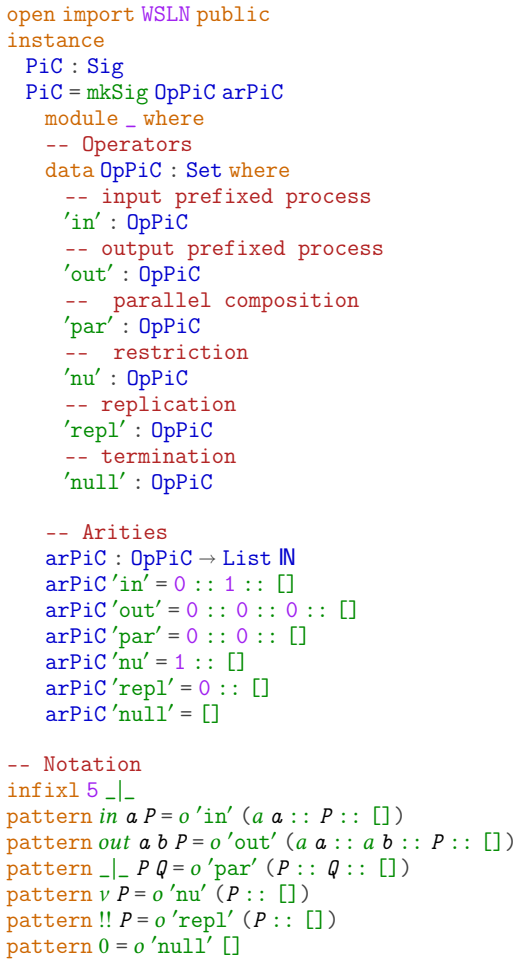
The paper describes generic code parameterized by a Plotkin-style binding signature for a well-scoped version of the locally nameless method of representing syntax. It gives a proof of its adequacy with respect to naive nameful syntax modulo alpha-conversion and discusses some examples of its use.
What carries the argument
Well-scoped locally nameless representation, a syntax encoding that uses de Bruijn indices for bound variables and named free variables while enforcing scoping at the type level to prevent invalid terms
If this is right
- Users can define syntax for languages with binders in Agda using the generic code for any Plotkin-style signature.
- The adequacy proof ensures that reasoning in the locally nameless representation corresponds to reasoning up to alpha-equivalence in the nameful version.
- Examples demonstrate practical application to common binding constructs.
- The parameterization supports reuse across different language definitions.
Where Pith is reading between the lines
- This method could be ported to other interactive theorem provers that support dependent types.
- It might reduce the overhead of proving substitution lemmas by leveraging the well-scoped property.
- Further work could test the approach on more complex signatures with multiple binding operators.
Load-bearing premise
The generic code correctly implements the well-scoped locally nameless representation for arbitrary Plotkin-style binding signatures and the adequacy relation holds after parameterization.
What would settle it
A specific example of a binding signature where some term in the locally nameless representation does not correspond to any alpha-equivalence class in the nameful syntax, or vice versa, would show the adequacy proof fails.
Figures
read the original abstract
When using interactive theorem provers based on dependent type theory to define and reason about languages involving binding constructs, we advocate the use of a well-scoped version of the locally nameless method of representing syntax. This paper describes generic code parameterized by a Plotkin-style binding signature for this style of syntax representation within the Agda theorem prover, gives a proof of its adequacy with respect to naive nameful syntax modulo alpha-conversion and discusses some examples of its use.
Editorial analysis
A structured set of objections, weighed in public.
Referee Report
Summary. The manuscript presents generic Agda code, parameterized over Plotkin-style binding signatures, for well-scoped locally nameless representations of syntax with binding. It supplies a machine-checked adequacy theorem relating the representation to an independently defined nameful syntax modulo alpha-conversion and illustrates the approach with examples.
Significance. If the formalization holds, the work supplies a reusable, verified library for handling binders in dependent type theory, a recurring pain point when formalizing languages and logics. The machine-checked adequacy proof against an external nameful definition is a clear strength, as is the parameterization over arbitrary binding signatures and the emphasis on well-scoped representations that avoid common de Bruijn or name-related errors.
minor comments (3)
- The abstract states that the code is 'generic' and 'parameterized by a Plotkin-style binding signature,' but the main text would benefit from an early, self-contained example of a concrete signature (e.g., for lambda calculus) together with the corresponding Agda type declarations to make the parameterization concrete for readers unfamiliar with Plotkin signatures.
- Section 3 (or the adequacy theorem statement) should explicitly record the precise inductive definition of the adequacy relation and the induction hypotheses used in the proof; while the machine-checked development is authoritative, a compact informal statement in the paper would improve readability without duplicating the formal code.
- The discussion of examples would be strengthened by a short table comparing the size or complexity of the well-scoped locally nameless terms versus the nameful versions for at least one non-trivial example, to illustrate the practical overhead.
Simulated Author's Rebuttal
We thank the referee for their positive summary and significance assessment of our manuscript on well-scoped locally nameless syntax. We are pleased that the generic Agda development, parameterization over Plotkin-style binding signatures, machine-checked adequacy theorem, and illustrative examples are viewed as a strength for formalizing languages with binders in dependent type theory.
Circularity Check
No significant circularity
full rationale
The paper supplies a machine-checked Agda formalization of generic well-scoped locally nameless syntax parameterized over Plotkin-style binding signatures, together with an explicit adequacy theorem relating it to an independently defined nameful syntax modulo alpha-conversion. The central claim rests on the correctness of that formalization and the external definition of nameful syntax rather than on any self-referential definition, fitted parameter renamed as prediction, or load-bearing self-citation chain. No equations or steps in the provided description reduce the result to its own inputs by construction.
Axiom & Free-Parameter Ledger
axioms (2)
- domain assumption Plotkin-style binding signature
- standard math Alpha-equivalence on nameful syntax
Lean theorems connected to this paper
-
IndisputableMonolith/Foundation/ArithmeticFromLogic.leanLogicNat (inductive zero/step structure) unclearThe type Trm[ n ] of n-terms ... i : Fin n → Trm[ n ], a : A → Trm[ n ], o : (op : Op Σ) → Arg[ n ] (ar Σ op) → Trm[ n ] (Definition 4.2)
-
IndisputableMonolith/Foundation/AbsoluteFloorClosure.leanabsolute_floor_iff_bare_distinguishability unclearadequacy ... bijection between Trm and α-equivalence classes of nameful terms (Proposition 5.5)
Reference graph
Works this paper leans on
-
[1]
Abel.Normalization by Evaluation: Dependent Types and Impredicativity
A. Abel.Normalization by Evaluation: Dependent Types and Impredicativity. Habilitation thesis, Institut für Informatik, Ludwig-Maximilians-Universität München, may 2013
work page 2013
-
[2]
A. Abel, N. A. Danielsson, and O. Eriksson. A graded modal dependent type theory with erasure, formalized.ArXiv e-prints, arXiv:2603.29716 [cs.LO], 2026
work page internal anchor Pith review Pith/arXiv arXiv 2026
-
[3]
A. Abel, J. Öhman, and A. Vezzosi. Decidability of conversion for type theory in type theory.Proc. ACM Program. Lang., 2(POPL), December 2017
work page 2017
-
[4]
T. Altenkirch, M. Hofmann, and T. Streicher. Categorical reconstruction of a reduction free normalization proof. In D. Pitt, D. E. Rydeheard, and P. T. Johnstone, editors,Category Theory and Computer Science, pages 182–199, Berlin, Heidelberg, 1995. Springer
work page 1995
-
[5]
B. E. Aydemir, A. Bohannon, M. Fairbairn, J. N. Foster, B. C. Pierce, P. Sewell, D. Vytiniotis, G. Washburn, S. Weirich, and S. Zdancewic. Mechanised metatheory for the masses: The POPLmark challenge. In J. Hurd and T. Melham, editors,18th International Conference on Theorem Proving in Higher Order Logics: TPHOLs 2005, volume 3603 ofLecture Notes in Compu...
work page 2005
-
[6]
B. E. Aydemir, A. Charguéraud, B. C. Pierce, R. Pollack, and S. Weirich. Engineering for- mal metatheory. InProceedings of the 35th Annual ACM SIGPLAN-SIGACT Symposium on Principles of Programming Languages, POPL ’08, page 3–15, New York, NY, USA, 2008. Association for Computing Machinery
work page 2008
-
[7]
U. Berger and H. Schwichtenberg. An inverse of the evaluation functional for typed𝜆- calculus. In6th Annual Symposium on Logic in Computer Science, pages 203–211. IEEE Computer Society Press, Washington, 1991
work page 1991
-
[8]
A. Charguéraud. The locally nameless representation.Journal of Automated Reasoning, 49(3):363–408, 2012
work page 2012
- [9]
-
[10]
T. Coquand. Pattern matching with dependent types. In B. Nordström, K. Petersson, and G. D. Plotkin, editors,Proceedings of the 1992 Workshop on Types for Proofs and Programs, Båstad, Sweden, pages 66–79, June 1992
work page 1992
-
[11]
M. L . Daggitt, G. Allais, J. McKinna, A. Abel, N. Van Doorn, J. Wood, U. Norell, D. O. Kidney, and S. Meshveliani. The Agda standard library: Version 2.0.Journal of Open Source Software, 10(116):9241, 2025. 18
work page 2025
-
[12]
N. G. de Bruijn. Lambda calculus notation with nameless dummies, a tool for automatic formula manipulation, with application to the Church-Rosser theorem.Indagationes Math- ematicae, 34:381–392, 1972
work page 1972
-
[13]
L. de Moura and S. Ullrich. The Lean 4 theorem prover and programming language. In Automated Deduction – CADE 28, pages 625–635. Springer International Publishing, 2021
work page 2021
-
[14]
M. P. Fiore, G. D. Plotkin, and D. Turi. Abstract syntax and variable binding. In14th Annual Symposium on Logic in Computer Science, pages 193–202. IEEE Computer Society Press, Washington, 1999
work page 1999
-
[15]
Semantic analysis of normalisation by evaluation for typed lambda calculus
Marcelo Fiore. Semantic analysis of normalisation by evaluation for typed lambda calculus. Mathematical Structures in Computer Science, 32(8):1028–1065, September 2022
work page 2022
-
[16]
M. J. Gabbay. Foundations of nominal techniques: Logic and semantics of variables in abstract syntax.Bulletin of Symbolic Logic, 17(2):161–229, 2011
work page 2011
-
[17]
K. Gödel. Über eine bisher noch nicht benüzte Erweiterung des finiten Standpunktes. Dialectica, 12:280–287, 1958
work page 1958
-
[18]
H. Goguen, C. McBride, and J. McKinna. Eliminating dependent pattern matching. In K. Futatsugi, J.-P. Jouannaud, and J. Meseguer, editors,Algebra, Meaning, and Computation: Essays dedicated to Joseph A. Goguen on the Occasion of His 65th Birthday, pages 521–540. Springer Berlin Heidelberg, Berlin, Heidelberg, 2006
work page 2006
-
[19]
A. D. Gordon. A mechanisation of name-carrying syntax up to alpha-conversion. In J. J. Joyce and C.-J. H. Seger, editors,Higher Order Logic Theorem Proving and Its Applications, pages 413–425, Berlin, Heidelberg, 1994. Springer Berlin Heidelberg. ISBN 978-3-540- 48346-5
work page 1994
-
[20]
Harper.Practical Foundation for Programming Languages, Second Edition
R. Harper.Practical Foundation for Programming Languages, Second Edition. Cambridge University Press, 2016
work page 2016
-
[21]
M. Hedberg. A coherence theorem for Martin-Löf’s type theory.Journal of Functional Programming, 8(4):413–436, 1998
work page 1998
-
[22]
P. Martin-Löf. An intuitionistic theory of types: Predicative part. In H. E. Rose and J. C. Shepherdson, editors,Logic Colloquium ’73, pages 73–118. North-Holland, 1975
work page 1975
- [23]
- [24]
-
[25]
B. Nordström, K. Petersson, and J. M. Smith.Programming in Martin-Löf’s Type Theory. Oxford University Press, 1990. 19
work page 1990
-
[26]
A. M. Pitts. Alpha-structural recursion and induction.Journal of the ACM, 53:459–506, 2006
work page 2006
-
[27]
A. M. Pitts.Nominal Sets: Names and Symmetry in Computer Science, volume 57 ofCam- bridge Tracts in Theoretical Computer Science. Cambridge University Press, 2013
work page 2013
-
[28]
A. M. Pitts. Locally nameless sets.Proc. ACM Program. Lang., 7(POPL, Article 17):488–514, January 2023
work page 2023
-
[29]
Well-Scoped Locally Nameless Representation of Syntax
A. M. Pitts. Agda code accompanying “Well-Scoped Locally Nameless Representation of Syntax”, 2026. Browsable code:https://amp12.github.io/WSLN
work page 2026
-
[30]
G. D. Plotkin. An illative theory of relations. In R. Cooper, Mukai, and J. Perry, editors, Situation Theory and its Applications, Volume 1, volume 22 ofCSLI Lecture Notes, pages 133–146. Stanford University, 1990
work page 1990
-
[31]
A. Popescu. Rensets and renaming-based recursion for syntax with bindings. In J. Blanchette, L. Kovács, and D. Pattinson, editors,Automated Reasoning : 11th Interna- tional Joint Conference, IJCAR 2022, Haifa, Israel, August 8-10, 2022, Proceedings, volume 13385 ofLecture Notes in Computer Science, pages 618–639. Springer International Publish- ing AG, Au...
work page 2022
- [32]
- [33]
-
[34]
W. W. Tait. Intensional interpretation of functionals of finite type, I.Journal of Symbolic Logic, 32(2):198–212, 1967
work page 1967
-
[35]
Agda, version 2.8.0, July 2025
The Agda Development Team. Agda, version 2.8.0, July 2025. URLhttps://agda. readthedocs.io/en/stable
work page 2025
-
[36]
The Rocq prover, version 9.0, March 2025
The Rocq Development Team. The Rocq prover, version 9.0, March 2025. URLhttps: //rocq-prover.org
work page 2025
-
[37]
The Univalent Foundations Program.Homotopy Type Theory: Univalent Foundations for Mathematics.http://homotopytypetheory.org/book, Institute for Advanced Study, 2013. 20
work page 2013
discussion (0)
Sign in with ORCID, Apple, or X to comment. Anyone can read and Pith papers without signing in.