Recognition: 2 theorem links
· Lean TheoremSEM-RAG: Structure-Preserving Multimodal Graph Compilation and Entropy-Guided Retrieval for Telecommunication Standards
Pith reviewed 2026-05-12 02:14 UTC · model grok-4.3
The pith
SEM-RAG compiles telecommunication standards into structure-preserving graphs and uses entropy-guided retrieval to reach 94.1% accuracy on TeleQnA and 93.8% on ORAN-Bench-13K while reducing indexing token usage compared to standard GraphRAG.
A machine-rendered reading of the paper's core claim, the machinery that carries it, and where it could break.
Core claim
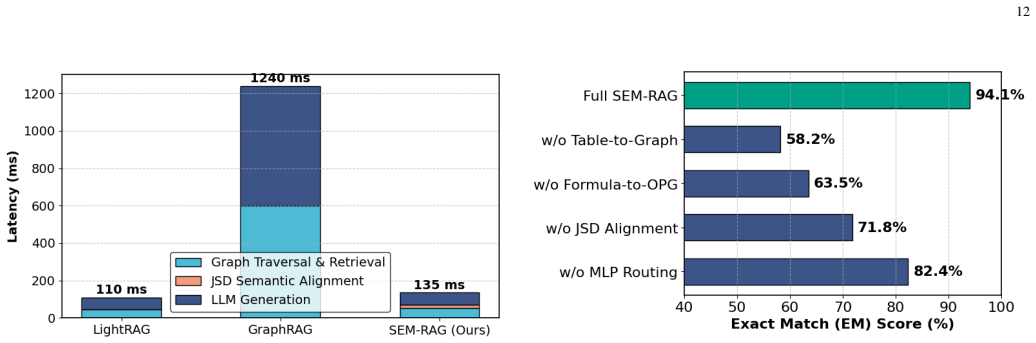
Experiments on TeleQnA, TSpec-LLM, SPEC5G, and ORAN-Bench-13K show that SEM-RAG improves performance on table-heavy and formula-heavy questions, reaches 94.1% accuracy on TeleQnA and 93.8% on ORAN-Bench-13K, and cuts indexing-time token usage by a wide margin relative to standard GraphRAG. These results indicate that structure-preserving compilation is a practical requirement for retrieval over telecom specifications, not merely an optional preprocessing step.
Load-bearing premise
The layout-aware compiler accurately converts tables, conditions, and formulas into typed graph primitives that preserve all critical dependencies and relationships without introducing errors or information loss.
Figures


read the original abstract
Telecommunication standards pose a unique challenge for retrieval systems, where accuracy depends on semantic relevance as well as on preserving the structural logic embedded in the documents, including structured relationships embedded in tables, conditions, and formulas. When these elements are flattened into text, critical dependencies are lost, leading to unreliable retrieval. In this paper, we present SEM-RAG, an end-to-end retrieval framework built around two design choices. First, a layout-aware compiler converts text, tables, and formulas into typed graph primitives. Each table cell is linked to its row headers, column headers, predicates, and source coordinates, while each formula is converted into an operator graph tied to nearby symbol definitions. Second, the compiled graph is compressed with Structural Entropy Minimization (SEM), which avoids LLM-based bottom-up clustering during indexing. A Jensen-Shannon alignment layer and a lightweight query controller serve as supporting retrieval components that map user queries to the right subgraphs, while keeping online cost stable. Experiments on TeleQnA, TSpec-LLM, SPEC5G, and ORAN-Bench-13K show that SEM-RAG improves performance on table-heavy and formula-heavy questions, reaches 94.1\% accuracy on TeleQnA and 93.8\% on ORAN-Bench-13K, and cuts indexing-time token usage by a wide margin relative to standard GraphRAG. These results indicate that structure-preserving compilation is a practical requirement for retrieval over telecom specifications, not merely an optional preprocessing step.
Editorial analysis
A structured set of objections, weighed in public.
Referee Report
Summary. The paper introduces SEM-RAG, an end-to-end retrieval framework for telecommunication standards. It features a layout-aware compiler that converts text, tables, conditions, and formulas into typed graph primitives (linking table cells to headers/predicates/coordinates and formulas to operator graphs), followed by Structural Entropy Minimization (SEM) for graph compression without LLM-based clustering, plus a Jensen-Shannon alignment layer and lightweight query controller. Experiments on TeleQnA, TSpec-LLM, SPEC5G, and ORAN-Bench-13K report 94.1% accuracy on TeleQnA and 93.8% on ORAN-Bench-13K, with gains on table-heavy and formula-heavy questions and reduced indexing-time token usage versus standard GraphRAG, concluding that structure-preserving compilation is a practical requirement rather than optional preprocessing.
Significance. If the central claims hold after verification, the work would be significant for advancing RAG systems in technical domains with dense structured content. It highlights efficiency benefits from entropy-guided compression over LLM clustering and provides concrete evidence that preserving table and formula dependencies improves retrieval accuracy in telecom standards, potentially influencing future graph-based approaches for regulatory and specification documents.
major comments (2)
- [Experiments section] The experimental evaluation reports concrete accuracy figures (94.1% on TeleQnA, 93.8% on ORAN-Bench-13K) and efficiency gains but supplies no details on experimental setup, baseline implementations, statistical tests, or controls for confounding factors. This gap directly affects verification of the claimed improvements on table-heavy and formula-heavy questions and the conclusion that structure preservation is required.
- [Layout-aware compiler description] The central claim that structure-preserving compilation is a practical requirement rests on the layout-aware compiler correctly converting tables, conditions, and formulas into typed graph primitives while preserving all critical dependencies without errors or information loss. The manuscript provides no implementation details, conversion examples, error rates, or ablation studies on information preservation for this component.
minor comments (1)
- The abstract states that indexing-time token usage is cut 'by a wide margin' relative to GraphRAG but does not provide quantitative values or specific comparisons; adding these would improve clarity of the efficiency claims.
Simulated Author's Rebuttal
We thank the referee for the constructive feedback and positive evaluation of the work's significance. We address each major comment below and will revise the manuscript to incorporate the requested details and clarifications.
read point-by-point responses
-
Referee: [Experiments section] The experimental evaluation reports concrete accuracy figures (94.1% on TeleQnA, 93.8% on ORAN-Bench-13K) and efficiency gains but supplies no details on experimental setup, baseline implementations, statistical tests, or controls for confounding factors. This gap directly affects verification of the claimed improvements on table-heavy and formula-heavy questions and the conclusion that structure preservation is required.
Authors: We agree that additional experimental details are necessary for full reproducibility and verification. In the revised manuscript, we will expand the Experiments section to include: (1) a complete description of the experimental setup, including hardware, software versions, and dataset preprocessing steps; (2) implementation details for all baselines, particularly how standard GraphRAG was configured and run for fair comparison; (3) statistical tests (e.g., McNemar's test or bootstrap confidence intervals) with p-values for accuracy differences; and (4) explicit controls and breakdowns for confounding factors such as query type (table-heavy vs. formula-heavy) and document complexity. These additions will directly support the claims regarding improvements on structured questions. revision: yes
-
Referee: [Layout-aware compiler description] The central claim that structure-preserving compilation is a practical requirement rests on the layout-aware compiler correctly converting tables, conditions, and formulas into typed graph primitives while preserving all critical dependencies without errors or information loss. The manuscript provides no implementation details, conversion examples, error rates, or ablation studies on information preservation for this component.
Authors: We acknowledge that the current manuscript describes the layout-aware compiler at a conceptual level without sufficient low-level details. In the revision, we will add: (1) pseudocode or algorithmic steps for converting tables (linking cells to headers/predicates/coordinates), conditions, and formulas (to operator graphs); (2) concrete conversion examples drawn from telecommunication standards excerpts; (3) any measured error rates or failure modes during compilation; and (4) ablation studies quantifying information preservation, such as retrieval accuracy drops when specific structural links are removed. These changes will provide stronger empirical grounding for the claim that structure preservation is required. revision: yes
Circularity Check
No circularity: empirical framework evaluated on external benchmarks
full rationale
The paper describes SEM-RAG as a retrieval framework with a layout-aware compiler converting documents to typed graph primitives and Structural Entropy Minimization for compression, followed by empirical evaluation on independent benchmarks (TeleQnA, TSpec-LLM, SPEC5G, ORAN-Bench-13K). Reported accuracies (94.1% on TeleQnA, 93.8% on ORAN-Bench-13K) and token savings are presented as experimental outcomes, not as quantities derived from fitted parameters or self-referential equations. No derivation chain, mathematical predictions, or load-bearing self-citations are indicated in the abstract or description that would reduce claims to inputs by construction. The framework is self-contained as a proposed system with external validation.
Axiom & Free-Parameter Ledger
free parameters (2)
- parameters of the lightweight query controller
- weights or thresholds in Jensen-Shannon alignment layer
axioms (2)
- domain assumption The layout-aware compiler correctly links table cells to row/column headers, predicates, and source coordinates while converting formulas into operator graphs tied to symbol definitions without loss of critical dependencies.
- domain assumption Structural Entropy Minimization compresses the compiled graph while retaining all information necessary for accurate retrieval on table-heavy and formula-heavy queries.
Lean theorems connected to this paper
-
IndisputableMonolith/Cost/FunctionalEquation.leanwashburn_uniqueness_aczel unclear?
unclearRelation between the paper passage and the cited Recognition theorem.
layout-aware compiler converts text, tables, and formulas into typed graph primitives... Structural Entropy Minimization (SEM)... Jensen-Shannon alignment layer
-
IndisputableMonolith/Foundation/RealityFromDistinction.leanreality_from_one_distinction unclear?
unclearRelation between the paper passage and the cited Recognition theorem.
Experiments on TeleQnA, TSpec-LLM, SPEC5G, and ORAN-Bench-13K... 94.1% accuracy
What do these tags mean?
- matches
- The paper's claim is directly supported by a theorem in the formal canon.
- supports
- The theorem supports part of the paper's argument, but the paper may add assumptions or extra steps.
- extends
- The paper goes beyond the formal theorem; the theorem is a base layer rather than the whole result.
- uses
- The paper appears to rely on the theorem as machinery.
- contradicts
- The paper's claim conflicts with a theorem or certificate in the canon.
- unclear
- Pith found a possible connection, but the passage is too broad, indirect, or ambiguous to say the theorem truly supports the claim.
Reference graph
Works this paper leans on
-
[1]
Large Generative AI Models for Telecom: The Next Big Thing?
L. Bariah, Q. Zhao, H. Zou, Y . Tian, F. Bader, and M. Debbah, “Large Generative AI Models for Telecom: The Next Big Thing?”IEEE Communications Magazine, vol. 62, no. 11, pp. 84–90, 2024
work page 2024
-
[2]
H. Zhouet al., “Large language model (llm) for telecommunications: A comprehensive survey on principles, key techniques, and opportunities,” IEEE Communications Surveys & Tutorials, 2024
work page 2024
-
[3]
Large Language Models in 6G from Standard to On- device Networks,
H. Zouet al., “Large Language Models in 6G from Standard to On- device Networks,”Nat. Rev. Electr. Eng., vol. 3, pp. 123–134, 2026
work page 2026
-
[4]
Tspec-llm: An open-source dataset for llm understanding of 3gpp specifications,
R. Nikbakht, M. Benzaghta, and G. Geraci, “Tspec-llm: An open-source dataset for llm understanding of 3gpp specifications,” in2024 IEEE Globecom Workshops (GC Wkshps). IEEE, 2024, pp. 1–6
work page 2024
-
[5]
Oran-bench-13k: An open source benchmark for assessing llms in open radio access networks,
P. Gajjar and V . K. Shah, “Oran-bench-13k: An open source benchmark for assessing llms in open radio access networks,” in2025 IEEE 22nd Consumer Communications & Networking Conference (CCNC). IEEE, 2025, pp. 1–4
work page 2025
-
[6]
Teleqna: A benchmark dataset to assess large language models telecommunications knowledge,
A. Maatouk, F. Ayed, N. Piovesan, A. De Domenico, M. Debbah, and Z.- Q. Luo, “Teleqna: A benchmark dataset to assess large language models telecommunications knowledge,”IEEE Network, vol. 40, pp. 253–260, 2026
work page 2026
-
[7]
Gsma open-telco llm benchmarks,
G. Foundry, “Gsma open-telco llm benchmarks,” 2025. [Online]. Available: https://www.gsma.com/newsroom/press-release/ gsma-open-telco-llm-benchmarks-launches-to-advance-ai-in-telecoms/
work page 2025
-
[8]
Retrieval-Augmented Generation for Large Language Models: A Survey
Y . Gaoet al., “Retrieval-augmented generation for large language models: A survey,”arXiv preprint arXiv:2312.10997, 2023
work page internal anchor Pith review Pith/arXiv arXiv 2023
-
[9]
From Local to Global: A Graph RAG Approach to Query-Focused Summarization
D. Edge, H. Trinh, N. Cheng, J. Bradley, A. Chao, A. Mody, S. Truitt, D. Metropolitansky, R. O. Ness, and J. Larson, “From local to global: A graph rag approach to query-focused summarization,”arXiv preprint arXiv:2404.16130, 2024
work page internal anchor Pith review Pith/arXiv arXiv 2024
-
[10]
Unifying large language models and knowledge graphs: A roadmap,
S. Pan, L. Luo, Y . Wang, C. Chen, J. Wang, and X. Wu, “Unifying large language models and knowledge graphs: A roadmap,”IEEE Transactions on Knowledge and Data Engineering, vol. 36, no. 7, pp. 3580–3599, 2024
work page 2024
-
[11]
Under- standing telecom language through large language models,
L. Bariah, H. Zou, Q. Zhao, M. Belkacem, and M. Debbah, “Under- standing telecom language through large language models,” inIEEE Global Communications Conference, 2023, pp. 6542–6547
work page 2023
-
[12]
TelecomGPT: A Framework to Build Telecom-Specific Large Language Models,
H. Zou, Q. Zhao, Y . Tian, L. Bariah, F. Bader, T. Lestable, and M. Debbah, “TelecomGPT: A Framework to Build Telecom-Specific Large Language Models,”IEEE Transactions on Machine Learning in Communications and Networking, vol. 3, pp. 948–975, 2025
work page 2025
-
[13]
R. Ghosh, C.-H. Liu, G. Rele, V . S. Ravipati, and H. Aouad, “Telcoai: Advancing 3gpp technical specification search through agentic multi- modal retrieval-augmented generation,” inProceedings of the 14th International Joint Conference on Natural Language Processing and the 4th Conference of the Asia-Pacific Chapter of the Association for Computational Li...
work page 2025
-
[14]
Telco-rag: Navigating the challenges of retrieval augmented language models for telecommunications,
A.-L. Bornea, F. Ayed, A. De Domenico, N. Piovesan, and A. Maatouk, “Telco-rag: Navigating the challenges of retrieval augmented language models for telecommunications,” inGLOBECOM 2024-2024 IEEE Global Communications Conference. IEEE, 2024, pp. 2359–2364
work page 2024
-
[15]
Large language models for wireless networks: An overview from the prompt engineering perspective,
H. Zhouet al., “Large language models for wireless networks: An overview from the prompt engineering perspective,”IEEE Wireless Communications, vol. 32, no. 4, pp. 98–106, 2025
work page 2025
-
[16]
K. Sun, Z. Zhao, H. Yang, J. Zhang, and G. Q. Huang, “Curricu- lum engineering: Structured learning for large language models (llms) through curriculum based retrieval,”IEEE Transactions on Industrial Informatics, vol. 22, 2026
work page 2026
-
[17]
J. Chu, C. Liu, X. Bai, and J. Tan, “A 2ra-nsmtsllm: Adversarially aligning retrieval-augmented llms for nonstationary multivariate time series forecasting,”IEEE Transactions on Industrial Informatics, vol. 22, no. 3, pp. 1805–1816, 2025
work page 2025
-
[18]
A knowledge-augmented multistage reason- ing approach for wind turbine fault cause analysis,
Y . Hu, P. Wen, and Y . Dai, “A knowledge-augmented multistage reason- ing approach for wind turbine fault cause analysis,”IEEE Transactions on Industrial Informatics, 2026
work page 2026
-
[19]
Can knowledge-graph- based retrieval augmented generation really retrieve what you need?
J. Yu, Y . Liu, J. Gu, P. Torr, and D. Zhou, “Can knowledge-graph- based retrieval augmented generation really retrieve what you need?” in The Thirty-ninth Annual Conference on Neural Information Processing Systems, 2025
work page 2025
-
[20]
S. Kim, S. J. Hwang, J. Kim, J. Park, and Y . S. Choi, “Regraphrag: Re- organizing fragmented knowledge graphs for multi-perspective retrieval- augmented generation,” inFindings of the Association for Computational Linguistics: EMNLP 2025, 2025, pp. 5426–5443
work page 2025
-
[21]
LightRAG: Simple and Fast Retrieval-Augmented Generation
Z. Guo, L. Xia, Y . Yu, T. Ao, and C. Huang, “Lightrag: Simple and fast retrieval-augmented generation,”arXiv preprint arXiv:2410.05779, vol. 2, no. 3, 2024
work page internal anchor Pith review arXiv 2024
-
[22]
Pathrag: Pruning graph-based retrieval augmented generation with relational paths,
B. Chen, Z. Guo, Z. Yang, Y . Chen, J. Chen, Z. Liu, C. Shi, and C. Yang, “Pathrag: Pruning graph-based retrieval augmented generation with relational paths,” inProceedings of the AAAI Conference on Artificial Intelligence, vol. 40, no. 36, 2026, pp. 30 183–30 191
work page 2026
-
[23]
Hypergraphrag: Retrieval-augmented generation via hypergraph-structured knowledge representation,
H. Luoet al., “Hypergraphrag: Retrieval-augmented generation via hypergraph-structured knowledge representation,” inThe Thirty-ninth Annual Conference on Neural Information Processing Systems, 2025
work page 2025
-
[24]
When to use graphs in rag: A comprehensive analysis for graph retrieval-augmented generation,
Z. Xiang, C. Wu, Q. Zhang, S. Chen, Z. Hong, X. Huang, and J. Su, “When to use graphs in rag: A comprehensive analysis for graph retrieval-augmented generation,”arXiv preprint arXiv:2506.05690, 2025
-
[25]
Lad-rag: layout-aware dynamic rag for visually-rich document understanding,
Z. Souratiet al., “Lad-rag: layout-aware dynamic rag for visually-rich document understanding,”arXiv preprint arXiv:2510.07233, 2025
-
[26]
Superrag: Beyond rag with layout-aware graph modeling,
C. Yang, D.-K. Vu, M.-T. Nguyen, X.-Q. Nguyen, L. Nguyen, and H. Le, “Superrag: Beyond rag with layout-aware graph modeling,” in Proceedings of the 2025 Conference of the Nations of the Americas Chapter of the Association for Computational Linguistics: Human Language Technologies (Volume 3: Industry Track), 2025, pp. 544–557
work page 2025
-
[27]
B. Wanget al., “Infinity parser: Layout aware reinforcement learning for scanned document parsing,”arXiv preprint arXiv:2506.03197, 2025
-
[28]
N. Drushchak, N. Polyakovska, M. Bautina, T. Semenchenko, J. Ko- scielecki, W. Sykala, and M. Wegrzynowski, “Multimodal retrieval- augmented generation: Unified information processing across text, im- age, table, and video modalities,” inProceedings of the 1st Workshop on Multimodal Augmented Generation via Multimodal Retrieval (MAGMaR 2025), 2025, pp. 59–64
work page 2025
-
[29]
Math formula graph retrieval using con- trastive learning over visual and semantic embeddings,
B. Amador and R. Zanibbi, “Math formula graph retrieval using con- trastive learning over visual and semantic embeddings,” inProceedings of the 2025 International ACM SIGIR Conference on Innovative Con- cepts and Theories in Information Retrieval (ICTIR), 2025, pp. 230–237
work page 2025
-
[30]
Enhancing technical question answering quality through multimodal document segmentation,
D. Lvov, I. Smirnov, V . V olokha, A. Laushkina, and A. Boukhanovsky, “Enhancing technical question answering quality through multimodal document segmentation,”IEEE Access, 2026
work page 2026
-
[31]
Structure entropy and resistor graphs,
A. Li and Y . Pan, “Structure entropy and resistor graphs,”arXiv preprint arXiv:1801.03404, 2018
-
[32]
Y . Cao, H. Peng, Z. Yu, and P. S. Yu, “Hierarchical and incremental structural entropy minimization for unsupervised social event detection,” inProceedings of the AAAI conference on artificial intelligence, vol. 38, no. 8, 2024, pp. 8255–8264
work page 2024
-
[33]
Unsuper- vised timeline summarization via time-aware graph structural entropy minimization,
F. Peng, Y . Xian, H. Wang, Y . Huang, R. Song, and Z. Yu, “Unsuper- vised timeline summarization via time-aware graph structural entropy minimization,” in2025 IEEE International Conference on Big Data (BigData). IEEE, 2025, pp. 589–598
work page 2025
-
[34]
Hyperbolic continuous structural entropy for hierarchical clustering,
G. Zeng, H. Peng, A. Li, L. Sun, C. Liu, S. Li, Y . Pan, and P. S. Yu, “Hyperbolic continuous structural entropy for hierarchical clustering,” in Proceedings of the AAAI Conference on Artificial Intelligence, vol. 40, no. 33, 2026, pp. 28 094–28 102
work page 2026
-
[35]
T-retriever: Tree- based hierarchical retrieval augmented generation for textual graphs,
C. Wei, H. Qin, S. He, Y . Wang, and Y . Chen, “T-retriever: Tree- based hierarchical retrieval augmented generation for textual graphs,” inProceedings of the AAAI Conference on Artificial Intelligence, 2026
work page 2026
-
[36]
Spec5g: A dataset for 5g cellular network protocol analysis,
I. Karim, K. S. Mubasshir, M. M. Rahman, and E. Bertino, “Spec5g: A dataset for 5g cellular network protocol analysis,” inFindings of the Association for Computational Linguistics: IJCNLP-AACL 2023 (Findings), 2023, pp. 20–38
work page 2023
discussion (0)
Sign in with ORCID, Apple, or X to comment. Anyone can read and Pith papers without signing in.