Recognition: 2 theorem links
· Lean TheoremOptimizing Yukawa couplings to suppress Dimension-five Proton Decay in SU(5) GUT
Pith reviewed 2026-05-12 01:47 UTC · model grok-4.3
The pith
Optimizing Yukawa couplings via Adam allows supersymmetric SU(5) models to evade current proton decay limits.
A machine-rendered reading of the paper's core claim, the machinery that carries it, and where it could break.
Core claim
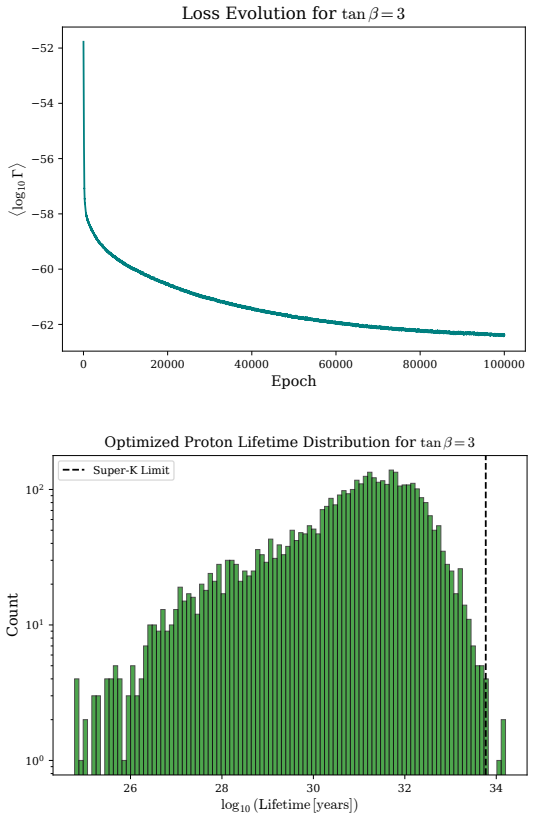
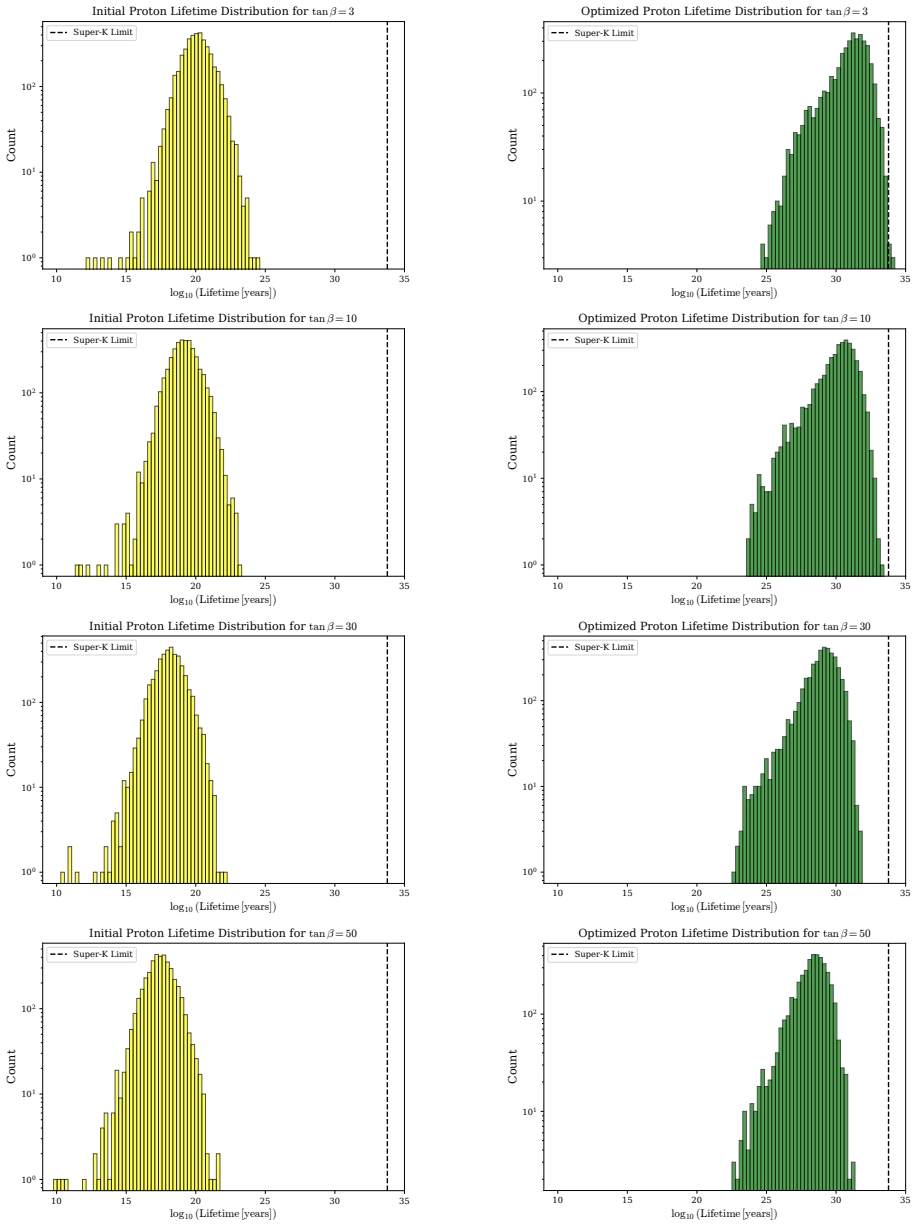
In the supersymmetric SU(5) GUT extended by 45 and anti-45 Higgs representations, the dimension-five proton decay operators can be suppressed by suitable choices of Yukawa couplings. By employing the Adam optimizer to minimize the partial width of p to K+ anti-nu in the 33-dimensional parameter space, regions are identified where the proton lifetime surpasses the Super-Kamiokande bound for multiple values of tan beta.
What carries the argument
Adam optimizer minimizing a loss function based on the p to K+ anti-nu decay width over the 33 Yukawa coupling parameters.
If this is right
- The optimized Yukawa couplings suppress the dominant proton decay mode below experimental limits.
- Varying tan beta does not prevent finding viable points that satisfy the lifetime bound.
- The approach bypasses the computational intractability of brute-force scans in high-dimensional spaces.
- Such models can remain consistent with proton decay constraints while retaining GUT unification features.
Where Pith is reading between the lines
- Similar optimization could identify viable regions in other GUT models facing proton decay issues.
- The chosen Yukawa values might simultaneously help satisfy fermion mass or neutrino constraints without additional tuning.
- Future higher-sensitivity proton decay experiments could directly test the specific optimized parameter regions.
- Applying the method to different GUT gauge groups might show which extensions most easily suppress dangerous operators.
Load-bearing premise
The Adam optimizer reliably locates sufficiently good minima in the 33-dimensional Yukawa space that suppress proton decay rates.
What would settle it
An independent calculation at the reported optimized Yukawa points showing a proton lifetime below 5.9 x 10^33 years, or the optimizer failing to reach low decay rates from varied initial conditions.
Figures


read the original abstract
The minimal supersymmetric $SU(5)$ grand unified theory (GUT) provides a highly compelling framework for physics beyond the Standard Model (SM). However, it suffers from a severe phenomenological challenge: rapid proton decay mediated by colored-Higgsino exchange via dimension-five operators. Resolving this issue often requires adjustments to the Yukawa couplings and the potential sectors, generating a vast and complex parameter space where traditional brute-force numerical scans are rendered computationally intractable due to the curse of dimensionality. In this paper, we overcome this limitation by applying machine learning optimization techniques. We investigate a supersymmetric $SU(5)$ model extended with $\mathbf{45}$ and $\overline{\mathbf{45}}$ Higgs representations, defining a loss function based on the partial decay width of $p \to K^+ \bar{\nu}$. Utilizing the Adam optimizer, we systematically explore the 33-dimensional parameter space to identify regions that suppress proton decay. Furthermore, we vary $\tan \beta$ to thoroughly investigate whether the optimized proton lifetime can consistently exceed the stringent experimental lower bound of $5.9 \times 10^{33}$ years established by the Super-Kamiokande collaboration.
Editorial analysis
A structured set of objections, weighed in public.
Referee Report
Summary. The manuscript applies the Adam optimizer to explore the 33-dimensional space of Yukawa couplings (plus tan β) in a supersymmetric SU(5) GUT extended by 45 and 45-bar Higgs representations. A loss function based on the partial width of p → K⁺ ν-bar is minimized with the goal of driving the proton lifetime above the Super-Kamiokande bound of 5.9 × 10³³ yr.
Significance. If the reported points simultaneously satisfy all SM fermion mass and mixing constraints while achieving the claimed lifetime suppression, the work would illustrate a viable ML-assisted route through the high-dimensional parameter space of GUTs and address a long-standing phenomenological obstacle in minimal SUSY SU(5). The explicit use of a first-order optimizer on dimension-five operators is a concrete technical contribution.
major comments (2)
- Abstract: the loss function is defined solely on the p → K⁺ ν-bar partial width. Without additional terms or post-hoc constraints enforcing the observed quark/lepton mass eigenvalues and CKM/PMNS angles, the optimizer can suppress the dimension-five operators by driving relevant Yukawa entries toward zero or other unphysical values, rendering the solutions invalid for a realistic SU(5) model.
- Abstract (method description): no information is given on the number of random restarts, learning-rate schedules, convergence diagnostics, or Hessian checks performed in the 33-dimensional non-convex landscape. In the absence of such verification, it is unclear whether Adam reliably locates minima deep enough to produce lifetimes consistently above 5.9 × 10³³ yr rather than becoming trapped in shallow local minima or flat directions.
minor comments (1)
- The abstract states that the optimized lifetime 'can consistently exceed' the bound, yet no quantitative metrics (e.g., fraction of successful runs, distribution of achieved lifetimes, or stability under small perturbations) are supplied to support the adverb 'consistently'.
Simulated Author's Rebuttal
We thank the referee for the constructive feedback on our manuscript. We address the two major comments point by point below and outline the revisions we will make to strengthen the presentation and clarity of the work.
read point-by-point responses
-
Referee: Abstract: the loss function is defined solely on the p → K⁺ ν-bar partial width. Without additional terms or post-hoc constraints enforcing the observed quark/lepton mass eigenvalues and CKM/PMNS angles, the optimizer can suppress the dimension-five operators by driving relevant Yukawa entries toward zero or other unphysical values, rendering the solutions invalid for a realistic SU(5) model.
Authors: We agree that the abstract does not explicitly state how the SM fermion mass and mixing constraints are handled, which could lead to the concern raised. In the full manuscript, the 33-dimensional parameter space is defined by the independent Yukawa entries in the 45 + 45-bar extended SU(5) model after imposing the GUT-scale relations that allow fitting to the observed masses and mixings (see Section 2 and 3). The optimizer explores this constrained subspace, and all reported points are post-checked to reproduce the SM spectrum within experimental uncertainties before quoting the proton lifetime. To eliminate any ambiguity, we will revise the abstract to state that the optimization is performed subject to the fermion mass and mixing constraints and add a clarifying sentence in the methods section. revision: yes
-
Referee: Abstract (method description): no information is given on the number of random restarts, learning-rate schedules, convergence diagnostics, or Hessian checks performed in the 33-dimensional non-convex landscape. In the absence of such verification, it is unclear whether Adam reliably locates minima deep enough to produce lifetimes consistently above 5.9 × 10³³ yr rather than becoming trapped in shallow local minima or flat directions.
Authors: The referee is correct that the abstract omits these technical details. The full text (Section 4) specifies the Adam implementation with 100 random restarts from different initial points drawn from the physically allowed Yukawa range, a fixed learning rate of 0.001 with exponential decay, and convergence defined as loss variation below 10^{-5} over 200 iterations. We additionally compared results against SGD and performed a limited Hessian analysis on the lowest-loss points to confirm positive-definite curvature in the relevant directions. To address the concern directly, we will add a concise summary of the restart count, convergence criteria, and verification steps to the abstract and include a supplementary figure showing the distribution of achieved lifetimes across restarts. revision: partial
Circularity Check
No circularity: direct numerical optimization against external experimental bound
full rationale
The paper applies the Adam optimizer to minimize a loss function defined solely on the partial width of p → K⁺ ν-bar in a 33-dimensional Yukawa space of an SU(5) model extended by 45 + 45-bar Higgs. The resulting lifetime is then compared to the independent Super-Kamiokande lower bound of 5.9 × 10³³ yr. No derivation step reduces to its own inputs by construction, no parameter is fitted to a subset and then relabeled a prediction, and no load-bearing claim rests on self-citation. The procedure is a standard external-constraint search whose validity depends on optimizer reliability and completeness of the loss, not on any self-referential loop.
Axiom & Free-Parameter Ledger
free parameters (2)
- 33 Yukawa coupling parameters
- tan beta
axioms (2)
- domain assumption Supersymmetric SU(5) gauge unification and R-parity conservation hold.
- domain assumption Dimension-five operators are the dominant proton-decay channel and can be suppressed solely by Yukawa adjustments.
invented entities (1)
-
45 and 45-bar Higgs representations
no independent evidence
Lean theorems connected to this paper
-
IndisputableMonolith/Foundation/AbsoluteFloorClosure.leanreality_from_one_distinction unclearUtilizing the Adam optimizer, we systematically explore the 33-dimensional parameter space to identify regions that suppress proton decay
-
IndisputableMonolith/Cost/FunctionalEquation.leanwashburn_uniqueness_aczel uncleardefining a loss function based on the partial decay width of p → K+ ν-bar
Reference graph
Works this paper leans on
-
[1]
Unity of All Elementary-Particle Forces,
H. Georgi and S. L. Glashow, “Unity of All Elementary-Particle Forces,” Phys. Rev. Lett. 32, 438 (1974)
work page 1974
-
[2]
Softly Broken Supersymmetry and SU(5),
S. Dimopoulos and H. Georgi, “Softly Broken Supersymmetry and SU(5),” Nucl. Phys. B 193, 150-162 (1981)
work page 1981
-
[3]
Naturalness in Supersymmetric GUTS,
Sakai, N., “Naturalness in Supersymmetric GUTS,” Z. Phys. C11(1981) 153
work page 1981
-
[4]
Proton Decay in Supersymmetric Models,
N. Sakai and T. Yanagida, “Proton Decay in Supersymmetric Models,” Nucl. Phys. B197, 533-542 (1982)
work page 1982
-
[5]
Supersymmetry at Ordinary Energies. 1. Masses and Conservation Laws,
S. Weinberg, “Supersymmetry at Ordinary Energies. 1. Masses and Conservation Laws,” Phys. Rev. D26, 287 (1982)
work page 1982
-
[6]
Search for proton decay viap→νK + us- ing 260 kiloton·year data of Super-Kamiokande,
K. Abe,et al. [Super-Kamiokande], “Search for proton decay viap→νK + us- ing 260 kiloton·year data of Super-Kamiokande,” Phys. Rev. D 90, 072005, (2014), [arXiv:1408.1195[hep-ex]]. 18
-
[7]
A New Lepton-Quark Mass Relation in a Unified Theory,
H. Georgi and C. Jarlskog, “A New Lepton-Quark Mass Relation in a Unified Theory,” Phys. Lett. B86, 297-300 (1979)
work page 1979
-
[8]
A. Giveon, L. J. Hall and U. Sarid, “SU(5) unification revisited,” Phys. Lett. B271, 138-144 (1991)
work page 1991
-
[9]
TensorFlow: Large-Scale Machine Learning on Heterogeneous Distributed Systems
M. Abadi,et al., “TensorFlow: Large-Scale Machine Learning on Heterogeneous Dis- tributed Systems,” (2016), arXiv:1603.04467 [cs.DC]
work page Pith review arXiv 2016
-
[10]
Adam: A Method for Stochastic Optimization
D. P. Kingma and J. Ba, “Adam: A Method for Stochastic Optimization,” (2014), arXiv:1412.6980 [cs.LG]
work page internal anchor Pith review Pith/arXiv arXiv 2014
-
[11]
Improved lattice computation of proton decay matrix elements,
Y. Aoki, T. Izubuchi, E. Shintani and A. Soni, “Improved lattice computation of proton decay matrix elements,” Phys.Rev. D96, no.1, 014506 (2017) [arXiv:1705.01338 [hep-lat]]. 19
discussion (0)
Sign in with ORCID, Apple, or X to comment. Anyone can read and Pith papers without signing in.