Recognition: 2 theorem links
· Lean TheoremSeparate Universe Super-Resolution Emulator
Pith reviewed 2026-05-12 01:46 UTC · model grok-4.3
The pith
A conditional GAN generates high-resolution N-body simulations with spatial curvature from low-resolution inputs, recovering most missing power on large scales.
A machine-rendered reading of the paper's core claim, the machinery that carries it, and where it could break.
Core claim
Our model accurately reproduces large-scale statistics, robustly recovering most of the power that was missing from the low-resolution input, but exhibits a residual suppression of power on small scales of up to ∼10% at k∼1 h Mpc^{-1}. The abundance of halos around 10^{14} M_⊙ is affected at a similar level, and we find that the profiles of these halos have a lower central density. To show a production-scale use case, we apply our model to upscale the resolution of a light cone from a large-volume N-body simulation with spatial curvature, producing a first-of-its-kind catalogue that simultaneously captures geometric effects at large scales and accurate nonlinear structure at small scales.
What carries the argument
Conditional generative adversarial network for upscaling N-body simulation fields with injected noise for stochastic structure, taking cosmological parameters including Omega_k as input.
If this is right
- Drastically reduces the computational cost of producing high-resolution simulations for modeling large-scale structure surveys.
- Enables generation of ensembles of high-resolution realizations to account for stochastic small-scale structure.
- Allows creation of light cone catalogues that include both curvature effects on large scales and nonlinear clustering on small scales.
- Maintains fidelity on large scales while introducing up to 10% suppression in small-scale power and halo central densities.
Where Pith is reading between the lines
- The residual small-scale discrepancies could be mitigated by expanding the training dataset or refining the model architecture.
- This emulator might be combined with other simulation techniques to cover a wider range of cosmological models.
- Further validation on simulations with parameters outside the training distribution would be needed before using it for precision cosmology.
Load-bearing premise
That the GAN trained on a finite set of simulations generalizes to produce unbiased small-scale structure and halo properties across the full range of input parameters and redshifts without systematic errors affecting downstream cosmological inference.
What would settle it
A direct comparison of the generated simulations' small-scale power spectrum and halo density profiles against an independent set of high-resolution N-body simulations with matching initial conditions and cosmological parameters.
Figures


read the original abstract
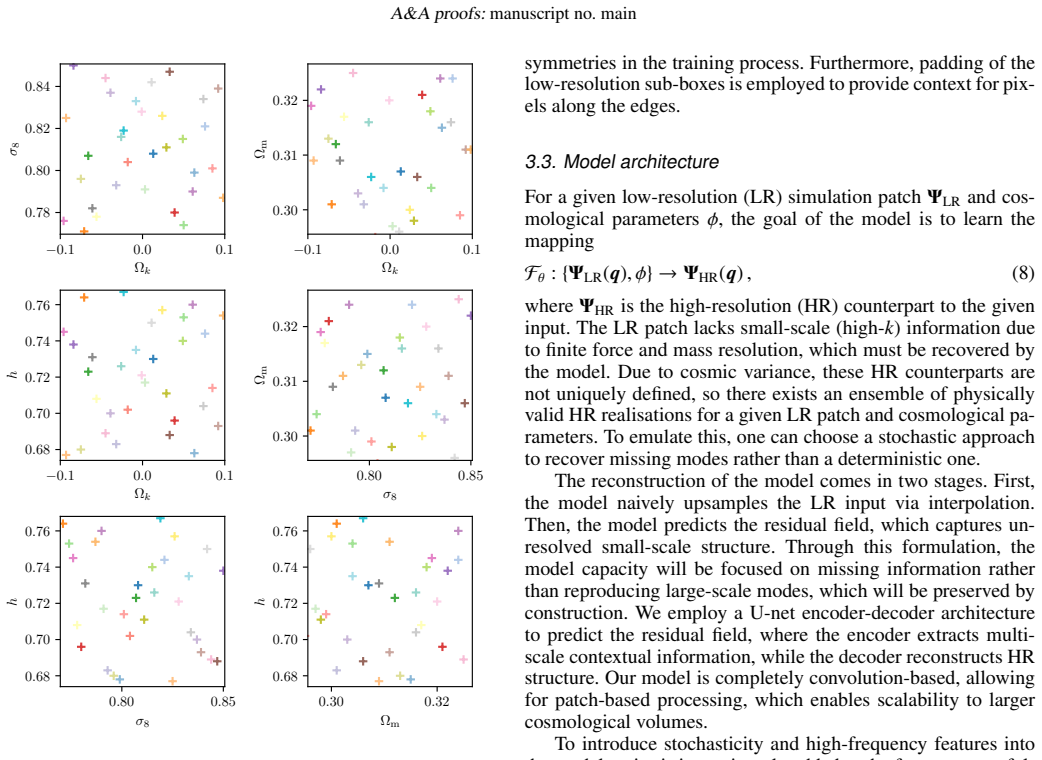
We present a machine-learning model for generating super-resolution $N$-body simulations with non-vanishing spatial curvature, conditioned on a given low-resolution field, $\Omega_k$, $\Omega_\mathrm{m}$, $\sigma_8$, $h$, and redshift. By upscaling the resolution of $N$-body simulations, such models can drastically reduce the computational cost of producing high-resolution simulations suitable for modelling current and future surveys of large-scale structure. Our model is trained as a generative adversarial network, allowing injected noise to be interpreted as stochastic structure and enabling the generation of an ensemble of plausible high-resolution realisations. We evaluate the model performance by comparing key cosmological summary statistics in the generated simulations to their high-resolution counterparts. We find that the model accurately reproduces large-scale statistics, robustly recovering most of the power that was missing from the low-resolution input, but exhibits a residual suppression of power on small scales of up to $\sim 10\%$ at $k \sim 1\,h\,\mathrm{Mpc}^{-1}$. The abundance of halos around $10^{14}\,M_\odot$ is affected at a similar level, and we find that the profiles of these halos have a lower central density. Although the overall performance is decent, we anticipate that the fidelity of the generative model can be further increased with more and better training data, as well as through improvements in the model architecture and training process. To show a production-scale use case, we apply our model to upscale the resolution of a light cone from a large-volume $N$-body simulation with spatial curvature, producing a first-of-its-kind catalogue that simultaneously captures geometric effects at large scales and accurate nonlinear structure at small scales.
Editorial analysis
A structured set of objections, weighed in public.
Referee Report
Summary. The paper presents a GAN-based super-resolution emulator for N-body simulations that incorporates non-vanishing spatial curvature. Conditioned on a low-resolution field plus parameters (Ω_k, Ω_m, σ_8, h, redshift), the model generates high-resolution realizations and is evaluated on summary statistics including power spectra and halo properties. It reports robust recovery of large-scale power with a residual ~10% suppression at k~1 h Mpc^{-1}, similar effects on halo abundance near 10^{14} M_⊙, and lower central densities in halo profiles. A production-scale demonstration applies the model to upscale a light-cone catalogue from a large-volume curved simulation.
Significance. If the reported performance generalizes, the emulator offers a practical route to high-resolution simulations with curvature at reduced cost, which is valuable for modeling geometric effects in future large-scale structure surveys. The explicit conditioning on curvature and the GAN's ability to produce ensembles are strengths; the light-cone application demonstrates a concrete use case. The acknowledged small-scale residuals are framed transparently as improvable with more data or architecture changes.
major comments (2)
- [§3] The manuscript provides limited information on training data volume, exact GAN architecture details (layers, loss terms, conditioning implementation), validation splits, and error propagation in the reported statistics. This weakens support for the central performance claims of large-scale recovery and quantified small-scale deficits (abstract and §4).
- [§4.2] The evaluation of halo abundance and profiles (around 10^{14} M_⊙) reports ~10% level effects but lacks discussion of how these residuals would propagate into cosmological parameter biases or survey forecasts, which is load-bearing for the claimed utility in downstream analyses (§4.2).
minor comments (2)
- Figure captions and text should specify the number of realizations in the ensemble averages and the precise k-range or mass bins used for the power spectrum and halo comparisons to improve reproducibility.
- [Abstract] The abstract could briefly note the redshift and parameter ranges over which the model was trained and tested.
Simulated Author's Rebuttal
We thank the referee for their constructive review and recommendation of minor revision. We address the two major comments below, providing additional details where possible and clarifying the scope of the present work.
read point-by-point responses
-
Referee: [§3] The manuscript provides limited information on training data volume, exact GAN architecture details (layers, loss terms, conditioning implementation), validation splits, and error propagation in the reported statistics. This weakens support for the central performance claims of large-scale recovery and quantified small-scale deficits (abstract and §4).
Authors: We agree that the current manuscript is concise on these technical aspects. In the revised version we will expand the methods section to report the precise training data volume (including the number of low- and high-resolution simulation pairs and their box sizes), the full GAN architecture (number of layers, filter counts, and activation functions), the explicit loss terms and weighting, the implementation of conditioning on Ω_k, Ω_m, σ_8, h and redshift, the train/validation/test split ratios, and a quantitative discussion of statistical uncertainties on the reported power-spectrum and halo statistics derived from multiple realizations. revision: yes
-
Referee: [§4.2] The evaluation of halo abundance and profiles (around 10^{14} M_⊙) reports ~10% level effects but lacks discussion of how these residuals would propagate into cosmological parameter biases or survey forecasts, which is load-bearing for the claimed utility in downstream analyses (§4.2).
Authors: We acknowledge that a dedicated propagation study would strengthen the case for downstream use. However, a full forecast analysis lies outside the scope of this emulator-development paper, which is focused on demonstrating fidelity on summary statistics. In the revision we will add a concise paragraph in §4.2 that (i) notes the ~10 % residuals are comparable to those reported for other emulators at similar scales, (ii) qualitatively indicates that such suppression could induce percent-level biases in σ_8 or halo-mass-function-derived parameters, and (iii) states that users should perform their own validation for precision applications. We will also cite relevant literature on emulator error propagation. revision: partial
Circularity Check
No significant circularity; evaluation uses independent high-resolution benchmarks
full rationale
The paper describes a conditional GAN trained to upscale low-resolution N-body fields into high-resolution realizations, with performance assessed via direct comparison of power spectra, halo mass functions, and density profiles against separate high-resolution simulation outputs. No load-bearing step reduces by construction to fitted parameters or self-referential definitions; the model is not claimed to derive new physics but to emulate existing simulation results, and residuals are explicitly quantified against external truth data rather than being tautological. No self-citation chain, uniqueness theorem, or ansatz smuggling is invoked to justify the core architecture or results. The derivation chain is therefore self-contained through empirical validation on held-out simulation suites.
Axiom & Free-Parameter Ledger
Lean theorems connected to this paper
-
IndisputableMonolith/Foundation/RealityFromDistinction.leanreality_from_one_distinction unclear?
unclearRelation between the paper passage and the cited Recognition theorem.
Our model is trained as a generative adversarial network... conditioned on a given low-resolution field, Ω_k, Ω_m, σ_8, h, and redshift.
-
IndisputableMonolith/Cost/FunctionalEquation.leanwashburn_uniqueness_aczel unclear?
unclearRelation between the paper passage and the cited Recognition theorem.
We find that the model accurately reproduces large-scale statistics, robustly recovering most of the power... residual suppression of power on small scales of up to ∼10% at k∼1 h Mpc^{-1}.
What do these tags mean?
- matches
- The paper's claim is directly supported by a theorem in the formal canon.
- supports
- The theorem supports part of the paper's argument, but the paper may add assumptions or extra steps.
- extends
- The paper goes beyond the formal theorem; the theorem is a base layer rather than the whole result.
- uses
- The paper appears to rely on the theorem as machinery.
- contradicts
- The paper's claim conflicts with a theorem or certificate in the canon.
- unclear
- Pith found a possible connection, but the passage is too broad, indirect, or ambiguous to say the theorem truly supports the claim.
Reference graph
Works this paper leans on
-
[1]
Abdul Karim, M. et al. 2025, Phys. Rev. D, 112, 083515
work page 2025
- [2]
-
[3]
Aghanim, N. et al. 2020, Astron. Astrophys., 641, A6, [Erratum: Astron. Astro- phys. 652, C4 (2021)]
work page 2020
- [4]
-
[5]
Arjovsky, M., Chintala, S., & Bottou, L. 2017 [arXiv:1701.07875]
work page Pith review arXiv 2017
-
[6]
Bacon, D. J. et al. 2020, Publ. Astron. Soc. Austral., 37, e007
work page 2020
- [7]
-
[8]
Castander, F. J. et al. 2025, Astron. Astrophys., 697, A5
work page 2025
- [9]
-
[10]
Chisari, N. E., Richardson, M. L. A., Devriendt, J., et al. 2018, Mon. Not. Roy. Astron. Soc., 480, 3962 Di Dio, E., Montanari, F., Lesgourgues, J., & Durrer, R. 2013, JCAP, 11, 044 Di Dio, E., Montanari, F., Raccanelli, A., et al. 2016, JCAP, 06, 013
work page 2018
-
[11]
Efstathiou, G., Davis, M., Frenk, C. S., & White, S. D. M. 1985, Astrophys. J. Suppl., 57, 241
work page 1985
-
[12]
Generative Adversarial Networks
Goodfellow, I. J., Pouget-Abadie, J., Mirza, M., et al. 2014 [arXiv:1406.2661] Górski, K. M., Hivon, E., Banday, A. J., et al. 2005, Astrophys. J., 622, 759
work page internal anchor Pith review arXiv 2014
-
[13]
Improved Training of Wasserstein GANs
Gulrajani, I., Ahmed, F., Arjovsky, M., Dumoulin, V ., & Courville, A. 2017 [arXiv:1704.00028]
work page Pith review arXiv 2017
- [14]
- [15]
-
[16]
Levi, M. et al. 2013 [arXiv:1308.0847]
work page Pith review arXiv 2013
-
[17]
Lewis, A., Challinor, A., & Lasenby, A. 2000, Astrophys. J., 538, 473
work page 2000
- [18]
- [19]
- [20]
-
[21]
Mellier, Y . et al. 2025, Astron. Astrophys., 697, A1
work page 2025
-
[22]
Newburgh, L. B. et al. 2016, Proc. SPIE Int. Soc. Opt. Eng., 9906, 99065X
work page 2016
- [23]
-
[24]
K., Charnock, T., Villaescusa-Navarro, F., & Wandelt, B
Ramanah, D. K., Charnock, T., Villaescusa-Navarro, F., & Wandelt, B. D. 2020, Mon. Not. Roy. Astron. Soc., 495, 4227
work page 2020
-
[25]
Rouhiainen, A., Münchmeyer, M., Shiu, G., Gira, M., & Lee, K. 2024, Phys. Rev. D, 109, 123536
work page 2024
- [26]
-
[27]
2025, yt-project/yt_astro_analysis: yt_astro_analysis 1.1.4 Release
Smith, B., Turk, M., ZuHone, J., et al. 2025, yt-project/yt_astro_analysis: yt_astro_analysis 1.1.4 Release
work page 2025
- [28]
-
[29]
Turk, M. J., Smith, B. D., Oishi, J. S., et al. 2011, The Astrophysical Journal Supplement Series, 192, 9
work page 2011
-
[30]
Villaescusa-Navarro, F. 2018, Pylians: Python libraries for the analysis of numer- ical simulations, Astrophysics Source Code Library, record ascl:1811.008
work page 2018
-
[31]
Villaescusa-Navarro, F. et al. 2020, Astrophys. J. Suppl., 250, 2
work page 2020
- [32]
- [33]
discussion (0)
Sign in with ORCID, Apple, or X to comment. Anyone can read and Pith papers without signing in.