Recognition: no theorem link
Manipulation of magnetic skyrmions by non-uniform electric fields
Pith reviewed 2026-05-12 01:49 UTC · model grok-4.3
The pith
Localized electric fields from charged tips can create, drive, and annihilate magnetic skyrmions and related textures via the magnetoelectric effect.
A machine-rendered reading of the paper's core claim, the machinery that carries it, and where it could break.
Core claim
Combining complementary numerical simulations and analytical approaches, we develop a consistent theory describing the stability and dynamics of Néel-type skyrmions under the influence of the electric field from a charged tip. Specifically, we demonstrate that the electric field can create, drive, and annihilate skyrmions of both chiralities, as well as more complex textures such as skyrmioniums and target skyrmions. We identify several distinct dynamical regimes of skyrmion motion near the tip and map them onto a phase diagram.
What carries the argument
Magnetoelectric coupling between the localized electric field of a charged tip and the spin texture of a Néel skyrmion, which modifies the skyrmion energy landscape and produces forces or torques on the texture.
If this is right
- Skyrmions of either chirality can be nucleated at targeted locations by positioning the tip and applying voltage.
- Skyrmion motion falls into distinct regimes that allow either trapping or controlled translation near the tip.
- Annihilation of skyrmions provides a direct method to erase stored information bits.
- The same electric-field protocol works for more complex textures including skyrmioniums and target skyrmions.
- The phase diagram supplies a predictive map for choosing tip voltage and distance to achieve a desired dynamical outcome.
Where Pith is reading between the lines
- All-electric control could eliminate the need for spin-polarized currents and thereby reduce Joule heating in skyrmion-based memory.
- Arrays of independently addressable tips might enable dense, scalable skyrmion logic or storage architectures integrated with conventional electronics.
- The same principle may apply to other magnetoelectric materials or to hybrid systems that combine skyrmions with superconducting or quantum-dot elements.
- Device feasibility will ultimately depend on finding or engineering thin films where the magnetoelectric response remains strong at room temperature without introducing unwanted pinning or heating.
Load-bearing premise
The magnetoelectric coupling strength and material parameters used in the model are representative of real ferromagnetic films that can host stable Néel skyrmions at room temperature.
What would settle it
An experiment that applies voltage to a sharp tip above a thin ferromagnetic film known to host stable room-temperature Néel skyrmions and checks whether skyrmions appear, move, or disappear exactly as predicted by the phase diagram.
Figures




read the original abstract
Magnetic skyrmions are topologically protected spin textures in ferromagnetic materials that hold great promise for both classical information storage and processing, as well as for fault-tolerant quantum computing. Realizing practical skyrmion-based devices demands an energy-efficient and precise method for their flexible manipulation. In this paper, we theoretically propose such a tool, leveraging the magnetoelectric effect induced by a localized electric field generated by one or several charged tips. Combining complementary numerical simulations and analytical approaches, we develop a consistent theory describing the stability and dynamics of N\'eel-type skyrmions under the influence of the electric field from a charged tip. Specifically, we demonstrate that the electric field can create, drive, and annihilate skyrmions of both chiralities, as well as more complex textures such as skyrmioniums and target skyrmions. We identify several distinct dynamical regimes of skyrmion motion near the tip and map them onto a phase diagram. Finally, we discuss the feasibility of a practical device capable of controlled skyrmion manipulation based on this principle.
Editorial analysis
A structured set of objections, weighed in public.
Referee Report
Summary. The manuscript proposes using non-uniform electric fields from one or more charged tips to manipulate Néel skyrmions in ferromagnetic films via the magnetoelectric effect. Combining micromagnetic simulations with analytical modeling, the authors show that such fields can create, drive, and annihilate skyrmions of both chiralities as well as skyrmioniums and target skyrmions; they map distinct dynamical regimes onto a phase diagram and discuss device feasibility.
Significance. If the model parameters prove realistic, the work offers a concrete, energy-efficient route to all-electric skyrmion control that could impact spintronic memory and logic. The dual numerical-analytical strategy is a clear strength, providing both quantitative dynamics and mechanistic insight into the identified regimes. The breadth across chiralities and higher-order textures (skyrmioniums, targets) further strengthens the contribution.
major comments (2)
- [Model and Methods] Model and Methods section: The magnetoelectric coupling strength (the coefficient linking the local E field to effective anisotropy or DMI in the Hamiltonian) and the micromagnetic parameters (A, K, D) are stated without any comparison to measured values in room-temperature Néel-skyrmion hosts such as Co/Pt or Ta/CoFeB multilayers. Because these parameters set the energy scales for creation/annihilation thresholds and the boundaries of the dynamical regimes in the phase diagram, the claim that the protocols are practically feasible cannot be assessed.
- [Results] Results section (phase diagram and dynamical regimes): No robustness checks are presented for variations in the magnetoelectric coefficient within experimentally reported ranges; the reported regimes (e.g., the transition from pinned to driven motion near the tip) may therefore be artifacts of the specific numerical choice rather than generic features.
minor comments (3)
- [Abstract] The abstract states that 'complementary numerical and analytical approaches' were used, yet the analytical derivations (effective potential, Thiele-equation reduction) are only sketched; a short appendix or subsection detailing the approximations and their validity range would improve transparency.
- [Figures] Figure captions for the phase diagrams do not explicitly state the normalization used for the electric-field strength or tip distance axes, making it difficult to map the plotted regimes onto physical units.
- [Introduction] A few references to prior electric-field manipulation studies (e.g., voltage-controlled anisotropy or DMI tuning) are missing from the introduction; adding them would better situate the novelty of the tip geometry.
Simulated Author's Rebuttal
We thank the referee for the positive evaluation of our manuscript and for the constructive comments. We address each major comment point by point below. Where the comments identify gaps in the original submission, we have revised the manuscript accordingly.
read point-by-point responses
-
Referee: Model and Methods section: The magnetoelectric coupling strength (the coefficient linking the local E field to effective anisotropy or DMI in the Hamiltonian) and the micromagnetic parameters (A, K, D) are stated without any comparison to measured values in room-temperature Néel-skyrmion hosts such as Co/Pt or Ta/CoFeB multilayers. Because these parameters set the energy scales for creation/annihilation thresholds and the boundaries of the dynamical regimes in the phase diagram, the claim that the protocols are practically feasible cannot be assessed.
Authors: We agree that an explicit comparison to experimental values is needed to substantiate the feasibility claims. In the revised manuscript we have added a dedicated paragraph in the Model and Methods section that directly compares our chosen micromagnetic parameters (A, K, D) and the magnetoelectric coupling coefficient to literature values for room-temperature Néel-skyrmion hosts such as Co/Pt and Ta/CoFeB multilayers. We cite the relevant experimental reports and note that our parameters lie within the experimentally observed ranges, thereby placing the energy scales of the creation, annihilation, and dynamical thresholds on a realistic footing. revision: yes
-
Referee: Results section (phase diagram and dynamical regimes): No robustness checks are presented for variations in the magnetoelectric coefficient within experimentally reported ranges; the reported regimes (e.g., the transition from pinned to driven motion near the tip) may therefore be artifacts of the specific numerical choice rather than generic features.
Authors: We acknowledge that robustness against parameter variation is essential. We have performed additional micromagnetic simulations in which the magnetoelectric coefficient was varied by ±30 % around the nominal value, a range consistent with experimental reports. The outcomes are now included in the revised manuscript as a supplementary figure together with a short discussion in the Results section. These checks confirm that the identified dynamical regimes and the topology of the phase diagram remain qualitatively unchanged; only minor quantitative shifts in the transition lines occur. This demonstrates that the reported regimes are generic features of the non-uniform-field driving mechanism. revision: yes
Circularity Check
No significant circularity; derivation is self-contained forward modeling
full rationale
The paper develops a consistent theory via complementary numerical micromagnetic simulations and analytical approaches applied to the standard Landau-Lifshitz-Gilbert dynamics augmented by a magnetoelectric coupling term from a localized electric field. Central results (creation/annihilation of skyrmions of both chiralities, skyrmioniums, target skyrmions, and mapped dynamical regimes) are obtained as forward predictions from the model equations rather than by fitting parameters to those same outcomes or by self-referential definitions. No load-bearing step reduces to a fitted input renamed as prediction, a self-citation chain, or an ansatz smuggled via prior work. The model parameters are chosen to represent plausible ferromagnetic films, but the phase diagram and manipulation protocols are independent outputs, not tautological with the inputs.
Axiom & Free-Parameter Ledger
axioms (2)
- domain assumption Micromagnetic energy functional with Dzyaloshinskii-Moriya interaction supports stable Néel skyrmions
- domain assumption Magnetoelectric effect couples electric field to magnetic anisotropy or DMI in a linear fashion
Reference graph
Works this paper leans on
-
[1]
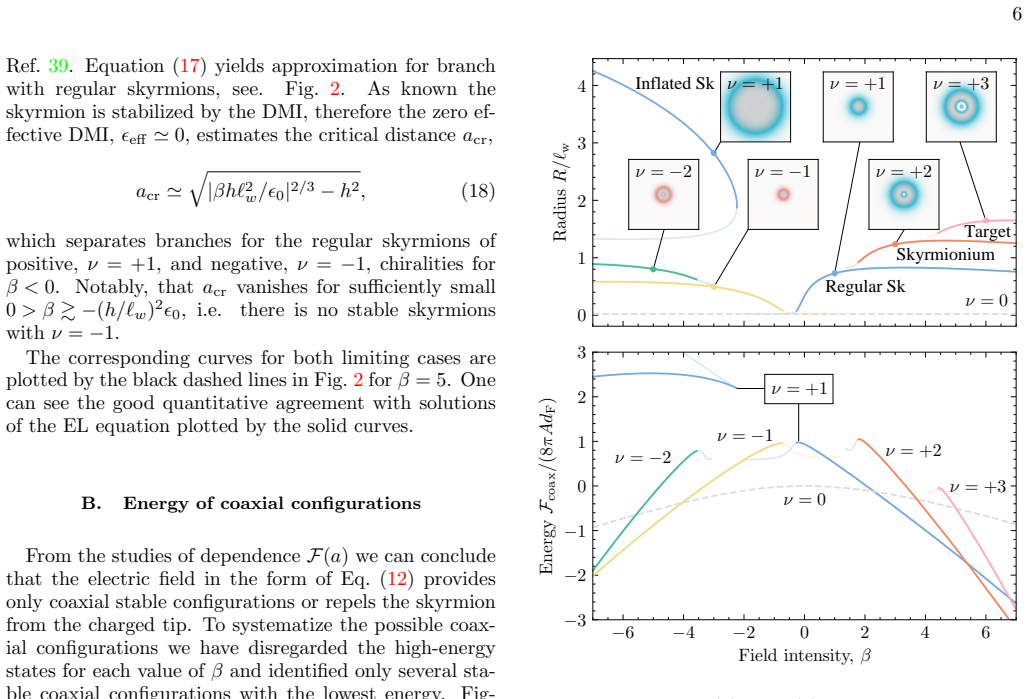
Magnetoelectric effect A nonuniform magnetization in the ferromagnetic film induces a ferroelectric polarization [23–25], P=γ ME m∇ ·m−(m· ∇)m ,(3) whereγ ME is the magnetoelectric coupling constant. Consequently, the energy of the ferromagnetic film ac- quires an additional contribution with the density−P·E when an external electric fieldEis applied. In ...
-
[2]
Skyrmions The DMI in the form (2) allows the stabilization of N´ eel-type skyrmions in the ferromagnetic film [1]. As follows from Eq. (4), a uniform external electric field pro- duces the same effect as the common DMI. This can be used to control the parameters of skyrmions across the 27, 28] 3 entire film [4, 31], but not their positions. If the externa...
-
[3]
Evolution equation The evolution of magnetization can be described by the Landau-Lifshitz-Gilbert (LLG) equation [33, 34], ∂tm=−γm×H eff +αm×∂ tm,(9) whereH eff =−M −1 s δF/δmis the effective magnetic field,M s is the saturation magnetization, andγandα are phenomenological constants governing the precession and relaxation of the magnetization, respectivel...
-
[4]
Electric field distribution To proceed, we determine the specific distribution of the external electric field used to derive analytical re- sults and perform micromagnetic simulations. Since an experimentally consistent field source is generated by a thin, electrically charged tip [11], we model it as a point chargeqpositioned at heighthabove the pointr=−...
-
[5]
direct” approach a higher field intensity is required than in the “swing
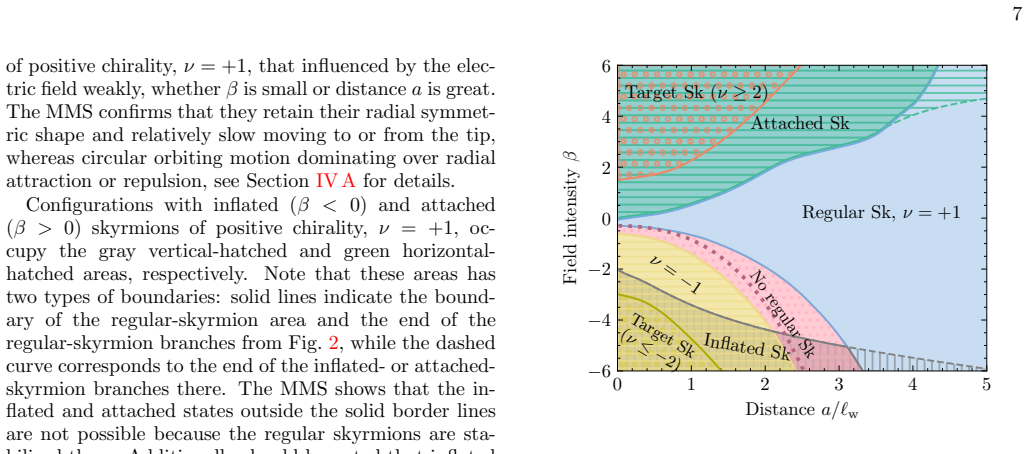
Skyrmions of positive chirality Here we introduce two methods for the creation of a skyrmion of positive chirality (ν= +1) mediated by the electric field of the tip. The first approach relies on a rapid reversal (“swing”) of the field polarity. Initially, in the homogeneously magnetized ferromagnet film,m=e z, a strong enough electric field withβ=−β +sw <...
-
[6]
Skyrmions with negative chirality For the skyrmions with negative chirality,ν=−1, the same two (“direct” and “swing”) methods can be applied with the same qualitative results as forν= +1. However, due to the positive DMI parameter,ϵ 0 >0, the values of the critical fields that are needed for the creation of a skyrmion withν=−1 appear to be slightly strong...
-
[7]
In MMS we observed creation of target skyrmions when|β|≳8
Skyrmioniums and target skyrmions Similarly to a regular skyrmion, skyrmioniums and tar- get skyrmions,|ν| ≥2 can be created with application of electric fields of higher intensity. In MMS we observed creation of target skyrmions when|β|≳8. Note that the appropriate field should be applied not only for creating such target skyrmions, but also to keep them...
-
[8]
Skyrmions of positive chirality As one can see from Fig. 4 the skyrmion of the positive chirality,ν= +1, shifted from the tip is stable practically for any intensity of electric field. Therefore, to be anni- hilated, the skyrmion should be firstly attracted to the tip nearly coaxially, see Fig. 5 and details in Sec. IV A. Then one should switch the voltag...
-
[9]
Skyrmions of negative chirality Unlike skyrmions of positive chirality, skyrmions of negative chirality,ν=−1, require negative field intensity to exist. However, turning on the positive field intensity β >0 may lead to switch the chirality of a skyrmion from negative to positive, avoiding annihilation. Therefore, to annihilate a skyrmion reliably we shoul...
-
[10]
Skyrmioniums and target skyrmions Because skyrmioniums,|ν|= 2, and target skyrmions, |ν|>2, are not stable without additional condition, in particular, the appropriate electric field, then it is enough to turn the field off to destroy them. Also the tip and skyrmion or target skyrmion can be pulled apart somehow at sufficient distance, see the cor- respon...
work page 2025
-
[11]
Expression forq i(R, δ)andp(R, δ)without electric field In this limiting case we assume that the skyrmion is a circle domain with radiusR≫ℓ w and wall of thick- nessδ≈ℓ w, and its magnetization can be described by skyrmion angle from Eq. (A2). Then we can calculate functionsq i(R, δ) from Eqs. (B3) andpwithout electric field,β= 0, asymptotically, q0 ≈ ℓw ...
-
[12]
Free energy Then to calculate the total free energy F=F magn +F ME, see Eq. (B4), we should use ex- pressions forq 1,q 2, andp β=0 to get first two terms and the first term inside square brackets in Eq. (15). The second term in square brackets is resulted from the ME energy and, in the main approximation inR≫ℓ w, can be expressed as β ¯Ea(R)f(R−a) = β π Z...
-
[13]
Adjusted radius In the limitR≫ℓ w Eq. (B6) takes the following form, ∂δρ ∂Rρ = π2δ 12R .(C5) that can be solved explicitly, ρ=F(R 2 +π 2δ2/12),(C6) whereFis the arbitrary function, which can be naturally taken as the square root. Therefore, we get the adjusted radiusρas ρ= r R2 + π2δ2 12 ≈R+ π2δ2 12R .(C7) Appendix D: Multiple solution of Euler-Lagrange e...
- [14]
-
[15]
S. M¨ uhlbauer, B. Binz, F. Jonietz, C. Pfleiderer, A. Rosch, A. Neubauer, R. Georgii, and P. B¨ oni, Skyrmion lattice in a chiral magnet, Science323, 915 (2009)
work page 2009
-
[16]
S. Seki, X. Z. Yu, S. Ishiwata, and Y. Tokura, Observa- tion of skyrmions in a multiferroic material, Science336, 198 (2012)
work page 2012
-
[17]
N. Nagaosa and Y. Tokura, Topological properties and dynamics of magnetic skyrmions, Nature Nanotechnol- ogy8, 899 (2013)
work page 2013
-
[18]
C. Back, V. Cros, H. Ebert, K. Everschor-Sitte, A. Fert, M. Garst, T. Ma, S. Mankovsky, T. L. Monchesky, M. Mostovoy, N. Nagaosa, S. S. P. Parkin, C. Pfleiderer, N. Reyren, A. Rosch, Y. Taguchi, Y. Tokura, K. von Bergmann, and J. Zang, The 2020 skyrmionics roadmap, J. Phys. D: Applied Phys.53, 363001 (2020)
work page 2020
-
[19]
K. Litzius, J. Leliaert, P. Bassirian, D. Rodrigues, S. Kromin, I. Lemesh, J. Zazvorka, K.-J. Lee, J. Mulkers, N. Kerber, D. Heinze, N. Keil, R. M. Reeve, M. Weigand, B. Van Waeyenberge, G. Sch¨ utz, K. Everschor-Sitte, G. S. D. Beach, and M. Kl¨ aui, The role of temperature and drive current in skyrmion dynamics, Nature Elec- tronics3, 30–36 (2020). 15
work page 2020
-
[20]
J. A. Brock, S. A. Montoya, M.-Y. Im, and E. E. Fuller- ton, Energy-efficient generation of skyrmion phases in co/ni/pt-based multilayers using joule heating, Phys. Rev. Mater.4, 104409 (2020)
work page 2020
-
[21]
K. Litzius, I. Lemesh, B. Kr¨ uger, P. Bassirian, L. Caretta, K. Richter, F. B¨ uttner, K. Sato, O. A. Tretiakov, J. F¨ orster, R. M. Reeve, M. Weigand, I. Bykova, H. Stoll, G. Sch¨ utz, G. S. D. Beach, and M. Kl¨ aui, Skyrmion hall effect revealed by direct time-resolved x-ray microscopy, Nature Physics13, 170 (2017)
work page 2017
-
[22]
M. S. Shustin, V. A. Stepanenko, and D. M. Dzebisas- hvili, Higher-order magnetic skyrmions in nonuniform magnetic fields, Phys. Rev. B107, 195428 (2023)
work page 2023
-
[23]
S. S. Apostoloff, E. S. Andriyakhina, and I. S. Bur- mistrov, Deformation of a N´ eel-type skyrmion in a weak inhomogeneous magnetic field: Magnetization ansatz and interaction with a Pearl vortex, Phys. Rev. B109(2024)
work page 2024
-
[24]
A. Pyatakov, A. Sergeev, F. Mikailzade, and A. Zvezdin, Spin flexoelectricity and chiral spin structures in mag- netic films, Journal of Magnetism and Magnetic Materi- als383, 255–258 (2015)
work page 2015
-
[25]
X.-g. Wang, L. Chotorlishvili, G.-h. Guo, C.-L. Jia, and J. Berakdar, Thermally assisted skyrmion drag in a nonuniform electric field, Physical Review B99, 10.1103/physrevb.99.064426 (2019)
-
[26]
Y.-D. Wang, Z.-J. Wei, H.-R. Tu, C.-H. Zhang, and Z.-P. Hou, Electric field manipulation of mag- netic skyrmions, Rare Metals41, 4000 (2022), https://onlinelibrary.wiley.com/doi/pdf/10.1007/s12598- 022-02084-0
-
[27]
E. S. Andriyakhina, S. Apostoloff, and I. S. Burmistrov, Repulsion of a N´ eel-type skyrmion from a pearl vortex in thin ferromagnet–superconductor heterostructures, JETP Letters116, 825 (2022)
work page 2022
-
[28]
R. M. Menezes, J. F. S. Neto, C. C. de Souza Silva, and M. V. Miloˇ sevi´ c, Manipulation of magnetic skyrmions by superconducting vortices in ferromagnet-superconductor heterostructures, Phys. Rev. B100, 014431 (2019)
work page 2019
-
[29]
A. P. Petrovi´ c, M. Raju, X. Y. Tee, A. Louat, I. Maggio- Aprile, R. M. Menezes, M. J. Wyszy´ nski, N. K. Duong, M. Reznikov, C. Renner, M. V. Milosevi´ c, and C. Panagopoulos, Skyrmion-(Anti)vortex coupling in a chiral magnet-superconductor heterostructure, Phys. Rev. Lett.126, 117205 (2021)
work page 2021
-
[30]
Y. Xie, A. Qian, B. He, Y. Wu, S. Wang, B. Xu, G. Yu, X. Han, and X. Qiu, Visualization of skyrmion- superconducting vortex pairs in a chiral magnet- superconductor heterostructure, Phys. Rev. Lett133, 166706 (2024)
work page 2024
-
[31]
S. S. Apostoloff, E. S. Andriyakhina, and I. S. Bur- mistrov, The effect of pearl vortices on the shape and po- sition of n´ eel-type skyrmions in superconductor—chiral ferromagnet heterostructures, Physics-Uspekhi , To be UPDATED! (2025)
work page 2025
-
[32]
G. Yang, P. Stano, J. Klinovaja, and D. Loss, Majorana bound states in magnetic skyrmions, Phys. Rev. B93, 224505 (2016)
work page 2016
-
[33]
S. Rex, I. V. Gornyi, and A. D. Mirlin, Majorana bound states in magnetic skyrmions imposed onto a supercon- ductor, Phys. Rev. B100, 064504 (2019)
work page 2019
-
[34]
J. Nothhelfer, S. A. D´ ıaz, S. Kessler, T. Meng, M. Rizzi, K. M. D. Hals, and K. Everschor-Sitte, Steering majorana braiding via skyrmion-vortex pairs: A scalable platform, Phys. Rev. B105, 224509 (2022)
work page 2022
-
[35]
S. T. Konakanchi, J. I. V¨ ayrynen, Y. P. Chen, P. Upad- hyaya, and L. P. Rokhinson, Platform for braiding Ma- jorana modes with magnetic skyrmions, Phys. Rev. Res. 5, 033109 (2023)
work page 2023
-
[36]
V. G. Bar’yakhtar, V. A. L’vov, and D. A. Yablonskii, Inhomogeneous magnetoelectric effect, JETP Letters37, 673 (1983)
work page 1983
-
[37]
Mostovoy, Ferroelectricity in spiral magnets, Phys
M. Mostovoy, Ferroelectricity in spiral magnets, Phys. Rev. Lett.96, 067601 (2006)
work page 2006
-
[38]
Dzyaloshinskii, Magnetoelectricity in ferromagnets, EPL83, 67001 (2008)
I. Dzyaloshinskii, Magnetoelectricity in ferromagnets, EPL83, 67001 (2008)
work page 2008
-
[39]
A. P. Pyatakov, A. S. Sergeev, E. P. Nikolaeva, T. B. Kosykh, A. V. Nikolaev, K. A. Zvezdin, and A. K. Zvezdin, Micromagnetism and topological defects in mag- netoelectric media, Physics-Uspekhi58, 981–992 (2015)
work page 2015
-
[40]
E. S. Andriyakhina and I. S. Burmistrov, Interaction of a N´ eel-type skyrmion with a superconducting vortex, Phys. Rev. B103(2021)
work page 2021
- [41]
-
[42]
N. A. Spaldin and M. Fiebig, The renaissance of magne- toelectric multiferroics, Science309, 391–392 (2005)
work page 2005
-
[43]
R. C. Pullar, Hexagonal ferrites: A review of the synthe- sis, properties and applications of hexaferrite ceramics, Progress in Materials Science57, 1191–1334 (2012)
work page 2012
-
[44]
E. Ruff, S. Widmann, P. Lunkenheimer, V. Tsurkan, S. Bord´ acs, I. K´ ezsm´ arki, and A. Loidl, Multiferroicity and skyrmions carrying electric polarization in gav 4 s 8, Science Advances1, 10.1126/sciadv.1500916 (2015)
-
[45]
B. G¨ obel, I. Mertig, and O. A. Tretiakov, Beyond skyrmions: Review and perspectives of alternative mag- netic quasiparticles, Phys. Rep.895, 1 (2021)
work page 2021
-
[46]
L. Landau and E. Lifshitz, On the theory of the disper- sion of magnetic permeability in ferromagnetic bodies, Phys. Z. Sowj.8, 153 (1935)
work page 1935
-
[47]
T. Gilbert, A phenomenological theory of damping in fer- romagnetic materials, IEEE Transactions on Magnetics 40, 3443 (2004)
work page 2004
-
[48]
J. E. Miltat and M. J. Donahue, Numerical micromagnet- ics: Finite difference methods, inHandbook of Magnetism and Advanced Magnetic Materials(John Wiley & Sons, Ltd, 2007)
work page 2007
-
[49]
M. J. Donahue and D. G. Porter, OOMMF user’s guide, version 1.0, Interagency Report NISTIR6376(1999)
work page 1999
-
[50]
M. Beg, M. Lang, and H. Fangohr, Ubermag: Towards more effective micromagnetic workflows, IEEE Transac- tions on Magnetics58, 1 (2022)
work page 2022
-
[51]
A. A. Thiele, Steady-state motion of magnetic domains, Physical Review Letters30, 230–233 (1973)
work page 1973
-
[52]
X. S. Wang, H. Y. Yuan, and X. R. Wang, A theory on skyrmion size, Communications Physics1, 10.1038/s42005-018-0029-0 (2018)
- [53]
-
[54]
K. Nakamura and A. O. Leonov, Communicating skyrmions as the main mechanism underlying skyrmion- ium (meta)stability in quasi-two-dimensional chiral mag- nets (2024), arXiv:2404.10189 [cond-mat.mes-hall]. 16
-
[55]
R. Tomasello, E. Martinez, R. Zivieri, L. Torres, M. Car- pentieri, and G. Finocchio, A strategy for the design of skyrmion racetrack memories, Scientific Reports4, 10.1038/srep06784 (2014)
-
[56]
B. He, R. Tomasello, X. Luo, R. Zhang, Z. Nie, M. Car- pentieri, X. Han, G. Finocchio, and G. Yu, All-electrical 9-bit skyrmion-based racetrack memory designed with laser irradiation, Nano Letters23, 9482–9490 (2023)
work page 2023
-
[57]
H. Niu, H. G. Yoon, H. Y. Kwon, Z. Cheng, S. Fu, H. Zhu, B. Miao, L. Sun, Y. Wu, A. K. Schmid, K. Liu, C. Won, H. Ding, and G. Chen, Magnetic skyrmionic structures with variable topological charges in engineered dzyaloshinskii-moriya interaction systems, Nature Com- munications16, 3453 (2025)
work page 2025
discussion (0)
Sign in with ORCID, Apple, or X to comment. Anyone can read and Pith papers without signing in.