Recognition: no theorem link
Changing the Game: Status-Quo Inertia, Institutional Design, and Equilibrium Transition
Pith reviewed 2026-05-12 03:31 UTC · model grok-4.3
The pith
Interventions that delete or replace actions shift entrenched equilibria more effectively than price changes when selection shows status-quo inertia.
A machine-rendered reading of the paper's core claim, the machinery that carries it, and where it could break.
Core claim
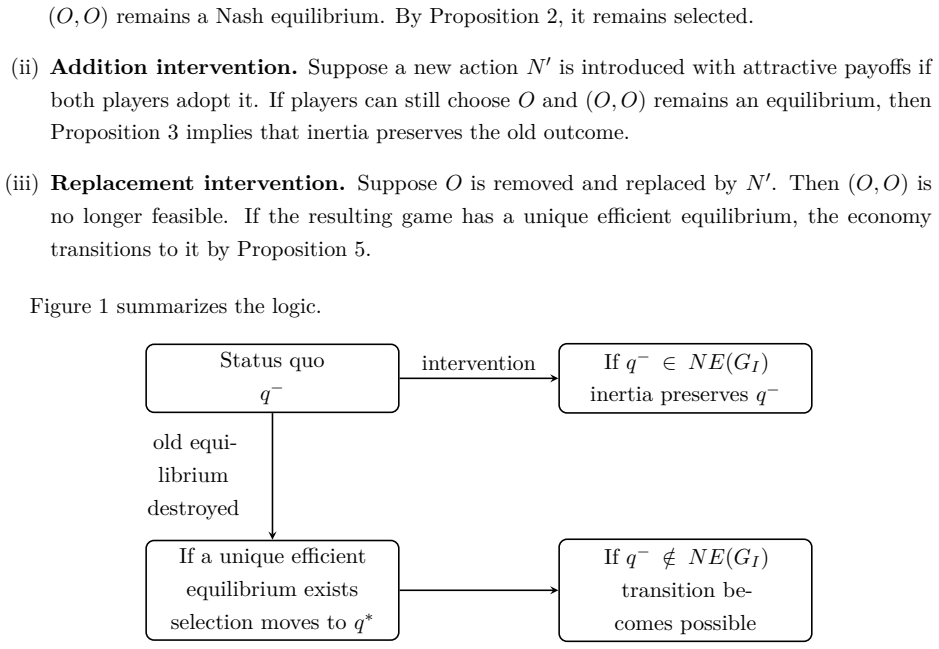
When equilibrium selection follows status-quo inertia, the prior equilibrium is retained if it is still a Nash equilibrium after intervention. Price-based policies and simple expansions of options therefore often leave behavior unchanged. Deletion and replacement interventions succeed because they make the old equilibrium no longer feasible, removing the basis for its continued selection. General results follow from this setup and are applied to show how such action-space modifications produce transitions in the listed policy domains.
What carries the argument
status-quo inertia in equilibrium selection, the rule that the pre-intervention equilibrium continues to be chosen if it remains a Nash equilibrium after the policy
If this is right
- Price or subsidy interventions fail to induce equilibrium transition whenever they leave the status-quo outcome feasible.
- Deletion of actions that support the inefficient equilibrium makes that equilibrium no longer viable and forces selection of an alternative.
- Replacement interventions achieve similar disruption by substituting new strategies for old ones without requiring precise payoff calibration.
- In the examples, climate, financial, and platform policies succeed only when they alter the feasible strategies rather than merely adjusting their costs.
- Institutional design should therefore focus on changing the structure of available moves rather than refining incentives within an unchanged structure.
Where Pith is reading between the lines
- Policymakers facing coordination traps could map the minimal removable actions needed to break inertia in specific settings.
- The same distinction between preserving and altering action spaces may apply to changing default behaviors in organizations or social norms.
- Controlled experiments that apply both intervention types side by side could measure the size of the difference in switching rates.
- The approach formalizes one mechanism behind path dependence and suggests when small reforms are structurally insufficient to overcome lock-in.
Load-bearing premise
If the old equilibrium remains a stable outcome after the intervention, players continue to select it.
What would settle it
A laboratory coordination game or field observation in which an incentive adjustment that leaves the original equilibrium feasible nevertheless produces a switch to a new equilibrium, or in which deletion of an action fails to trigger the predicted transition.
Figures
read the original abstract
Many economic interventions are designed as marginal changes in incentives. Yet in environments shaped by coordination, institutional persistence, and path dependence, such reforms often leave behavior largely unchanged. This paper studies interventions in games when equilibrium selection displays status-quo inertia: if the pre-intervention equilibrium remains a Nash equilibrium after policy, it continues to be selected. In that environment, price-based interventions and simple option expansion may fail even when they improve welfare in a partial-equilibrium sense. By contrast, interventions that modify the feasible action space, especially deletion and replacement interventions, can be substantially more effective because they remove the strategic basis for persistence. We develop a simple framework, derive general results, provide complete proofs, and illustrate the economics with examples from climate transition, platform regulation, financial reform, and industrial modernization. The analysis highlights a basic policy lesson: when inefficient equilibria are institutionally entrenched, the central problem is often not how to price the existing game more finely, but how to change the game itself.
Editorial analysis
A structured set of objections, weighed in public.
Referee Report
Summary. The paper develops a framework for policy interventions in coordination games where equilibrium selection exhibits status-quo inertia: the pre-intervention Nash equilibrium continues to be selected if it remains feasible and a Nash equilibrium after the intervention. It shows that marginal interventions (price changes or simple option expansions) often fail to induce transition because they leave the old equilibrium intact, whereas interventions that modify the action space—particularly deletion and replacement of actions—can eliminate the strategic basis for persistence and induce a shift to a new equilibrium. General results with complete proofs are claimed, illustrated by applications to climate transition, platform regulation, financial reform, and industrial modernization.
Significance. If the formal results hold, the paper provides a clear and useful distinction between incentive tweaks and structural changes to the game in settings with institutional inertia and path dependence. The explicit modeling of status-quo inertia, the general results, and the complete proofs constitute a strength, as does the mapping to concrete policy domains. This could inform when 'changing the game' is necessary rather than refining payoffs within the existing game.
major comments (2)
- [Model setup and equilibrium selection section] The status-quo inertia selection rule is load-bearing for the central claim that marginal interventions fail while deletion/replacement succeed. The paper should specify the exact conditions under which the pre-intervention profile remains a Nash equilibrium post-intervention (e.g., in the general theorem) and whether the results extend to cases with multiple remaining equilibria.
- [General results and proofs] The abstract states that general results and complete proofs are provided, yet the scope of the theorems (e.g., whether they apply to finite vs. infinite action spaces or specific classes of games) needs explicit statement to assess how broadly the policy conclusion follows.
minor comments (2)
- [Applications section] The illustrative examples (climate, platforms, finance) would benefit from a short table or explicit mapping showing which intervention type (deletion, replacement, price) corresponds to each real-world case and how the action-space change is formalized.
- [Framework section] Notation for the intervention operators (deletion, replacement) should be introduced once and used consistently to avoid ambiguity when comparing across examples.
Simulated Author's Rebuttal
We thank the referee for the positive evaluation and the recommendation for minor revision. We address each major comment below and will incorporate clarifications to strengthen the exposition of the model and results.
read point-by-point responses
-
Referee: [Model setup and equilibrium selection section] The status-quo inertia selection rule is load-bearing for the central claim that marginal interventions fail while deletion/replacement succeed. The paper should specify the exact conditions under which the pre-intervention profile remains a Nash equilibrium post-intervention (e.g., in the general theorem) and whether the results extend to cases with multiple remaining equilibria.
Authors: We agree that greater precision on this point will improve readability. Section 2 defines status-quo inertia as selecting the pre-intervention profile whenever it remains feasible and a Nash equilibrium after the intervention. In the general theorem, this occurs exactly when the intervention preserves the feasibility of the profile's actions and does not alter the best-response property for those actions (as holds for marginal price changes but not for deletions or replacements). We will insert an explicit statement of these conditions into the theorem and add a remark clarifying that the results continue to hold when multiple equilibria exist post-intervention, since the selection rule prioritizes the status-quo profile by construction. This is a clarification rather than a change in substance. revision: yes
-
Referee: [General results and proofs] The abstract states that general results and complete proofs are provided, yet the scope of the theorems (e.g., whether they apply to finite vs. infinite action spaces or specific classes of games) needs explicit statement to assess how broadly the policy conclusion follows.
Authors: The theorems and proofs are developed for finite normal-form games, the standard setting for the coordination environments and applications in the paper. We will revise the abstract and the opening paragraph of the results section to state this scope explicitly, along with the fact that the results apply to the broad class of games in which players coordinate on equilibria with status-quo inertia. This addition will make the domain of the policy conclusions transparent without requiring any alteration to the formal statements or proofs. revision: yes
Circularity Check
No significant circularity detected
full rationale
The paper presents an explicit modeling assumption of status-quo inertia in equilibrium selection and derives comparative results on intervention types (deletion/replacement vs. marginal) directly from that assumption plus standard Nash equilibrium logic. No self-definitional loops, fitted inputs renamed as predictions, or load-bearing self-citations appear in the derivation chain. The framework is self-contained: the central claim follows from the stated selection rule without reducing to a redefinition or prior result by the same authors.
Axiom & Free-Parameter Ledger
axioms (1)
- domain assumption Equilibrium selection displays status-quo inertia: if the pre-intervention equilibrium remains a Nash equilibrium after policy, it continues to be selected.
Reference graph
Works this paper leans on
-
[1]
John F. Nash. Equilibrium points in n-person games.Proceedings of the National Academy of Sciences, 36(1):48–49, 1950
work page 1950
-
[2]
John F. Nash. Non-cooperative games.Annals of Mathematics, 54(2):286–295, 1951
work page 1951
-
[3]
Schelling.The Strategy of Conflict
Thomas C. Schelling.The Strategy of Conflict. Harvard University Press, 1960
work page 1960
-
[4]
Harsanyi and Reinhard Selten.A General Theory of Equilibrium Selection in Games
John C. Harsanyi and Reinhard Selten.A General Theory of Equilibrium Selection in Games. MIT Press, 1988. 12
work page 1988
-
[5]
On informationally decentralized systems
Leonid Hurwicz. On informationally decentralized systems. InDecision and Organization, pages 297–336. North-Holland, 1972
work page 1972
-
[6]
Roger B. Myerson. Optimal coordination mechanisms in generalized principal-agent problems. Journal of Mathematical Economics, 10(1):67–81, 1982
work page 1982
-
[7]
Nash equilibrium and welfare optimality.Review of Economic Studies, 66(1):23–38, 1999
Eric Maskin. Nash equilibrium and welfare optimality.Review of Economic Studies, 66(1):23–38, 1999
work page 1999
-
[8]
North.Institutions, Institutional Change and Economic Performance
Douglass C. North.Institutions, Institutional Change and Economic Performance. Cambridge University Press, 1990. 13
work page 1990
discussion (0)
Sign in with ORCID, Apple, or X to comment. Anyone can read and Pith papers without signing in.