Recognition: 2 theorem links
· Lean TheoremEffect of spin-dependent tunneling and intervalley scattering in magnetic-semiconductor van der Waals heterostructures on exciton and trion polarization
Pith reviewed 2026-05-12 02:34 UTC · model grok-4.3
The pith
The ratio of electron tunneling time to intervalley scattering and radiative lifetimes sets photoluminescence polarization dynamics and sign in magnetic TMD heterostructures
A machine-rendered reading of the paper's core claim, the machinery that carries it, and where it could break.
Core claim
The ratio between the electron tunneling timescale and the exciton and trion intervalley scattering lifetimes and radiative lifetimes determines the PL dynamics. A possibility to switch PL polarization sign due to the quasi-particles dynamics under circularly polarized laser excitations is revealed, with generalization to intervalley and intravalley processes between bright and dark excitons.
What carries the argument
Spin-dependent interlayer charge transfer combined with intervalley scattering of excitons and trions, analyzed self-consistently in TMD/magnetic material van der Waals heterostructures.
If this is right
- Long-distance manipulation of exciton and trion behaviors is possible via heterostructure design.
- Effective control under spin and valley pseudospin can be realized in multilayer magnetic-semiconductor van der Waals heterostructures.
- The model extends to account for both intervalley and intravalley scattering between bright and dark excitons.
Where Pith is reading between the lines
- Device architectures could exploit the predicted polarization switch for valleytronic logic elements without external magnetic fields.
- Systematic variation of layer thickness or material choice would allow direct mapping of the critical tunneling-to-scattering timescale ratio in experiments.
- Inclusion of substrate-induced effects or defect scattering in refined models might reveal additional control knobs for polarization.
Load-bearing premise
That the observed peculiarities in photoluminescence polarization arise primarily from the interplay of spin-dependent interlayer charge transfer and intervalley scattering rather than from defects, substrate effects, or additional scattering channels.
What would settle it
Experimental observation that photoluminescence polarization sign and dynamics show no clear dependence on the ratio of tunneling timescale to intervalley scattering and radiative lifetimes, or remain unchanged when the magnetic layer is replaced by a non-magnetic one.
Figures
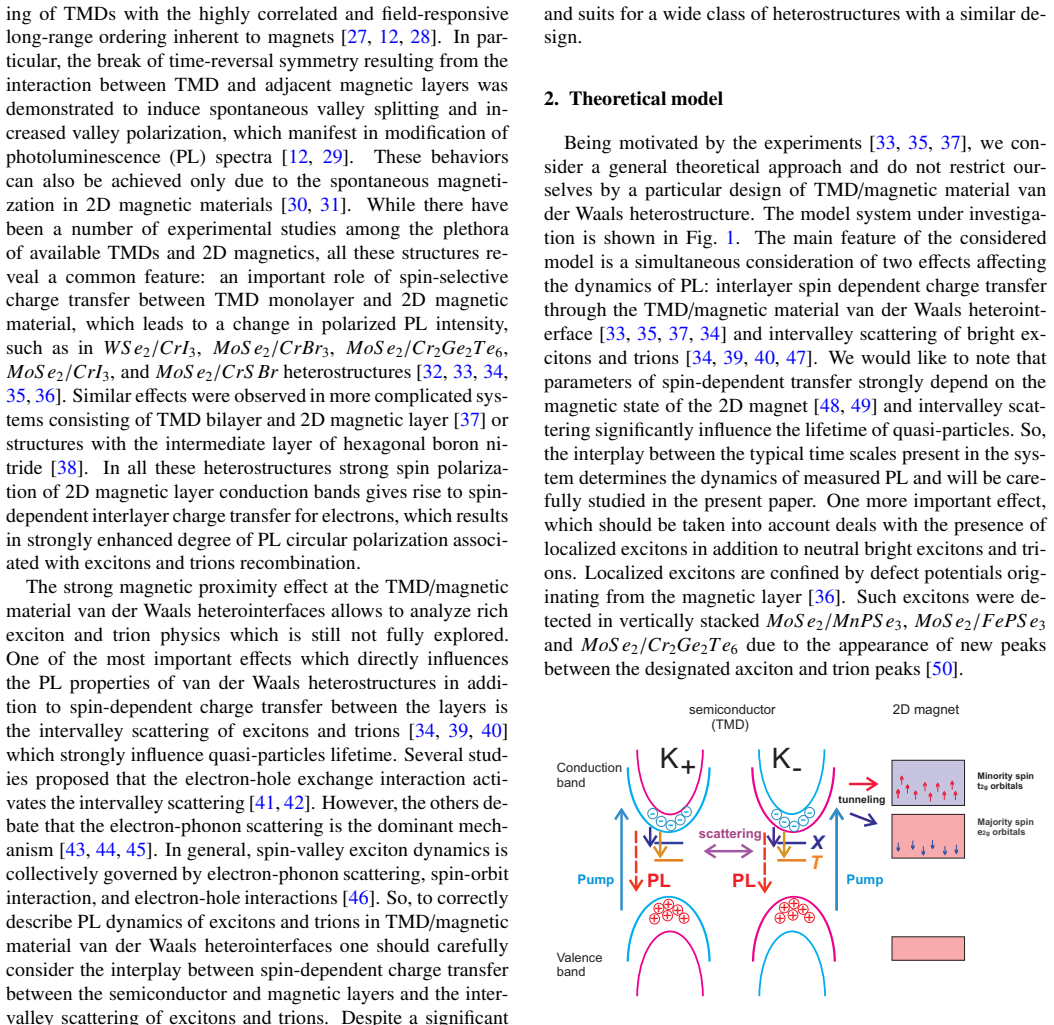


read the original abstract
We present a theoretical analysis of valley pseudospin control in the transition metal dichalcogenide (TMD) monolayer by utilizing the magnetic proximity effect of 2D magnetic layer and, propose self-consistent analysis of photoluminescence (PL) polarization peculiarities in TMD/magnetic material van der Waals heterostructures. We attribute observed peculiarities to the interplay between spin-dependent interlayer charge transfer and intervalley scattering of excitons and trions. The ratio between the electron tunneling timescale and the exciton and trion intervalley scattering lifetimes and radiative lifetimes determine the PL dynamics. A possibility to switch PL polarization sign due to the quasi-particles dynamics under circularly polarized laser excitations is revealed. We also discuss generalization of the proposed model due to the careful analysis of both intervalley and intravalley scattering processes between bright and dark excitons. Obtained results allow a long-distance manipulation of exciton and trion behaviors and open the possibilities for the effective control under spin and valley pseudospin in multilayer magnetic-semiconductor van der Waals heterostructures.
Editorial analysis
A structured set of objections, weighed in public.
Referee Report
Summary. The manuscript develops a rate-equation model for the population dynamics of bright and dark excitons and trions in TMD/magnetic-semiconductor van der Waals heterostructures. It incorporates spin-dependent interlayer tunneling, intervalley and intravalley scattering channels, and radiative recombination to explain photoluminescence (PL) polarization peculiarities. The central claim is that the ratio of the electron tunneling timescale to the exciton/trion intervalley scattering and radiative lifetimes governs the PL dynamics, with a predicted possibility of polarization sign reversal under circularly polarized excitation. The model is generalized to include both intervalley and intravalley processes and extended to multilayer structures for long-distance control of spin and valley pseudospin.
Significance. If the model's derivations and predictions hold, this work supplies a useful theoretical framework for valley pseudospin manipulation via magnetic proximity effects in 2D heterostructures. The self-consistent treatment of multiple scattering channels (bright/dark states, intra- and intervalley) and the explicit prediction of polarization sign switching constitute falsifiable, testable outcomes that could guide experiments in valleytronics. The absence of free parameters or ad-hoc entities in the construction, together with the direct derivation of the sign-switch from timescale ordering, strengthens the contribution.
minor comments (3)
- The notation and symbols for the various timescales (tunneling time, intervalley scattering lifetime, radiative lifetime) should be collected in a single table or clearly defined list early in the model section to improve readability.
- The manuscript refers to 'observed peculiarities' in PL polarization; adding a brief comparison (even qualitative) to one or two specific experimental datasets from the TMD/magnetic heterostructure literature would strengthen the attribution to the proposed interplay of processes.
- A schematic diagram illustrating the intervalley and intravalley scattering channels between bright and dark states would clarify the generalization discussed in the final section.
Simulated Author's Rebuttal
We thank the referee for the careful reading and positive assessment of our manuscript, including the accurate summary of the rate-equation model and the recommendation for minor revision. No specific major comments were raised that require point-by-point rebuttal.
Circularity Check
No significant circularity detected
full rationale
The manuscript constructs a self-consistent rate-equation model for exciton and trion populations that incorporates spin-dependent tunneling, intervalley/intravalley scattering, and bright/dark states. The claimed PL polarization dynamics and sign-reversal possibility are direct consequences of solving these equations once timescale orderings are posited; no parameter is shown to be fitted to the polarization data it is then said to predict, and no derivation step reduces to a self-citation or redefinition of its own inputs. The model remains predictive under its stated assumptions and is therefore self-contained against external benchmarks.
Axiom & Free-Parameter Ledger
Lean theorems connected to this paper
-
IndisputableMonolith/Cost/FunctionalEquation.leanwashburn_uniqueness_aczel unclear?
unclearRelation between the paper passage and the cited Recognition theorem.
We propose a general theoretical model which considers both the interlayer spin dependent charge transfer and intervalley scattering of excitons and trions... The ratio between the electron tunneling timescale and the exciton and trion intervalley scattering lifetimes and radiative lifetimes determine the PL dynamics.
-
IndisputableMonolith/Foundation/RealityFromDistinction.leanreality_from_one_distinction unclear?
unclearRelation between the paper passage and the cited Recognition theorem.
The model operates with parameters directly available from experimental measurements
What do these tags mean?
- matches
- The paper's claim is directly supported by a theorem in the formal canon.
- supports
- The theorem supports part of the paper's argument, but the paper may add assumptions or extra steps.
- extends
- The paper goes beyond the formal theorem; the theorem is a base layer rather than the whole result.
- uses
- The paper appears to rely on the theorem as machinery.
- contradicts
- The paper's claim conflicts with a theorem or certificate in the canon.
- unclear
- Pith found a possible connection, but the passage is too broad, indirect, or ambiguous to say the theorem truly supports the claim.
Reference graph
Works this paper leans on
-
[1]
A. K. Geim, I. V . Grigorieva, V an der waals het- erostructures, Nature 499 (2013) 419-425. URL: http://dx.doi.org/10.1038/nature12385. doi:10.1038/nature12385
-
[2]
J. F. Sierra, J. Fabian, R. K. Kawakami, S. Roche, S. O. V alenzuela, V an der waals heterostruc- tures for spintronics and opto-spintronics, Na- ture Nanotechnology 16 (2021) 856-868. URL: http://dx.doi.org/10.1038/s41565-021-00936-x . doi:10.1038/s41565-021-00936-x
-
[3]
S. Manzeli, D. Ovchinnikov, D. Pasquier, O. V . Y azyev, A. Kis, 2d transition metal dichalco- genides, Nature Reviews Materials 2 (2017). URL: http://dx.doi.org/10.1038/natrevmats.2017.33. doi:10.1038/natrevmats.2017.33
-
[4]
K. F. Mak, K. He, J. Shan, T. F. Heinz, Control of valley polarization in monolayer mos2 by optical helic- ity, Nature Nanotechnology 7 (2012) 494-498. URL: http://dx.doi.org/10.1038/nnano.2012.96. doi:10.1038/nnano.2012.96
-
[5]
Z. Y e, D. Sun, T. F. Heinz, Optical manipulation of valley pseudospin, Nature Physics 13 (2016) 26-
work page 2016
-
[6]
URL: http://dx.doi.org/10.1038/NPHYS3891. doi:10.1038/nphys3891
-
[7]
H. Zeng, J. Dai, W . Y ao, D. Xiao, X. Cui, V alley polarization in mos2 monolayers by optical pump- ing, Nature Nanotechnology 7 (2012) 490-493. URL: http://dx.doi.org/10.1038/nnano.2012.95. doi:10.1038/nnano.2012.95
-
[8]
G. Wang, A. Chernikov, M. M. Glazov, T. F. Heinz, X. Marie, T. Amand, B. Urbaszek, Colloquium : Excitons in atomically thin transition metal dichalco- genides, Reviews of Modern Physics 90 (2018). URL: http://dx.doi.org/10.1103/RevModPhys.90.021001. doi:10.1103/revmodphys.90.021001
-
[9]
D. MacNeill, C. Heikes, K. F. Mak, Z. Anderson, A. Kormanyos, V . Zolyomi, J. Park, D. C. Ralph, Breaking of valley degeneracy by magnetic field in mono- layer mose2, Physical Review Letters 114 (2015). URL: http://dx.doi.org/10.1103/PhysRevLett.114.037401. doi:10.1103/physrevlett.114.037401
-
[10]
N. S. Maslova, I. V . Rozhansky, V . N. Mantsevich, P . I. Arseyev, N. S. Averkiev, E. Lähderanta, Dynamic spin injection into a quantum well coupled to a spin- split bound state, Physical Review B 97 (2018). URL: http://dx.doi.org/10.1103/PhysRevB.97.195445. doi:10.1103/physrevb.97.195445
-
[11]
V . N. Mantsevich, I. V . Rozhansky, N. S. Maslova, P . I. Arseyev, N. S. Averkiev, E. Lähderanta, Mech- anism of ultrafast spin-polarization switching in nanostructures, Physical Review B 99 (2019). URL: http://dx.doi.org/10.1103/PhysRevB.99.115307. doi:10.1103/physrevb.99.115307
-
[12]
B. Scharf, G. Xu, A. Matos-Abiague, I. Zu- tic, Magnetic proximity e ffects in transition- metal dichalcogenides: Converting excitons, Physical Review Letters 119 (2017). URL: http://dx.doi.org/10.1103/PhysRevLett.119.127403. doi:10.1103/physrevlett.119.127403
-
[13]
D. Zhong, K. L. Seyler, X. Linpeng, R. Cheng, N. Sivadas, B. Huang, E. Schmidgall, T. Taniguchi, K. Watanabe, M. A. McGuire, W . Y ao, D. Xiao, K.-M. C. Fu, X. Xu, V an der waals engineering of ferromagnetic semiconductor heterostructures for spin and valleytronics, Science Advances 3 (2017). URL: http://dx.doi.org/10.1126/sciadv.1603113. doi:10.1126/scia...
-
[14]
B. Huang, G. Clark, D. R. Klein, D. MacNeill, E. Navarro- Moratalla, K. L. Seyler, N. Wilson, M. A. McGuire, D. H. Cobden, D. Xiao, W . Y ao, P . Jarillo-Herrero, X. Xu, Electrical control of 2d magnetism in bilayer cri3, Nature Nanotechnology 13 (2018) 544-548. URL: http://dx.doi.org/10.1038/s41565-018-0121-3 . doi:10.1038/s41565-018-0121-3
-
[15]
C. Gong, X. Zhang, Two-dimensional magnetic crystals and emergent heterostruc- ture devices, Science 363 (2019). URL: http://dx.doi.org/10.1126/science.aav4450. doi:10.1126/science.aav4450
-
[16]
K. S. Burch, D. Mandrus, J.-G. Park, Mag- netism in two-dimensional van der waals ma- terials, Nature 563 (2018) 47-52. URL: http://dx.doi.org/10.1038/s41586-018-0631-z . doi:10.1038/s41586-018-0631-z
-
[17]
M. Gibertini, M. Koperski, A. F. Morpurgo, K. S. Novoselov, Magnetic 2d materials and heterostructures, Nature Nanotechnology 14 (2019) 408-419. URL: 8 http://dx.doi.org/10.1038/s41565-019-0438-6 . doi:10.1038/s41565-019-0438-6
-
[18]
C. Gong, L. Li, Z. Li, H. Ji, A. Stern, Y . Xia, T. Cao, W . Bao, C. Wang, Y . Wang, Z. Q. Qiu, R. J. Cava, S. G. Louie, J. Xia, X. Zhang, Discov- ery of intrinsic ferromagnetism in two-dimensional van der waals crystals, Nature 546 (2017) 265-269. URL: http://dx.doi.org/10.1038/nature22060. doi:10.1038/nature22060
-
[19]
N. Sivadas, M. W . Daniels, R. H. Swendsen, S. Okamoto, D. Xiao, Magnetic ground state of semiconducting transition-metal trichalcogenide monolayers, Physical Review B 91 (2015). URL: http://dx.doi.org/10.1103/PhysRevB.91.235425. doi:10.1103/physrevb.91.235425
-
[20]
W .-B. Zhang, Q. Qu, P . Zhu, C.-H. Lam, Robust intrinsic ferromagnetism and half semiconductivity in stable two-dimensional single-layer chromium trihalides , Journal of Materials Chemistry C 3 (2015) 12457-12468. URL: http://dx.doi.org/10.1039/C5TC02840J. doi:10.1039/c5tc02840j
-
[21]
X. Wang, K. Du, Y . Y . Fredrik Liu, P . Hu, J. Zhang, Q. Zhang, M. H. S. Owen, X. Lu, C. K. Gan, P . Sengupta, C. Kloc, Q. Xiong, Raman spectroscopy of atomically thin two-dimensional magnetic iron phosphorus trisulfide ( f eps3) crystals, 2D Materials 3 (2016) 031009. URL: http://dx.doi.org/10.1088/2053-1583/3/3/031009. doi:10.1088/2053-1583/3/3/031009
-
[22]
M. Bonilla, S. Kolekar, Y . Ma, H. C. Diaz, V . Kalap- pattil, R. Das, T. Eggers, H. R. Gutierrez, M.-H. Phan, M. Batzill, Strong room-temperature ferromag- netism in vse2 monolayers on van der waals substrates, Nature Nanotechnology 13 (2018) 289-293. URL: http://dx.doi.org/10.1038/s41565-018-0063-9 . doi:10.1038/s41565-018-0063-9
-
[23]
D. J. OHara, T. Zhu, A. H. Trout, A. S. Ahmed, Y . K. Luo, C. H. Lee, M. R. Brenner, S. Rajan, J. A. Gupta, D. W . McComb, R. K. Kawakami, Room temperature intrinsic ferromagnetism in epi- taxial manganese selenide films in the monolayer limit, Nano Letters 18 (2018) 3125-3131. URL: http://dx.doi.org/10.1021/acs.nanolett.8b00683. doi:10.1021/acs.nanolett.8b00683
-
[24]
Z. Fei, B. Huang, P . Malinowski, W . Wang, T. Song, J. Sanchez, W . Y ao, D. Xiao, X. Zhu, A. F. May, W . Wu, D. H. Cobden, J.-H. Chu, X. Xu, Two- dimensional itinerant ferromagnetism in atomically thin f e3gete2, Nature Materials 17 (2018) 778-782. URL: http://dx.doi.org/10.1038/s41563-018-0149-7 . doi:10.1038/s41563-018-0149-7
-
[25]
X. Li, J. Y ang, crxte 3(x = si, ge) nanosheets: two dimensional intrinsic ferromagnetic semiconductors, Journal of Materials Chemistry C 2 (2014) 7071. URL: http://dx.doi.org/10.1039/C4TC01193G. doi:10.1039/c4tc01193g
-
[26]
D. I. Markina, P . Mondal, L. Krelle, S. Shradha, M. M. Glazov, R. von Klitzing, K. Mosina, Z. Sofer, B. Ur- baszek, Interplay of vibrational, electronic, and magneti c states in crsbr, npj Quantum Materials 11 (2026). URL: http://dx.doi.org/10.1038/s41535-026-00850-2 . doi:10.1038/s41535-026-00850-2
-
[27]
O. Göser, W . Paul, H. Kahle, Magnetic prop- erties of crsbr, Journal of Magnetism and Magnetic Materials 92 (1990) 129-136. URL: http://dx.doi.org/10.1016/0304-8853(90)90689-N. doi:10.1016/0304-8853(90)90689-n
-
[28]
X. Xu, W . Y ao, D. Xiao, T. F. Heinz, Spin and pseudospins in layered transition metal dichalco- genides, Nature Physics 10 (2014) 343-350. URL: http://dx.doi.org/10.1038/nphys2942. doi:10.1038/nphys2942
-
[29]
Q. Tong, M. Chen, W . Y ao, Magnetic prox- imity e ffect in a van der waals moire superlat- tice, Physical Review Applied 12 (2019). URL: http://dx.doi.org/10.1103/PhysRevApplied.12.024031. doi:10.1103/physrevapplied.12.024031
-
[30]
J. Choi, C. Lane, J.-X. Zhu, S. A. Crooker, Asymmetric magnetic proximity interactions in mose2/ crbr3 van der waals heterostructures, Nature Materials 22 (2022) 305-310. URL: http://dx.doi.org/10.1038/s41563-022-01424-w . doi:10.1038/s41563-022-01424-w
-
[31]
L. Ciorciaro, M. Kroner, K. Watanabe, T. Taniguchi, A. Imamoglu, Observation of magnetic proxim- ity e ffect using resonant optical spectroscopy of an electrically tunable mose2/ crbr3 heterostruc- ture, Physical Review Letters 124 (2020). URL: http://dx.doi.org/10.1103/PhysRevLett.124.197401. doi:10.1103/physrevlett.124.197401
-
[32]
K. L. Seyler, D. Zhong, B. Huang, X. Linpeng, N. P . Wilson, T. Taniguchi, K. Watanabe, W . Y ao, D. Xiao, M. A. McGuire, K.-M. C. Fu, X. Xu, V alley manipulation by optically tuning the mag- netic proximity e ffect in wse2/ cri3 heterostruc- tures, Nano Letters 18 (2018) 3823-3828. URL: http://dx.doi.org/10.1021/acs.nanolett.8b01105. doi:10.1021/acs.nanol...
-
[33]
D. Zhong, K. L. Seyler, X. Linpeng, N. P . Wilson, T. Taniguchi, K. Watanabe, M. A. McGuire, K.-M. C. Fu, D. Xiao, W . Y ao, X. Xu, Layer-resolved magnetic proximity e ffect in van der waals heterostructures, Nature Nanotechnology 15 (2020) 187-191. URL: http://dx.doi.org/10.1038/s41565-019-0629-1 . doi:10.1038/s41565-019-0629-1 . 9
-
[34]
T. P . Lyons, D. Gillard, A. Molina-Sanchez, A. Misra, F. Withers, P . S. Keatley, A. Kozikov, T. Taniguchi, K. Watanabe, K. S. Novoselov, J. Fernandez- Rossier, A. I. Tartakovskii, Interplay between spin proximity e ffect and charge-dependent exciton dy- namics in mose2/ crbr3 van der waals heterostruc- tures, Nature Communications 11 (2020). URL: http://...
-
[35]
T. Zhang, S. Zhao, A. Wang, Z. Xiong, Y . Liu, M. Xi, S. Li, H. Lei, Z. V . Han, F. Wang, Electrically and magnetically tunable valley polarization in monolayer mose2 proximitized by a 2d ferromagnetic semiconduc- tor, Advanced Functional Materials 32 (2022). URL: http://dx.doi.org/10.1002/adfm.202204779. doi:10.1002/adfm.202204779
-
[36]
G.-Y . Hong, S. Zhao, F. Jin, L. Liu, L. Y ang, Q. Zhang, M. Tan, K. Li, C. Hu, H.-B. Sun, L. Lin, Asym- metric valley polarization of excitons and trions in antiferromagnet-semiconductor mose2/ cri3 heterostruc- tures, ACS Nano 19 (2025) 34880-34889. URL: http://dx.doi.org/10.1021/acsnano.5c10756. doi:10.1021/acsnano.5c10756
-
[37]
X. Huang, Z. Song, Y . Gao, P . Gu, K. Watan- abe, T. Taniguchi, S. Y ang, Z. Chen, Y . Y e, In- trinsic localized excitons in mose2/ crsbr het- erostructure, Advanced Materials 37 (2024). URL: http://dx.doi.org/10.1002/adma.202413438. doi:10.1002/adma.202413438
-
[38]
W . Wu, M. Liu, J. Zhou, J. Li, Y . Zhang, F. Xu, X. Li, Y . Wu, Z. Wu, J. Kang, Chirality-dependent valley polarization in magnetic van der waals heterostructures via spin-selective charge trans- fer, Nano Letters 24 (2024) 6225-6232. URL: http://dx.doi.org/10.1021/acs.nanolett.4c00503. doi:10.1021/acs.nanolett.4c00503
-
[39]
J. Dang, T. Wu, S. Y an, K. Watanabe, T. Taniguchi, H. Lei, X.-X. Zhang, Electrical switching of spin-polarized light-emitting diodes based on a 2d cri3/ hbn/ wse2 het- erostructure, Nature Communications 15 (2024). URL: http://dx.doi.org/10.1038/s41467-024-51287-9 . doi:10.1038/s41467-024-51287-9
-
[40]
G. Kioseoglou, A. T. Hanbicki, M. Currie, A. L. Friedman, D. Gunlycke, B. T. Jonker, V alley po- larization and intervalley scattering in monolayer mos2, Applied Physics Letters 101 (2012) 221907. URL: http://dx.doi.org/10.1063/1.4768299. doi:10.1063/1.4768299
-
[41]
A. Surrente, L. Klopotowski, N. Zhang, M. Baranowski, A. A. Mitioglu, M. V . Ballottin, P . C. Christianen, D. Dumcenco, Y .-C. Kung, D. K. Maude, A. Kis, P . Plochocka, Intervalley scattering of interlayer ex- citons in a mos2/ mose2/ mos2 heterostructure in high magnetic field, Nano Letters 18 (2018) 3994-4000. URL: http://dx.doi.org/10.1021/acs.nanolett...
-
[42]
C. Mai, A. Barrette, Y . Y u, Y . G. Semenov, K. W . Kim, L. Cao, K. Gundogdu, Many-body e ffects in valleytronics: Direct measurement of valley lifetimes in single-layer mos2, Nano Letters 14 (2013) 202-
work page 2013
-
[43]
URL: http://dx.doi.org/10.1021/nl403742j. doi:10.1021/nl403742j
-
[44]
T. Y u, M. W . Wu, V alley depolarization due to intervalley and intravalley electron-hole exchange interactions in monolayer mos2, Physical Review B 89 (2014). URL: http://dx.doi.org/10.1103/PhysRevB.89.205303. doi:10.1103/physrevb.89.205303
-
[45]
A. Molina-Sanchez, D. Sangalli, L. Wirtz, A. Marini, Ab initio calculations of ultrashort carrier dynamics in two- dimensional materials: V alley depolarization in single- layer wse2, Nano Letters 17 (2017) 4549-4555. URL: http://dx.doi.org/10.1021/acs.nanolett.7b00175. doi:10.1021/acs.nanolett.7b00175
-
[46]
B. R. Carvalho, Y . Wang, S. Mignuzzi, D. Roy, M. Ter- rones, C. Fantini, V . H. Crespi, L. M. Malard, M. A. Pimenta, Intervalley scattering by acoustic phonons in two-dimensional mos2 revealed by double-resonance raman spectroscopy, Nature Communications 8 (2017). URL: http://dx.doi.org/10.1038/ncomms14670. doi:10.1038/ncomms14670
-
[47]
B. Miller, J. Lindlau, M. Bommert, A. Neumann, H. Y amaguchi, A. Holleitner, A. Högele, U. Wurstbauer, Tuning the fröhlich exciton-phonon scattering in mono- layer mos2, Nature Communications 10 (2019). URL: http://dx.doi.org/10.1038/s41467-019-08764-3 . doi:10.1038/s41467-019-08764-3
-
[48]
X. Jiang, Q. Zheng, Z. Lan, W . A. Saidi, X. Ren, J. Zhao, Real-time gw-bse investigations on spin- valley exciton dynamics in monolayer transition metal dichalcogenide, Science Advances 7 (2021). URL: http://dx.doi.org/10.1126/sciadv.abf3759. doi:10.1126/sciadv.abf3759
-
[49]
A. Bergmann-Iwe, S. Deb, K. Zollner, V . Schneidt, M. Hemaid, K. Watanabe, T. Taniguchi, R. Schwartz, J. Fabian, T. Korn, Effect of spin-dependent tunneling in a mose2/ cr2ge2te6 van der waals heterostructure on exciton and trion emission, Physical Review Applied 24 (2025). URL: http://dx.doi.org/10.1103/km88-dxsb. doi:10.1103/km88-dxsb
-
[50]
N. P . Wilson, K. Lee, J. Cenker, K. Xie, A. H. Dis- mukes, E. J. Telford, J. Fonseca, S. Sivakumar, C. Dean, T. Cao, X. Roy, X. Xu, X. Zhu, Interlayer electronic coupling on demand in a 2d magnetic semiconduc- tor, Nature Materials 20 (2021) 1657-1662. URL: 10 http://dx.doi.org/10.1038/s41563-021-01070-8 . doi:10.1038/s41563-021-01070-8
-
[51]
C. Serati de Brito, P . E. Faria Junior, T. S. Ghiasi, J. Ingla-A ynes, C. R. Rabahi, C. Cavalini, F. Dirn- berger, S. Manas-V alero, K. Watanabe, T. Taniguchi, K. Zollner, J. Fabian, C. Schüller, H. S. J. van der Zant, Y . G. Gobato, Charge transfer and asymmet- ric coupling of mose2 valleys to the magnetic order of crsbr, Nano Letters 23 (2023) 11073-11...
-
[52]
M. Onga, Y . Sugita, T. Ideue, Y . Nakagawa, R. Suzuki, Y . Motome, Y . Iwasa, Antiferromagnet- semiconductor van der waals heterostructures: Interlayer interplay of exciton with magnetic or- dering, Nano Letters 20 (2020) 4625-4630. URL: http://dx.doi.org/10.1021/acs.nanolett.0c01493. doi:10.1021/acs.nanolett.0c01493
-
[53]
V . M. Bermudez, D. S. McClure, Spectroscopic studies of the two-dimensional magnetic insulators chromium trichloride and chromium tribromide, Journal of Physics and Chemistry of Solids 40 (1979) 129-147. URL: http://dx.doi.org/10.1016/0022-3697(79)90030-1. doi:10.1016/0022-3697(79)90030-1
-
[54]
J. Dillon, H. Kamimura, J. Remeika, Magneto- optical properties of ferromagnetic chromium trihalides, Journal of Physics and Chem- istry of Solids 27 (1966) 1531-1549. URL: http://dx.doi.org/10.1016/0022-3697(66)90148-X. doi:10.1016/0022-3697(66)90148-x
-
[55]
S. Terres, L. Scalon, J. Brunner, D. Horneber, J. Düreth , S. Huang, T. Taniguchi, K. Watanabe, A. F. Nogueira, S. Höfling, S. Klembt, Y . V aynzof, A. Chernikov, Exciton di ffusion in two-dimentional chiral per- ovskites, Advanced Optical Materials 13 (2025). URL: http://dx.doi.org/10.1002/adom.202402606. doi:10.1002/adom.202402606
-
[56]
F. T. Rabouw, M. Kamp, R. J. A. van Dijk-Moes, D. R. Gamelin, A. F. Koenderink, A. Meijerink, D. V anmaekelbergh, Delayed exciton emis- sion and its relation to blinking in cdse quantum dots, Nano Letters 15 (2015) 7718-7725. URL: http://dx.doi.org/10.1021/acs.nanolett.5b03818. doi:10.1021/acs.nanolett.5b03818
-
[57]
A. A. Kurilovich, V . N. Mantsevich, K. J. Steven- son, A. V . Chechkin, V . V . Palyulin, Complex diffusion-based kinetics of photoluminescence in semiconductor nanoplatelets, Physical Chem- istry Chemical Physics 22 (2020) 24686-24696. URL: http://dx.doi.org/10.1039/d0cp03744c. doi:10.1039/d0cp03744c
-
[58]
A. A. Kurilovich, V . N. Mantsevich, Y . Mardoukhi, K. J. Stevenson, A. V . Chechkin, V . V . Palyulin, Non-markovian di ffusion of excitons in layered per- ovskites and transition metal dichalcogenides, Physical Chemistry Chemical Physics 24 (2022) 13941-13950. URL: http://dx.doi.org/10.1039/d2cp00557c. doi:10.1039/d2cp00557c
-
[59]
A. Steinho ff, E. Wietek, M. Florian, T. Schulz, T. Taniguchi, K. Watanabe, S. Zhao, A. Högele, F. Jahnke, A. Chernikov, Exciton-exciton interactions in van der waals heterobilayers, Physical Review X 14 (2024). URL: http://dx.doi.org/10.1103/PhysRevX.14.031025. doi:10.1103/physrevx.14.031025
-
[60]
N. Kumar, Q. Cui, F. Ceballos, D. He, Y . Wang, H. Zhao, Exciton-exciton annihilation in mose 2 monolayers, Physical Review B 89 (2014). URL: http://dx.doi.org/10.1103/PhysRevB.89.125427. doi:10.1103/physrevb.89.125427
-
[61]
H. Zhao, B. Dal Don, S. Moehl, H. Kalt, K. Ohkawa, D. Hommel, Spatiotemporal dynamics of quantum- well excitons, Physical Review B 67 (2003). URL: http://dx.doi.org/10.1103/PhysRevB.67.035306. doi:10.1103/physrevb.67.035306
-
[62]
O. P . Adejumobi, V . N. Mantsevich, V . V . Pa- lyulin, Di ffusion of fast and slow excitons with an exchange in quasi-two-dimensional sys- tems, Physical Review E 110 (2024). URL: http://dx.doi.org/10.1103/PhysRevE.110.054139. doi:10.1103/physreve.110.054139
-
[63]
N. S. Maslova, V . N. Mantsevich, P . I. Ar- seyev, Exciton transport in atomically flat het- erostructures: The appearance of negative dif- fusivity, Physical Review E 112 (2025). URL: http://dx.doi.org/10.1103/cbyp-h4kw. doi:10.1103/cbyp-h4kw
-
[64]
A. A. Kurilovich, V . N. Mantsevich, A. V . Chechkin, V . V . Palyulin, Negative di ffusion of excitons in quasi-two-dimensional systems, Physical Chem- istry Chemical Physics 26 (2024) 922-935. URL: http://dx.doi.org/10.1039/d3cp03521b. doi:10.1039/d3cp03521b
-
[65]
V . Korenev, I. Akimov, S. Zaitsev, V . Sapega, L. Langer, D. Y akovlev, Y . A. Danilov, M. Bayer, Dynamic spin polarization by orientation-dependent separation in a ferromagnet-semiconductor hy- brid, Nature Communications 3 (2012). URL: http://dx.doi.org/10.1038/ncomms1957. doi:10.1038/ncomms1957
-
[66]
J. Zipfel, K. Wagner, M. A. Semina, J. D. Ziegler, T. Taniguchi, K. Watanabe, M. M. Glazov, A. Chernikov, Electron recoil e ffect in electrically tunable Mose 2 monolayers, Physical Review B 105 (2022). URL: 11 http://dx.doi.org/10.1103/PhysRevB.105.075311. doi:10.1103/physrevb.105.075311
-
[67]
T. V enanzi, M. Cuccu, R. Perea-Causin, X. Sun, S. Brem, D. Erkensten, T. Taniguchi, K. Watanabe, E. Malic, M. Helm, S. Winnerl, A. Chernikov, Ul- trafast switching of trions in 2d materials by terahertz photons, Nature Photonics 18 (2024) 1344-1349. URL: http://dx.doi.org/10.1038/s41566-024-01512-0 . doi:10.1038/s41566-024-01512-0
-
[68]
K. Mourzidis, V . Jindal, M. Glazov, A. Balocchi, C. Robert, D. Lagarde, P . Renucci, L. Lombez, T. Taniguchi, K. Watanabe, T. Amand, S. Francoeur, X. Marie, Exciton formation in two-dimensional semiconductors, Physical Review X 15 (2025). URL: http://dx.doi.org/10.1103/66rj-jbqw. doi:10.1103/66rj-jbqw
-
[69]
F. Ceballos, Q. Cui, M. Z. Bellus, H. Zhao, Ex- citon formation in monolayer transition metal dichalcogenides, Nanoscale 8 (2016) 11681-11688. URL: http://dx.doi.org/10.1039/C6NR02516A. doi:10.1039/c6nr02516a
-
[70]
T. Cao, G. Wang, W . Han, H. Y e, C. Zhu, J. Shi, Q. Niu, P . Tan, E. Wang, B. Liu, J. Feng, V alley- selective circular dichroism of monolayer molybde- num disulphide, Nature Communications 3 (2012). URL: http://dx.doi.org/10.1038/ncomms1882. doi:10.1038/ncomms1882
-
[71]
D. Lagarde, L. Bouet, X. Marie, C. R. Zhu, B. L. Liu, T. Amand, P . H. Tan, B. Urbaszek, Carrier and polarization dynamics in monolayer mos2, Physical Review Letters 112 (2014). URL: http://dx.doi.org/10.1103/PhysRevLett.112.047401. doi:10.1103/physrevlett.112.047401
-
[72]
P . Merkl, F. Mooshammer, P . Steinleitner, A. Girnghuber, K.-Q. Lin, P . Nagler, J. Holler, C. Schüller, J. M. Lupton, T. Korn, S. Ovesen, S. Brem, E. Malic, R. Huber, Ultrafast transition between exciton phases in van der waals het- erostructures, Nature Materials 18 (2019) 691-696. URL: http://dx.doi.org/10.1038/s41563-019-0337-0 . doi:10.1038/s41563-0...
-
[73]
S. Das, A. Prakash, R. Salazar, J. Appen- zeller, Toward low-power electronics: Tun- neling phenomena in transition metal dichalco- genides, ACS Nano 8 (2014) 1681-1689. URL: http://dx.doi.org/10.1021/nn406603h. doi:10.1021/nn406603h
-
[74]
Z. Zhao, L. Ma, M. Men, W . Li, X. Wang, All two-dimensional van der waals magnetic tunnel- ing junctions, Applied Physics Reviews 12 (2025). URL: http://dx.doi.org/10.1063/5.0279573. doi:10.1063/5.0279573
-
[75]
C. R. Zhu, K. Zhang, M. Glazov, B. Urbaszek, T. Amand, Z. W . Ji, B. L. Liu, X. Marie, Exci- ton valley dynamics probed by kerr rotation in wse 2 monolayers, Physical Review B 90 (2014). URL: http://dx.doi.org/10.1103/PhysRevB.90.161302. doi:10.1103/physrevb.90.161302
-
[76]
E. Wietek, M. Florian, J. Göser, T. Taniguchi, K. Watanabe, A. Högele, M. M. Glazov, A. Stein- hoff, A. Chernikov, Nonlinear and negative e ffective diffusivity of interlayer excitons in moirefree heter- obilayers, Physical Review Letters 132 (2024). URL: http://dx.doi.org/10.1103/PhysRevLett.132.016202. doi:10.1103/physrevlett.132.016202
-
[77]
R. Bertoni, C. Nicholson, L. Waldecker, H. Hübener, C. Monney, U. De Giovannini, M. Puppin, M. Hoesch, E. Springate, R. Chapman, C. Ca- cho, M. Wolf, A. Rubio, R. Ernstorfer, Gener- ation and evolution of spin-, valley-, and layer- polarized excited carriers in inversion-symmetric wse2, Physical Review Letters 117 (2016). URL: http://dx.doi.org/10.1103/Ph...
-
[78]
F. Liu, Q. Li, X.-Y . Zhu, Direct determina- tion of momentum-resolved electron transfer in the photoexcited van der waals heterobilayer ws2/ mos2, Physical Review B 101 (2020). URL: http://dx.doi.org/10.1103/PhysRevB.101.201405. doi:10.1103/physrevb.101.201405. 12
discussion (0)
Sign in with ORCID, Apple, or X to comment. Anyone can read and Pith papers without signing in.