Recognition: no theorem link
Theory and Experiment of Chirality-induced Magnetic Nonreciprocity Manifested by Coupling Phase
Pith reviewed 2026-05-12 02:07 UTC · model grok-4.3
The pith
Field polarization maps onto the phase of complex coupling strengths to unify conventional and synthetic chirality in magnetic nonreciprocity.
A machine-rendered reading of the paper's core claim, the machinery that carries it, and where it could break.
Core claim
We establish a microscopic theoretical framework that maps field polarization onto the phase of a complex coupling strength and validate it with systematic experiments, thereby providing a consistent formalism that describes both conventional and synthetic chirality. The symmetry properties and unique features of synthetic chirality distinguish it from conventional nonreciprocal mechanisms.
What carries the argument
the mapping of electromagnetic field polarization onto the phase of a complex coupling strength between photons and magnons
If this is right
- Conventional chiral interactions generate nonreciprocity through structures that produce chiral electromagnetic fields.
- Synthetic chirality arises specifically from nontrivial phase accumulation during traveling-wave-mediated coupling.
- The single formalism covers both mechanisms and highlights distinct symmetry properties of the synthetic case.
- Nonreciprocity can be engineered by controlling either field polarization or coupling phase in magnonic and photonic devices.
Where Pith is reading between the lines
- The same phase-mapping idea might apply to other coupled wave systems such as acoustic or plasmonic resonators where phase accumulation creates effective chirality.
- Device designers could reduce reliance on bulky external magnets by engineering traveling-wave paths instead.
- Further tests in quantum regimes could check whether the phase mapping preserves coherence or introduces additional decoherence channels.
Load-bearing premise
The nontrivial phase accumulation in traveling-wave-mediated coupling systems can be directly mapped to field polarization to produce the observed nonreciprocity without unaccounted losses, higher-order effects, or material-specific details.
What would settle it
Measurements of transmission or reflection spectra in traveling-wave coupling devices where the propagation path length or wave speed is varied while holding polarization fixed, showing whether the nonreciprocity phase shift scales exactly as predicted by the polarization-to-coupling-phase map.
Figures








read the original abstract
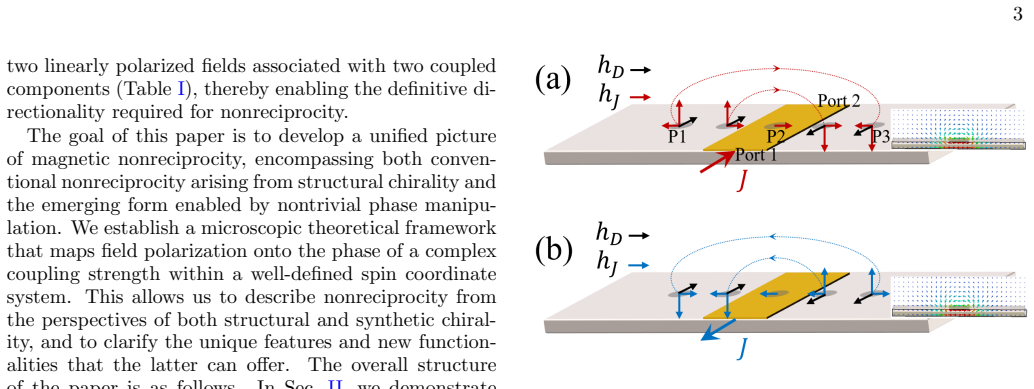
Magnetic interactions have long served as the most robust and widely used approach for realizing nonreciprocity, with an externally applied magnetic field breaking time-reversal symmetry (TRS) and chiral photon-magnon interactions introducing spatial asymmetry. In this work, we investigate the chirality mechanisms essential for magnetic nonreciprocity from a unified experimental and theoretical perspective. We begin by examining conventional chiral interactions that generate chiral electromagnetic fields through specially designed structures, and then place particular emphasis on synthetic chirality enabled by nontrivial phase accumulation in traveling-wave-mediated coupling systems. We establish a microscopic theoretical framework that maps field polarization onto the phase of a complex coupling strength and validate it with systematic experiments, thereby providing a consistent formalism that describes both conventional and synthetic chirality. Notably, we highlight the symmetry properties and the unique features of synthetic chirality that distinguish it from conventional nonreciprocal mechanisms.
Editorial analysis
A structured set of objections, weighed in public.
Referee Report
Summary. The manuscript develops a unified theoretical and experimental treatment of chirality-induced magnetic nonreciprocity in photon-magnon systems. It distinguishes conventional chirality (arising from geometrically structured electromagnetic fields) from synthetic chirality (arising from nontrivial phase accumulation in traveling-wave-mediated couplings), establishes a microscopic framework that maps field polarization directly onto the phase of a complex coupling strength, and reports systematic experiments that validate the formalism for both classes of chirality while highlighting their distinct symmetry properties.
Significance. If the central mapping holds under realistic conditions, the work supplies a consistent formalism that unifies two previously separate routes to nonreciprocity and could guide the design of compact, field-tunable nonreciprocal devices in magnonics and hybrid quantum systems. The experimental component strengthens the claim, but the overall significance is tempered by the need to demonstrate that the reported nonreciprocity is isolated from propagation losses and higher-order effects.
major comments (1)
- [Theoretical framework (mapping of polarization to coupling phase)] The microscopic framework equates the phase of the complex coupling strength directly to field polarization. The derivation must explicitly retain or bound the contributions of propagation loss, material damping, and multimode interference; otherwise the synthetic-chirality signature cannot be cleanly separated from conventional or extrinsic mechanisms. This assumption is load-bearing for the central claim that the observed nonreciprocity originates from the designed chirality.
minor comments (1)
- [Abstract] The abstract states that the framework is validated by 'systematic experiments' but supplies no information on the specific device geometry, frequency range, or measured observables; a single sentence summarizing these would improve accessibility.
Simulated Author's Rebuttal
We thank the referee for the detailed and constructive review of our manuscript. The major comment raises a valid point about the need for explicit bounds in the theoretical framework, which we will address directly in the revision to strengthen the separation of synthetic chirality from other effects.
read point-by-point responses
-
Referee: [Theoretical framework (mapping of polarization to coupling phase)] The microscopic framework equates the phase of the complex coupling strength directly to field polarization. The derivation must explicitly retain or bound the contributions of propagation loss, material damping, and multimode interference; otherwise the synthetic-chirality signature cannot be cleanly separated from conventional or extrinsic mechanisms. This assumption is load-bearing for the central claim that the observed nonreciprocity originates from the designed chirality.
Authors: We agree that explicit retention and bounding of these contributions is necessary to rigorously isolate the synthetic-chirality mechanism. Our microscopic derivation begins from the driven Maxwell equations for the photon-magnon system, where the complex coupling strength is obtained by projecting the electromagnetic field polarization onto the magnon mode; propagation loss and material damping enter through the imaginary parts of the permittivity and permeability. In the main text we presented the ideal mapping for conceptual clarity, but we acknowledge that the bounds were not stated explicitly. In the revised manuscript we will add a dedicated subsection (and supporting appendix) that retains the loss and damping terms throughout the derivation, derives the resulting correction to the coupling phase, and shows that this correction remains below 5% for the low-loss materials and short propagation lengths used in the experiments. For multimode interference we will include a modal decomposition based on the waveguide geometry, demonstrating that higher-order modes contribute negligibly to the phase accumulation under the operating conditions. These additions will make the separation from conventional and extrinsic mechanisms fully explicit while leaving the central conclusions unchanged. revision: yes
Circularity Check
No significant circularity; derivation is self-contained
full rationale
The paper derives a microscopic framework mapping field polarization to the phase of complex coupling strength and validates it experimentally. No quoted equations or sections reduce any central prediction to a fitted input by construction, self-definition, or load-bearing self-citation chain. The mapping is presented as a derived result with independent experimental checks, satisfying the criteria for a non-circular, self-contained derivation.
Axiom & Free-Parameter Ledger
axioms (1)
- domain assumption Magnetic interactions break time-reversal symmetry to enable nonreciprocity
Reference graph
Works this paper leans on
-
[1]
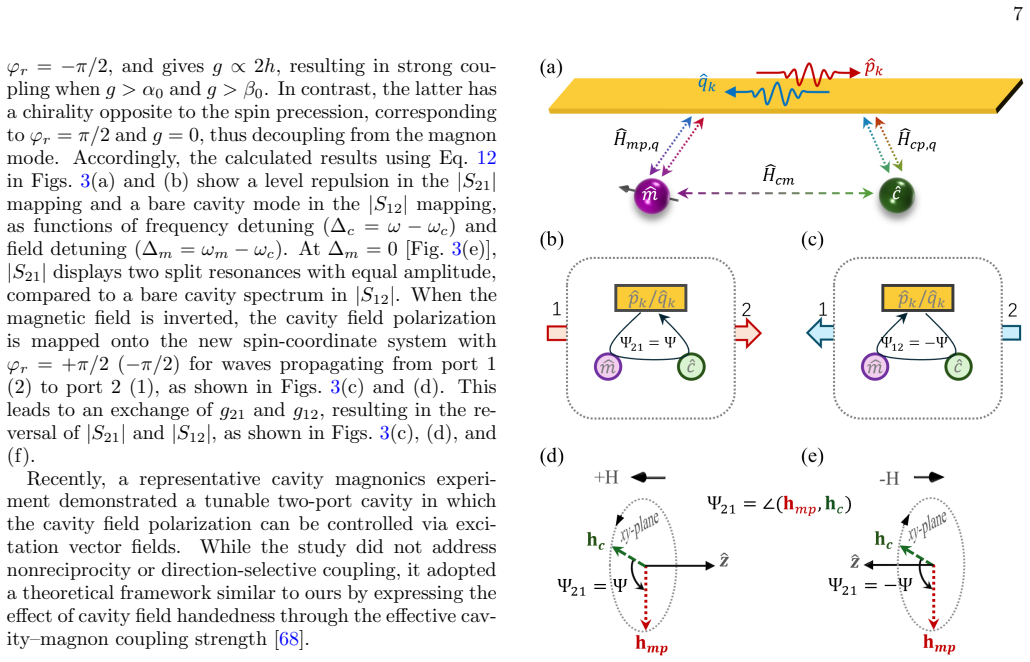
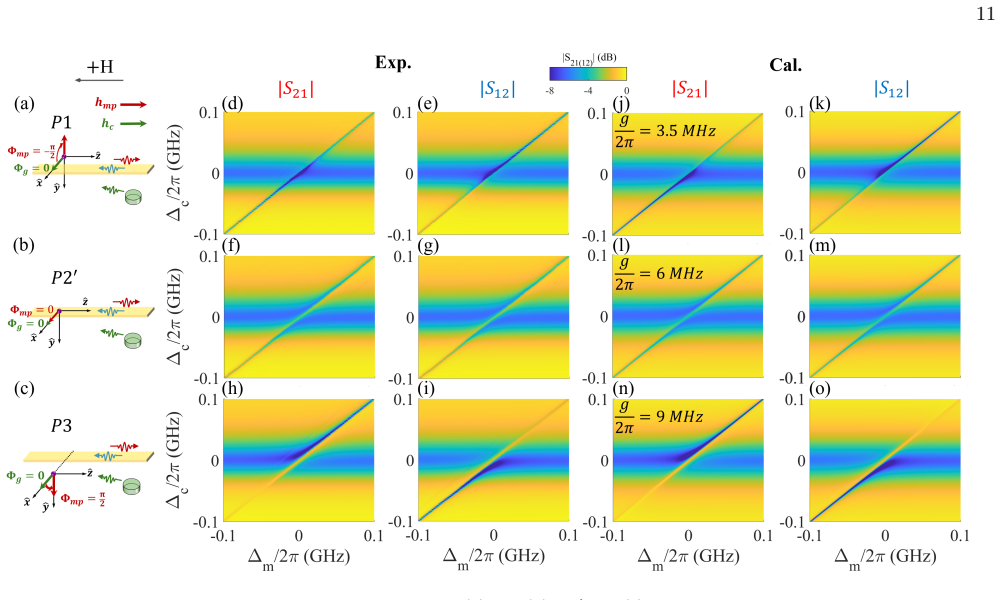
It means that the phase accu- mulated along the closed interaction loop involving the cavity, magnon, and traveling-wave modes is direction- dependent, with its sign reversed upon propagation re- versal, as shown in Figs. 4(b) and (c). This is physically attributed to the specific order of interactions within the closed coupling loop. In addition, synthet...
-
[2]
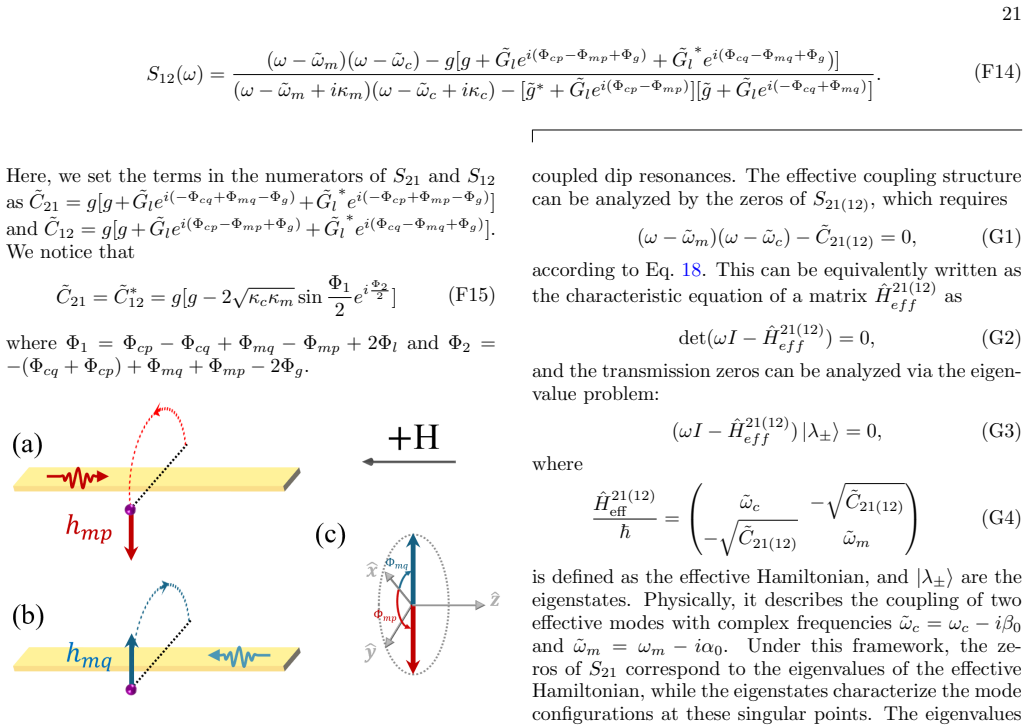
In Fig. 16(a), the original interaction Hamiltonian has two coupling loops, and these constraints lead to two gauge-invariant phases θ1 and θ2 in Fig. 16(b) under unitary transformation [54, 55]. Furthermore, by recombining the gauge-invariant phases as: Φ 1 = (θ2 − θ1)/2 = (Φcp − Φcq + Φmq − Φmp + 2Φl)/2 and Φ 2 = (θ2 + θ1)/2 = [ −(Φcq + Φcp) + Φmq + Φmp...
- [3]
-
[4]
A. Kord, D. L. Sounas, and A. Al` u, Microwave Nonre- ciprocity, Proc. IEEE 108, 1728 (2020)
work page 2020
-
[5]
S. Barzanjeh, A. Xuereb, A. Al` u, S. A. Mann, N. Nefed- kin, V. Peano, and P. Rabl, Nonreciprocity in Quantum Technology, arXiv:2508.03945
-
[6]
K. Fang, Z. Yu, and S. Fan, Realizing effective mag- netic field for photons by controlling the phase of dy- namic modulation, Nat. Photonics 6, 782 (2012)
work page 2012
-
[7]
N. A. Estep, D. L. Sounas, J. Soric, and A. Al` u, Magnetic-free non-reciprocity and isolation based on parametrically modulated coupled-resonator loops, Nat. Phys. 10, 923 (2014)
work page 2014
-
[8]
D. L. Sounas, and A. Al` u, Non-reciprocal photon- ics based on time modulation, Nat. Photonics 11, 774 (2017)
work page 2017
-
[9]
L. Fan, J. Wang, L. T. Varghese, H. Shen, B. Niu, Y. Xuan, A. M. Weiner, and M. Qi, An all-silicon pas- sive optical diode, Science 335, 447 (2012)
work page 2012
-
[10]
D. L. Sounas, J. Soric, and A. Al` u, Broadband pas- sive isolators based on coupled nonlinear resonances, Nat. Electron. 1, 113 (2018)
work page 2018
-
[11]
A. Rosario Hamann, C. M¨ uller, M. Jerger, M. Zanner, J. Combes, M. Pletyukhov, M. Weides, T. M. Stace, and A. Fedorov, Nonreciprocity Realized with Quantum Nonlinearity, Phys. Rev. Lett. 121, 123601 (2018)
work page 2018
-
[12]
B. Lax, and K. J. Button, Microwave ferrites and ferri- 25 magnetics (McGraw-Hill, New York, 1962)
work page 1962
- [13]
-
[14]
D. Nakamura, M.-K. Lee, K. Karube, M. Mochizuki, N. Nagaosa, Y. Tokura, and Y. Taguchi, Nonrecipro- cal transport in a room-temperature chiral magnet, Sci. Adv. 11, eadw8023 (2025)
work page 2025
-
[15]
K. Y. Bliokh, D. Smirnova, and F. Nori, Quantum spin Hall effect of light, Science 348, 1448 (2015)
work page 2015
-
[16]
T. Van Mechelen, and Z. Jacob, Universal spin- momentum locking of evanescent waves, Optica 3, 118 (2016)
work page 2016
-
[17]
T. Yu, Z. Luo, and G. E. W. Bauer, Chirality as gen- eralized spin-orbit interaction in spintronics, Phys. Rep. 1009, 1 (2023)
work page 2023
-
[18]
D. G. Su´ arez-Forero, M. Jalali Mehrabad, C. Vega, A. Gonz´ alez-Tudela, and M. Hafezi, Chiral Quantum Optics: Recent Developments and Future Directions, PRX Quantum 6, 020101 (2025)
work page 2025
-
[19]
C. P. Wen, Coplanar Waveguide: A Surface Strip Trans- mission Line Suitable for Nonreciprocal Gyromagnetic Device Applications, IEEE Trans. Microw. Theory Tech. 17, 1087 (1969)
work page 1969
-
[20]
M. E. Hines, Reciprocal and nonreciprocal modes of propagation in ferrite stripline and microstrip devices, IEEE Trans. Microw. Theory Tech. 19, 442 (1971)
work page 1971
-
[21]
T. M. F. Elshafiey, J. T. Aberle, and E.-B. El-Sharawy, Full wave analysis of edge-guided mode microstrip isola- tor, IEEE Trans. Microw. Theory Tech. 44, 2661 (1996)
work page 1996
- [22]
-
[23]
B. K. Kuanr, V. Veerakumar, R. Marson, S. R. Mishra, R. E. Camley, and Z. Celinski, Nonreciprocal microwave devices based on magnetic nanowires, Appl. Phys. Lett. 94, 202505 (2009)
work page 2009
-
[24]
I. S¨ ollner, S. Mahmoodian, S. L. Hansen, L. Midolo, A. Javadi, G. Kirˇ sansk˙ e, T. Pregnolato, H. El-Ella, E. H. Lee, J. D. Song, et al. , Deterministic photon–emitter coupling in chiral photonic circuits, Nat. Nanotechnol. 10, 775 (2015)
work page 2015
-
[25]
A. B. Young, A. C. T. Thijssen, D. M. Beggs, P. An- drovitsaneas, L. Kuipers, J. G. Rarity, S. Hughes, and R. Oulton, Polarization engineering in photonic crystal waveguides for spin-photon entanglers, Phys. Rev. Lett. 115, 153901 (2015)
work page 2015
-
[26]
J. Petersen, J. Volz, and A. Rauschenbeutel, Chiral nanophotonic waveguide interface based on spin–orbit in- teraction of light, Science 346, 67 (2014)
work page 2014
-
[27]
M. Xu, K. Yamamoto, J. Puebla, K. Baumgaertl, B. Rana, K. Miura, H. Takahashi, D. Grundler, S. Maekawa, and Y. Otani, Nonreciprocal surface acoustic wave propagation via magneto-rotation coupling, Sci. Adv. 6, eabb1724 (2020)
work page 2020
-
[28]
J. Wu, M. Li, X. Yang, S. Beguhn, and N. X. Sun, A novel tunable planar isolator with serrated microstrip structure, IEEE Trans. Magn. 48, 4371 (2012)
work page 2012
-
[29]
J. Qian, Q. Hong, Z.-Y. Wang, W.-X. Wu, Y. Yang, C.- M. Hu, J.-Q. You, and Y.-P. Wang, Unidirectional perfect absorption induced by chiral coupling in spin- momentum locked waveguide magnonics, Nat. Commun. 16, 8100 (2025)
work page 2025
-
[30]
R. Sun, K. S. Park, A. H. Comstock, A. McConnell, Y.- C. Chen, P. Zhang, D. Beratan, W. You, A. Hoffmann, Z.-G. Yu, et al., Inverse chirality-induced spin selectivity effect in chiral assemblies of π-conjugated polymers, Nat. Mater. 23, 782 (2024)
work page 2024
-
[31]
R. R. Riso, L. Grazioli, E. Ronca, T. Giovannini, and H. Koch, Strong coupling in chiral cavities: nonperturba- tive framework for enantiomer discrimination, Phys. Rev. X 13, 031002 (2023)
work page 2023
-
[32]
D. G. Su´ arez-Forero, D. W. Session, M. Jalali Mehrabad, P. Kn¨ uppel, S. Faelt, W. Wegscheider, and M. Hafezi, Spin-selective strong light–matter coupling in a 2D hole gas–microcavity system, Nat. Photonics 17, 912 (2023)
work page 2023
-
[33]
Z. Yuan, Y. Zhou, Z. Qiao, C. Eng Aik, W.-C. Tu, X. Wu, and Y.-C. Chen, Stimulated chiral light–matter interactions in biological microlasers, ACS Nano15, 8965 (2021)
work page 2021
-
[34]
P. Yang, M. Li, X. Han, H. He, G. Li, C.-L. Zou, P. Zhang, Y. Qian, and T. Zhang, Non-Reciprocal Cav- ity Polariton with Atoms Strongly Coupled to Optical Cavity, Laser Photonics Rev. 17, 2200574 (2023)
work page 2023
- [35]
-
[36]
L. Tang, J. Tang, W. Zhang, G. Lu, H. Zhang, Y. Zhang, K. Xia, and M. Xiao, On-chip chiral single-photon in- terface: Isolation and unidirectional emission, Phys. Rev. A 99, 043833 (2019)
work page 2019
-
[37]
W.-J. Gu, L. Wang, Z. Yi, and L.-H. Sun, Generation of nonreciprocal single photons in the chiral waveguide– cavity–emitter system, Phys. Rev. A106, 043722 (2022)
work page 2022
-
[38]
D. M. Lukin, M. A. Guidry, J. Yang, M. Ghezellou, S. Deb Mishra, H. Abe, T. Ohshima, J. Ul-Hassan, and J. Vuˇ ckovi´ c, Two-emitter multimode cavity quantum elec- trodynamics in thin-film silicon carbide photonics, Phys. Rev. X 13, 011005 (2023)
work page 2023
-
[39]
M. Ardisson, G. Bourcin, J. Haumant, R. Lebrun, I. Boventer, and V. Castel, Controllable Non- reciprocity in Multi-sphere Loaded Chiral Resonator, arXiv:2506.22230
- [40]
- [41]
- [42]
-
[43]
J. Bourhill, W. Yu, V. Vlaminck, G. E. W. Bauer, G. Ruoso, and V. Castel, Generation of circulating cav- ity magnon polaritons, Phys. Rev. Applied 19, 014030 (2023)
work page 2023
-
[44]
Y.-P. Wang, J. W. Rao, Y. Yang, P.-C. Xu, Y. S. Gui, B. M. Yao, J. Q. You, and C.-M. Hu, Nonreciprocity and unidirectional invisibility in cavity magnonics, Phys. Rev. Lett. 123, 127202 (2019)
work page 2019
-
[45]
J. Qian, J. W. Rao, Y. S. Gui, Y.-P. Wang, Z. H. An, and C.-M. Hu, Manipulation of the zero-damping conditions and unidirectional invisibility in cavity magnonics, Appl. Phys. Lett. 116, 192401 (2020). 26
work page 2020
-
[46]
Y. T. Zhao, J. W. Rao, Y. S. Gui, Y.-P. Wang, and C.-M. Hu, Broadband nonreciprocity realized by locally controlling the magnon’s radiation, Phys. Rev. Applied 14, 014035 (2020)
work page 2020
-
[47]
Y. Shi, C. Zhang, C. Jiang, C. K. Ong, and G. Chai, Mirror symmetric nonreciprocity and circular transmis- sion in cavity magnonics, Appl. Phys. Lett. 119, 132403 (2021)
work page 2021
-
[48]
Z.-Y. Wang, J. Qian, Y.-P. Wang, J. Li, and J. Q. You, Realization of the unidirectional amplification in a cavity magnonic system, Appl. Phys. Lett. 123, 153904 (2023)
work page 2023
-
[49]
J. Yao, C. Lu, X. Fan, D. Xue, G. E. Bridges, and C.- M. Hu, Nonreciprocal control of the speed of light using cavity magnonics, Phys. Rev. Lett. 134, 196904 (2025)
work page 2025
-
[50]
K. Fang, J. Luo, A. Metelmann, M. H. Matheny, F. Marquardt, A. A. Clerk, and O. Painter, Generalized non-reciprocity in an optomechanical circuit via synthetic magnetism and reservoir engineering, Nat. Phys. 13, 465 (2017)
work page 2017
-
[51]
Y. Chen, Y.-L. Zhang, Z. Shen, C.-L. Zou, G.-C. Guo, and C.-H. Dong, Synthetic gauge fields in a single op- tomechanical resonator, Phys. Rev. Lett. 126, 123603 (2021)
work page 2021
-
[52]
Y.-J. Lin, R. L. Compton, K. Jim´ enez-Garc´ ıa, J. V. Porto, and I. B. Spielman, Synthetic magnetic fields for ultracold neutral atoms, Nature 462, 628 (2009)
work page 2009
-
[53]
N. Goldman, G. Juzeli¯ unas, P.¨Ohberg, and I. B. Spiel- man, Light-induced gauge fields for ultracold atoms, Rep. Prog. Phys. 77, 126401 (2014)
work page 2014
-
[54]
P. Roushan, C. Neill, A. Megrant, Y. Chen, R. Bab- bush, R. Barends, B. Campbell, Z. Chen, B. Chiaro, A. Dunsworth, et al., Chiral ground-state currents of inter- acting photons in a synthetic magnetic field, Nat. Phys. 13, 146 (2017)
work page 2017
-
[55]
B. Z. Rameshti, S. V. Kusminskiy, J. A. Haigh, K. Usami, D. Lachance-Quirion, Y. Nakamura, C.-M. Hu, H. X. Tang, G. E. W. Bauer, and Y. M. Blanter, Cavity magnonics, Phys. Rep. 979, 1 (2022)
work page 2022
- [56]
- [57]
-
[58]
A. Metelmann, and A. A. Clerk, Nonreciprocal photon transmission and amplification via reservoir engineering, Phys. Rev. X 5, 021025 (2015)
work page 2015
-
[59]
T. Yu, X. Zhang, S. Sharma, Y. M. Blanter, and G. E. W. Bauer, Chiral coupling of magnons in waveg- uides, Phys. Rev. B 101, 094414 (2020)
work page 2020
-
[60]
J. O. Artman, and P. E. Tannenwald, Measurement of susceptibility tensor in ferrites, J. Appl. Phys. 26, 1124 (1955)
work page 1955
- [61]
-
[62]
Y. Tabuchi, S. Ishino, T. Ishikawa, R. Yamazaki, K. Usami, and Y. Nakamura, Hybridizing ferromagnetic magnons and microwave photons in the quantum limit, Phys. Rev. Lett. 113, 083603 (2014)
work page 2014
-
[63]
X. Zhang, C.-L. Zou, L. Jiang, and H. X. Tang, Strongly coupled magnons and cavity microwave photons, Phys. Rev. Lett. 113, 156401 (2014)
work page 2014
-
[64]
M. Goryachev, W. G. Farr, D. L. Creedon, Y. Fan, M. Kostylev, and M. E. Tobar, High-cooperativity cavity QED with magnons at microwave frequencies, Phys. Rev. Applied 2, 054002 (2014)
work page 2014
-
[65]
L. Bai, M. Harder, Y. P. Chen, X. Fan, J. Q. Xiao, and C.-M. Hu, Spin pumping in electrodynamically coupled magnon–photon systems, Phys. Rev. Lett. 114, 227201 (2015)
work page 2015
-
[66]
Y. Li, T. Polakovic, Y.-L. Wang, J. Xu, S. Lendinez, Z. Zhang, J. Ding, T. Khaire, H. Saglam, R. Divan, et al. , Strong coupling between magnons and microwave pho- tons in on-chip ferromagnet–superconductor thin-film de- vices, Phys. Rev. Lett. 123, 107701 (2019)
work page 2019
-
[67]
J. T. Hou, and L. Liu, Strong coupling between mi- crowave photons and nanomagnet magnons, Phys. Rev. Lett. 123, 107702 (2019)
work page 2019
-
[68]
W. Yu, T. Yu, and G. E. W. Bauer, Circulating cavity magnon polaritons, Phys. Rev. B 102, 064416 (2020)
work page 2020
-
[69]
J. Wang, and J. Xiao, Dynamic control of coupling regimes in oscillator systems via tunable open channels, Phys. Rev. B 111, 115425 (2025)
work page 2025
- [70]
-
[71]
K. Lalumi` ere, B. C. Sanders, A. F. van Loo, A. Fe- dorov, A. Wallraff, and A. Blais, Input–output theory for waveguide QED with an ensemble of inhomogeneous atoms, Phys. Rev. A 88, 043806 (2013)
work page 2013
-
[72]
A. F. van Loo, A. Fedorov, K. Lalumi` ere, B. C. Sanders, A. Blais, and A. Wallraff, Photon-mediated interac- tions between distant artificial atoms, Science 342, 1494 (2013)
work page 2013
- [73]
-
[74]
Y. Yang, J. W. Rao, Y. S. Gui, B. M. Yao, W. Lu, and C.-M. Hu, Control of the magnon–photon level attrac- tion in a planar cavity, Phys. Rev. Applied 11, 054023 (2019)
work page 2019
-
[75]
W. Yu, J. Wang, H. Y. Yuan, and J. Xiao, Prediction of attractive level crossing via a dissipative mode, Phys. Rev. Lett. 123, 227201 (2019)
work page 2019
-
[76]
B. Bhoi, B. Kim, S.-H. Jang, J. Kim, J. Yang, Y.-J. Cho, and S.-K. Kim, Abnormal anticrossing effect in photon– magnon coupling, Phys. Rev. B 99, 134426 (2019)
work page 2019
-
[77]
Y.-P. Wang, and C.-M. Hu, Dissipative couplings in cavity magnonics, J. Appl. Phys. 127, 130901 (2020)
work page 2020
- [78]
-
[79]
C. Lu, B. Turner, J. Yao, L. Zhong, M. Kim, Y. Yang, and C.-M. Hu, Temporal evolution of indirectly coupled resonators in open systems, Phys. Rev. B 112, 134309 (2025)
work page 2025
-
[80]
J. Wang, and J. Xiao, Interpreting S-parameter spectra in coupled resonant systems: the role of probing config- 27 urations, Opt. Express 33, 7146 (2025)
work page 2025
discussion (0)
Sign in with ORCID, Apple, or X to comment. Anyone can read and Pith papers without signing in.