Recognition: no theorem link
Nuclear charge radii of aluminium isotopes at the proton drip line
Pith reviewed 2026-05-12 02:47 UTC · model grok-4.3
The pith
Aluminium nuclei show a step-like increase in charge radius approaching the proton drip line, with nearly identical sizes for the two lightest isotopes.
A machine-rendered reading of the paper's core claim, the machinery that carries it, and where it could break.
Core claim
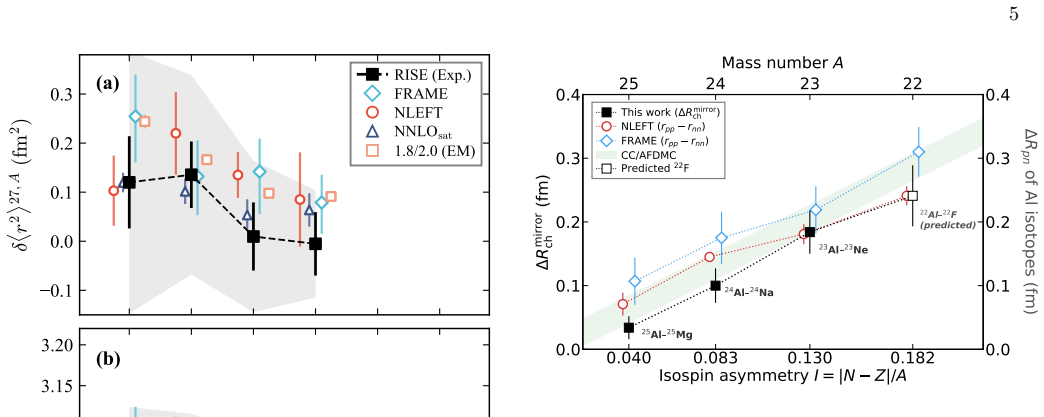
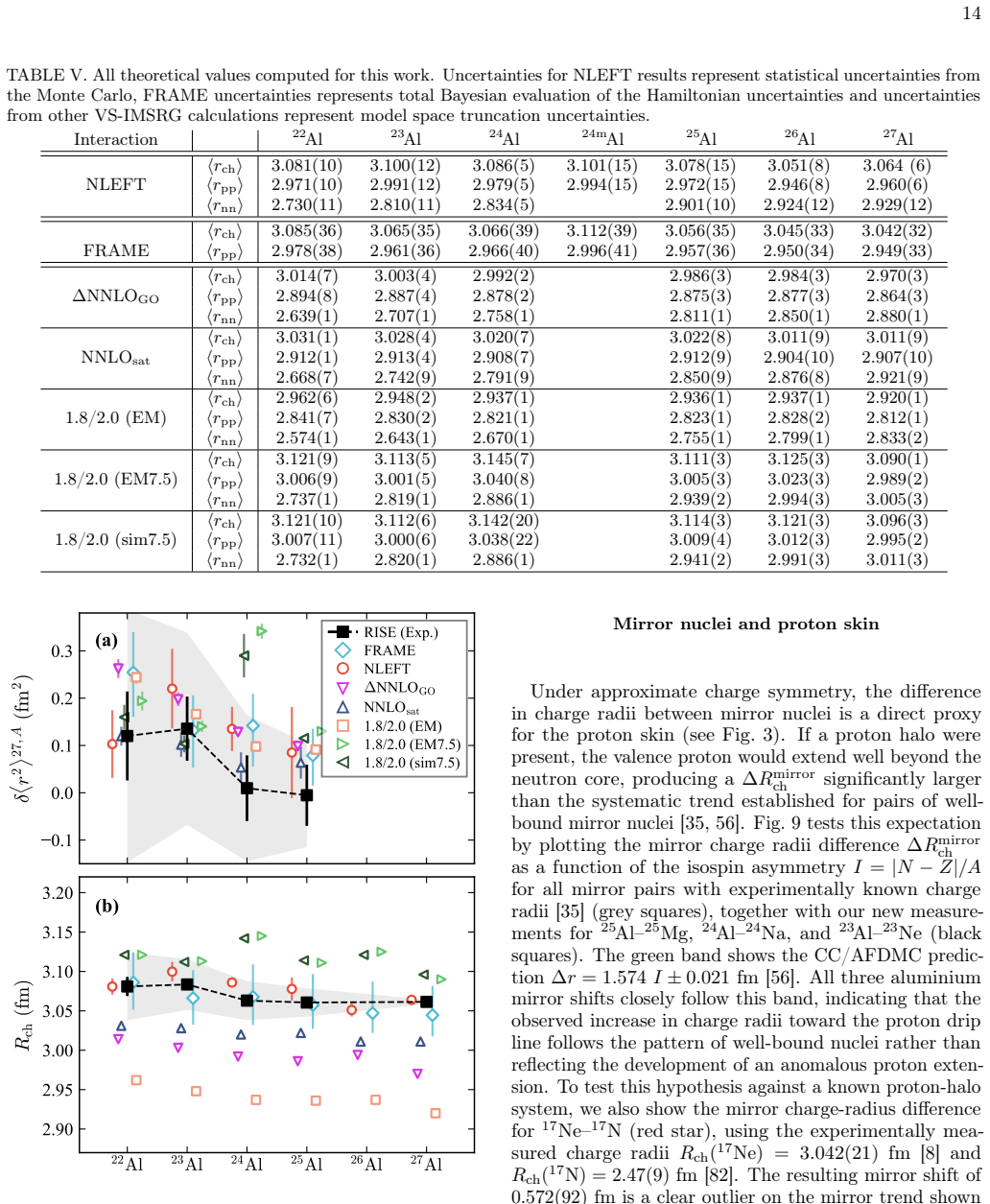
Our measurements reveal a step-like increase in charge radius toward the drip line, with similar radii for 22,23Al. A comparison of our results with those of their mirror partners reveals an almost identical correlation with the calculated proton skins and is consistent with the systematic trend of well-bound nuclei.
What carries the argument
Nuclear charge radii extracted from measured isotope shifts in resonance ionization laser spectra, which directly reflect the change in the spatial extent of the proton distribution.
If this is right
- Nuclear size changes abruptly rather than smoothly near the proton drip line in light nuclei.
- Mirror nuclei maintain closely correlated proton-skin effects even when one partner is weakly bound.
- Theoretical models must reproduce this step to describe nuclear structure at the drip line.
- The same trend that holds for well-bound nuclei continues to apply at the limits of existence.
Where Pith is reading between the lines
- The step may mark the point where proton-skin formation begins to dominate the charge distribution in light drip-line nuclei.
- Analogous measurements in neighboring isotopic chains could reveal whether the step-like pattern is general.
- The consistency with mirror trends suggests that electromagnetic observables remain predictable even for weakly bound systems.
- These radii supply a direct test for models that link binding energy to nuclear volume.
Load-bearing premise
The conversion from observed isotope shifts to charge radii for these short-lived, low-yield nuclei contains no large unaccounted systematic errors that could produce an artificial step.
What would settle it
An independent remeasurement of the isotope shift between 22Al and 23Al that finds a radius difference inconsistent with the reported step-like jump would falsify the central observation.
Figures





read the original abstract
Understanding the evolution of nuclear size away from stability remains a central challenge in nuclear physics. In neutron-deficient systems, charge radii can be highly sensitive to the interplay between strong and electromagnetic interactions, and the effects of weak binding, giving rise to exotic nuclear phenomena. However, experimental data on these systems has been limited by short lifetimes and low production rates. Here we report the first laser-spectroscopy measurements of nuclear charge radii along the neutron-deficient aluminium isotopic chain, from $^{25}$Al to the proton-drip-line nucleus $^{22}$Al, using the {Resonance Ionization Spectroscopy Experiment} (RISE) at the {Facility for Rare Isotope Beams} (FRIB). Our measurements reveal a step-like increase in charge radius toward the drip line, with similar radii for $^{22,\,23}$Al. A comparison of our results with those of their mirror partners reveals an almost identical correlation with the calculated proton skins and is consistent with the systematic trend of well-bound nuclei. These results offer insight for understanding the evolution of nuclear size at the proton dripline and place important constraints on modern nuclear theory. They also demonstrate the unique combined capabilities of RISE and FRIB to probe the structures of previously inaccessible nuclei at the limits of existence.
Editorial analysis
A structured set of objections, weighed in public.
Referee Report
Summary. The manuscript reports the first laser-spectroscopy measurements of nuclear charge radii for the neutron-deficient aluminum isotopes from 25Al to the proton-drip-line nucleus 22Al, performed with the RISE setup at FRIB. The central experimental result is a step-like increase in charge radius approaching the drip line, with 22Al and 23Al having essentially identical radii; these data are compared to mirror-partner radii and to calculated proton skins, showing consistency with the trend observed in well-bound nuclei.
Significance. If the radius extraction is free of significant unaccounted systematics, the measurements supply the first direct experimental constraints on charge-radius evolution at the proton drip line in the Al chain. This is valuable for testing modern nuclear-structure calculations that incorporate weak-binding and continuum effects. The work also demonstrates the technical reach of RISE+FRIB for low-yield exotic nuclei.
major comments (2)
- [Methods / Radius extraction] The extraction of δ⟨r²⟩ from the measured isotope shifts (via King-plot or equivalent procedure) assumes a fixed field-shift factor and negligible higher-order corrections. No explicit sensitivity analysis to variations in the electronic factor or inclusion of quadratic field-shift terms is presented; because the reported step-like feature between 23Al and 22Al is directly proportional to this conversion, even a 5–10 % shift in the factor could erase or fabricate the step. This is load-bearing for the headline claim.
- [Results / Error analysis] The manuscript provides no comprehensive uncertainty budget table that quantifies all statistical and systematic contributions (laser-frequency calibration, atomic parameters, production-rate effects, reference-isotope calibration). Without this, the statistical significance of the claimed similarity between 22Al and 23Al radii cannot be assessed.
minor comments (2)
- Add explicit references to prior charge-radius data on neighboring isotopes (e.g., Mg or Si chains) to place the new Al results in context.
- Ensure all figures display visible error bars and that the caption for the radius-vs-N plot clearly states the reference isotope used for the isotope-shift calibration.
Simulated Author's Rebuttal
We thank the referee for their thorough review and positive evaluation of the significance of our measurements. We address the major comments point by point below. We agree with the need for additional details on the radius extraction procedure and error analysis, and we will incorporate these into the revised manuscript.
read point-by-point responses
-
Referee: [Methods / Radius extraction] The extraction of δ⟨r²⟩ from the measured isotope shifts (via King-plot or equivalent procedure) assumes a fixed field-shift factor and negligible higher-order corrections. No explicit sensitivity analysis to variations in the electronic factor or inclusion of quadratic field-shift terms is presented; because the reported step-like feature between 23Al and 22Al is directly proportional to this conversion, even a 5–10 % shift in the factor could erase or fabricate the step. This is load-bearing for the headline claim.
Authors: We appreciate the referee's concern regarding the robustness of the radius extraction. The field-shift factor used in our analysis is derived from a King-plot analysis incorporating data from stable Al isotopes and literature values for the electronic factors, which are known to high precision. However, we acknowledge that an explicit sensitivity study was not presented in the original manuscript. In the revised version, we will add a sensitivity analysis showing the effect of varying the field-shift factor by ±5-10% on the extracted δ⟨r²⟩ values. We will demonstrate that the step-like increase and the near-equality of radii for 22Al and 23Al persist under these variations. Additionally, we will address the potential impact of quadratic field-shift terms, which are expected to be small for these isotopes based on theoretical estimates, and confirm they do not affect the main conclusions. revision: yes
-
Referee: [Results / Error analysis] The manuscript provides no comprehensive uncertainty budget table that quantifies all statistical and systematic contributions (laser-frequency calibration, atomic parameters, production-rate effects, reference-isotope calibration). Without this, the statistical significance of the claimed similarity between 22Al and 23Al radii cannot be assessed.
Authors: We agree that a consolidated uncertainty budget would enhance the transparency of our error analysis. Although the sources of uncertainty are described in the methods and results sections, we did not provide a single table summarizing all contributions. In the revised manuscript, we will include a comprehensive uncertainty budget table that breaks down the statistical and systematic uncertainties, including laser-frequency calibration, atomic parameters, production-rate effects, and reference-isotope calibration. This will enable a clear assessment of the precision and the significance of the observed similarity between the charge radii of 22Al and 23Al. revision: yes
Circularity Check
No significant circularity in experimental measurement paper
full rationale
This is a pure experimental paper reporting first laser-spectroscopy measurements of charge radii for neutron-deficient Al isotopes. The central claims are direct observational results (step-like increase, similar radii for 22,23Al, mirror-nucleus correlation) obtained via standard isotope-shift analysis. No theoretical derivations, first-principles predictions, or fitted parameters are presented as outputs that reduce by construction to the inputs. Extraction procedures follow established methods without self-referential loops or load-bearing self-citations that force the headline result. The paper is self-contained against external benchmarks as a measurement report.
Axiom & Free-Parameter Ledger
axioms (1)
- domain assumption Standard atomic-physics relations convert measured isotope shifts into nuclear charge radii.
Reference graph
Works this paper leans on
-
[1]
Yang, X. F., Wang, S. J., Wilkins, S. G. & Garcia Ruiz, R. F. Laser spectroscopy for the study of exotic nuclei. Prog. Part. Nucl. Phys.129, 104005 (2022)
work page 2022
-
[2]
Koszorús, A.et al.Charge radii of exotic potassium isotopes challenge nuclear theory and the magic character ofN= 32.Nature Phys.17, 439 (2021)
work page 2021
-
[3]
Garcia Ruiz, R. F.et al.Unexpectedly large charge radii of neutron-rich calcium isotopes.Nature Phys.12, 594–598 (2016)
work page 2016
-
[4]
Nature Phys.20, 1719–1725 (2024)
Karthein, J.et al.Electromagnetic properties of indium isotopes illuminate the doubly magic character of100Sn. Nature Phys.20, 1719–1725 (2024)
work page 2024
-
[5]
de Groote, R.et al.Measurement and microscopic de- scription of odd–even staggering of charge radii of exotic copper isotopes.Nature Phys.16, 620–624 (2020)
work page 2020
-
[6]
J.et al.Proton superfluidity and charge radii in proton-rich calcium isotopes.Nat
Miller, A. J.et al.Proton superfluidity and charge radii in proton-rich calcium isotopes.Nat. Phys.15, 432 (2019)
work page 2019
-
[7]
König, K.et al.Surprising charge-radius kink in the Sc isotopes at A = 20.Phys. Rev. Lett.131, 102501 (2023)
work page 2023
-
[8]
Geithner, W.et al.Masses and charge radii of 17−22Ne and the two-proton-halo candidate17Ne.Phys. Rev. Lett. 101, 252502 (2008)
work page 2008
-
[9]
Lu, Z.-T.et al.Colloquium: Laser probing of neutron-rich nuclei in light atoms.Rev. Mod. Phys.85, 1383–1400 (2013)
work page 2013
-
[10]
Tanihata, I.et al.Measurements of interaction cross sections and nuclear radii in the lightp-shell region.Phys. Rev. Lett.55, 2676 (1985)
work page 1985
-
[11]
Lin, Y. R., Wang, S. M. & Nazarewicz, W. Nuclear radii of proton-unbound systems.Phys. Rev. Lett.136, 122501 (2026)
work page 2026
-
[12]
Heylen, H.et al.High-resolution laser spectroscopy of 27−32Al.Phys. Rev. C103, 014318 (2021)
work page 2021
-
[13]
S.et al.Clarifying the N, Z = 14shells near the drip lines from the spectroscopy of 22Si and 21Al
Phillips, J. S.et al.Clarifying the N, Z = 14shells near the drip lines from the spectroscopy of 22Si and 21Al. Phys. Rev. Lett.135, 252501 (2025)
work page 2025
-
[14]
Lee, J.et al.Large Isospin Asymmetry in 22Si–22OMirror Gamow-Teller Transitions Reveals the Halo Structure of 22Al.Phys. Rev. Lett.125, 192503 (2020)
work page 2020
-
[15]
Z.et al.Existence of a proton halo in23Al and its significance.Phys
Cai, X. Z.et al.Existence of a proton halo in23Al and its significance.Phys. Rev. C65, 024610 (2002)
work page 2002
-
[16]
Kostyleva, D.et al.Observation and spectroscopy of the proton-unbound nucleus Al 21.Phys. Rev. C110, L031301 (2024)
work page 2024
-
[17]
E.et al.Precision Mass Measurement of the Proton Dripline Halo Candidate22Al.Phys
Campbell, S. E.et al.Precision Mass Measurement of the Proton Dripline Halo Candidate22Al.Phys. Rev. Lett. 132, 152501 (2024)
work page 2024
-
[18]
Sun, M.et al.Ground-state mass of 22Al and test of state-of-the-artab initiocalculations.Chin. Phys. C48, 034002 (2024)
work page 2024
- [19]
-
[20]
J.et al.Resonance Ionization Spectroscopy Experiment at Facility for Rare Isotope Beams.Phys
Brinson, A. J.et al.Resonance Ionization Spectroscopy Experiment at Facility for Rare Isotope Beams.Phys. Rev. Res.8, 013276 (2026)
work page 2026
-
[21]
Minamisono, K.et al.Commissioning of the collinear laser spectroscopy system in the BECOLA facility at NSCL. Nucl. Instrum. Methods Phys. Res., Sect. A709, 85–94 (2013)
work page 2013
-
[22]
Rossi, D. M.et al.A field programmable gate array-based time-resolved scaler for collinear laser spectroscopy with bunched radioactive potassium beams.Rev. Sci. Instrum. 85, 093503 (2014)
work page 2014
-
[23]
Schulz, C.et al.Resonance ionization spectroscopy on a fast atomic ytterbium beam.J. Phys. B24, 4831 (1991)
work page 1991
-
[24]
T.et al.Collinear resonance ionization spectroscopy of neutron-deficient francium isotopes.Phys
Flanagan, K. T.et al.Collinear resonance ionization spectroscopy of neutron-deficient francium isotopes.Phys. Rev. Lett.111, 212501 (2013)
work page 2013
-
[25]
R.et al.Online tests of the Advanced Cryogenic Gas Stopper at NSCL.Nucl
Lund, K. R.et al.Online tests of the Advanced Cryogenic Gas Stopper at NSCL.Nucl. Instrum. Methods Phys. Res., Sect. B463, 378–381 (2020)
work page 2020
-
[26]
R.et al.RFQ beam cooler and buncher for collinear laser spectroscopy of rare isotopes.Nucl
Barquest, B. R.et al.RFQ beam cooler and buncher for collinear laser spectroscopy of rare isotopes.Nucl. Instrum. Methods Phys. Res., Sect. A866, 18–28 (2017)
work page 2017
-
[27]
Klose, A.et al.Tests of atomic charge-exchange cells for collinear laser spectroscopy.Nucl. Instrum. Methods Phys. Res., Sect. A678, 114–121 (2012)
work page 2012
-
[28]
J.Investigating the Possible Halo Structure in 22Al and 23Al
Rickey, B. J.Investigating the Possible Halo Structure in 22Al and 23Al. Ph.D. dissertation, Michigan State Univer- sity (2025)
work page 2025
-
[29]
Rickey, B. J.et al.Hyperfine structures of4s,5 s, 2S1/2,3 p 2P1/2,3/2, and mixedndγ 2D3/2,5/2 states in 27Al I.Phys. Rev. A113, 042824 (2026)
work page 2026
-
[30]
Hausmann, M.et al.Design of the Advanced Rare Isotope Separator ARIS at FRIB., Nucl. Instrum. Methods Phys. Res., Sect. B317, 349 (2013)
work page 2013
-
[31]
König, K.et al.High voltage determination and stabi- lization for collinear laser spectroscopy applications.Rev. Sci. Instrum.95, 083307 (2024)
work page 2024
-
[32]
Portillo, M.et al.Commissioning of the Advanced Rare Isotope Separator ARIS at FRIB.Nucl. Instrum. Methods Phys. Res., Sect. B540, 151–157 (2023)
work page 2023
-
[33]
Dockery, A., Minamisono, K., Ortiz-Cortes, A. & Rickey, B. Spectral line-shape in collinear laser spectroscopy after atomic charge exchange.Spectrochim. Acta, Part B233, 107280 (2025)
work page 2025
-
[34]
Skripnikov, L. V.et al.Isotope-shift factors with quantum electrodynamics effects for many-electron systems: A study of the nuclear charge radius of26mAl.Phys. Rev. A 110, 012807 (2024)
work page 2024
-
[35]
Critical evaluation of reference charge radii and applications in mirror nuclei.At
Ohayon, B. Critical evaluation of reference charge radii and applications in mirror nuclei.At. Data Nucl. Data Tables165, 101732 (2025)
work page 2025
-
[36]
A Guided Tour ofab initio Nuclear Many- Body Theory.Front
Hergert, H. A Guided Tour ofab initio Nuclear Many- Body Theory.Front. Phys.8, 379 (2020)
work page 2020
-
[37]
Nuclear radii from first principles.Front
Miyagi, T. Nuclear radii from first principles.Front. Phys. 13, 1581854 (2025)
work page 2025
-
[38]
Epelbaum, E., Hammer, H.-W. & Meißner, U.-G. Modern theory of nuclear forces.Rev. Mod. Phys.81, 1773–1825 (2009)
work page 2009
-
[39]
Machleidt, R. & Entem, D. R. Chiral effective field theory and nuclear forces.Phys. Rep.503, 1–75 (2011). 8
work page 2011
-
[40]
Elhatisari, S.et al.Wavefunction matching for solving quantum many-body problems.Nature (London)630, 59–63 (2024). 2210.17488
-
[41]
Hergert, H., Bogner, S. K., Morris, T. D., Schwenk, A. & Tsukiyama, K. The In-Medium Similarity Renormaliza- tion Group: A Novel Ab Initio Method for Nuclei.Phys. Rep.621, 165–222 (2016)
work page 2016
-
[42]
Stroberg, S. R., Bogner, S. K., Hergert, H. & Holt, J. D. Nonempirical Interactions for the Nuclear Shell Model: An Update.Ann. Rev. Nucl. Part. Sci.69, 307–362 (2019)
work page 2019
-
[43]
Xu, Z. C., Shang, H. Y., Wang, S. M. & Ma, Y. G. Structure evolution of ground and excited states in the exotic nucleus22Al.arXiv:2602.01552(2026). 2602.01552
-
[44]
König, K.et al.Nuclear charge radii of silicon isotopes. Phys. Rev. Lett.132, 162502 (2024)
work page 2024
-
[45]
Ren, Z., Elhatisari, S. & Meißner, U.-G. Ab initio study of the radii of oxygen isotopes.Phys. Rev. Lett.135, 152502 (2025)
work page 2025
-
[46]
Hebeler, K., Bogner, S. K., Furnstahl, R. J., Nogga, A. & Schwenk, A. Improved nuclear matter calculations from chiral low-momentum interactions.Phys. Rev. C 83, 031301 (2011)
work page 2011
-
[47]
Ekström, A.et al.Accurate nuclear radii and binding energiesfromachiralinteraction.Phys. Rev. C91, 051301 (2015)
work page 2015
-
[48]
Jiang, W., Forssén, C., Djärv, T. & Hagen, G. Emulating ab initio computations of infinite nucleonic matter.Phys. Rev. C109, 064314 (2024)
work page 2024
-
[49]
Munoz, J. M.et al.Linking electromagnetic moments to nuclear interactions with a global physics-driven machine- learning emulator (2026). 2603.26905
-
[50]
Hagen, G.et al.Neutron and weak-charge distributions of the 48Ca nucleus.Nature Phys.12, 186–190 (2016)
work page 2016
-
[51]
Somà, V., Barbieri, C., Duguet, T. & Navrátil, P. Mov- ing away from singly-magic nuclei with Gorkov Green’s function theory.Eur. Phys. J. A57, 135 (2021)
work page 2021
-
[52]
Ohayon, B.et al.Nuclear charge radii of Na isotopes: Interplay of atomic and nuclear theory.Phys. Rev. C105, L031305 (2022)
work page 2022
-
[53]
Androić, D.et al.Determination of the 27Al Neutron Dis- tribution Radius from a Parity-Violating Electron Scat- tering Measurement.Phys. Rev. Lett.128, 132501 (2022)
work page 2022
-
[54]
Mirrorchargeradiiandtheneutronequation of state.Phys
Brown, B.A. Mirrorchargeradiiandtheneutronequation of state.Phys. Rev. Lett.119, 122502 (2017)
work page 2017
-
[55]
Yang, J. & Piekarewicz, J. Difference in proton radii of mirror nuclei as a possible surrogate for the neutron skin. Phys. Rev. C97, 014314 (2018)
work page 2018
-
[56]
J., Lonardoni, D., Gandolfi, S
Novario, S. J., Lonardoni, D., Gandolfi, S. & Hagen, G. Trends of neutron skins and radii of mirror nuclei from first principles.Phys. Rev. Lett.130, 032501 (2023)
work page 2023
-
[57]
Bendali, N., Duong, H. T., Juncar, P., Saint Jalm, J. M. & Vialle, J. L. Na+-Na charge exchange processes studied by collinear laser spectroscopy.J. Phys. B:At., Mol. Opt. Phys.19, 233 (1986)
work page 1986
-
[58]
König, K., Minamisono, K., Lantis, J., Pineda, S. & Powel, R. Beam energy determination via collinear laser spectroscopy.Phys. Rev. A103, 032806 (2021)
work page 2021
-
[59]
Huang, W. J., Wang, M., Kondev, F. G., Audi, G. & Naimi, S. The AME 2020 atomic mass evaluation (I). Evaluation of input data, and adjustment procedures. Chin. Phys. C45, 030002 (2021)
work page 2020
-
[60]
Honkanen, J., Kortelahti, M., Äystö, J., Eskola, K. & Hautojärvi, A. Decay of 24Al and 24Alm toγ-Ray and α-Particle Emitting States in 24Mg.Phys. Scr.19, 239 (1979)
work page 1979
-
[61]
König, K.et al.On the performance of wavelength meters: Part 2—frequency-comb based characterization for more accurate absolute wavelength determinations.Appl. Phys. B:Lasers Opt.126, 86– (2020)
work page 2020
-
[62]
Elhatisari, S.et al.Ab initio calculations of the isotopic dependence of nuclear clustering.Phys. Rev. Lett.119, 222505 (2017)
work page 2017
- [63]
-
[64]
Filin, A. A.et al.High-accuracy calculation of the deuteron charge and quadrupole form factors in chiral effective field theory.Phys. Rev. C103, 024313 (2021)
work page 2021
-
[65]
Lin, Y.-H., Hammer, H.-W. & Meißner, U.-G. New in- sights into the nucleon’s electromagnetic structure.Phys. Rev. Lett.128, 052002 (2022)
work page 2022
-
[66]
Tsukiyama, K., Bogner, S. K. & Schwenk, A. In-medium similarity renormalization group for open-shell nuclei. Phys. Rev. C85, 061304 (2012)
work page 2012
-
[67]
Bogner, S. K.et al.Nonperturbative shell-model inter- actions from the in-medium similarity renormalization group.Phys. Rev. Lett.113, 142501 (2014)
work page 2014
-
[68]
Stroberg, S. R., Hergert, H., Holt, J. D., Bogner, S. K. & Schwenk, A. Ground and excited states of doubly open- shell nuclei from ab initio valence-space Hamiltonians. Phys. Rev. C93, 051301(R) (2016)
work page 2016
-
[69]
R.et al.Nucleus-Dependent Valence-Space Approach to Nuclear Structure.Phys
Stroberg, S. R.et al.Nucleus-Dependent Valence-Space Approach to Nuclear Structure.Phys. Rev. Lett.118, 032502 (2017)
work page 2017
-
[70]
Shimizu, N., Mizusaki, T., Utsuno, Y. & Tsunoda, Y. Thick-restart block Lanczos method for large-scale shell- model calculations.Comput. Phys. Commun.244, 372– 384 (2019)
work page 2019
-
[71]
Friar, J. L., Martorell, J. & Sprung, D. W. L. Nuclear sizes and the isotope shift.Phys. Rev. A56, 4579 (1997). nucl-th/9707016
- [72]
- [73]
-
[74]
L.et al.Review of Particle Physics.Progr
Workman, R. L.et al.Review of Particle Physics.Progr. Theoret. Exp. Phys.2022, 083C01 (2022)
work page 2022
-
[75]
Miyagi, T., Stroberg, S. R., Navrátil, P., Hebeler, K. & Holt, J. D. Converged ab initio calculations of heavy nuclei.Phys. Rev. C105, 014302 (2022)
work page 2022
-
[76]
Simonis, J., Stroberg, S. R., Hebeler, K., Holt, J. D. & Schwenk, A. Saturation with chiral interactions and consequences for finite nuclei.Phys. Rev. C96, 014303 (2017)
work page 2017
-
[77]
Arthuis, P., Hebeler, K. & Schwenk, A. Neutron-rich nuclei and neutron skins from chiral low-resolution inter- actions (2024). 2401.06675
-
[78]
G.et al.Accurate bulk properties of nuclei from A = 2to ∞ from potentials with∆isobars.Phys
Jiang, W. G.et al.Accurate bulk properties of nuclei from A = 2to ∞ from potentials with∆isobars.Phys. Rev. C102, 054301 (2020)
work page 2020
-
[79]
Tews, I., Davoudi, Z., Ekström, A., Holt, J. D. & Lynn, J. E. New ideas in constraining nuclear forces.J. Phys. G47, 103001 (2020). 9
work page 2020
-
[80]
Cook, P., Jammooa, D., Hjorth-Jensen, M., Lee, D. D. et al.Parametric matrix models.Nat. Commun.16, 5929 (2025)
work page 2025
discussion (0)
Sign in with ORCID, Apple, or X to comment. Anyone can read and Pith papers without signing in.