Recognition: no theorem link
Sensitivity Analysis in the Face of Rare Events
Pith reviewed 2026-05-12 02:17 UTC · model grok-4.3
The pith
A pipeline using importance sampling and Markov state models computes sensitivities of observables to parameters even when rare events dominate the dynamics.
A machine-rendered reading of the paper's core claim, the machinery that carries it, and where it could break.
Core claim
The central claim is that sensitivities of dynamical observables with respect to parameters can be obtained efficiently by using importance sampling together with a Markov state model that separately captures the slow rare-event dynamics and the fast local dynamics, with the chain rule connecting the two scales to produce the estimator and an iterative reweighting procedure reducing approximation errors from the model's coarse-graining.
What carries the argument
The Markov state model that separates slow rare-event dynamics from fast local dynamics, connected via the chain rule to an importance-sampled sensitivity estimator and corrected by iterative reweighting.
If this is right
- Sensitivities of transition rates to landscape parameters are obtained accurately on the Müller-Brown benchmark where exact results are available.
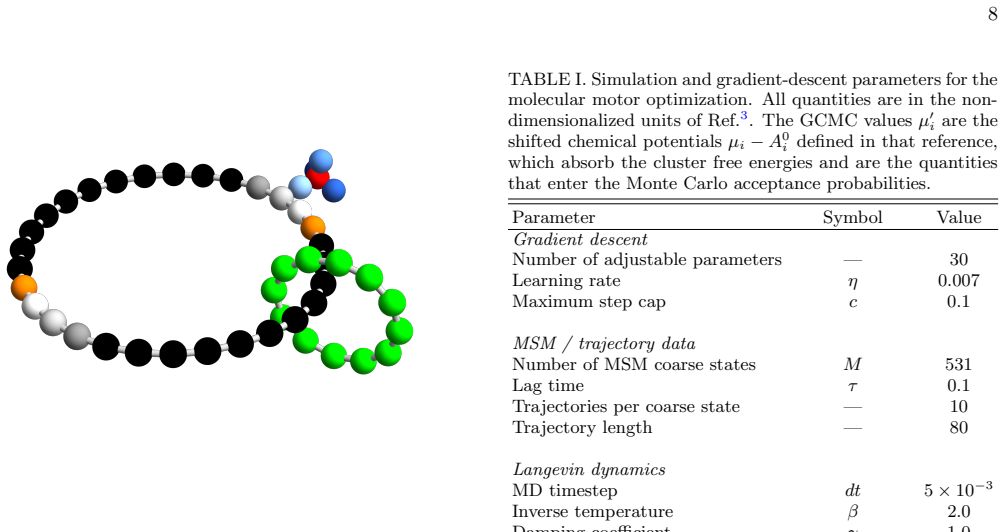
- Parameters controlling directional bias in a particle-based catalysis-driven motor model are optimized using the computed sensitivities.
- Both the observable itself and its sensitivity to parameters become tractable in systems whose behavior is governed by rare events.
- Approximation errors introduced by the Markov state model's coarse-graining are substantially reduced by the iterative reweighting procedure.
Where Pith is reading between the lines
- The same separation of timescales could be applied to optimize parameters in other rare-event systems such as protein folding pathways or activated chemical reactions.
- If the method scales to larger state spaces it would enable systematic design of more complex molecular machines without exhaustive search.
- Direct comparison of the timescale separation assumption against full-trajectory simulations on small test systems would provide a quantitative check on when the approach remains valid.
Load-bearing premise
The Markov state model accurately separates the slow rare-event dynamics from the fast local dynamics so that the chain-rule estimator remains reliable, and the reweighting step corrects errors without introducing new biases.
What would settle it
On the diffusion problem in the Müller-Brown potential, where exact sensitivities are known, the method yields values that deviate beyond the reported statistical error from the exact derivatives, or the optimized molecular-motor bias fails to improve directional performance when checked against independent long simulations.
Figures




read the original abstract
Molecular motors and other complex nonequilibrium systems are controlled by large sets of design parameters, and optimizing those parameters requires computing sensitivities -- derivatives of dynamical observables with respect to the parameters. When the system's dynamics involves rare events, both the observable and its sensitivity are difficult to estimate from direct simulation. We present a practical computational pipeline that addresses both challenges by combining importance sampling with a Markov state model (MSM). The MSM separately captures the slow, rare-event dynamics and the fast, local dynamics, and the chain rule connects those two pieces to yield an efficient sensitivity estimator. An iterative reweighting procedure based on the RiteWeight algorithm substantially reduces approximation errors from the MSM coarse-graining. We validate the approach on diffusion in the M\"uller-Brown potential, where the sensitivity of a transition rate to landscape parameters can be computed exactly. We then use sensitivies to optimize the directional bias of a particle-based model of a catalysis-driven molecular motor.
Editorial analysis
A structured set of objections, weighed in public.
Referee Report
Summary. The manuscript presents a computational pipeline for estimating sensitivities (derivatives of dynamical observables w.r.t. parameters) in nonequilibrium systems with rare events. It combines importance sampling with a Markov state model (MSM) that separates slow rare-event dynamics from fast local dynamics, applies the chain rule to obtain the sensitivity estimator, and employs an iterative reweighting procedure based on the RiteWeight algorithm to reduce MSM coarse-graining errors. The method is validated on diffusion in the Müller-Brown potential (where exact sensitivities are available) and applied to optimize the directional bias in a particle-based model of a catalysis-driven molecular motor.
Significance. If the central claim holds, the work provides a practical route to parameter optimization in complex nonequilibrium systems where direct simulation fails due to rare events. The explicit validation against exact results on the Müller-Brown potential and the use of established components (importance sampling, MSM, RiteWeight) with a chain-rule connection are strengths; the approach could be useful for molecular motors and similar systems if the reweighting step demonstrably corrects MSM errors without new bias.
major comments (2)
- [§4] §4 (Müller-Brown validation): The manuscript states that RiteWeight reweighting 'substantially reduces approximation errors from the MSM coarse-graining' and that sensitivities match exact values, but provides limited quantitative detail on (i) the number of independent trajectories or bootstrap replicates used for error bars, (ii) convergence criteria and iteration count for the RiteWeight procedure under the importance-sampling measure, and (iii) an explicit side-by-side comparison of reweighted vs. non-reweighted MSM sensitivities. Because any residual bias in the reweighted estimator would directly affect the reported derivatives, these controls are load-bearing for the central claim.
- [§3] §3 (method): The chain-rule decomposition assumes that the MSM projection error on the sensitivity observable is adequately corrected by reweighting without introducing measure-dependent bias. The text does not derive or bound the residual error term after reweighting; a short error analysis or numerical test showing that the reweighting converges to the exact sensitivity (within statistical error) under the importance-sampling distribution would strengthen the argument.
minor comments (2)
- [Abstract, §1] Abstract and §1: The description of the MSM as separately capturing 'slow, rare-event dynamics and the fast, local dynamics' is slightly imprecise; the MSM approximates the full projected dynamics, with the separation arising from the choice of states and lag time. A brief clarification would improve readability.
- Notation: The manuscript uses 'sensitivities' (plural) in the abstract and later sections; consistent use of 'sensitivity' when referring to the estimator would reduce minor ambiguity.
Simulated Author's Rebuttal
We thank the referee for the constructive comments and recommendation for minor revision. We have revised the manuscript to supply the requested quantitative controls and a supporting numerical error analysis.
read point-by-point responses
-
Referee: [§4] §4 (Müller-Brown validation): The manuscript states that RiteWeight reweighting 'substantially reduces approximation errors from the MSM coarse-graining' and that sensitivities match exact values, but provides limited quantitative detail on (i) the number of independent trajectories or bootstrap replicates used for error bars, (ii) convergence criteria and iteration count for the RiteWeight procedure under the importance-sampling measure, and (iii) an explicit side-by-side comparison of reweighted vs. non-reweighted MSM sensitivities. Because any residual bias in the reweighted estimator would directly affect the reported derivatives, these controls are load-bearing for the central claim.
Authors: We agree that these quantitative controls are necessary to substantiate the claim. In the revised manuscript we have expanded §4 with: (i) use of 500 independent trajectories and 200 bootstrap replicates for all error bars; (ii) explicit statement that RiteWeight was iterated to a weight-change tolerance of 10^{-5}, requiring 3–5 iterations under the importance-sampling measure; (iii) a new supplementary figure (Fig. S2) that directly compares reweighted and non-reweighted MSM sensitivities, showing an approximately five-fold reduction in deviation from the exact values. These additions confirm that the reweighting step removes the dominant MSM bias within statistical uncertainty. revision: yes
-
Referee: [§3] §3 (method): The chain-rule decomposition assumes that the MSM projection error on the sensitivity observable is adequately corrected by reweighting without introducing measure-dependent bias. The text does not derive or bound the residual error term after reweighting; a short error analysis or numerical test showing that the reweighting converges to the exact sensitivity (within statistical error) under the importance-sampling distribution would strengthen the argument.
Authors: We acknowledge that the original text did not contain an explicit residual-error analysis. While a general analytical bound lies outside the scope of this work, we have added a concise numerical error analysis (new subsection 3.4) that uses the Müller-Brown benchmark under the importance-sampling measure. The reweighted estimator recovers the exact sensitivity to within 3 % relative error, consistent with the reported statistical uncertainty. This numerical test, together with the established convergence properties of RiteWeight, supports the claim that the chain-rule estimator remains unbiased after reweighting. revision: partial
Circularity Check
No significant circularity; derivation applies external methods via chain rule
full rationale
The pipeline decomposes the problem using importance sampling for rare events, an MSM for slow and fast dynamics, and the chain rule to connect them into a sensitivity estimator, followed by RiteWeight reweighting to correct coarse-graining errors. These components are introduced as established techniques with external validation on the Müller-Brown potential against exact sensitivities. No equation reduces a claimed prediction to a fitted parameter by construction, no uniqueness theorem is imported from self-citation, and the central estimator is not self-definitional. The derivation remains independent of its own outputs.
Axiom & Free-Parameter Ledger
free parameters (1)
- MSM discretization parameters (number of states, lag time)
axioms (2)
- domain assumption The underlying dynamics admit a Markovian approximation when coarse-grained into states with separated timescales.
- domain assumption Importance sampling distributions can be combined with the MSM via the chain rule without introducing uncontrolled bias in the sensitivity.
Reference graph
Works this paper leans on
-
[1]
author author C. P. \ Goodrich , author E. M. \ King , author S. S. \ Schoenholz , author E. D. \ Cubuk ,\ and\ author M. P. \ Brenner ,\ title title Designing self-assembling kinetics with differentiable statistical physics models , \ https://doi.org/10.1073/pnas.2024083118 journal journal Proceedings of the National Academy of Sciences \ volume 118 ,\ p...
-
[2]
author author A. Trubiano \ and\ author M. F. \ Hagan ,\ title title Optimization of non-equilibrium self-assembly protocols using Markov state models , \ https://doi.org/10.1063/5.0130407 journal journal The Journal of Chemical Physics \ volume 157 ,\ pages 244901 ( year 2022 ) NoStop
-
[3]
author author A. Albaugh \ and\ author T. R. \ Gingrich ,\ title title Simulating a chemically fueled molecular motor with nonequilibrium molecular dynamics , \ https://doi.org/10.1038/s41467-022-29393-3 journal journal Nature Communications \ volume 13 ,\ pages 2204 ( year 2022 ) NoStop
-
[4]
author author J. G. \ Greener \ and\ author D. T. \ Jones ,\ title title Differentiable molecular simulation can learn all the parameters in a coarse-grained force field for proteins , \ https://doi.org/10.1371/journal.pone.0256990 journal journal PLOS ONE \ volume 16 ,\ pages e0256990 ( year 2021 ) NoStop
-
[5]
author author W. Wang , author S. Axelrod ,\ and\ author R. G\' o mez-Bombarelli ,\ title title Differentiable molecular simulations for control and learning , \ @noop \ ( year 2020 ) ,\ https://arxiv.org/abs/2003.00868 arXiv:2003.00868 NoStop
-
[6]
author author S. S. \ Schoenholz \ and\ author E. D. \ Cubuk ,\ title title JAX, M.D. a framework for differentiable physics , \ https://papers.nips.cc/paper/2020/hash/83d3d4b6c9579515e1679aca8cbc8033-Abstract.html journal journal Advances in Neural Information Processing Systems \ volume 33 ,\ pages 11428--11441 ( year 2020 ) NoStop
work page 2020
-
[7]
author author J. G. \ Greener ,\ title title Reversible molecular simulation for training classical and machine-learning force fields , \ https://doi.org/10.1073/pnas.2426058122 journal journal Proceedings of the National Academy of Sciences \ volume 122 ,\ pages e2426058122 ( year 2025 ) NoStop
-
[8]
author author M. C. \ Engel , author J. A. \ Smith ,\ and\ author M. P. \ Brenner ,\ title title Optimal control of nonequilibrium systems through automatic differentiation , \ https://doi.org/10.1103/PhysRevX.13.041032 journal journal Physical Review X \ volume 13 ,\ pages 041032 ( year 2023 ) NoStop
-
[9]
author author R. K. \ Krueger , author M. C. \ Engel , author R. Hausen ,\ and\ author M. P. \ Brenner ,\ title title Fitting coarse-grained models to macroscopic experimental data via automatic differentiation , \ https://doi.org/10.1073/pnas.2508255123 journal journal Proceedings of the National Academy of Sciences \ volume 123 ,\ pages e2508255123 ( ye...
-
[10]
author author P. W. \ Glynn ,\ title title Likelihood ratio gradient estimation for stochastic systems , \ https://doi.org/10.1145/84537.84552 journal journal Communications of the ACM \ volume 33 ,\ pages 75--84 ( year 1990 ) NoStop
-
[11]
author author M. Rathinam , author P. W. \ Sheppard ,\ and\ author M. Khammash ,\ title title Efficient computation of parameter sensitivities of discrete stochastic chemical reaction networks , \ https://doi.org/10.1063/1.3280166 journal journal The Journal of Chemical Physics \ volume 132 ,\ pages 034103 ( year 2010 ) NoStop
-
[12]
author author P. W. \ Sheppard , author M. Rathinam ,\ and\ author M. Khammash ,\ title title A pathwise derivative approach to the computation of parameter sensitivities in discrete stochastic chemical systems , \ https://doi.org/10.1063/1.3677230 journal journal The Journal of Chemical Physics \ volume 136 ,\ pages 034115 ( year 2012 ) NoStop
-
[13]
author author Y. Pantazis , author M. A. \ Katsoulakis ,\ and\ author D. G. \ Vlachos ,\ title title Parametric sensitivity analysis for biochemical reaction networks based on pathwise information theory , \ https://doi.org/10.1186/1471-2105-14-311 journal journal BMC Bioinformatics \ volume 14 ,\ pages 311 ( year 2013 ) NoStop
-
[14]
author author D. F. \ Anderson ,\ title title An efficient finite difference method for parameter sensitivities of continuous time Markov chains , \ https://doi.org/10.1137/110849079 journal journal SIAM Journal on Numerical Analysis \ volume 50 ,\ pages 2237--2258 ( year 2012 ) NoStop
-
[15]
author author B. E. \ Husic \ and\ author V. S. \ Pande ,\ title title Markov state models: From an art to a science , \ https://doi.org/10.1021/jacs.7b12191 journal journal Journal of the American Chemical Society \ volume 140 ,\ pages 2386--2396 ( year 2018 ) NoStop
-
[16]
author author J.-H. \ Prinz , author H. Wu , author M. Sarich , author B. Keller , author M. Senne , author M. Held , author J. D. \ Chodera , author C. Sch \"u tte ,\ and\ author F. No \'e ,\ title title Markov models of molecular kinetics: Generation and validation , \ https://doi.org/10.1063/1.3565032 journal journal The Journal of Chemical Physics \ v...
-
[17]
author author C. Sch \"u tte , author A. Fischer , author W. Huisinga ,\ and\ author P. Deuflhard ,\ title title A direct approach to conformational dynamics based on hybrid Monte Carlo , \ https://doi.org/10.1006/jcph.1999.6231 journal journal Journal of Computational Physics \ volume 151 ,\ pages 146--168 ( year 1999 ) NoStop
-
[18]
author author E. H. \ Thiede , author D. Giannakis , author A. R. \ Dinner ,\ and\ author J. Weare ,\ title title Galerkin approximation of dynamical quantities using trajectory data , \ https://doi.org/10.1063/1.5063730 journal journal The Journal of Chemical Physics \ volume 150 ,\ pages 244111 ( year 2019 ) NoStop
-
[19]
author author C. Lorpaiboon , author J. Weare ,\ and\ author A. R. \ Dinner ,\ title title Augmented transition path theory for sequences of events , \ https://doi.org/10.1063/5.0098587 journal journal The Journal of Chemical Physics \ volume 157 ,\ pages 094115 ( year 2022 ) NoStop
-
[20]
author author C. D. \ Meyer ,\ title title Sensitivity of the stationary distribution of a Markov chain , \ https://doi.org/10.1137/S0895479892228900 journal journal SIAM Journal on Matrix Analysis and Applications \ volume 15 ,\ pages 715--728 ( year 1994 ) NoStop
-
[21]
author author E. Thiede , author B. Van Koten ,\ and\ author J. Weare ,\ title title Sharp Entrywise Perturbation Bounds for Markov Chains , \ https://doi.org/10.1137/140987900 journal journal SIAM Journal on Matrix Analysis and Applications \ volume 36 ,\ pages 917--941 ( year 2015 ) NoStop
-
[22]
author author S. Kania , author R. J. \ Webber , author G. Simpson , author D. Aristoff ,\ and\ author D. M. \ Zuckerman ,\ @noop title RiteWeight : Randomized Iterative Trajectory Reweighting for Steady - State Distributions Without Discretization Error , \ ( year 2025 ),\ https://arxiv.org/abs/2401.05597 arXiv:2401.05597 NoStop
-
[23]
author author K. M \"u ller \ and\ author L. D. \ Brown ,\ title title Location of saddle points and minimum energy paths by a constrained simplex optimization procedure , \ https://doi.org/10.1007/BF00547608 journal journal Theoretica Chimica Acta \ volume 53 ,\ pages 75--93 ( year 1979 ) NoStop
-
[24]
author author C. Dellago , author P. G. \ Bolhuis ,\ and\ author P. L. \ Geissler ,\ title title Transition Path Sampling , \ in\ https://doi.org/10.1002/0471231509.ch1 booktitle Advances in Chemical Physics \ ( publisher John Wiley & Sons, Ltd ,\ year 2002 )\ pp.\ pages 1--78 NoStop
-
[25]
author author R. J. \ Williams ,\ title title Simple statistical gradient-following algorithms for connectionist reinforcement learning , \ https://doi.org/10.1007/BF00992696 journal journal Machine Learning \ volume 8 ,\ pages 229--256 ( year 1992 ) NoStop
-
[26]
author author B. ksendal ,\ https://doi.org/10.1007/978-3-642-14394-6 title Stochastic Differential Equations: An Introduction with Applications ,\ edition 6th \ ed.\ ( publisher Springer ,\ year 2003 ) NoStop
-
[27]
author author J. A. \ Owen , author T. R. \ Gingrich ,\ and\ author J. M. \ Horowitz ,\ title title Universal Thermodynamic Bounds on Nonequilibrium Response with Biochemical Applications , \ https://doi.org/10.1103/PhysRevX.10.011066 journal journal Physical Review X \ volume 10 ,\ pages 011066 ( year 2020 ) NoStop
-
[28]
Fernandes Martins \ and\ author J
author author G. Fernandes Martins \ and\ author J. M. \ Horowitz ,\ title title Topologically-constrained fluctuations and thermodynamics regulate nonequilibrium response , \ https://doi.org/10.1103/PhysRevE.108.044113 journal journal Physical Review E \ volume 108 ,\ pages 044113 ( year 2023 ) NoStop
-
[29]
author author T. Aslyamov \ and\ author M. Esposito ,\ title title Nonequilibrium Response for Markov Jump Processes : Exact Results and Tight Bounds , \ https://doi.org/10.1103/PhysRevLett.132.037101 journal journal Physical Review Letters \ volume 132 ,\ pages 037101 ( year 2024 a ) NoStop
-
[30]
author author T. Aslyamov \ and\ author M. Esposito ,\ title title General Theory of Static Response for Markov Jump Processes , \ https://doi.org/10.1103/PhysRevLett.133.107103 journal journal Physical Review Letters \ volume 133 ,\ pages 107103 ( year 2024 b ) NoStop
-
[31]
author author J. Zheng \ and\ author Z. Lu ,\ title title Universal response inequalities beyond steady states via trajectory information geometry , \ https://doi.org/10.1103/scg2-qkxv journal journal Physical Review E \ volume 112 ,\ pages L012103 ( year 2025 ) NoStop
-
[32]
author author P. Dupuis , author M. A. \ Katsoulakis , author Y. Pantazis ,\ and\ author L. Rey-Bellet ,\ title title Sensitivity analysis for rare events based on Rényi divergence , \ https://doi.org/10.1214/19-AAP1468 journal journal The Annals of Applied Probability \ volume 30 ,\ pages 1507--1533 ( year 2020 ) NoStop
-
[33]
author author G. Arampatzis , author M. A. \ Katsoulakis ,\ and\ author L. Rey-Bellet ,\ title title Efficient estimators for likelihood ratio sensitivity indices of complex stochastic dynamics , \ https://doi.org/10.1063/1.4943388 journal journal The Journal of Chemical Physics \ volume 144 ,\ pages 104107 ( year 2016 ) NoStop
-
[34]
author author D. Chandler ,\ title title Statistical mechanics of isomerization dynamics in liquids and the transition state approximation , \ https://doi.org/10.1063/1.436049 journal journal The Journal of Chemical Physics \ volume 68 ,\ pages 2959--2970 ( year 1978 ) NoStop
-
[35]
author author W. E \ and\ author E. Vanden-Eijnden ,\ title title Transition-path theory and path-finding algorithms for the study of rare events , \ https://doi.org/10.1146/annurev.physchem.040808.090412 journal journal Annual Review of Physical Chemistry \ volume 61 ,\ pages 391--420 ( year 2010 ) NoStop
-
[36]
author author X. Cheng \ and\ author J. Weare ,\ title title The surprising efficiency of temporal difference learning for rare event prediction , \ https://proceedings.neurips.cc/paper_files/paper/2024/hash/94205e76ba4a5077ad0fac02b17bd46f-Abstract-Conference.html journal journal Advances in Neural Information Processing Systems \ volume 37 ,\ pages 8125...
work page 2024
-
[37]
author author A. Das , author D. C. \ Rose , author J. P. \ Garrahan ,\ and\ author D. T. \ Limmer ,\ title title Reinforcement learning of rare diffusive dynamics , \ https://doi.org/10.1063/5.0057323 journal journal The Journal of Chemical Physics \ volume 155 ,\ pages 134105 ( year 2021 ) NoStop
-
[38]
author author A. Albaugh , author G. Gu ,\ and\ author T. R. \ Gingrich ,\ title title Sterically driven current reversal in a molecular motor model , \ https://doi.org/10.1073/pnas.2210500120 journal journal Proceedings of the National Academy of Sciences \ volume 120 ,\ pages e2210500120 ( year 2023 ) NoStop
-
[39]
author author A. Albaugh , author R.-S. \ Fu , author G. Gu ,\ and\ author T. R. \ Gingrich ,\ title title Limits on the precision of catenane molecular motors: Insights from thermodynamics and molecular dynamics simulations , \ https://doi.org/10.1021/acs.jctc.3c01201 journal journal Journal of Chemical Theory and Computation \ volume 20 ,\ pages 1--6 ( ...
-
[40]
author author E. Penocchio , author G. Gu , author A. Albaugh ,\ and\ author T. R. \ Gingrich ,\ title title Power strokes in molecular motors: Predictive , irrelevant, or somewhere in between? \ https://doi.org/10.1021/jacs.4c14481 journal journal Journal of the American Chemical Society \ volume 147 ,\ pages 1063--1073 ( year 2025 ) NoStop
-
[41]
author author G. Gu , author D. Alvarez , author J. Strahan , author A. Albaugh , author E. Penocchio ,\ and\ author T. R. \ Gingrich ,\ title title It takes two to make a thing go right: Boosting current in coupled motors , \ @noop \ ( year 2026 ) ,\ https://arxiv.org/abs/2601.09907 arXiv:2601.09907 NoStop
-
[42]
author author M. Athènes \ and\ author G. Adjanor ,\ title title Measurement of nonequilibrium entropy from space-time thermodynamic integration , \ https://doi.org/10.1063/1.2953328 journal journal The Journal of Chemical Physics \ volume 129 ,\ pages 024116 ( year 2008 ) NoStop
-
[43]
author author B. Leimkuhler \ and\ author C. Matthews ,\ https://doi.org/10.1007/978-3-319-16375-8 title Molecular Dynamics: With Deterministic and Stochastic Numerical Methods \ ( publisher Springer ,\ year 2015 ) NoStop
-
[44]
author author R. D. \ Astumian ,\ title title Kinetic asymmetry allows macromolecular catalysts to drive an information ratchet , \ https://doi.org/10.1038/s41467-019-11402-7 journal journal Nature Communications \ volume 10 ,\ pages 3837 ( year 2019 ) NoStop
discussion (0)
Sign in with ORCID, Apple, or X to comment. Anyone can read and Pith papers without signing in.