Recognition: 2 theorem links
· Lean TheoremProbing In-Solid Proton Energy Distributions in Laser-Driven Fusion via Nuclear Activation Diagnostics
Pith reviewed 2026-05-12 02:41 UTC · model grok-4.3
The pith
Nuclear activation inside solid targets reconstructs the energy distribution of trapped protons in laser-driven fusion.
A machine-rendered reading of the paper's core claim, the machinery that carries it, and where it could break.
Core claim
Absolute yields of ^{11}C and ^{7}Be generated via ^{11}B(p,n)^{11}C and ^{10}B(p,α)^{7}Be reactions inside the solid target are used to reconstruct an exponential-equivalent in-solid proton energy distribution; a side-channel analysis of the same data set then determines the absolute number of ^{11}B(p,2α)^{4}He reactions with propagated cross-section uncertainties.
What carries the argument
Nuclear activation reactions ^{11}B(p,n)^{11}C and ^{10}B(p,α)^{7}Be serve as internal probes whose measured product yields encode the in-solid proton flux and allow inversion to the energy distribution.
If this is right
- Absolute reaction rates for proton-boron fusion inside the target become directly measurable from activation data.
- Diagnostics no longer need to correct for plasma-field distortions on escaping ions to obtain in-target conditions.
- Energy deposition models for high-intensity laser fusion can be validated against internal proton distributions rather than external proxies.
Where Pith is reading between the lines
- The same activation approach could be adapted to other solid-fuel mixtures to extract ion distributions in different fusion schemes.
- Combining activation yields with time-resolved data might allow monitoring of how the proton spectrum evolves during a single shot.
- Target designs could be optimized by using the inferred distributions to predict and maximize nonthermal reaction yields.
Load-bearing premise
The proton energy distribution inside the solid can be represented accurately as an exponential-equivalent form and the observed activation products are produced solely by those protons without significant interference from plasma fields or other unaccounted processes.
What would settle it
A measurement or simulation of the actual in-solid proton spectrum that deviates substantially from the reconstructed exponential form, or activation yields that cannot be accounted for by the inferred proton flux alone, would show the method is not recovering the correct distribution.
Figures
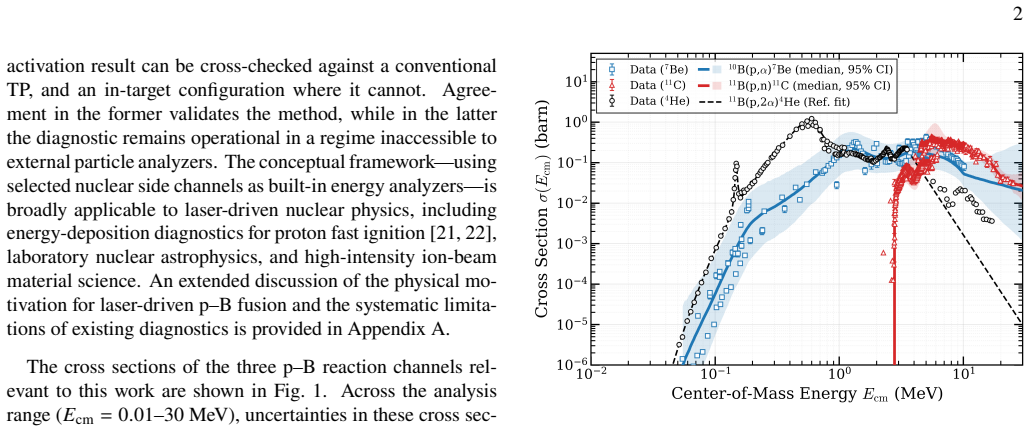


read the original abstract
The energy distribution of energetic protons inside a solid target is a key quantity governing nuclear reaction yields and energy deposition in high-intensity laser-driven fusion, including nonthermal proton--boron (p--B) schemes and proton fast ignition. Yet it has remained inaccessible to conventional particle diagnostics, which detect only ions escaping the target and are perturbed by intense plasma electromagnetic fields. Here we establish a quantitative diagnostic that uses nuclear activation reactions occurring within the target itself as an internal probe of the in-solid proton energy distribution. Applied to laser-driven p--B fusion experiments on the kJ-class laser, the method reconstructs an exponential-equivalent in-solid proton energy distribution from the absolute yields of $^{11}\mathrm{C}$ and $^{7}\mathrm{Be}$ produced via $\mathrm{^{11}B(p,n)^{11}C}$ and $\mathrm{^{10}B(p,\alpha)^{7}Be}$, and yields the absolute number of $\mathrm{^{11}B(p,2\alpha)^{4}He}$ reactions through a side-channel analysis with propagated cross-section uncertainties. This work opens a quantitative window onto the in-solid proton dynamics that drive nuclear reactions in laser-driven fusion experiments.
Editorial analysis
A structured set of objections, weighed in public.
Referee Report
Summary. The manuscript presents a diagnostic method to reconstruct the in-solid proton energy distribution in laser-driven p-B fusion experiments by fitting an exponential-equivalent spectrum to the absolute yields of ^{11}C and ^{7}Be produced via ^{11}B(p,n)^{11}C and ^{10}B(p,α)^{7}Be reactions. It then uses this distribution in a side-channel analysis to determine the absolute number of ^{11}B(p,2α)^{4}He fusion reactions, propagating cross-section uncertainties.
Significance. If validated, the approach offers a valuable internal probe for proton distributions and reaction yields inside solid targets, which are inaccessible to conventional escaping-ion diagnostics due to plasma fields. This could meaningfully advance quantitative understanding of laser-driven fusion, including p-B schemes. The use of activation products as an in-target diagnostic is a clear strength.
major comments (2)
- [Abstract and method description] The central reconstruction (abstract and method description) fits an exponential-equivalent form to only two activation yields whose cross sections have different energy dependences. This determines the two parameters but provides no test against alternative spectra (e.g., power-law or cutoff Maxwellian modified by stopping); any deviation introduces systematic bias into the extrapolated ^{11}B(p,2α)^{4}He yield that is not captured by the quoted cross-section uncertainties.
- [Results and discussion] No independent validation of the functional-form assumption is reported (e.g., comparison to PIC simulations of in-solid stopping, multi-reaction data sets, or escaping-ion spectra corrected for fields). This is load-bearing because the side-channel extrapolation to the fusion yield inherits the assumption directly.
minor comments (2)
- [Abstract] The abstract is concise but would benefit from a brief statement of the laser energy class or target conditions to orient readers.
- [Throughout] Notation for nuclear reactions and isotopes is generally clear; ensure consistent superscript formatting (e.g., ^{11}B) in all equations and tables.
Simulated Author's Rebuttal
We thank the referee for the positive evaluation of the work's significance and for the constructive comments on the spectral assumptions. We address each major comment below and have revised the manuscript to improve clarity and transparency regarding the functional-form choice and its implications.
read point-by-point responses
-
Referee: [Abstract and method description] The central reconstruction (abstract and method description) fits an exponential-equivalent form to only two activation yields whose cross sections have different energy dependences. This determines the two parameters but provides no test against alternative spectra (e.g., power-law or cutoff Maxwellian modified by stopping); any deviation introduces systematic bias into the extrapolated ^{11}B(p,2α)^{4}He yield that is not captured by the quoted cross-section uncertainties.
Authors: We agree that the reconstruction relies on fitting a two-parameter exponential-equivalent form to the two measured activation yields, and that this choice means alternative spectral shapes (such as power-law or modified Maxwellian distributions accounting for in-solid stopping) are not directly tested. Any mismatch would propagate as an unquantified systematic uncertainty into the side-channel fusion-yield estimate, separate from the cross-section uncertainties already propagated. The exponential-equivalent form was selected because it is a standard parametrization for laser-driven proton spectra in the literature and matches the degrees of freedom available from the two independent reactions. In the revised manuscript we have added an explicit statement of this modeling assumption in the methods section together with a new sensitivity study in the results that recomputes the ^{11}B(p,2α)^{4}He yield under power-law and cutoff-Maxwellian alternatives, thereby quantifying the possible bias. revision: yes
-
Referee: [Results and discussion] No independent validation of the functional-form assumption is reported (e.g., comparison to PIC simulations of in-solid stopping, multi-reaction data sets, or escaping-ion spectra corrected for fields). This is load-bearing because the side-channel extrapolation to the fusion yield inherits the assumption directly.
Authors: We acknowledge that the present manuscript contains no direct, independent validation of the exponential-equivalent assumption via PIC simulations of proton stopping, additional activation channels, or field-corrected escaping-ion spectra. Such comparisons would be valuable but lie outside the scope of the current experimental data set. The revised discussion now includes a more detailed literature-based justification for the spectral shape, drawing on established models of laser-accelerated protons and their transport in solids, and explicitly flags the assumption as a limitation of the method. We also outline how future campaigns could incorporate the suggested validation routes. The core diagnostic advance—using in-target activation to access the otherwise inaccessible in-solid proton distribution—remains intact. revision: partial
Circularity Check
Fitted exponential-equivalent spectrum determines main-reaction yield by construction
specific steps
-
fitted input called prediction
[Abstract]
"the method reconstructs an exponential-equivalent in-solid proton energy distribution from the absolute yields of ^{11}C and ^{7}Be produced via ^{11}B(p,n)^{11}C and ^{10}B(p,α)^{7}Be, and yields the absolute number of ^{11}B(p,2α)^{4}He reactions through a side-channel analysis with propagated cross-section uncertainties."
An exponential-equivalent spectrum is defined by two parameters. These parameters are fixed by the two absolute yields. The reported absolute number of the main reaction is then computed directly from the same fitted spectrum and its cross section. The output quantity is therefore forced by the input data once the functional form is chosen; any deviation of the true in-solid spectrum from the assumed shape propagates as an unquantified systematic bias not captured by the quoted cross-section uncertainties.
full rationale
The paper's method assumes an exponential-equivalent proton energy distribution (two free parameters) and determines those parameters by matching the two measured activation yields. The absolute number of the primary ^{11}B(p,2α)^4He reactions is then obtained by integrating the fitted distribution against the corresponding cross section. This side-channel result is therefore a direct algebraic consequence of the assumed functional form plus the input yields and tabulated cross sections; no additional independent data or validation of the spectral shape is described. While the assumption is stated explicitly and the procedure is transparent, the central quantitative output reduces to the fit under the model, meeting the definition of a fitted input called prediction. No self-citation chains, self-definitional loops, or renamed known results are required to reach this conclusion.
Axiom & Free-Parameter Ledger
free parameters (1)
- exponential scale parameter
axioms (1)
- domain assumption Known nuclear reaction cross-sections for ^{11}B(p,n)^{11}C, ^{10}B(p,α)^{7}Be, and ^{11}B(p,2α)^{4}He are accurate and applicable.
Lean theorems connected to this paper
-
IndisputableMonolith/Cost/FunctionalEquation.leanwashburn_uniqueness_aczel unclear?
unclearRelation between the paper passage and the cited Recognition theorem.
We model the incident proton energy distribution ... with the two-parameter Boltzmann form f(E0; A0, T0) = A0 exp(−E0/T0) ... T0 is then determined uniquely from the yield ratio Y7Be/Y11C ... A0 is fixed by a weighted least-squares fit to the two absolute yields.
-
IndisputableMonolith/Foundation/BranchSelection.leanbranch_selection unclear?
unclearRelation between the paper passage and the cited Recognition theorem.
the Boltzmann form yielded the smallest residual against the activation data ... and is adopted throughout this work.
What do these tags mean?
- matches
- The paper's claim is directly supported by a theorem in the formal canon.
- supports
- The theorem supports part of the paper's argument, but the paper may add assumptions or extra steps.
- extends
- The paper goes beyond the formal theorem; the theorem is a base layer rather than the whole result.
- uses
- The paper appears to rely on the theorem as machinery.
- contradicts
- The paper's claim conflicts with a theorem or certificate in the canon.
- unclear
- Pith found a possible connection, but the passage is too broad, indirect, or ambiguous to say the theorem truly supports the claim.
Reference graph
Works this paper leans on
-
[1]
Abu-Shawarebet al.(Indirect Drive ICF Collaboration), Phys
H. Abu-Shawarebet al.(Indirect Drive ICF Collaboration), Phys. Rev. Lett.132, 065102 (2024)
work page 2024
-
[2]
S. C. Hsu, J. Fusion Energy42, 12 (2023)
work page 2023
- [3]
-
[4]
V. S. Belyaev, A. P. Matafonov, V. I. Vinogradov, V. P. Krainov, V. S. Lisitsa, A. S. Roussetski, G. N. Ignatyev, and V. P. Andri- anov, Phys. Rev. E72, 026406 (2005)
work page 2005
-
[5]
C. Labaune, C. Baccou, S. Depierreux, C. Goyon, G. Loisel, V. Yahia, and J. Rafelski, Nat. Commun.4, 2506 (2013)
work page 2013
-
[6]
A. Picciotto, D. Margarone, A. Velyhan, P. Bellutti, J. Krasa, A. Szydlowsky, G. Bertuccio, Y. Shi, A. Mangione, J. Proku- pek, A. Malinowska, E. Krousky, J. Ullschmied, L. Laska, M. Kucharik, and G. Korn, Phys. Rev. X4, 031030 (2014)
work page 2014
-
[7]
J. Bonvalet, P. Nicolaï, D. Raffestin, E. d’Humières, D. Batani, V.Tikhonchuk,V.Kantarelou,L.Giuffrida,M.Tosca,G.Korn, A. Picciotto, A. Morace, Y. Abe, Y. Arikawa, S. Fujioka, Y. Fukuda, Y. Kuramitsu, H. Habara, and D. Margarone, Phys. Rev. E103, 053202 (2021)
work page 2021
-
[8]
D. Margarone, J. Bonvalet, L. Giuffrida, A. Morace, V. Kantarelou, M. Tosca, D. Raffestin, P. Nicolai, A. Picciotto, Y. Abe, Y. Arikawa, S. Fujioka, Y. Fukuda, Y. Kuramitsu, H. Habara, and D. Batani, Appl. Sci.12, 1444 (2022)
work page 2022
-
[9]
C. Labaune, C. Baccou, V. Yahia, C. Neuville, and J. Rafelski, Sci. Rep.6, 21202 (2016)
work page 2016
-
[10]
D. C. Carroll, P. Brummitt, D. Neely, F. Lindau, O. Lundh, C.- G. Wahlström, and P. McKenna, Nucl. Instrum. Methods Phys. Res. Sect. A620, 23 (2010)
work page 2010
-
[11]
V.Kantarelou,A.Velyhan,P.Tchórz,M.Rosiński,G.Petringa, G. A. P. Cirrone, V. Istokskaia, J. Krása, M. Krus, A. Picciotto, D. Margarone, L. Giuffrida, and S. Pikuz, Laser Part. Beams 2023, 3125787 (2023)
work page 2023
-
[12]
F. Nürnberg, M. Schollmeier, E. Brambrink, A. Blažević, D. C. Carroll, K. Flippo, D. C. Gautier, M. Geibel, K. Harres, B. M. Hegelich, O. Lundh, K. Markey, P. McKenna, D. Neely, J.Schreiber,andM.Roth,Rev.Sci.Instrum.80,033301(2009)
work page 2009
-
[13]
Y. Abe, A. Morace, Y. Arikawa, S. R. Mirfayzi, D. Golovin, K. F. F. Law, S. Fujioka, A. Yogo, and M. Nakai, Rev. Sci. Instrum.92, 063301 (2021)
work page 2021
- [14]
-
[15]
B. G. Cartwright, E. K. Shirk, and P. B. Price, Nucl. Instrum. Methods153, 457 (1978)
work page 1978
-
[16]
R. M. Cassou and E. V. Benton, Nucl. Track Detect.2, 173 (1978)
work page 1978
- [17]
- [18]
-
[19]
B. Chen, W. Zhuo, and Y. Kong, Radiat. Meas.46, 371 (2011)
work page 2011
- [20]
-
[21]
M. Roth, T. E. Cowan, M. H. Key, S. P. Hatchett, C. Brown, W.Fountain,J.Johnson,D.M.Pennington,R.A.Snavely,S.C. Wilks, K. Yasuike, H. Ruhl, F. Pegoraro, S. V. Bulanov, E. M. Campbell, M. D. Perry, and H. Powell, Phys. Rev. Lett.86, 436 (2001)
work page 2001
-
[22]
J. C. Fernández, B. J. Albright, F. N. Beg, M. E. Foord, B. M. Hegelich, J. J. Honrubia, M. Roth, R. B. Stephens, and L. Yin, Nucl. Fusion54, 054006 (2014)
work page 2014
-
[23]
A. Caciolli, R. Depalo, C. Broggini, M. L. Cognata, L. Lamia, R. Menegazzo, L. Mou, S. M. R. Puglia, V. Rigato, S. Romano, C. R. Alvarez, M. L. Sergi, C. Spitaleri, and A. Tumino, Eur. Phys. J. A52, 136 (2016)
work page 2016
-
[24]
A. Kafkarkou, M. W. Ahmed, P. H. Chu, R. H. France, H. J. 10 Karwowski, D. P. Kendellen, G. Laskaris, I. Mazumdar, J. M. Mueller, L.S.Myers, R.M.Prior, M.H.Sikora, M.C.Spraker, H. R. Weller, and W. R. Zimmerman, Nucl. Instrum. Methods Phys. Res. Sect. B316, 48 (2013)
work page 2013
-
[25]
N. Tian, J. Hu, S. W. Xu, K. H. Fang, Y. Y. Li, J. B. Liu, J. F. Lv,N.Lu,Y.F.Han,X.Y.Han,J.J.Zhou,andJ.Li,Phys.Rev. C110, 045806 (2024)
work page 2024
-
[26]
B.V.Kolk,K.T.Macon,R.J.deBoer,T.Anderson,A.Boeltzig, K. Brandenburg, C. R. Brune, Y. Chen, A. M. Clark, T. Dan- ley, B. Frentz, R. Giri, J. Görres, M. Hall, S. L. Henderson, E. Holmbeck, K. B. Howard, D. Jacobs, J. Lai, Q. Liu, J. Long, K. Manukyan, T. Massey, M. Moran, L. Morales, D. Odell, P.O’Malley,S.N.Paneru,A.Richard,D.Schneider,M.Skulski, N.Senshar...
work page 2022
- [27]
- [28]
- [29]
- [30]
-
[31]
J. F. Ziegler, M. D. Ziegler, and J. P. Biersack, Nucl. Instrum. Methods Phys. Res. Sect. B268, 1818 (2010)
work page 2010
-
[32]
International Atomic Energy Agency, (2019), IAEA Nuclear Data Services,https://nds.iaea.org/ stopping-legacy/stopping_201909/stopping_stat. html, accessed 2026
work page 2019
-
[33]
H. Nishino, T. Fujita, N. T. Cuong, S. Tominaka, M. Miyauchi, S. Iimura, A. Hirata, N. Umezawa, S. Okada, E. Nishibori, A. Fujino, J. Nakamura, and H. Hosono, J. Am. Chem. Soc. 139, 13761 (2017)
work page 2017
-
[34]
A.P.L.Robinson,P.Gibbon,M.Zepf,S.Kar,R.G.Evans,and C. Bellei, Plasma Phys. Control. Fusion51, 024004 (2009)
work page 2009
-
[35]
C.Vandecasteele,J.Dewaele,M.Esprit,andP.Goethals,Anal. Chim. Acta119, 121 (1980)
work page 1980
-
[36]
M. Lagunas-Solar, O. Carvacho, and R. Cima, Appl. Radiat. Isot.43, 1375 (1992)
work page 1992
-
[37]
National Nuclear Data Center, (2024), brookhaven National Laboratory,https://www.nndc.bnl.gov/ensdf/, accessed via IAEA Live Chart of Nuclides
work page 2024
-
[38]
S.Agostinelli, J.Allison, K.Amako, J.Apostolakis, H.Araújo, P. Arce, M. Asai, D. Axen, S. Banerjee, G. Barrand, F. Behner, L.Bellagamba,J.Boudreau,L.Broglia,A.Brunengo,S.Chau- vie, J. Chuma, R. Chytracek, G. Cooperman,et al., Nucl. In- strum. Methods Phys. Res. Sect. A506, 250 (2003)
work page 2003
- [39]
- [40]
-
[41]
A. S. Rusetskii, M. A. Negodaev, A. V. Oginov, V. A. Ryabov, K.V.Shpakov,A.E.Shemyakov,andI.N.Zavestovskaya,Nucl. Instrum. Methods Phys. Res. Sect. B563, 165651 (2025)
work page 2025
-
[42]
B.Anders,P.Herges,andW.Scobel,Z.Phys.A301,353(1981)
work page 1981
-
[43]
K.Ramavataram,R.Larue,V.Turcotte,C.St-Pierre,andS.Ra- mavataram, Nuovo Cimento A58, 342 (1980)
work page 1980
-
[44]
M.L.Sklavenitis,C.R.Acad.Sci.ParisSér.B263,833(1966), eXFOR O2133002
work page 1966
-
[45]
R.E.Segel,S.S.Hanna,andR.G.Allas,Phys.Rev.139,B818 (1965)
work page 1965
- [46]
-
[47]
G. J. F. Legge and I. F. Bubb, Nucl. Phys.26, 616 (1961)
work page 1961
-
[48]
M. Furukawa, Y. Ishizaki, Y. Nakano, T. Nozaki, Y. Saji, and S. Tanaka, J. Phys. Soc. Jpn.15, 2167 (1960)
work page 1960
-
[49]
J. H. Gibbons and R. L. Macklin, Phys. Rev.114, 571 (1959)
work page 1959
-
[50]
S. P. Kalinin, A. A. Ogloblin, and Y. M. Petrov, Sov. J. At. Energy2, 193 (1957), eXFOR A0923004, English translation
work page 1957
-
[51]
J. P. Blaser, F. Boehm, P. Marmier, and P. Scherrer, Helv. Phys. Acta24, 465 (1951), eXFOR D0095002, article in French
work page 1951
- [52]
-
[53]
L. Valentin, G. Albouy, J. P. Cohen, and M. Gusakow, Phys. Lett.7, 163 (1963)
work page 1963
-
[54]
G. G. Bach and D. J. Livesey, Philos. Mag.46, 824 (1955)
work page 1955
-
[55]
O. Abril-Pla, V. Andreani, C. Carroll, L. Dong, C. J. Fonnes- beck, M. Kochurov, R. Kumar, J. Lao, C. C. Luhmann, O. A. Martin, M. Osthege, R. Vieira, T. Wiecki, and R. Zinkov, PeerJ Comput. Sci.9, e1516 (2023)
work page 2023
-
[56]
M. C. Lagunas-Solar, O. F. Carvacho, and R. R. Cima, Int. J. Radiat. Appl. Instrum. A39, 41 (1988)
work page 1988
discussion (0)
Sign in with ORCID, Apple, or X to comment. Anyone can read and Pith papers without signing in.