Recognition: no theorem link
MPEX AI Digital Twins
Pith reviewed 2026-05-12 02:30 UTC · model grok-4.3
The pith
MPEX will supply experimental and simulation data to train AI digital twins that model material assessment metrics under plasma conditions.
A machine-rendered reading of the paper's core claim, the machinery that carries it, and where it could break.
Core claim
By collecting and uploading experimental data along with physics-based simulations from the MPEX device to a shared cloud platform, AI models can be trained into digital twins that replicate material assessment metrics for tested and synthetic materials with simulated plasma-material interactions.
What carries the argument
The AI digital twin of MPEX material assessment metrics, built by training models on submitted experimental and physics simulation data for plasma-material interactions.
If this is right
- AI models trained this way will support improved data processing, analysis, and operational control of the MPEX device.
- Simulations of plasma-material interactions and material behaviors will become more capable through the trained models.
- Material assessment metrics can be evaluated for synthetic materials that have not yet been physically tested.
- The overall scientific output of MPEX experiments will increase by leveraging AI on the shared data.
- The approach creates reusable digital twins that can be applied to multiple material types.
Where Pith is reading between the lines
- If the data pipeline succeeds, researchers could use the digital twins to screen candidate materials before committing to full experimental campaigns.
- The same data-sharing model might extend to other plasma-material test facilities to build a wider library of twins.
- Discrepancies between the AI predictions and physics simulations could point to specific areas where current multi-physics models need refinement.
- Success would depend on the cloud platform providing reliable access and version control for both raw data and trained models.
Load-bearing premise
High-quality experimental and simulation data will be generated in sufficient quantity and submitted without gaps or biases that would prevent accurate AI representation of complex plasma-material interactions.
What would settle it
Training the digital twin on the collected data and then comparing its predictions for material metrics against new, independent experimental results from MPEX or similar devices; large systematic discrepancies would falsify the claim of accurate representation.
Figures


read the original abstract
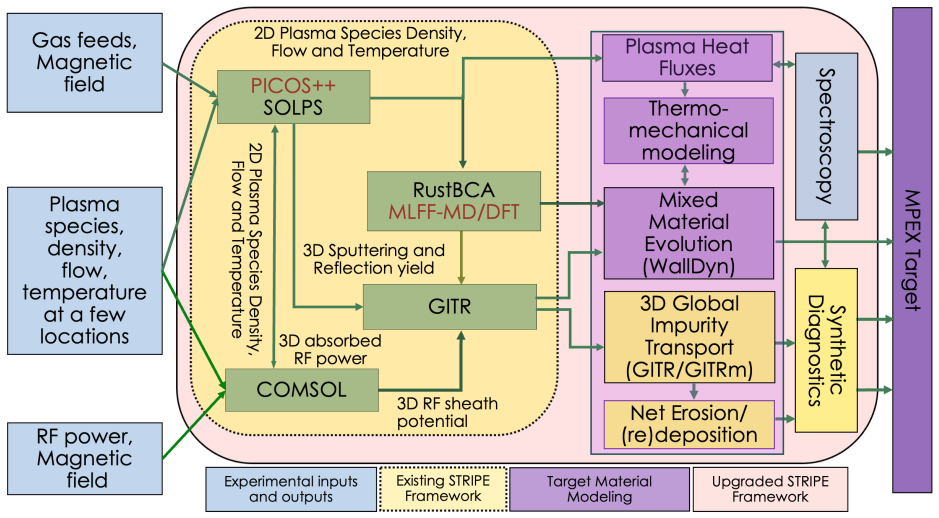
Our vision for the MPEX AI Digital Twins project is to supply experimental and physics model simulation data to train Artificial Intelligence (AI) models for data processing, analysis, operational control, PMI and materials simulation to maximize the scientific output of the MPEX device. Ultimately, an AI digital twin of MPEX material assessment metrics for tested and synthetic material types with simulated PMI will be trained by the AI Modeling Teams on the experimental and physics simulation data submitted to the American Science Cloud by this project
Editorial analysis
A structured set of objections, weighed in public.
Referee Report
Summary. The manuscript presents a forward-looking vision for the MPEX AI Digital Twins project. It plans to generate experimental and physics simulation data on plasma-material interactions (PMI), submit this data to the American Science Cloud, and have AI Modeling Teams train models for data processing, analysis, operational control, PMI simulation, and materials modeling. The ultimate objective is an AI digital twin of MPEX material assessment metrics applicable to both tested and synthetic material types under simulated PMI.
Significance. If the described data generation, submission, and AI training pipeline can be executed with sufficient fidelity, the project could accelerate predictive capabilities for plasma-facing materials in fusion-relevant environments by combining experimental benchmarks with physics-informed simulations. No machine-checked proofs, reproducible code, or falsifiable predictions are provided in the current text.
major comments (3)
- [Abstract] Abstract: The central claim that an AI digital twin of material assessment metrics 'will be trained' on submitted data is presented without any specification of expected data volume, formats, quality metrics, or fidelity requirements. This omission is load-bearing because the feasibility of training accurate multi-physics PMI models cannot be assessed without these details.
- [the manuscript] The manuscript: No description is given of the AI architectures (e.g., physics-informed neural networks, surrogate models, or hybrid approaches), training procedures, or validation strategy against experimental benchmarks. This is critical for the claim that the models will 'accurately represent' complex PMI without significant gaps or biases.
- [the manuscript] The manuscript: The text contains no discussion of how gaps, biases, or uncertainties in synthetic PMI data would be detected, quantified, or mitigated during model training. This directly affects the reliability of the envisioned digital twin for both tested and synthetic materials.
minor comments (1)
- [Abstract] Abstract: The list of AI applications ('data processing, analysis, operational control, PMI and materials simulation') would benefit from parallel structure or explicit separation for readability.
Simulated Author's Rebuttal
We thank the referee for the thoughtful review of our vision paper on the MPEX AI Digital Twins project. This manuscript describes a forward-looking plan for data generation, submission to the American Science Cloud, and subsequent AI model training rather than reporting completed implementations or quantitative results. We address each major comment below and have revised the manuscript to clarify the project's scope and planned approaches where feasible.
read point-by-point responses
-
Referee: [Abstract] Abstract: The central claim that an AI digital twin of material assessment metrics 'will be trained' on submitted data is presented without any specification of expected data volume, formats, quality metrics, or fidelity requirements. This omission is load-bearing because the feasibility of training accurate multi-physics PMI models cannot be assessed without these details.
Authors: We agree that the abstract is high-level. As this is a project vision document, specific quantitative details such as exact data volumes remain under development through ongoing experimental planning at MPEX. We have revised the abstract to reference the planned data categories (experimental PMI measurements and physics-based simulation outputs) and the submission pipeline to the American Science Cloud, while noting that detailed volume and format specifications will be established in subsequent technical reports. This maintains the visionary nature of the paper without introducing unsubstantiated commitments. revision: partial
-
Referee: [the manuscript] The manuscript: No description is given of the AI architectures (e.g., physics-informed neural networks, surrogate models, or hybrid approaches), training procedures, or validation strategy against experimental benchmarks. This is critical for the claim that the models will 'accurately represent' complex PMI without significant gaps or biases.
Authors: The original manuscript deliberately emphasizes the overall data-generation and integration strategy rather than prescribing specific AI methods, which will be selected by the AI Modeling Teams based on the characteristics of the collected data. In the revised version, we have added a dedicated subsection outlining example architectures under consideration, including physics-informed neural networks for PMI simulation, surrogate models for materials assessment, and hybrid approaches. We also describe a high-level validation framework involving cross-validation against experimental benchmarks and iterative refinement with physics constraints. These additions provide conceptual guidance without claiming completed implementations. revision: yes
-
Referee: [the manuscript] The manuscript: The text contains no discussion of how gaps, biases, or uncertainties in synthetic PMI data would be detected, quantified, or mitigated during model training. This directly affects the reliability of the envisioned digital twin for both tested and synthetic materials.
Authors: We acknowledge that the original text did not explicitly address uncertainty handling for synthetic data. The revised manuscript now includes a discussion of planned mitigation strategies, such as ensemble-based uncertainty quantification, sensitivity analysis to identify biases, and hybrid training that anchors synthetic data to experimental benchmarks. These measures are intended to support reliable digital twins for both tested and synthetic material types. We note that detailed implementation will occur during the AI training phase. revision: yes
Circularity Check
No circularity: purely descriptive project proposal with no derivations or equations
full rationale
The manuscript is a high-level vision statement for an AI digital twin project. It contains no equations, no fitted parameters, no derivation chains, and no mathematical claims that could reduce to inputs by construction. All content describes planned data submission, model training, and future outcomes without self-referential definitions or load-bearing self-citations. The central claim (training an AI twin on submitted experimental/simulation data) is forward-looking and depends on external data generation rather than any internal tautology.
Axiom & Free-Parameter Ledger
Reference graph
Works this paper leans on
-
[1]
Helicon plasma ion temperature measurements and observed ion cyclotron heating in proto-MPEX
C. J. Beers et al. “Helicon plasma ion temperature measurements and observed ion cyclotron heating in proto-MPEX”. In:Physics of Plasmas25.1 (Jan. 2018), p. 013526.issn: 1070-664X.doi: 10.1063/ 1.4994541
work page 2018
-
[2]
C. J. Beers et al. “RF sheath induced sputtering on Proto-MPEX part 2: Impurity transport modeling and experimental comparison”. In:Physics of Plasmas28.10 (Oct. 2021), p. 103508.issn: 1070-664X. doi:10.1063/5.0065464
-
[3]
C. J. Beers et al. “RF sheath induced sputtering on Proto-MPEX. I. Sheath equivalent dielectric layer for modeling the RF sheath”. In:Physics of Plasmas28.9 (Sept. 2021), p. 093503.issn: 1070-664X. doi:10.1063/5.0054074
- [4]
-
[5]
Final Design and Analysis of the Superconducting Magnets for the Material Plasma Exposure Experiment
E. E. Burkhardt et al. “Final Design and Analysis of the Superconducting Magnets for the Material Plasma Exposure Experiment”. In:IEEE Transactions on Applied Superconductivity33.5 (2023), p. 4201505.doi:10.1109/TASC.2023.3260185
-
[6]
J. F. Caneses et al. “Characterizing the plasma-induced thermal loads on a 200 kW light-ion helicon plasma source via infra-red thermography”. In:Plasma Sources Science and Technology30.7 (July 2021), p. 075022.doi:10.1088/1361-6595/abf814
-
[7]
J. F. Caneses et al. “Power transport efficiency during O-X-B 2nd harmonic electron cyclotron heating in a helicon linear plasma device1”. In:Plasma Physics and Controlled Fusion64.2 (Dec. 2021), p. 025005.doi:10.1088/1361-6587/ac4525
-
[8]
M. Cianciosa, D. Batchelor, and W. Elwasif.graph framework: A Domain Specific Compiler for Building Physics Applications. 2025.url:https://arxiv.org/abs/2508.15967
-
[9]
Impurity transport in PISCES-RF
G. Dhamale et al. “Impurity transport in PISCES-RF”. In:Plasma Physics and Controlled Fusion 66.9 (Aug. 2024), p. 095015.doi: 10.1088/1361-6587/ad6a85.url: https://dx.doi.org/10. 1088/1361-6587/ad6a85
-
[10]
Hermes-3: Multi-component plasma simulations with BOUT++
Ben Dudson et al. “Hermes-3: Multi-component plasma simulations with BOUT++”. In:Computer Physics Communications296 (2024), p. 108991.doi: https://doi.org/10.1016/j.cpc.2023. 108991
-
[11]
The Design and Implementation of the SWIM Integrated Plasma Simulator
W. R. Elwasif et al. “The Design and Implementation of the SWIM Integrated Plasma Simulator”. In:2010 18th Euromicro Conference on Parallel, Distributed and Network-based Processing. 2010, pp. 419–427.doi:10.1109/PDP.2010.63
-
[12]
Drift kinetic electrostatic simulations of the edge localized mode heat pulse
V . I. Geyko et al. “Drift kinetic electrostatic simulations of the edge localized mode heat pulse”. In: Physics of Plasmas31.12 (Dec. 2024), p. 123903.doi:10.1063/5.0230913
-
[13]
Ion cyclotron heating at high plasma density in Proto-MPEX
R. H. Goulding et al. “Ion cyclotron heating at high plasma density in Proto-MPEX”. In:Physics of Plasmas30.1 (Jan. 2023), p. 013505.issn: 1070-664X.doi:10.1063/5.0122915
-
[14]
Design and first applications of the ITER integrated modelling & analysis suite
F. Imbeaux et al. “Design and first applications of the ITER integrated modelling & analysis suite”. In: Nuclear Fusion55.12 (Oct. 2015), p. 123006.doi:10.1088/0029-5515/55/12/123006
-
[15]
Analysing the effects of heating and gas puffing in Proto-MPEX helicon and auxiliary heated plasmas
M. S. Islam et al. “Analysing the effects of heating and gas puffing in Proto-MPEX helicon and auxiliary heated plasmas”. In:Plasma Physics and Controlled Fusion65.9 (Aug. 2023), p. 095020. doi:10.1088/1361-6587/ace793
-
[16]
Simulation of plasma and neutral transport in PISCES-RF using SOLPS-ITER
M. S. Islam et al. “Simulation of plasma and neutral transport in PISCES-RF using SOLPS-ITER”. In: Plasma Physics and Controlled Fusion67.2 (2024).doi:10.1088/1361-6587/ada1f6
-
[17]
The strong coupling constant: state of the art and the decade ahead,
A. Kumar and J. F. Caneses. “Kinetic simulations of collision-less plasmas in open magnetic geome- tries”. In:Plasma Physics and Controlled Fusion64.3 (Jan. 2022), p. 035012.doi: 10.1088/1361- 6587/ac3dee. 15
-
[18]
A. Kumar et al. “Density drop at the divertor target in the prototype material plasma exposure eXperiment (Proto-MPEX)”. In:Physics of Plasmas31.12 (2024).doi:10.1063/5.0216995
-
[19]
Integrated modeling of RF-Induced Tungsten Erosion at ICRH Antenna Structures in the WEST Tokamak
A. Kumar et al. “Integrated modeling of RF-Induced Tungsten Erosion at ICRH Antenna Structures in the WEST Tokamak”. In:Nuclear Fusion65 (2025), p. 076039.doi: 10.1088/1741-4326/ade455
-
[20]
Validation of D–T fusion power prediction capability against 2021 JET D–T experiments
A. Kumar et al. “Parallel transport modeling of linear divertor simulators with fundamental ion cyclotron heating”. In:Nuclear Fusion63.3 (Jan. 2023), p. 036004.doi: 10.1088/1741- 4326/ acb160
-
[21]
Simulation of the interaction between plasma turbulence and neutrals in linear devices
J. Leddy, B. Dudson, and H. Willett. “Simulation of the interaction between plasma turbulence and neutrals in linear devices”. In:Nuclear Materials and Energy12 (2017). Proceedings of the 22nd International Conference on Plasma Surface Interactions 2016, 22nd PSI, pp. 994–998.doi: https://doi.org/10.1016/j.nme.2016.09.020
-
[22]
A. Lumsdaine et al. “Testing and analysis of steady-state helicon plasma source for the Material Plasma Exposure eXperiment (MPEX)”. In:Fusion Engineering and Design160 (2020), p. 112001. issn: 0920-3796.doi:https://doi.org/10.1016/j.fusengdes.2020.112001
-
[23]
D. D. Nath et al. “A 3D unstructured mesh based particle tracking code for impurity transport simulation in fusion tokamaks”. In:Computer Physics Communications292 (2023), p. 108861.doi: https://doi.org/10.1016/j.cpc.2023.108861
-
[24]
D. D. Nath et al. “A GPU-Accelerated 3D Unstructured Mesh Based Particle Tracking Code for Multi-Species Impurity Transport Simulation in Fusion Tokamaks”. In:Contributions to Plasma Physics65.5 (2025), e202400073.doi:https://doi.org/10.1002/ctpp.202400073
-
[25]
Final Design of the Material Plasma Exposure eXperiment
J. Rapp et al. “Final Design of the Material Plasma Exposure eXperiment”. In:Fusion Science and Technology79.8 (2023), pp. 1113–1123.doi:10.1080/15361055.2023.2168443
-
[26]
J. Rapp et al. “Research and Development to Reduce Impurity Production and Transport of the Impuri- ties to the Target in Linear Plasma Devices Using Helicon Plasma Sources”. In:IEEE Transactions on Plasma Science52.9 (2024), pp. 3885–3891.doi:10.1109/TPS.2024.3442531
-
[27]
Sam Reeve and Pablo Seleson.CabanaPD: Version 0.3. Version 0.3.0. Sept. 2024.doi: https : //doi.org/10.5281/zenodo.13844547
-
[28]
3D global impurity transport modeling with WallDYN and EMC3-Eirene
K. Schmid and T. Lunt. “3D global impurity transport modeling with WallDYN and EMC3-Eirene”. In:Nuclear Materials and Energy17 (2018), pp. 200–205.doi:10.1016/j.nme.2018.11.005
-
[29]
W. Tierens et al. “Radiofrequency sheath rectification on WEST: application of the sheath-equivalent dielectric layer technique in tokamak geometry”. In:Nuclear Fusion64.12 (Oct. 2024), p. 126039. doi:10.1088/1741-4326/ad80a9
-
[30]
M. Yang et al. “A Pseudoreversible Normalizing Flow for Stochastic Dynamical Systems with Various Initial Distributions”. In:SIAM Journal on Scientific Computing46.4 (2024), pp. C508–C533.doi: 10.1137/23M1585635
-
[31]
M. Yang et al. “Conditional pseudo-reversible normalizing flow for surrogate modeling in quantifying uncertainty propagation”. In:Journal of Machine Learning for Modeling and Computing6.4 (2025)
work page 2025
-
[32]
T.R. Younkin et al. “GITR: An accelerated global scale particle tracking code for wall material erosion and redistribution in fusion relevant plasma–material interactions”. In:Computer Physics Communications264 (2021), p. 107885.issn: 0010-4655.doi: https://doi.org/10.1016/j.cpc. 2021.107885. 16
discussion (0)
Sign in with ORCID, Apple, or X to comment. Anyone can read and Pith papers without signing in.