Recognition: no theorem link
TSNN: A Non-parametric and Interpretable Framework for Traffic Time Series Forecasting
Pith reviewed 2026-05-12 01:58 UTC · model grok-4.3
The pith
A non-parametric memory bank matching process forecasts traffic time series competitively with deep learning models while remaining fully interpretable.
A machine-rendered reading of the paper's core claim, the machinery that carries it, and where it could break.
Core claim
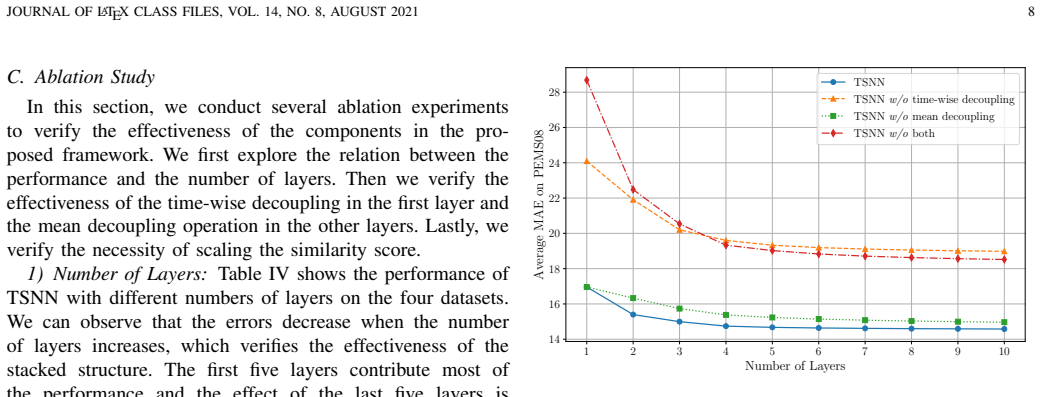
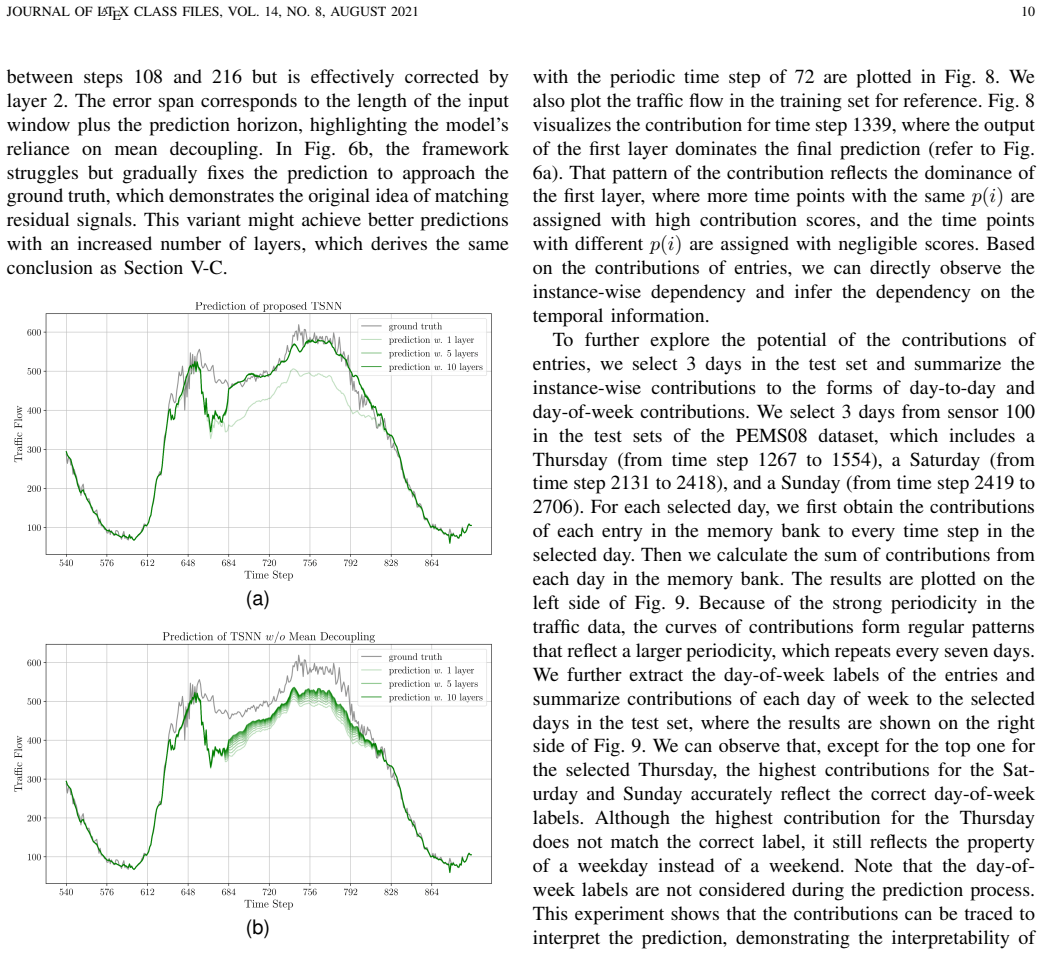
TSNN decouples an input time series by matching segments against a memory bank constructed from the training set using the identical matching procedure; the resulting additive components yield forecasts without any learned weights, and experiments show this yields competitive accuracy against standard deep learning baselines across four real-world traffic flow datasets while permitting direct visualization of each component's contribution.
What carries the argument
The memory bank of training patterns paired with a multi-layer matching process that successively decouples the series into interpretable additive parts for forecasting.
If this is right
- Each forecast can be inspected by listing the exact training time steps that contributed to it through the matching layers.
- No gradient-based training is required; only the memory bank needs to be assembled from the training records.
- The same matching visualization used in the paper can be applied to any new input to reveal which past patterns drove the output.
- Accuracy improves when the data exhibit strong periodicity because similar daily or weekly segments are more likely to exist in the memory bank.
Where Pith is reading between the lines
- The same memory-bank decoupling could be tested on other repetitive time series such as hourly electricity demand or retail sales.
- Because no parameters are tuned, the method may degrade more gracefully than neural nets when test distributions shift modestly from training.
- An online version that adds new observations to the memory bank after each forecast could support rolling predictions over longer horizons.
Load-bearing premise
The training data contain enough representative patterns that a memory bank built from them can supply accurate matches for unseen test sequences.
What would settle it
Apply the model to a traffic dataset recorded after a major schedule change or disruption not present in the training period and check whether its error exceeds that of a simple historical-average baseline.
Figures





read the original abstract
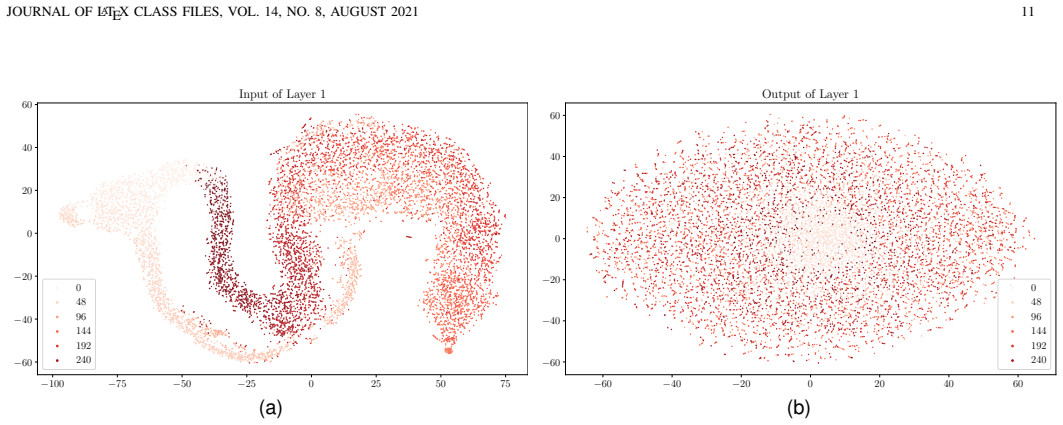
Although many complex models were proposed to analyze time series data, some studies have demonstrated remarkable performance with simpler structures. A recent study proposed a non-parametric framework for 3D point cloud classification, which has the potential to be adapted for time series forecasting and enable interpretability. Inspired by the previous works, we present TSNN, a non-parametric and interpretable framework for traffic time series forecasting. TSNN consists of multiple layers that decouple the time series by matching the entries in a memory bank, where the memory bank is constructed using a similar matching process within the training set. It leverages the periodicity in traffic data to enhance forecasting accuracy while maintaining a simple model architecture. The proposed model operates without trainable parameters, preserving its inherent interpretability. In the experiments, TSNN achieves competitive performance compared to the typical deep learning models in four real-world traffic flow datasets. We also visualize the decoupling process to show the effectiveness of the components. Finally, we demonstrate the interpretability of the model and illustrate the contribution of each time step within the memory bank.
Editorial analysis
A structured set of objections, weighed in public.
Referee Report
Summary. The paper proposes TSNN, a non-parametric and interpretable framework for traffic time series forecasting. TSNN consists of multiple layers that decouple input time series by matching entries against a memory bank constructed from the training set using an analogous matching process. The approach leverages periodicity in traffic data, requires no trainable parameters, and is reported to achieve competitive performance against typical deep learning models on four real-world traffic flow datasets, accompanied by visualizations of the decoupling process and illustrations of per-time-step contributions for interpretability.
Significance. If the empirical claims are substantiated, TSNN offers a simple, fully non-parametric alternative to deep neural networks for traffic forecasting that prioritizes interpretability via explicit historical pattern matching. This could be valuable in operational settings where transparency and reproducibility matter more than marginal accuracy gains, and the absence of fitted parameters eliminates overfitting concerns common in parametric models.
major comments (2)
- [Experiments] Experiments section: the headline claim that TSNN achieves competitive performance on four datasets supplies no quantitative metrics, baseline specifications, error bars, statistical tests, or description of the matching distance function, rendering the central empirical result impossible to evaluate.
- [Methodology] Memory bank construction and matching process (described in the methodology): no evidence is presented that nearest-neighbor matches from the training-only memory bank remain close or representative on test sequences. Missing are coverage statistics, nearest-neighbor distance distributions, or ablations on temporal splits that would address distribution shifts (incidents, holidays, sensor drift) in traffic data; this assumption is load-bearing for the non-parametric generalization claim.
minor comments (2)
- [Abstract] Abstract: the reference to the prior non-parametric 3D point-cloud work is not accompanied by a citation.
- [Methodology] The number of layers and the precise definition of the matching criterion are stated only at a high level; a concrete algorithmic description or pseudocode would improve clarity.
Simulated Author's Rebuttal
We thank the referee for their constructive and detailed comments, which help strengthen the empirical validation and robustness analysis of TSNN. We address each major comment below and have revised the manuscript to provide the requested details and additional experiments.
read point-by-point responses
-
Referee: [Experiments] Experiments section: the headline claim that TSNN achieves competitive performance on four datasets supplies no quantitative metrics, baseline specifications, error bars, statistical tests, or description of the matching distance function, rendering the central empirical result impossible to evaluate.
Authors: We agree that the original presentation of results would benefit from greater quantitative detail to allow full evaluation. In the revised manuscript we have added a results table reporting MAE and RMSE for TSNN and the deep-learning baselines on all four datasets, with means and standard deviations computed over multiple random seeds. We also describe the matching distance function (Euclidean distance on z-score-normalized segments) and include paired t-test p-values to assess statistical significance of differences. These changes make the central empirical claims transparent and reproducible. revision: yes
-
Referee: [Methodology] Memory bank construction and matching process (described in the methodology): no evidence is presented that nearest-neighbor matches from the training-only memory bank remain close or representative on test sequences. Missing are coverage statistics, nearest-neighbor distance distributions, or ablations on temporal splits that would address distribution shifts (incidents, holidays, sensor drift) in traffic data; this assumption is load-bearing for the non-parametric generalization claim.
Authors: The referee correctly highlights a load-bearing assumption for any non-parametric method. In the revised manuscript we now report coverage statistics (fraction of test queries with matches below training-derived distance thresholds), side-by-side histograms of nearest-neighbor distances on training versus test data, and an ablation that removes holiday periods from the memory bank to quantify performance under temporal distribution shift. These additions support that periodicity allows the training memory bank to remain representative for typical traffic patterns, while we discuss rare events as a limitation. revision: yes
Circularity Check
No circularity: non-parametric lookup method with independent empirical validation
full rationale
The paper describes a non-parametric forecasting procedure that builds a fixed memory bank exclusively from training data via intra-set matching and then performs nearest-neighbor lookup on test queries. No trainable parameters exist, no equations define a quantity in terms of itself, and no self-citation chain is invoked to justify uniqueness or an ansatz. Performance claims rest on direct experimental comparison against deep-learning baselines on four datasets rather than on any derived identity. The generalization assumption (that training patterns suffice for test queries) is an empirical premise, not a definitional tautology; it can be falsified by distance or coverage statistics without altering the method's internal logic. Consequently the derivation chain contains no self-referential reduction.
Axiom & Free-Parameter Ledger
axioms (1)
- domain assumption Traffic data exhibits sufficient periodicity and similarity across days or weeks that matching against a training memory bank yields useful forecasts.
invented entities (1)
-
Memory bank
no independent evidence
Reference graph
Works this paper leans on
-
[1]
Time-series forecasting with deep learning: a survey,
B. Lim and S. Zohren, “Time-series forecasting with deep learning: a survey,”Philosophical Transactions of the Royal Society A, vol. 379, no. 2194, p. 20200209, 2021
work page 2021
-
[2]
Road traffic forecasting: Recent advances and new challenges,
I. Lana, J. Del Ser, M. Velez, and E. I. Vlahogianni, “Road traffic forecasting: Recent advances and new challenges,”IEEE Intelligent Transportation Systems Magazine, vol. 10, no. 2, pp. 93–109, 2018
work page 2018
-
[3]
Informer: Beyond efficient transformer for long sequence time-series forecasting,
H. Zhou, S. Zhang, J. Peng, S. Zhang, J. Li, H. Xiong, and W. Zhang, “Informer: Beyond efficient transformer for long sequence time-series forecasting,” inProceedings of the AAAI conference on artificial intel- ligence, vol. 35, pp. 11106–11115, 2021
work page 2021
-
[4]
Trend analysis of climate time series: A review of methods,
M. Mudelsee, “Trend analysis of climate time series: A review of methods,”Earth-science reviews, vol. 190, pp. 310–322, 2019
work page 2019
-
[5]
Largest: A benchmark dataset for large- scale traffic forecasting,
X. Liu, Y . Xia, Y . Liang, J. Hu, Y . Wang, L. Bai, C. Huang, Z. Liu, B. Hooi, and R. Zimmermann, “Largest: A benchmark dataset for large- scale traffic forecasting,”Advances in Neural Information Processing Systems, vol. 36, 2024
work page 2024
-
[6]
Urban traffic flow prediction techniques: A review,
B. Medina-Salgado, E. S ´anchez-DelaCruz, P. Pozos-Parra, and J. E. Sierra, “Urban traffic flow prediction techniques: A review,”Sustainable Computing: Informatics and Systems, vol. 35, p. 100739, 2022
work page 2022
-
[7]
J. Kim, H. Kim, H. Kim, D. Lee, and S. Yoon, “A comprehensive survey of deep learning for time series forecasting: architectural diversity and open challenges,”Artificial Intelligence Review, vol. 58, no. 7, pp. 1–95, 2025
work page 2025
-
[8]
Short term traffic forecasting using time series methods,
C. Moorthy and B. Ratcliffe, “Short term traffic forecasting using time series methods,”Transportation planning and technology, vol. 12, no. 1, pp. 45–56, 1988
work page 1988
-
[9]
S. Lee and D. B. Fambro, “Application of subset autoregressive in- tegrated moving average model for short-term freeway traffic volume forecasting,”Transportation research record, vol. 1678, no. 1, pp. 179– 188, 1999
work page 1999
-
[10]
J. Guo, W. Huang, and B. M. Williams, “Adaptive kalman filter approach for stochastic short-term traffic flow rate prediction and uncertainty quantification,”Transportation Research Part C: Emerging Technolo- gies, vol. 43, pp. 50–64, 2014
work page 2014
-
[11]
Travel-time prediction with sup- port vector regression,
C.-H. Wu, J.-M. Ho, and D.-T. Lee, “Travel-time prediction with sup- port vector regression,”IEEE transactions on intelligent transportation systems, vol. 5, no. 4, pp. 276–281, 2004
work page 2004
-
[12]
Diffusion convolutional recurrent neural network: Data-driven traffic forecasting,
Y . Li, R. Yu, C. Shahabi, and Y . Liu, “Diffusion convolutional recurrent neural network: Data-driven traffic forecasting,” inInternational Con- ference on Learning Representations, 2018
work page 2018
-
[13]
Graph wavenet for deep spatial-temporal graph model- ing.arXiv preprint arXiv:1906.00121,
Z. Wu, S. Pan, G. Long, J. Jiang, and C. Zhang, “Graph wavenet for deep spatial-temporal graph modeling,”arXiv preprint arXiv:1906.00121, 2019
-
[14]
B. Yu, H. Yin, and Z. Zhu, “Spatio-temporal graph convolutional networks: A deep learning framework for traffic forecasting,”arXiv preprint arXiv:1709.04875, 2017
-
[15]
L. Cai, K. Janowicz, G. Mai, B. Yan, and R. Zhu, “Traffic transformer: Capturing the continuity and periodicity of time series for traffic forecasting,”Transactions in GIS, vol. 24, no. 3, pp. 736–755, 2020
work page 2020
-
[16]
Q. Luo, S. He, X. Han, Y . Wang, and H. Li, “Lsttn: A long-short term transformer-based spatiotemporal neural network for traffic flow forecasting,”Knowledge-Based Systems, vol. 293, p. 111637, 2024
work page 2024
-
[17]
Bidirectional spatial-temporal adaptive transformer for urban traffic flow forecasting,
C. Chen, Y . Liu, L. Chen, and C. Zhang, “Bidirectional spatial-temporal adaptive transformer for urban traffic flow forecasting,”IEEE Trans- actions on Neural Networks and Learning Systems, vol. 34, no. 10, pp. 6913–6925, 2022
work page 2022
-
[18]
Spatial-temporal identity: A simple yet effective baseline for multivariate time series forecasting,
Z. Shao, Z. Zhang, F. Wang, W. Wei, and Y . Xu, “Spatial-temporal identity: A simple yet effective baseline for multivariate time series forecasting,” inProceedings of the 31st ACM International Conference on Information & Knowledge Management, pp. 4454–4458, 2022
work page 2022
-
[19]
Revisiting spatial- temporal similarity: A deep learning framework for traffic prediction,
H. Yao, X. Tang, H. Wei, G. Zheng, and Z. Li, “Revisiting spatial- temporal similarity: A deep learning framework for traffic prediction,” inProceedings of the AAAI conference on artificial intelligence, vol. 33, pp. 5668–5675, 2019
work page 2019
-
[20]
Parameter is not all you need: Starting from non-parametric networks for 3d point cloud analysis,
R. Zhang, L. Wang, Y . Wang, P. Gao, H. Li, and J. Shi, “Parameter is not all you need: Starting from non-parametric networks for 3d point cloud analysis,”arXiv preprint arXiv:2303.08134, 2023
-
[21]
Pointnet++: Deep hierarchical feature learning on point sets in a metric space,
C. R. Qi, L. Yi, H. Su, and L. J. Guibas, “Pointnet++: Deep hierarchical feature learning on point sets in a metric space,”Advances in neural information processing systems, vol. 30, 2017
work page 2017
-
[22]
M. Lippi, M. Bertini, and P. Frasconi, “Short-term traffic flow forecast- ing: An experimental comparison of time-series analysis and supervised learning,”IEEE Transactions on Intelligent Transportation Systems, vol. 14, no. 2, pp. 871–882, 2013
work page 2013
-
[23]
S. I. Vagropoulos, G. Chouliaras, E. G. Kardakos, C. K. Simoglou, and A. G. Bakirtzis, “Comparison of sarimax, sarima, modified sarima and ann-based models for short-term pv generation forecasting,” in2016 IEEE international energy conference (ENERGYCON), pp. 1–6, IEEE, 2016
work page 2016
-
[24]
J. H. Stock and M. W. Watson, “Vector autoregressions,”Journal of Economic perspectives, vol. 15, no. 4, pp. 101–115, 2001
work page 2001
-
[25]
Time series forecasting of petroleum pro- duction using deep lstm recurrent networks,
A. Sagheer and M. Kotb, “Time series forecasting of petroleum pro- duction using deep lstm recurrent networks,”Neurocomputing, vol. 323, pp. 203–213, 2019
work page 2019
-
[26]
Financial time series forecasting model based on ceemdan and lstm,
J. Cao, Z. Li, and J. Li, “Financial time series forecasting model based on ceemdan and lstm,”Physica A: Statistical mechanics and its applications, vol. 519, pp. 127–139, 2019
work page 2019
-
[27]
Energy load forecast- ing using deep learning approach-lstm and gru in spark cluster,
S. Kumar, L. Hussain, S. Banarjee, and M. Reza, “Energy load forecast- ing using deep learning approach-lstm and gru in spark cluster,” in2018 fifth international conference on emerging applications of information technology (EAIT), pp. 1–4, IEEE, 2018
work page 2018
-
[28]
Lstm network: a deep learning approach for short-term traffic forecast,
Z. Zhao, W. Chen, X. Wu, P. C. Chen, and J. Liu, “Lstm network: a deep learning approach for short-term traffic forecast,”IET Intelligent Transport Systems, vol. 11, no. 2, pp. 68–75, 2017
work page 2017
-
[29]
Multi-lane short-term traffic forecasting with convolutional lstm network,
Y . Ma, Z. Zhang, and A. Ihler, “Multi-lane short-term traffic forecasting with convolutional lstm network,”IEEE Access, vol. 8, pp. 34629– 34643, 2020
work page 2020
-
[30]
A. Vaswani, N. Shazeer, N. Parmar, J. Uszkoreit, L. Jones, A. N. Gomez, Ł. Kaiser, and I. Polosukhin, “Attention is all you need,”Advances in neural information processing systems, vol. 30, 2017
work page 2017
-
[31]
Deep Time Series Models: A Comprehensive Survey and Benchmark
Y . Wang, H. Wu, J. Dong, Y . Liu, M. Long, and J. Wang, “Deep time series models: A comprehensive survey and benchmark,”arXiv preprint arXiv:2407.13278, 2024
work page internal anchor Pith review Pith/arXiv arXiv 2024
-
[32]
Pyraformer: Low-complexity pyramidal attention for long-range time series modeling and forecasting,
S. Liu, H. Yu, C. Liao, J. Li, W. Lin, A. X. Liu, and S. Dustdar, “Pyraformer: Low-complexity pyramidal attention for long-range time series modeling and forecasting,” inInternational Conference on Learn- ing Representations, 2022
work page 2022
-
[33]
Autoformer: Decomposition transformers with auto-correlation for long-term series forecasting,
H. Wu, J. Xu, J. Wang, and M. Long, “Autoformer: Decomposition transformers with auto-correlation for long-term series forecasting,” Advances in neural information processing systems, vol. 34, pp. 22419– 22430, 2021
work page 2021
-
[34]
A Time Series is Worth 64 Words: Long-term Forecasting with Transformers
Y . Nie, N. H. Nguyen, P. Sinthong, and J. Kalagnanam, “A time series is worth 64 words: Long-term forecasting with transformers,”arXiv preprint arXiv:2211.14730, 2022
work page internal anchor Pith review arXiv 2022
-
[35]
Y . Zhang and J. Yan, “Crossformer: Transformer utilizing cross- dimension dependency for multivariate time series forecasting,” inThe eleventh international conference on learning representations, 2023
work page 2023
-
[36]
Z. Shao, F. Wang, Y . Xu, W. Wei, C. Yu, Z. Zhang, D. Yao, T. Sun, G. Jin, X. Cao,et al., “Exploring progress in multivariate time series forecasting: Comprehensive benchmarking and heterogeneity analysis,” IEEE Transactions on Knowledge and Data Engineering, 2024
work page 2024
-
[37]
Y . Li, R. Yu, C. Shahabi, and Y . Liu, “Diffusion convolutional re- current neural network: Data-driven traffic forecasting,”arXiv preprint arXiv:1707.01926, 2017
-
[38]
Gman: A graph multi-attention network for traffic prediction,
C. Zheng, X. Fan, C. Wang, and J. Qi, “Gman: A graph multi-attention network for traffic prediction,” inProceedings of the AAAI conference on artificial intelligence, vol. 34, pp. 1234–1241, 2020
work page 2020
-
[39]
Dynamic graph convolutional recurrent network for traffic prediction: Benchmark and solution,
F. Li, J. Feng, H. Yan, G. Jin, F. Yang, F. Sun, D. Jin, and Y . Li, “Dynamic graph convolutional recurrent network for traffic prediction: Benchmark and solution,”ACM Transactions on Knowledge Discovery from Data (TKDD), 2021
work page 2021
-
[40]
Decoupled dynamic spatial-temporal graph neural network for traffic forecasting,
Z. Shao, Z. Zhang, W. Wei, F. Wang, Y . Xu, X. Cao, and C. S. Jensen, “Decoupled dynamic spatial-temporal graph neural network for traffic forecasting,”arXiv preprint arXiv:2206.09112, 2022
-
[41]
N., Carpov, D., Chapados, N., and Bengio, Y
B. N. Oreshkin, D. Carpov, N. Chapados, and Y . Bengio, “N-beats: Neural basis expansion analysis for interpretable time series forecasting,” arXiv preprint arXiv:1905.10437, 2019
-
[42]
Are transformers effective for time series forecasting?,
A. Zeng, M. Chen, L. Zhang, and Q. Xu, “Are transformers effective for time series forecasting?,” inProceedings of the AAAI conference on artificial intelligence, vol. 37, pp. 11121–11128, 2023
work page 2023
-
[43]
Revisiting long-term time series forecasting: An investigation on linear mapping
Z. Li, S. Qi, Y . Li, and Z. Xu, “Revisiting long-term time se- ries forecasting: An investigation on linear mapping,”arXiv preprint arXiv:2305.10721, 2023
-
[44]
Mixture-of-linear-experts for long- term time series forecasting,
R. Ni, Z. Lin, S. Wang, and G. Fanti, “Mixture-of-linear-experts for long- term time series forecasting,” inInternational Conference on Artificial Intelligence and Statistics, pp. 4672–4680, PMLR, 2024
work page 2024
-
[45]
Testam: A time-enhanced spatio-temporal attention model with mixture of experts,
H. Lee and S. Ko, “Testam: A time-enhanced spatio-temporal attention model with mixture of experts,”arXiv preprint arXiv:2403.02600, 2024
-
[46]
A time series is worth five experts: Heterogeneous mixture of experts for traffic flow prediction,
G. Wang, Y . Chen, M. Gao, Z. Wu, J. Tang, and J. Zhao, “A time series is worth five experts: Heterogeneous mixture of experts for traffic flow prediction,”arXiv preprint arXiv:2409.17440, 2024. JOURNAL OF LATEX CLASS FILES, VOL. 14, NO. 8, AUGUST 2021 14
-
[47]
Y . Carmon and O. Hinder, “Making sgd parameter-free,” inConference on Learning Theory, pp. 2360–2389, PMLR, 2022
work page 2022
-
[48]
Nonparametric variational auto-encoders for hierarchical representation learning,
P. Goyal, Z. Hu, X. Liang, C. Wang, and E. P. Xing, “Nonparametric variational auto-encoders for hierarchical representation learning,” in Proceedings of the IEEE International Conference on Computer Vision, pp. 5094–5102, 2017
work page 2017
-
[49]
Functional methods for time series prediction: a nonparametric approach,
G. Aneiros-P ´erez, R. Cao, and J. M. Vilar-Fern ´andez, “Functional methods for time series prediction: a nonparametric approach,”Journal of Forecasting, vol. 30, no. 4, pp. 377–392, 2011
work page 2011
-
[50]
E. A. Nadaraya, “On estimating regression,”Theory of Probability & Its Applications, vol. 9, no. 1, pp. 141–142, 1964
work page 1964
-
[51]
G. S. Watson, “Smooth regression analysis,”Sankhy ¯a: The Indian Journal of Statistics, Series A, pp. 359–372, 1964
work page 1964
-
[52]
Gaussian processes for regression,
C. Williams and C. Rasmussen, “Gaussian processes for regression,” Advances in neural information processing systems, vol. 8, 1995
work page 1995
-
[53]
Population shape regression from random design data,
B. C. Davis, P. T. Fletcher, E. Bullitt, and S. Joshi, “Population shape regression from random design data,”International journal of computer vision, vol. 90, pp. 255–266, 2010
work page 2010
-
[54]
Random forest regression for manifold-valued responses,
D. Tsagkrasoulis and G. Montana, “Random forest regression for manifold-valued responses,”Pattern Recognition Letters, vol. 101, pp. 6– 13, 2018
work page 2018
-
[55]
Deep non-parametric time series forecaster,
S. S. Rangapuram, J. Gasthaus, L. Stella, V . Flunkert, D. Salinas, Y . Wang, and T. Januschowski, “Deep non-parametric time series forecaster,”arXiv preprint arXiv:2312.14657, 2023
-
[56]
Unsupervised feature learning via non-parametric instance discrimination,
Z. Wu, Y . Xiong, S. X. Yu, and D. Lin, “Unsupervised feature learning via non-parametric instance discrimination,” inProceedings of the IEEE conference on computer vision and pattern recognition, pp. 3733–3742, 2018
work page 2018
-
[57]
Momentum contrast for unsupervised visual representation learning,
K. He, H. Fan, Y . Wu, S. Xie, and R. Girshick, “Momentum contrast for unsupervised visual representation learning,” inProceedings of the IEEE/CVF conference on computer vision and pattern recognition, pp. 9729–9738, 2020
work page 2020
-
[58]
No time to train: Empowering non-parametric networks for few-shot 3d scene segmentation,
X. Zhu, R. Zhang, B. He, Z. Guo, J. Liu, H. Xiao, C. Fu, H. Dong, and P. Gao, “No time to train: Empowering non-parametric networks for few-shot 3d scene segmentation,” inProceedings of the IEEE/CVF conference on computer vision and pattern recognition, pp. 3838–3847, 2024
work page 2024
-
[59]
Point-fcw: Transposed- fcw graph representation for point cloud classification using tda,
H. Lai, B. Liu, C.-T. Lam, B. Ng, and S.-K. Im, “Point-fcw: Transposed- fcw graph representation for point cloud classification using tda,”IEEE Signal Processing Letters, 2025
work page 2025
-
[60]
Historical inertia: A neglected but pow- erful baseline for long sequence time-series forecasting,
Y . Cui, J. Xie, and K. Zheng, “Historical inertia: A neglected but pow- erful baseline for long sequence time-series forecasting,” inProceedings of the 30th ACM international conference on information & knowledge management, pp. 2965–2969, 2021
work page 2021
-
[61]
Fast approximate correlation for massive time-series data,
A. Mueen, S. Nath, and J. Liu, “Fast approximate correlation for massive time-series data,” inProceedings of the 2010 ACM SIGMOD International Conference on Management of data, pp. 171–182, 2010
work page 2010
-
[62]
Combining multiple time series models through a robust weighted mechanism,
R. Adhikari and R. Agrawal, “Combining multiple time series models through a robust weighted mechanism,” in2012 1st International Con- ference on Recent Advances in Information Technology (RAIT), pp. 455– 460, IEEE, 2012
work page 2012
-
[63]
L. Gy ¨orfi, M. Kohler, A. Krzyzak, and H. Walk,A distribution-free theory of nonparametric regression. Springer Science & Business Media, 2006
work page 2006
-
[64]
C. Song, Y . Lin, S. Guo, and H. Wan, “Spatial-temporal synchronous graph convolutional networks: A new framework for spatial-temporal network data forecasting,” inProceedings of the AAAI conference on artificial intelligence, vol. 34, pp. 914–921, 2020
work page 2020
-
[65]
Basicts: A fair and scalable time series forecasting benchmark and toolkit
“Basicts: A fair and scalable time series forecasting benchmark and toolkit..” https://github.com/GestaltCogTeam/BasicTS/. Accessed: 2025-10-16
work page 2025
-
[66]
Z. Lu, C. Zhou, J. Wu, H. Jiang, and S. Cui, “Integrating granger causality and vector auto-regression for traffic prediction of large-scale wlans,”KSII Transactions on Internet and Information Systems (TIIS), vol. 10, no. 1, pp. 136–151, 2016
work page 2016
-
[67]
Fits: Modeling time series with10k parameters,
Z. Xu, A. Zeng, and Q. Xu, “Fits: Modeling time series with10k parameters,” inThe Twelfth International Conference on Learning Representations, 2024
work page 2024
-
[68]
St-norm: Spatial and temporal normalization for multi-variate time series forecasting,
J. Deng, X. Chen, R. Jiang, X. Song, and I. W. Tsang, “St-norm: Spatial and temporal normalization for multi-variate time series forecasting,” inProceedings of the 27th ACM SIGKDD conference on knowledge discovery & data mining, pp. 269–278, 2021
work page 2021
-
[69]
Visualizing data using t-sne.,
L. Van der Maaten and G. Hinton, “Visualizing data using t-sne.,” Journal of machine learning research, vol. 9, no. 11, 2008
work page 2008
-
[70]
Distilling the Knowledge in a Neural Network
G. Hinton, O. Vinyals, and J. Dean, “Distilling the knowledge in a neural network,”arXiv preprint arXiv:1503.02531, 2015
work page internal anchor Pith review Pith/arXiv arXiv 2015
-
[71]
A survey on mixture of experts,
W. Cai, J. Jiang, F. Wang, J. Tang, S. Kim, and J. Huang, “A survey on mixture of experts,”arXiv preprint arXiv:2407.06204, 2024
discussion (0)
Sign in with ORCID, Apple, or X to comment. Anyone can read and Pith papers without signing in.