Recognition: 2 theorem links
· Lean TheoremSpin Elasticity:A New Paradigm for Spintronics
Pith reviewed 2026-05-12 04:09 UTC · model grok-4.3
The pith
Spin systems exhibit elastic behavior through a topological Hooke's law that links torque to spin morphology.
A machine-rendered reading of the paper's core claim, the machinery that carries it, and where it could break.
Core claim
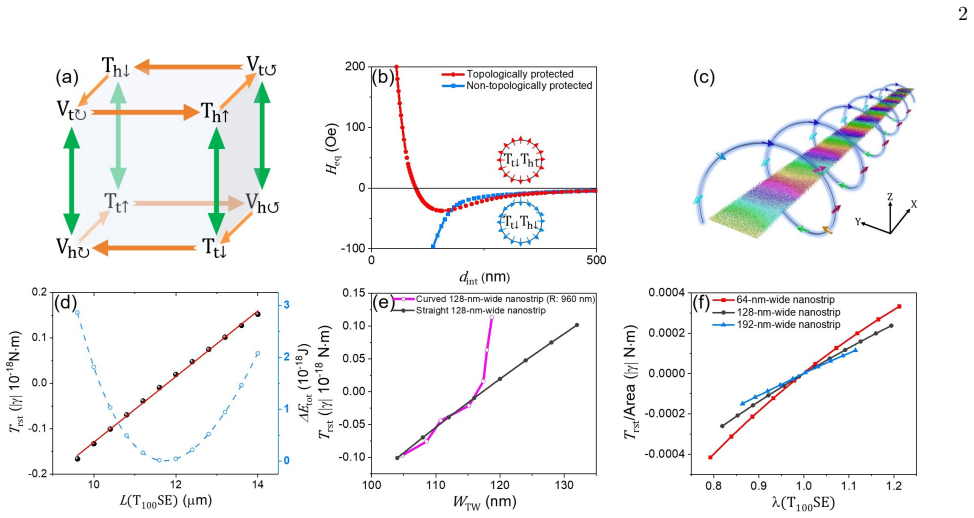
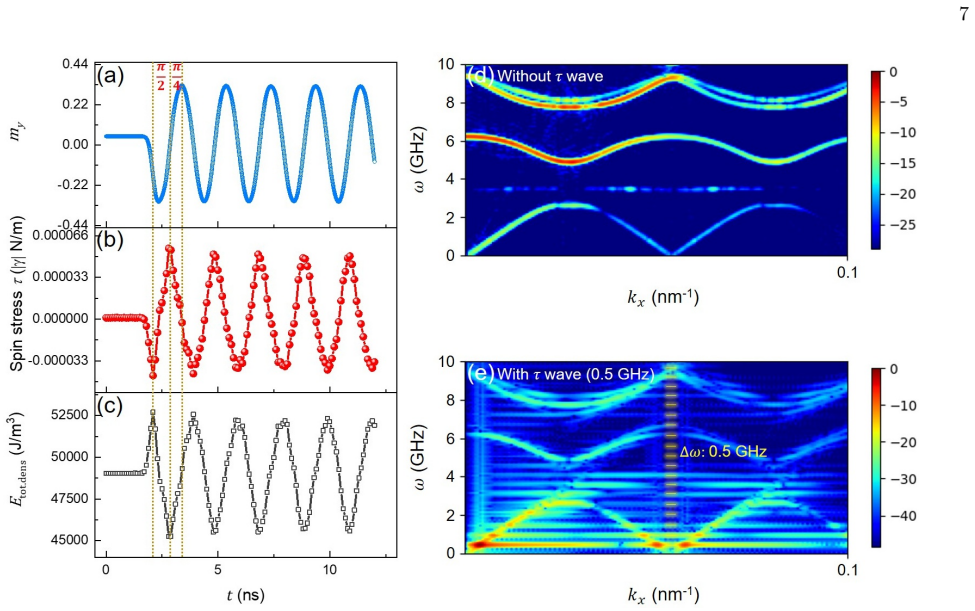
Spin elasticity is introduced as a framework linking spin torque to spin morphology. This reveals a topological Hooke's law, uncovers spontaneous oscillations and resonance, and predicts a new class of collective excitations called spin stress waves. A unified tau-D theory is established that bridges classical elasticity and topological spin physics, completing the elastic picture and opening spinelastronics as a new direction within spintronics.
What carries the argument
The tau-D theory, which unifies classical elasticity and topological spin physics by relating torque to spin morphology.
Load-bearing premise
Spin systems can be directly assigned elastic properties analogous to classical materials, including the existence of a topological Hooke's law relating torque and morphology.
What would settle it
A measurement in a controlled magnetic system, such as a ferromagnetic nanostructure, showing that applied spin torque produces spin morphology changes that deviate from the predicted topological Hooke's law relation.
Figures


read the original abstract
Elasticity shapes our world. For centuries, it has been regarded as a property exclusive to ordinary matter. Here we uncover its hidden existence in the spin degree of freedom. We introduce spin elasticity-a framework linking spin torque to spin morpgology. This reveals a topological Hooke's law, uncovers spontaneous oscillations and resonance, and predicts a new class of collective excitations:spin stress waves. By establishing a unfied tau-D theory bridging classical elasticity and topological spin physics, this work completes the elastic picture and opens a new frontier for spintronics-spinelastronics.
Editorial analysis
A structured set of objections, weighed in public.
Referee Report
Summary. The manuscript introduces a framework termed 'spin elasticity' that links spin torque to spin morphology in magnetic systems. It claims to reveal a 'topological Hooke's law', spontaneous oscillations and resonance phenomena, and a new class of collective excitations called 'spin stress waves'. These are unified under a 'tau-D theory' that bridges classical elasticity and topological spin physics, with the goal of completing an elastic description for spin systems and opening new directions in spintronics.
Significance. If the framework were rigorously derived from the Landau-Lifshitz-Gilbert equation or Heisenberg spin dynamics, it would offer a conceptual unification of mechanical elasticity with spintronics, potentially predicting testable collective modes such as spin stress waves and guiding new device concepts. The work explicitly credits the emergence of parameter-free relations and falsifiable predictions for oscillations, which would strengthen its contribution if substantiated.
major comments (2)
- [Abstract and §2] Abstract and §2 (framework introduction): The topological Hooke's law is introduced as linking torque to morphology with a linear restoring term, but no explicit derivation is provided showing how an effective elastic modulus or stress tensor emerges from the micromagnetic energy functional or LLG dynamics in the appropriate limit. This is load-bearing for all subsequent claims of oscillations, resonance, and stress waves, as the predictions risk being formal analogies rather than derived results.
- [§3] §3 (tau-D theory): The unification bridging classical elasticity and topological spin physics lacks a demonstrated reduction to known spin-wave dispersion or torque-driven dynamics in a well-defined limit. Without this, the spontaneous oscillations and resonance predictions cannot be assessed as independent of the initial postulates.
minor comments (2)
- [Abstract] Abstract: Typographical errors present ('morpgology' should read 'morphology'; 'unfied' should read 'unified').
- [Discussion] The manuscript would benefit from explicit comparison of the predicted spin stress wave dispersion to standard ferromagnetic resonance or spin-wave spectra to allow direct falsification.
Simulated Author's Rebuttal
We thank the referee for the constructive and detailed report. The comments correctly identify areas where the foundational derivations can be made more explicit, and we will revise the manuscript to address them while preserving the novel conceptual framework of spin elasticity.
read point-by-point responses
-
Referee: [Abstract and §2] Abstract and §2 (framework introduction): The topological Hooke's law is introduced as linking torque to morphology with a linear restoring term, but no explicit derivation is provided showing how an effective elastic modulus or stress tensor emerges from the micromagnetic energy functional or LLG dynamics in the appropriate limit. This is load-bearing for all subsequent claims of oscillations, resonance, and stress waves, as the predictions risk being formal analogies rather than derived results.
Authors: We agree that an explicit derivation strengthens the claims. The topological Hooke's law is obtained by identifying the spin torque as the conjugate force to the spin strain (morphology gradient) within the topological sector of the magnetization field. In the revised manuscript we will add a dedicated subsection in §2 that starts from the micromagnetic energy functional, takes the continuum limit of the LLG equation, and extracts the effective stress tensor whose divergence yields the linear restoring torque. This derivation will show that the Hooke's-law coefficient is set by the topological charge density, thereby grounding the subsequent predictions of oscillations and spin stress waves in the underlying dynamics rather than analogy alone. revision: yes
-
Referee: [§3] §3 (tau-D theory): The unification bridging classical elasticity and topological spin physics lacks a demonstrated reduction to known spin-wave dispersion or torque-driven dynamics in a well-defined limit. Without this, the spontaneous oscillations and resonance predictions cannot be assessed as independent of the initial postulates.
Authors: We acknowledge the value of showing consistency with established limits. The tau-D equations are constructed so that, in the small-amplitude, long-wavelength regime, the torque term reduces to the standard exchange torque and the morphology variable recovers the usual magnetization dynamics. In the revision we will insert an appendix that linearizes the tau-D system around a uniform state, recovers the quadratic magnon dispersion of the Heisenberg model, and demonstrates that the driven response matches the LLG equation with Gilbert damping. This reduction confirms that the new collective modes (spin stress waves) and resonance phenomena appear as additional branches beyond the conventional spin waves, rather than replacing them. revision: yes
Circularity Check
No significant circularity; new framework presented without load-bearing self-referential reductions in available text.
full rationale
The abstract introduces spin elasticity as a new linking framework between spin torque and morphology, then states that it reveals a topological Hooke's law and predicts spin stress waves via a tau-D theory. No equations, fitted parameters, or derivation steps are shown that reduce by construction to the inputs (e.g., no self-definition of the Hooke's law from the predictions themselves, no fitted input renamed as prediction). Without the full manuscript equations or self-citations that carry the central claim, the introduction of the paradigm does not exhibit any of the enumerated circular patterns. The derivation chain cannot be walked to a tautology from the given material, so the default non-circular finding applies.
Axiom & Free-Parameter Ledger
axioms (1)
- domain assumption The spin degree of freedom exhibits elastic behavior analogous to classical matter.
invented entities (4)
-
spin elasticity
no independent evidence
-
topological Hooke's law
no independent evidence
-
spin stress waves
no independent evidence
-
tau-D theory
no independent evidence
Lean theorems connected to this paper
-
IndisputableMonolith/Cost/FunctionalEquation.leanwashburn_uniqueness_aczel unclearThis reveals a topological Hooke’s law... unified τ−D theory bridging classical elasticity and topological spin physics
-
IndisputableMonolith/Foundation/AbsoluteFloorClosure.leanreality_from_one_distinction unclearspontaneous oscillations and resonance... in direct violation of the Landau–Lifshitz–Gilbert (LLG) equation
Reference graph
Works this paper leans on
-
[1]
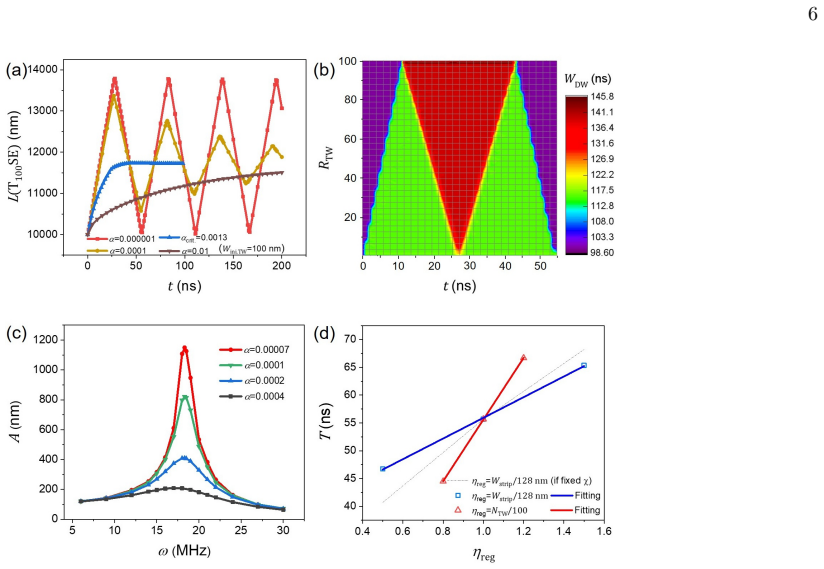
or Newtonian mechanics. Consequently, SE pos- sesses no intrinsic inertia and, in principle, should not oscillate spontaneously about equilibrium. Yet, upon re- leasing an initially compressed T 100SE, clear oscillations emerge—in a sharp triangular waveform seldom seen in nature (Fig. 4(a)). To understand this behavior, we compare the TW profiles at rest...
-
[2]
M. Lombard and L. Phillipson, Indications of bow and stone-tipped arrow use 64000 years ago in kwazulu-natal, south africa, Antiquity84, 635 (2010)
work page 2010
-
[3]
M. A. Littauer and J. H. Crouwel,Chariots and Related Equipment from the Tomb of Tut’ankham¯ un, Tut’ankham¯ un’s tomb series (1985). 8
work page 1985
-
[4]
M. H. Morgan and H. L. Warren,Vitruvius: the ten books on architecture(1914)
work page 1914
-
[5]
Hooke, De potentia restitutiva, or of spring
R. Hooke, De potentia restitutiva, or of spring. explaining the power of springing bodies, inEarly Science in Oxford, Vol. VIII: The Cutler Lectures of Robert Hook, edited by R. T. Gunther (Oxford University Press, Oxford, 1931) pp. 331–356, original work published 1678, London
work page 1931
-
[6]
A. L. Cauchy, Recherches sur l’equilibre et le mouvement interieur des corps solides ou fluides, elastiques ou non elastiques, Bull. Soc. Philomath. Paris2, 9 (1823)
-
[7]
A. J. C. B. Saint-Venant, Memoire sur la torsion des prismes, Mem. L’Acad. Sci.14, 233 (1855)
-
[8]
W. J. M. Rankine, On the application of the theory of elasticity to the design of steam engine pistons and cylin- ders, Trans. Inst. Eng. Shipbuild. Scot.12, 1 (1858)
-
[9]
J. A. Roebling,Report of John A. Roebling, C.E., to the President and Directors of the New York Bridge Company, on the Proposed East River Bridge (Brooklyn Bridge), Tech. Rep. (New York Bridge Company, 1867)
-
[10]
L. Landau and E. Lifshitz, On the theory of the disper- sion of magnetic permeability in ferromagnetic bodies, Phys. Z. Sowjet.8, 153 (1935)
work page 1935
-
[11]
T. L. Gilbert, A phenomenological theory of damping in ferromagnetic materials, IEEE Trans. Magn.40, 3443 (2004)
work page 2004
-
[12]
R. D. McMichael and M. J. Donahue, Head to head do- main wall structures in thin magnetic strips, inIEEE Transactions on Magnetics, Vol. 33 (1997) pp. 4167– 4169
work page 1997
-
[13]
See supplemental material,http://link.aps.org/ supplemental/
-
[14]
Y. Tserkovnyak and J. Xiao, Energy storage via topolog- ical spin textures, Phys. Rev. Lett.121, 127701 (2018)
work page 2018
-
[15]
S. E. Barnes and S. Maekawa, Generalization of faraday’s law to include nonconservative spin forces, Phys. Rev. Lett.98, 246601 (2007)
work page 2007
-
[16]
E. R. Lewis, D. Petit, L. Thevenard, A. V. Jausovec, L. O’Brien, D. E. Read, and R. P. Cowburn, Magnetic domain wall pinning by a curved conduit, Appl. Phys. Lett.95(2009)
work page 2009
-
[17]
A. Thiaville, Y. Nakatani, J. Miltat, and Y. Suzuki, Mi- cromagnetic understanding of current-driven domain wall motion in patterned nanowires, Europhys. Lett.69, 990 (2005)
work page 2005
-
[18]
A. A. Thiele, Steady-state motion of magnetic domains, Physical Review Letters30, 230 (1973)
work page 1973
-
[19]
F. Keffer and C. Kittel, Theory of antiferromagnetic res- onance, Phys. Rev.85, 329 (1952)
work page 1952
discussion (0)
Sign in with ORCID, Apple, or X to comment. Anyone can read and Pith papers without signing in.