Recognition: 2 theorem links
· Lean TheoremBenchmarking a restricted Boltzmann machine on the mathbb{Z}₂ Bose-Hubbard chain in the adiabatic hard-core regime
Pith reviewed 2026-05-12 03:32 UTC · model grok-4.3
The pith
A shallow restricted Boltzmann machine reproduces the adiabatic phase structure of the Z2 Bose-Hubbard chain at half filling
A machine-rendered reading of the paper's core claim, the machinery that carries it, and where it could break.
Core claim
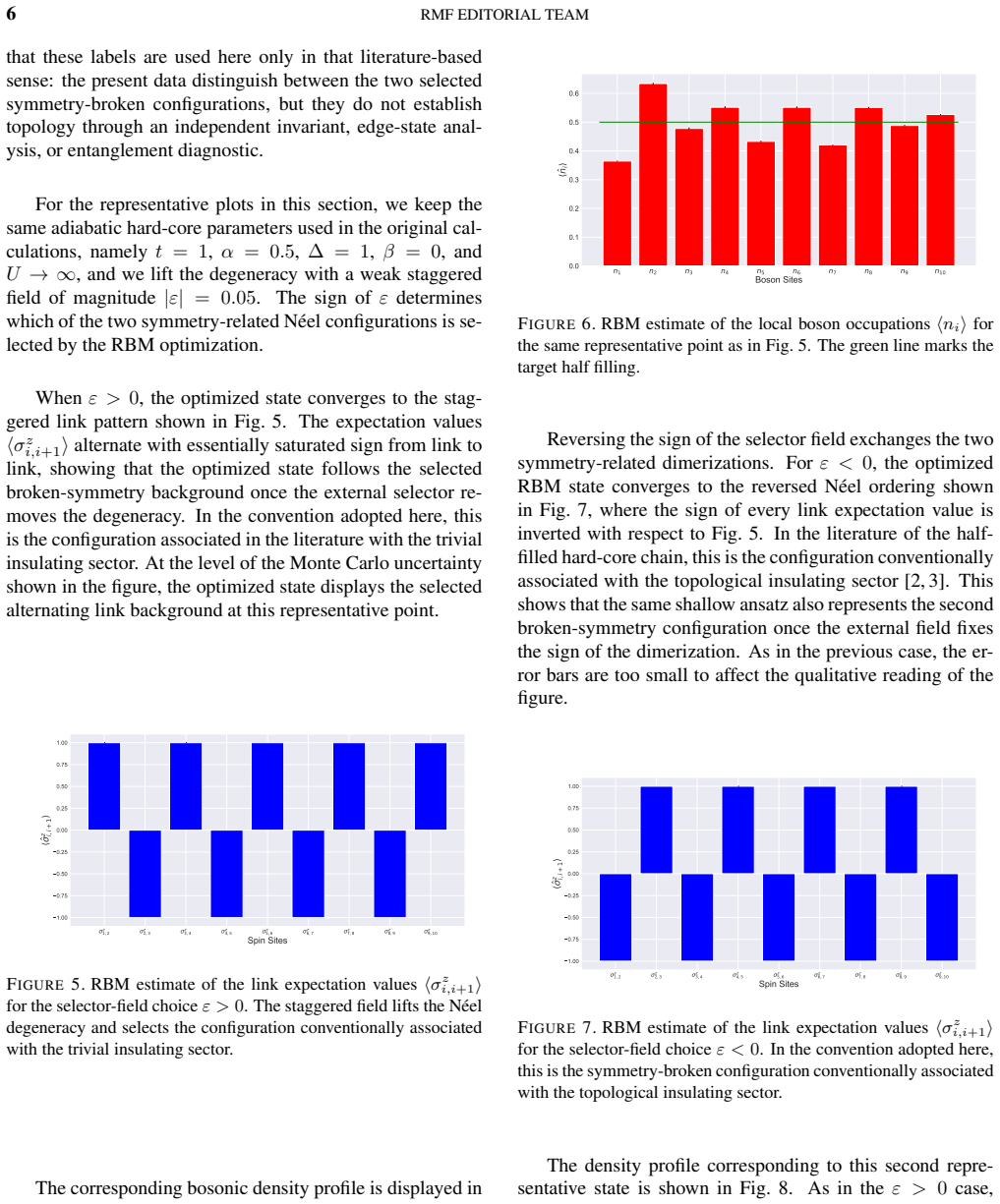
Using variational Monte Carlo with a shallow restricted Boltzmann machine as the variational ansatz, the ground state of the Z2 Bose-Hubbard chain in the adiabatic hard-core limit at half filling is studied. The variational results reproduce the overall structure of the phase diagram obtained from magnetization observables, distinguish the polarized and Neel-ordered regions, and capture representative spin patterns and site occupations for the staggered insulating configurations selected by a weak symmetry-breaking field.
What carries the argument
Shallow restricted Boltzmann machine as variational ansatz in Monte Carlo sampling, which parametrizes the wavefunction to approximate ground-state properties
If this is right
- The variational results match the expected overall phase diagram from magnetization observables.
- Polarized and Neel-ordered regions are distinguished by the neural ansatz.
- Staggered insulating configurations under weak symmetry breaking are recovered in site occupations and spin patterns.
Where Pith is reading between the lines
- The success on this one-dimensional gauge model suggests the same shallow ansatz could be tested on non-adiabatic regimes or small two-dimensional lattices where exact methods become costly.
- If the ansatz remains accurate, it offers a route to larger system sizes in similar Z2-coupled bosonic chains without requiring deeper networks.
- The ability to select symmetry-broken states with a weak field points to possible use in studying related symmetry-breaking phenomena in lattice gauge theories.
Load-bearing premise
The shallow restricted Boltzmann machine wavefunction combined with variational Monte Carlo sampling is sufficiently expressive and free of sampling bias to represent the true ground state in this regime.
What would settle it
Exact diagonalization on small chains in the same adiabatic hard-core regime at half filling that produces magnetization or order-parameter values differing substantially from the restricted Boltzmann machine results would falsify the reproduction claim.
Figures
read the original abstract
We study the ground state of the $\mathbb{Z}_2$ Bose-Hubbard chain in the adiabatic hard-core limit at half filling using variational Monte Carlo with a shallow restricted Boltzmann machine as the variational ansatz. In this context, the neural quantum state is compared with the established adiabatic description of the model. The variational results reproduce the overall structure of the phase diagram obtained from magnetization observables, distinguish the polarized and N\'eel-ordered regions, and capture representative spin patterns and site occupations for the staggered insulating configurations selected by a weak symmetry-breaking field. Taken together, these results show that a shallow restricted Boltzmann machine reproduces the main adiabatic phase structure of the one-dimensional $\mathbb{Z}_2$ Bose-Hubbard chain and captures the selected symmetry-broken insulating configurations at half filling.
Editorial analysis
A structured set of objections, weighed in public.
Referee Report
Summary. The manuscript benchmarks variational Monte Carlo sampling with a shallow restricted Boltzmann machine ansatz on the ground state of the one-dimensional Z2 Bose-Hubbard chain in the adiabatic hard-core regime at half filling. It reports that the variational results reproduce the overall structure of the phase diagram extracted from magnetization observables, distinguish polarized and Néel-ordered regions, and capture representative spin patterns together with site occupations for the staggered insulating states selected by a weak symmetry-breaking field.
Significance. If the reported reproduction holds under converged sampling, the work supplies a concrete benchmark showing that a shallow RBM can represent the essential adiabatic physics of this Z2-symmetric lattice model without apparent circularity in the comparison. Such benchmarks are useful for calibrating neural quantum states against independent analytic or numerical references in one-dimensional quantum spin systems.
major comments (2)
- [§4 (Results)] §4 (Results): the claim that the RBM-VMC 'reproduces the overall structure of the phase diagram' rests on visual or qualitative agreement in magnetization observables; quantitative metrics (e.g., L2 deviation of order parameters or location of phase boundaries with error bars) are not provided, leaving the strength of the reproduction open to interpretation.
- [§3 (Methods)] §3 (Methods): the description of the VMC sampling does not specify the number of samples per optimization step, the thermalization length, or the autocorrelation time used to compute the reported magnetization and spin patterns; without these, it is difficult to assess whether the captured configurations are statistically reliable.
minor comments (2)
- [Notation] The notation for the symmetry-breaking field strength should be introduced once in the text and used consistently in all figure captions and tables.
- [Figures] Figure 2 (or equivalent): the site-occupation plots for the Néel configurations would benefit from an overlay of the exact adiabatic reference pattern for direct visual comparison.
Simulated Author's Rebuttal
We thank the referee for the careful reading of our manuscript and the constructive comments. We appreciate the positive assessment of the benchmark and the recommendation for minor revision. We address each major comment below and have revised the manuscript accordingly to improve clarity and rigor.
read point-by-point responses
-
Referee: [§4 (Results)] §4 (Results): the claim that the RBM-VMC 'reproduces the overall structure of the phase diagram' rests on visual or qualitative agreement in magnetization observables; quantitative metrics (e.g., L2 deviation of order parameters or location of phase boundaries with error bars) are not provided, leaving the strength of the reproduction open to interpretation.
Authors: We agree that the original presentation relied primarily on visual comparison of magnetization observables and the distinction of polarized versus Néel-ordered regions. To strengthen the claim, we have added quantitative metrics in the revised §4: the L2 deviation between RBM-VMC and reference order parameters at selected points in the phase diagram, together with estimated locations of the phase boundaries including statistical uncertainties obtained from the Monte Carlo sampling. These additions are supported by a new table in the supplementary material. revision: yes
-
Referee: [§3 (Methods)] §3 (Methods): the description of the VMC sampling does not specify the number of samples per optimization step, the thermalization length, or the autocorrelation time used to compute the reported magnetization and spin patterns; without these, it is difficult to assess whether the captured configurations are statistically reliable.
Authors: We thank the referee for highlighting this omission in the methods description. In the revised manuscript we have expanded §3 to specify the sampling parameters used throughout the study: 10^4 samples per optimization step following 5000 thermalization sweeps, with an integrated autocorrelation time of approximately 50 Monte Carlo steps for the magnetization observables (computed via the blocking method). These details confirm that the reported configurations and observables are statistically reliable. revision: yes
Circularity Check
No significant circularity identified
full rationale
The paper benchmarks a shallow RBM variational ansatz via VMC optimization on the Z2 Bose-Hubbard chain at half filling in the adiabatic hard-core limit. The central procedure optimizes the neural quantum state parameters to minimize the variational energy (standard VMC), then compares resulting magnetization observables, phase boundaries, and selected symmetry-broken configurations against an independently established adiabatic description of the model. No load-bearing step reduces the reported reproduction to a self-definition, a fitted input renamed as prediction, or a self-citation chain; the adiabatic benchmark is external and the optimization does not incorporate the target phase structure or observables as constraints. The derivation chain is therefore self-contained against an external reference.
Axiom & Free-Parameter Ledger
axioms (1)
- domain assumption The adiabatic hard-core limit provides an accurate established description of the Z2 Bose-Hubbard chain at half filling.
Lean theorems connected to this paper
-
IndisputableMonolith/Cost/FunctionalEquation.leanwashburn_uniqueness_aczel unclearWe study the ground state of the Z2 Bose-Hubbard chain in the adiabatic hard-core limit at half filling using variational Monte Carlo with a shallow restricted Boltzmann machine as the variational ansatz... reproduce the overall structure of the phase diagram obtained from magnetization observables
-
IndisputableMonolith/Foundation/RealityFromDistinction.leanreality_from_one_distinction unclearThe variational results reproduce the overall structure of the phase diagram... distinguish the polarized and Néel-ordered regions
Reference graph
Works this paper leans on
-
[1]
and the early overview of RBMs in quantum physics [13], the field expanded toward recurrent and autoregres- sive wave functions with exact sampling [21], explicit ap- plications to topological order beyond conventional Landau phases [22], and deeper analyses of expressive power link- ing deep neural quantum states to tensor-network construc- tions [23]. M...
-
[2]
The optimized state is then probed through the total and staggered magnetizations introduced in Eq. (2). Since the two symmetry-related Néel configurations differ only by the Rev. Mex. Fis.??(*?*) (????) ???–??? A LATEXTEMPLATE FOR THE RMF, RMF-E, SRMF5 sign of the staggered response, the phase map is most con- veniently summarized by the pair(m t,|m s|)....
-
[3]
González-Cuadra, et al., Strongly Correlated Bosons on a Dynamical Lattice, Phys
D. González-Cuadra, et al., Strongly Correlated Bosons on a Dynamical Lattice, Phys. Rev. Lett. 121 (2018) 090402, 10.1103/PhysRevLett.121.090402
-
[4]
D. González-Cuadra, et al., Symmetry-Breaking Topological Insulators in theZ 2 Bose-Hubbard Model, Physical Review B 99 (2019) 045139
work page 2019
-
[5]
D. González-Cuadra, et al., Intertwined topological phases in- duced by emergent symmetry protection, Nature Communica- tions 10 (2019) 2694,10.1038/s41467-019-10796-8
-
[6]
Statistical Mechanics of Interacting Run-and-Tumble Bacteria
D. González-Cuadra, et al., Dynamical Solitons and Boson Fractionalization in Cold-Atom Topological Insulators, Phys. Rev. Lett. 125 (2020) 265301,10.1103/PhysRevLett. 125.265301
-
[7]
T. Chanda, et al., Devil’s staircase of topological Peierls in- sulators and Peierls supersolids, SciPost Phys. 12 (2022) 076, 10.21468/SciPostPhys.12.2.076
-
[8]
T. Chanda, et al., Recent progress on quantum simulations of non-standard Bose-Hubbard models, Reports on Progress in Physics 88 (2025) 044501,10.1088/1361-6633/ adc3a7
-
[9]
D. González-Cuadra, et al.,Z n solitons in intertwined topo- logical phases, Physical Review B 102 (2020) 245137,10. 1103/PhysRevB.102.245137
work page 2020
-
[10]
Y . Watanabe, S. Watabe, and T. Nikuni, Transverse Field De- pendence of the Ground State in theZ 2 Bose-Hubbard Model (2025)
work page 2025
-
[11]
S. R. White, Density matrix formulation for quantum renormal- ization groups, Phys. Rev. Lett. 69 (1992) 2863,10.1103/ PhysRevLett.69.2863
work page 1992
-
[12]
U. Schollwöck, The density-matrix renormalization group in the age of matrix product states, Annals of Physics 326 (2011) 96,10.1016/j.aop.2010.09.012
-
[13]
G. Catarina and B. Murta, Density-matrix renormal- ization group: a pedagogical introduction, The Euro- pean Physical Journal B 96 (2023),10.1140/epjb/ s10051-023-00575-2
-
[14]
G. Carleo and M. Troyer, Solving the Quantum Many-Body Problem with Artificial Neural Networks, Science 355 (2017) 602,10.1126/science.aag2302
-
[15]
R. Melko, et al., Restricted Boltzmann Machines in Quan- tum Physics, Nature Physics 15 (2019),10.1038/ s41567-019-0545-1
work page 2019
-
[16]
H. Lange, et al., From Architectures to Applications: A Review of Neural Quantum States, Quantum Science and Technology 9 (2024) 040501,10.1088/2058-9565/ad7168
-
[17]
H. Saito, Solving the Bose-Hubbard Model with Machine Learning, Journal of the Physical Society of Japan 86 (2017) 093001,10.7566/JPSJ.86.093001
-
[18]
H. Saito and M. Kato, Machine Learning Technique to Find Quantum Many-Body Ground States of Bosons on a Lattice, Journal of the Physical Society of Japan 87 (2018) 014001, 10.7566/JPSJ.87.014001
-
[19]
K. McBrian, G. Carleo, and E. Khatami, Ground state phase diagram of the one-dimensional Bose-Hubbard model from re- stricted Boltzmann machines, Journal of Physics: Conference Series 1290 (2019) 012005,10.1088/1742-6596/1290/ 1/012005
-
[20]
V . Vargas-Calderón, H. Vinck-Posada, and F. A. González, Phase Diagram Reconstruction of the Bose-Hubbard Model with a Restricted Boltzmann Machine Wavefunction, Journal of the Physical Society of Japan 89 (2020) 094002,10.7566/ JPSJ.89.094002
work page 2020
- [21]
-
[22]
M. Y . Pei and S. R. Clark, Specialising neural-network quan- tum states for the Bose Hubbard model, Journal of Physics B: Atomic, Molecular and Optical Physics 57 (2024) 215301, 10.1088/1361-6455/ad7e87
-
[23]
M. Hibat-Allah, et al., Recurrent neural network wave func- tions, Physical Review Research 2 (2020) 023358,10.1103/ PhysRevResearch.2.023358
work page 2020
-
[24]
M. Hibat-Allah, R. G. Melko, and J. Carrasquilla, Investigat- ing topological order using recurrent neural networks, Physical Review B 108 (2023) 075152,10.1103/PhysRevB.108. 075152
- [25]
-
[26]
A. Chen and M. Heyl, Empowering deep neural quantum states through efficient optimization, Nature Physics 20 (2024) 1476, 10.1038/s41567-024-02566-1
-
[27]
K. Sprague and S. Czischek, Variational Monte Carlo with Large Patched Transformers, Communications Physics 7 (2024) 90,10.1038/s42005-024-01584-y
-
[28]
Z. Denis and G. Carleo, Accurate neural quantum states for in- teracting lattice bosons, Quantum 9 (2025) 1772,10.22331/ q-2025-06-17-1772 Rev. Mex. Fis.??(*?*) (????) ???–??? 10RMF EDITORIAL TEAM
work page 2025
-
[29]
W. P. Su, J. R. Schrieffer, and A. J. Heeger, Solitons in Poly- acetylene, Phys. Rev. Lett. 42 (1979) 1698,10.1103/ PhysRevLett.42.1698
work page 1979
-
[30]
Vicentini, et al., NetKet 3: Machine Learning Toolbox for Many-Body Quantum Systems (2021)
F. Vicentini, et al., NetKet 3: Machine Learning Toolbox for Many-Body Quantum Systems (2021)
work page 2021
-
[31]
Sorella, Green Function Monte Carlo with Stochastic Re- configuration, Phys
S. Sorella, Green Function Monte Carlo with Stochastic Re- configuration, Phys. Rev. Lett. 80 (1998) 4558,10.1103/ PhysRevLett.80.4558 Rev. Mex. Fis.??(*?*) (????) ???–???
work page 1998
discussion (0)
Sign in with ORCID, Apple, or X to comment. Anyone can read and Pith papers without signing in.