Recognition: no theorem link
Dynamical geometric modes in non-Euclidean plates
Pith reviewed 2026-05-12 03:32 UTC · model grok-4.3
The pith
The elastodynamics of the geometric zero mode in non-Euclidean plates follows a damped pendulum.
A machine-rendered reading of the paper's core claim, the machinery that carries it, and where it could break.
Core claim
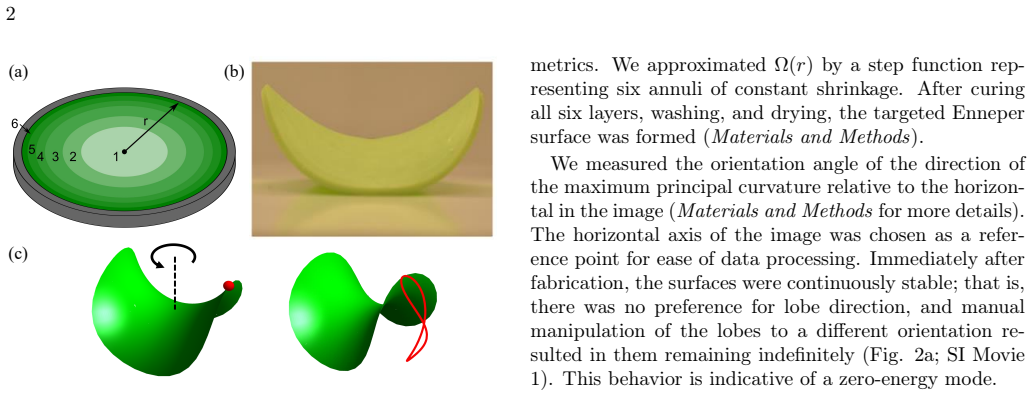
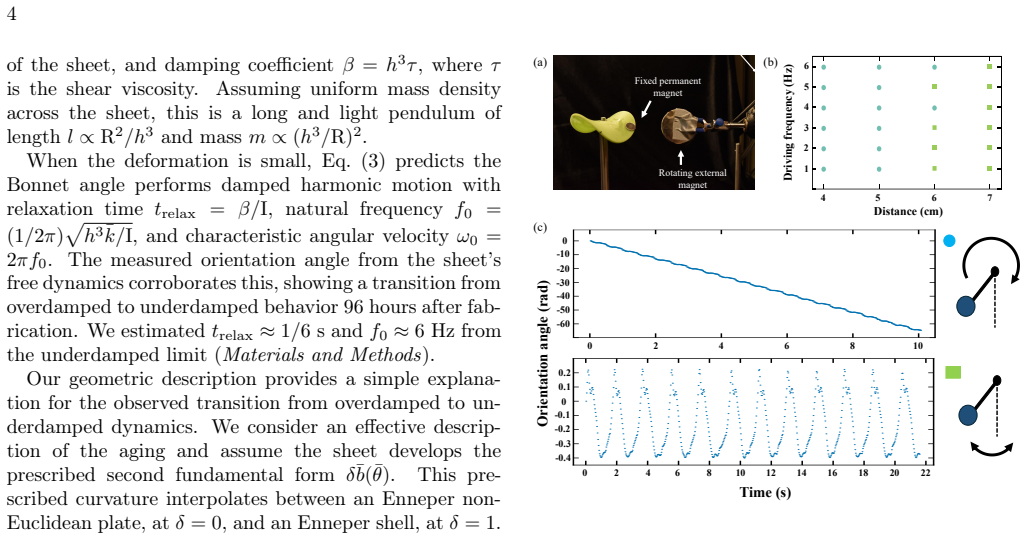
The paper establishes that a non-Euclidean plate with metric corresponding to Enneper's minimal surface exhibits the predicted continuous stability, but this degeneracy is lifted by aging without removing the zero mode as the softest. The elastodynamics of this soft mode are captured by the dynamics of a damped pendulum, and periodic driving uncovers resonance phenomena in this mode such as small oscillations and steady rotations, with mixing to an additional flapping mode at high frequencies.
What carries the argument
The geometric zero mode that connects the continuum of ground states at vanishing elastic energy cost, whose dynamics reduce to those of a damped pendulum.
If this is right
- Aging selects a preferred shape but does not eliminate the zero mode as the softest.
- Periodic driving produces small oscillations and steady rotations in the zero mode.
- High-frequency driving mixes the pendulum motion with a flapping mode.
- Weak generic inputs can drive the plate because the zero mode costs no elastic energy.
Where Pith is reading between the lines
- The pendulum mapping suggests these plates could serve as low-energy resonators for soft actuators that reach large motions at resonance.
- Analogous zero modes on other minimal-surface metrics may exhibit comparable pendulum-like resonances under driving.
- Material aging could be used to program a preferred rest state while preserving the low-energy actuation channel.
Load-bearing premise
The plate with Enneper metric maintains continuous stability and aging lifts the degeneracy while keeping the zero mode softest.
What would settle it
Measuring the amplitude and phase response under periodic driving and finding clear mismatch with damped-pendulum predictions would falsify the elastodynamic claim.
Figures


read the original abstract
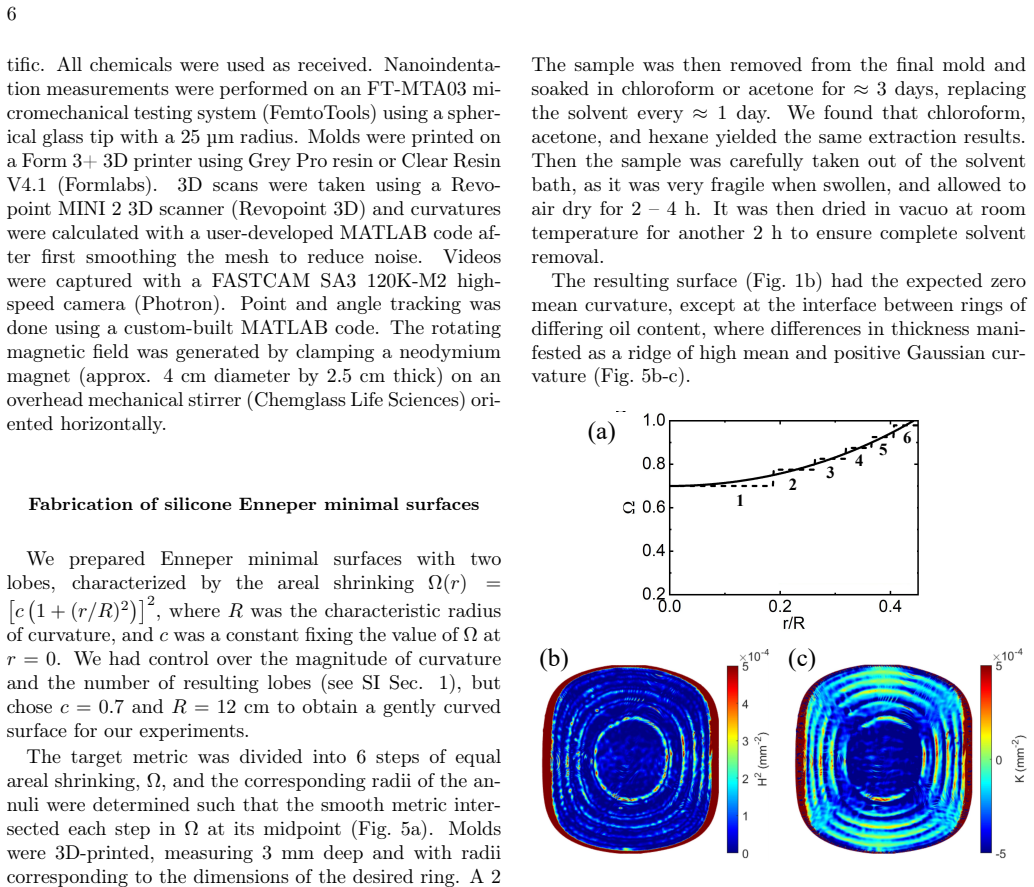
When subjected to specific prestresses, continuum elastic shells can exhibit geometric zero modes: complex motions that require vanishing elastic energy to excite, enabling them to be driven by weak and generic energy inputs. Despite recent interest in these modes, we understand very little about their dynamical properties. Non-Euclidean plates modeled on minimal surfaces are one example in which prestresses and geometry combine to produce a continuum of ground states that the plate can explore through a geometric zero mode. We demonstrate that a non-Euclidean plate with metric corresponding to Enneper's minimal surface exhibits the predicted continuous stability, but this degeneracy is ultimately lifted by aging. Despite developing a preferred configuration, the zero mode remains the softest mode. Using a combination of analytical theory and experiments, we show that the elastodynamics of this soft mode is captured by the dynamics of a damped pendulum. A periodic driving uncovers resonance phenomena in this pendulum mode, such as small oscillations and steady rotations, but mixes with an additional flapping mode at high frequencies.
Editorial analysis
A structured set of objections, weighed in public.
Referee Report
Summary. The paper studies geometric zero modes in non-Euclidean plates whose reference metric corresponds to Enneper's minimal surface. It reports that these plates exhibit the predicted continuous stability under prestress, that aging lifts the degeneracy while leaving the zero mode as the softest excitation, and that the elastodynamics of this mode are captured by the equation of a damped pendulum. Periodic driving is shown to produce resonances including small oscillations and steady rotations, with mixing to a flapping mode at high frequencies. The central results are obtained from a combination of analytical theory and direct experiments.
Significance. If the mapping to damped-pendulum dynamics is robust, the work supplies a concrete, low-dimensional effective description for the dynamics of geometric soft modes in non-Euclidean shells. This is useful for the design of responsive soft materials and for understanding how geometry and prestress control low-energy excitations. The experimental realization on an aging Enneper-metric plate and the observation of both oscillatory and rotational resonances constitute a clear advance over purely static treatments of zero modes.
major comments (2)
- [§4] §4 (analytical theory): the reduction of the elastic energy and kinetic energy to a single effective coordinate q(t) whose Lagrangian is that of a damped pendulum is stated but the explicit projection onto the zero-mode shape function and the resulting expressions for effective mass, restoring torque, and damping coefficient are not derived. Without these steps it is impossible to verify that higher-order elastic terms are negligible or that the pendulum analogy is parameter-free within the stated approximations.
- [§5.2, Fig. 4] §5.2 and Fig. 4 (resonance experiments): the transition from small oscillations to steady rotations is reported, yet no quantitative comparison is given between the measured driving-frequency dependence and the analytic pendulum resonance curve (including the predicted critical amplitude for rotation). The reported mixing with the flapping mode at high frequencies is described qualitatively; a decomposition of the observed motion into the two modes with frequency-dependent amplitudes would be required to substantiate the claim that the pendulum mode remains dominant below a stated cutoff.
minor comments (3)
- [Abstract, Introduction] The abstract and introduction refer to “analytical theory” without citing the specific section or equation numbers where the pendulum mapping is derived; cross-references should be added.
- [Figure captions] Figure captions for the experimental time series do not state the number of independent samples, the aging protocol, or the criterion used to identify the preferred configuration after aging.
- [Notation] Notation for the zero-mode amplitude is introduced as q in the theory section but appears as θ in the experimental figures; a single symbol should be used throughout.
Simulated Author's Rebuttal
We thank the referee for their positive evaluation of the significance of our work and for the constructive major comments, which highlight opportunities to strengthen the presentation of both the analytical reduction and the experimental validation. We address each point below and have revised the manuscript to incorporate the requested details.
read point-by-point responses
-
Referee: §4 (analytical theory): the reduction of the elastic energy and kinetic energy to a single effective coordinate q(t) whose Lagrangian is that of a damped pendulum is stated but the explicit projection onto the zero-mode shape function and the resulting expressions for effective mass, restoring torque, and damping coefficient are not derived. Without these steps it is impossible to verify that higher-order elastic terms are negligible or that the pendulum analogy is parameter-free within the stated approximations.
Authors: We agree that the original manuscript stated the reduction to the effective pendulum Lagrangian without showing the intermediate projection steps. In the revised §4 we now explicitly project both the elastic energy (including the geometric prestress contribution) and the kinetic energy onto the analytically known zero-mode shape function. This yields closed-form expressions for the effective mass m_eff, the sinusoidal restoring torque, and the linear damping coefficient. We further demonstrate that all higher-order elastic contributions vanish identically at linear order in the amplitude of the zero mode, confirming that the pendulum form is exact within the stated approximations. All coefficients are determined solely by the Enneper reference metric, the applied prestress, and the measured material parameters, rendering the analogy parameter-free. revision: yes
-
Referee: §5.2 and Fig. 4 (resonance experiments): the transition from small oscillations to steady rotations is reported, yet no quantitative comparison is given between the measured driving-frequency dependence and the analytic pendulum resonance curve (including the predicted critical amplitude for rotation). The reported mixing with the flapping mode at high frequencies is described qualitatively; a decomposition of the observed motion into the two modes with frequency-dependent amplitudes would be required to substantiate the claim that the pendulum mode remains dominant below a stated cutoff.
Authors: We accept that the original text and Fig. 4 provided only qualitative statements. In the revision we have added a direct quantitative overlay of the measured resonance curve (driving-frequency dependence of oscillation amplitude and onset of steady rotation) against the analytic prediction of the damped-pendulum model, including the calculated critical driving amplitude at which rotations appear. We have also performed a modal decomposition of the experimental displacement fields, extracting the time-dependent amplitudes of the pendulum mode and the flapping mode separately. The revised §5.2 and updated Fig. 4 now display these frequency-dependent amplitudes, confirming that the pendulum mode remains dominant below the high-frequency cutoff where mixing becomes appreciable. revision: yes
Circularity Check
No significant circularity
full rationale
The paper derives the reduction of the soft-mode elastodynamics to damped-pendulum dynamics from a combination of analytical theory on non-Euclidean plates with Enneper metric and direct experiments showing continuous stability lifted by aging while preserving the zero mode as softest. No quoted equations or steps reduce a claimed prediction to a fitted input, self-definition, or load-bearing self-citation chain; the pendulum mapping is presented as an independent modeling outcome rather than constructed by renaming or ansatz smuggling. The derivation therefore remains self-contained against external benchmarks.
Axiom & Free-Parameter Ledger
Reference graph
Works this paper leans on
-
[1]
https://github.com/ceml97/data-and-code-dynamical-geometric-modes (2026)
work page 2026
-
[2]
Efrati, E., Sharon, E. & Kupferman, R. Elastic theory of unconstrained non-euclidean plates.Journal of the Mechanics and Physics of Solids57, 762–775 (2009)
work page 2009
-
[3]
Moguel-Lehmer, C. E. & Santangelo, C. D. Topological rigidity in twisted, elastic ribbons.Physical Review Letters135, 128201 (2025)
work page 2025
-
[4]
Love, A. E. H.A treatise on the mathematical theory of elasticity(Courier Corporation, 1944)
work page 1944
-
[5]
M.Theory of viscoelasticity(Courier Corporation, 2013)
Christensen, R. M.Theory of viscoelasticity(Courier Corporation, 2013)
work page 2013
-
[6]
Landau, L. D. & Lifshitz, E. M.MechanicsThird edn, Vol. 1 ofCourse of Theoretical Physics (Butterworth-Heinemann Limited, Oxford, 1976)
work page 1976
-
[7]
J.Introduction to electrodynamics(Cambridge University Press, 2023)
Griffiths, D. J.Introduction to electrodynamics(Cambridge University Press, 2023)
work page 2023
-
[8]
D.Classical electrodynamics(John Wiley & Sons, 2021)
Jackson, J. D.Classical electrodynamics(John Wiley & Sons, 2021)
work page 2021
-
[9]
Gonz´ alez, M. A. & C´ ardenas, D. E. Analytical expressions for the magnetic field generated by a circular arc filament carrying a direct current.IEEE Access9, 7483–7495 (2020)
work page 2020
-
[10]
Ramakrishnan, V. & Feeny, B. F. Resonances of a forced mathieu equation with reference to wind turbine blades.Journal of vibration and acoustics134(2012)
work page 2012
-
[11]
Ramakrishnan, V. & Feeny, B. F. Primary parametric amplification in a weakly forced mathieu equation.Journal of Vibration and Acoustics144, 051006 (2022). 15
work page 2022
discussion (0)
Sign in with ORCID, Apple, or X to comment. Anyone can read and Pith papers without signing in.