Recognition: no theorem link
Bootstrap-Based Receiver Synchronization and System Discovery in B2X: An Extension of ATSC 3.0
Pith reviewed 2026-05-12 03:12 UTC · model grok-4.3
The pith
B2X bootstrap signals enable reliable synchronization and system discovery alongside ATSC 3.0 waveforms.
A machine-rendered reading of the paper's core claim, the machinery that carries it, and where it could break.
Core claim
The B2X extension of ATSC 3.0 introduces a bootstrap signaling design that supports a range of bandwidth configurations and enables reliable receiver synchronization and system identification in environments where multiple waveforms coexist. Through targeted parameter selection, the design maintains low cross-correlation with ATSC 3.0 bootstrap signals. Simulations across varied channel and mobility conditions confirm consistent detection performance suitable for multicast and broadcast operations.
What carries the argument
The bootstrap signal, a predefined sequence for initial detection and synchronization, engineered with parameters that ensure low cross-correlation to ATSC 3.0 while scaling across bandwidths.
If this is right
- Supports interworking between ATSC 3.0 broadcast networks and 3GPP mobile systems for efficient service delivery.
- Allows reliable system discovery when both B2X and ATSC 3.0 signals are present simultaneously.
- Maintains detection performance from stationary receivers through high-speed mobility scenarios.
- Provides a scalable bootstrap framework adaptable to different bandwidth requirements.
Where Pith is reading between the lines
- Hybrid broadcast-mobile networks could expand to handle more video streaming traffic if the bootstrap proves stable in live deployments.
- The parameter selection approach for low cross-correlation might guide similar extensions in future broadcast standards.
- Real-world testing beyond simulations could identify specific edge cases like multipath fading not fully captured in the models.
Load-bearing premise
The simulated propagation and mobility conditions accurately represent real-world environments where B2X receivers will operate.
What would settle it
Field measurements in actual urban or high-mobility settings showing bootstrap detection failure rates substantially above those in the simulations would undermine the robustness conclusion.
Figures



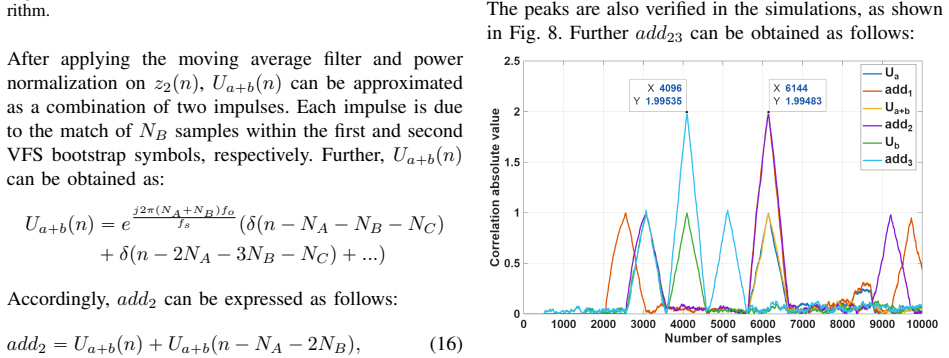


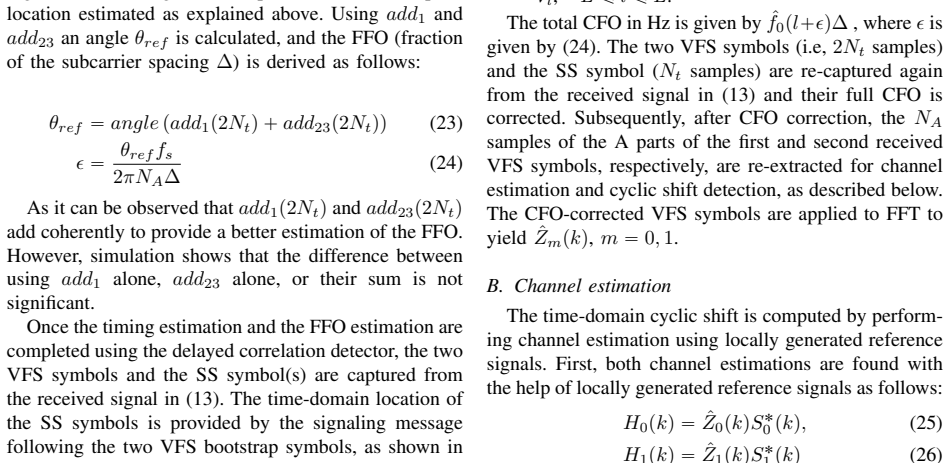
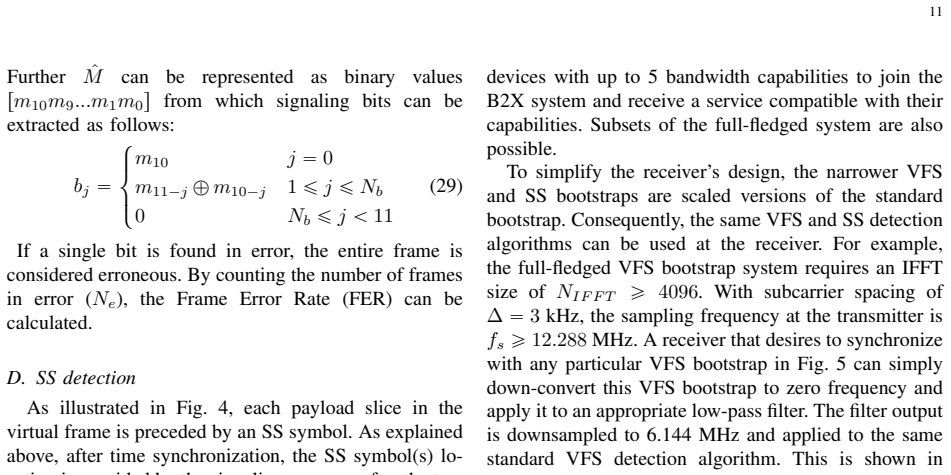


read the original abstract
Addressing the increasing and diversified demands of multicast and broadcast services require highly efficient multicast and broadcast technologies. Broadcast networks, such as Advanced Television Systems Committee 3.0 (ATSC 3.0), are inherently designed to support these services and continue to evolve to meet growing performance and scalability requirements. At the same time, smartphones are increasingly used for video streaming and other high-volume services, placing growing pressure on mobile network capacity. Interworking between broadcast and mobile networks is therefore an important enabler for efficient and seamless service delivery. In this context, Broadcast-to-Everything (B2X) extends ATSC 3.0 to support enhanced interoperability with Third Generation Partnership Project (3GPP) mobile systems while maintaining low cross-correlation with ATSC 3.0 bootstrap signals, supporting reliable system identification in scenarios where multiple waveforms may be present. Bootstrap signaling, which enables initial signal detection and synchronization, is a key feature of ATSC-based waveform discovery and synchronization, and B2X further extends this capability through a scalable bootstrap framework supporting a range of bandwidth configurations. This paper investigates system discovery through bootstrap signal detection at the B2X receiver and presents key design-related findings, including parameter selection and cross-testing with ATSC 3.0. We present extensive simulations of the receiver performance under diverse propagation and mobility conditions, ranging from stationary to high-speed scenarios. The results demonstrate the robustness of the B2X bootstrap signaling design across a broad range of channel conditions relevant to multicast and broadcast operation.
Editorial analysis
A structured set of objections, weighed in public.
Referee Report
Summary. The paper proposes B2X as an extension of ATSC 3.0 to enable interoperability with 3GPP mobile networks for multicast and broadcast services. It introduces a scalable bootstrap signaling framework with low cross-correlation to existing ATSC 3.0 signals, details parameter selection for system discovery and synchronization, and reports simulation results showing reliable bootstrap detection performance across stationary to high-mobility propagation conditions.
Significance. If the simulation-based robustness claims hold under more detailed scrutiny, the work would provide a concrete signaling solution for broadcast-mobile interworking, addressing capacity demands on mobile networks while preserving compatibility with ATSC 3.0 waveforms. The emphasis on extensive simulations across mobility regimes is a positive aspect that supports practical relevance for B2X deployment scenarios.
major comments (3)
- [Simulations section] Simulations section (likely §4 or equivalent): The central robustness claim rests on detection performance curves, yet the manuscript provides no error bars, confidence intervals, or details on the number of Monte Carlo trials used to generate the results. This omission makes it difficult to assess the statistical reliability of the reported performance across the tested channel conditions.
- [Channel model description] Channel model description (likely §3 or §4): The paper employs standard models (AWGN, Rayleigh, etc.) but does not quantify or simulate B2X-specific impairments such as co-channel interference from 3GPP waveforms, non-stationary Doppler spectra, or urban canyon multipath profiles. Since the weakest assumption is that these models represent real B2X environments, this gap directly affects the load-bearing claim of broad robustness.
- [Parameter selection subsection] Parameter selection subsection: The abstract notes post-hoc parameter selection for the bootstrap design, but the text does not include a sensitivity analysis or quantified impact of these choices on detection probability, leaving open whether the reported performance is robust to reasonable variations in the free parameters.
minor comments (2)
- [Abstract/Introduction] The abstract and introduction could more explicitly reference the specific ATSC 3.0 bootstrap signal structure (e.g., the Zadoff-Chu sequences or correlation properties) to clarify the cross-correlation claims.
- [Figures] Figure captions for performance plots should include the exact SNR range, mobility speeds, and channel model parameters used in each curve for reproducibility.
Simulated Author's Rebuttal
We thank the referee for the constructive comments on our manuscript. We provide point-by-point responses below and indicate the revisions to be made in the next version.
read point-by-point responses
-
Referee: Simulations section (likely §4 or equivalent): The central robustness claim rests on detection performance curves, yet the manuscript provides no error bars, confidence intervals, or details on the number of Monte Carlo trials used to generate the results. This omission makes it difficult to assess the statistical reliability of the reported performance across the tested channel conditions.
Authors: We acknowledge this omission. In the revised manuscript, we will specify the number of Monte Carlo trials performed for each simulation scenario and include error bars or confidence intervals on the detection performance curves to allow better assessment of statistical reliability. This revision will be made in the Simulations section. revision: yes
-
Referee: Channel model description (likely §3 or §4): The paper employs standard models (AWGN, Rayleigh, etc.) but does not quantify or simulate B2X-specific impairments such as co-channel interference from 3GPP waveforms, non-stationary Doppler spectra, or urban canyon multipath profiles. Since the weakest assumption is that these models represent real B2X environments, this gap directly affects the load-bearing claim of broad robustness.
Authors: The manuscript uses standard channel models to evaluate the fundamental performance of the B2X bootstrap under a range of mobility conditions. We agree that incorporating B2X-specific impairments would provide a more complete picture. In the revision, we will add a dedicated paragraph in the channel model section discussing these limitations and the rationale for using standard models as a starting point, along with plans for future extensions to include co-channel interference and urban canyon effects. This will clarify the scope without altering the core claims. revision: partial
-
Referee: Parameter selection subsection: The abstract notes post-hoc parameter selection for the bootstrap design, but the text does not include a sensitivity analysis or quantified impact of these choices on detection probability, leaving open whether the reported performance is robust to reasonable variations in the free parameters.
Authors: We will enhance the Parameter selection subsection to include a sensitivity analysis showing the impact of key parameter variations on detection probability. This will quantify the robustness of the chosen parameters and address the concern raised. revision: yes
Circularity Check
No circularity: performance claims rest on independent simulations
full rationale
The paper presents a bootstrap signaling design extension for B2X interoperability with ATSC 3.0 and 3GPP systems, followed by simulation-based evaluation of detection performance under AWGN, Rayleigh, and mobility channels. No equations, parameter fits, or predictions are shown that reduce by construction to the same data or self-citations. The central robustness claim is supported by external benchmark simulations rather than any self-referential derivation or ansatz smuggling. This is the expected non-circular outcome for a simulation-driven engineering paper.
Axiom & Free-Parameter Ledger
free parameters (1)
- bootstrap parameters
Reference graph
Works this paper leans on
-
[1]
Streaming statistics and growth projections for 2026,
S. Basu, “Streaming statistics and growth projections for 2026,” https://www.muvi.com/blogs/streaming-statistics-in-2025/, 2025, published: November 26, 2025. Accessed: 2026-03-28
work page 2026
-
[2]
Survey: Almost 90% of Gen Z Viewers Watch Video on Phones Weekly,
The Streamable, “Survey: Almost 90% of Gen Z Viewers Watch Video on Phones Weekly,” http://thestreamable.com/survey-alm ost-90-percent-of-gen-z-viewers-watch-video-on-phones-wee kly-are-mobile-streaming-plans-coming-to-us, 2023, accessed: 2026-03-28
work page 2023
- [3]
-
[4]
ATSC 3.0 Next Generation Digital TV Standard—An Overview and Preview of the Issue,
R. Chernock, D. Gomez-Barquero, J. Whitaker, S.-I. Park, and Y . Wu, “ATSC 3.0 Next Generation Digital TV Standard—An Overview and Preview of the Issue,”IEEE Transactions on Broadcasting, vol. 62, no. 1, p. 154–158, Mar. 2016
work page 2016
-
[5]
ATSC (B2X) Multicast Broadcast Neutral-Host O-RAN System Architecture,
Michael Simon, Sangsu Kim, James Kelso and Joe Fabiano, “ATSC (B2X) Multicast Broadcast Neutral-Host O-RAN System Architecture,”IBC, 2025
work page 2025
-
[6]
System Discovery and Signaling Transmission Using Bootstrap in ATSC 3.0,
D. He, K. Shelby, M. Earnshaw, Y . Huang, H. Xu, and S.-I. Park, “System Discovery and Signaling Transmission Using Bootstrap in ATSC 3.0,”IEEE Transactions on Broadcasting, vol. 62, no. 1, p. 172–180, Mar. 2016
work page 2016
-
[7]
System discovery and signaling,
ATSC, “System discovery and signaling,”A/321, March 2016
work page 2016
-
[8]
An Overview of the ATSC 3.0 Physical Layer Spec- ification,
L. Fay, L. Michael, D. Gomez-Barquero, N. Ammar, and M. W. Caldwell, “An Overview of the ATSC 3.0 Physical Layer Spec- ification,”IEEE Transactions on Broadcasting, vol. 62, no. 1, p. 159–171, Mar. 2016
work page 2016
-
[9]
Physical Layer Framing for ATSC 3.0,
M. Earnshaw, K. Shelby, H. Lee, Y . Oh, and M. Simon, “Physical Layer Framing for ATSC 3.0,”IEEE Transactions on Broadcast- ing, vol. 62, no. 1, p. 263–270, Mar. 2016
work page 2016
-
[10]
A Novel Iterative Detection Scheme of Bootstrap Signals for ATSC 3.0 System,
H. Kim, J. Kim, S. -I. Park, N. Hur, M. Simon and M. Aitken, “A Novel Iterative Detection Scheme of Bootstrap Signals for ATSC 3.0 System,”IEEE Transactions on Broadcasting, vol. 65, no. 2, p. 211–219, Jun. 2019
work page 2019
-
[11]
S. Kwon et al., “Comparative Assessment of Physical Layer Performance: ATSC 3.0 vs. 5G Broadcast in Laboratory and Field Tests,”IEEE Transactions on Broadcasting, vol. 71, no. 1, p. 2–10, Mar. 2025
work page 2025
-
[12]
Evaluation of ATSC 3.0 and 3GPP Rel-17 5G Broadcasting Systems for Mobile Handheld Applications,
S. -K. Ahn et al., “Evaluation of ATSC 3.0 and 3GPP Rel-17 5G Broadcasting Systems for Mobile Handheld Applications,”IEEE Transactions on Broadcasting, vol. 69, no. 2, p. 338–356, Jun. 2023
work page 2023
-
[13]
ETSI TS 102 831 V1.2.1, “Digital Video Broadcasting (DVB); Implementation Guidelines for a Second Generation Digital Ter- restrial Television Broadcasting System (DVB-T2),” Tech. Rep., Aug 2012
work page 2012
-
[14]
Study on Channel Model for Fre- quencies from 0.5 to 100 GHz (Release 18),
3GPP TR 38.901 V18.0.0, “Study on Channel Model for Fre- quencies from 0.5 to 100 GHz (Release 18),” Technical Report, Mar. 2024
work page 2024
-
[15]
S. Ahn et al., “Characterization and modeling of UHF wireless channel in terrestrial SFN environments: Urban fading profiles,” IEEE Transactions on Broadcasting, vol. 68, no. 4, pp. 803–818, 2022
work page 2022
-
[16]
A Survey on Multicast Broadcast Services in 5G and Beyond,
R. Kamran, P. Jha, S. Kiran, A. Karandikar, P. Chaporkar, A. Saha, and A. Chakraborty, “A Survey on Multicast Broadcast Services in 5G and Beyond,” in2022 National Conference on Communications (NCC), 2022, pp. 344–349
work page 2022
-
[17]
ATSC Standard: B2X System Discovery and Signaling,
ATSC, “ATSC Standard: B2X System Discovery and Signaling,” Doc. S44-2-A392-21r3, Feb. 2026
work page 2026
-
[18]
COST 207: Digital Land Mobile Radio Communications – Final Report,
COST 207 Management Committee, “COST 207: Digital Land Mobile Radio Communications – Final Report,” Commission of the European Communities, Brussels, Belgium, Tech. Rep., 1989, channel models for digital land mobile radio communications (including TU-6)
work page 1989
-
[19]
NR; User Equipment (UE) radio transmis- sion and reception; Part 4: Performance requirements,
3GPP TS 38.101-4, “NR; User Equipment (UE) radio transmis- sion and reception; Part 4: Performance requirements,” Technical Specification, 2022
work page 2022
discussion (0)
Sign in with ORCID, Apple, or X to comment. Anyone can read and Pith papers without signing in.