Recognition: 2 theorem links
· Lean TheoremConstitutive Priors for Inverse Design
Pith reviewed 2026-05-12 02:04 UTC · model grok-4.3
The pith
Inverse design of elastic networks proceeds by optimizing directly over a latent manifold of thermodynamically consistent constitutive behaviors learned from noisy stress-strain data.
A machine-rendered reading of the paper's core claim, the machinery that carries it, and where it could break.
Core claim
A latent representation learned from noisy stress-strain data can be used to define a manifold of admissible elastic material laws that automatically enforces thermodynamic consistency; the inverse design problem is then solved as PDE-constrained optimization over these latent variables, with homotopy continuation on affinely registered point clouds and a neural smoothness prior providing robustness and manufacturability.
What carries the argument
The constitutive prior, a latent manifold of admissible material laws constructed from noisy stress-strain data while enforcing thermodynamic consistency.
If this is right
- The inverse problem becomes well-posed over latent constitutive variables that parameterize arbitrary spatial variation in material response.
- Homotopy continuation on intermediate affinely registered point clouds improves convergence of the nonconvex PDE-constrained problem.
- Chamfer distance allows geometry matching without requiring identical mesh topology between reference and target configurations.
- A neural smoothness prior together with a graph-based metric enforces gradual spatial changes consistent with manufacturing constraints.
Where Pith is reading between the lines
- The same latent-manifold construction could be applied to other continuum systems such as plasticity or viscoelasticity by replacing the elastic energy functional.
- Because the prior is built directly from raw data, the approach may tolerate higher measurement noise than methods that first fit explicit constitutive equations.
- The framework suggests a route to co-design of material distribution and network topology when the latent space is further coupled to a topology optimization loop.
Load-bearing premise
The latent representation learned from noisy stress-strain data successfully defines a manifold that contains only thermodynamically consistent material laws and that the homotopy plus smoothness terms make the nonconvex optimization tractable.
What would settle it
An optimized network whose recovered stress-strain response under a new loading path violates the Clausius-Duhem inequality or whose deformed geometry deviates from the target by more than the measurement noise level.
Figures




read the original abstract
This work introduces an end-to-end framework for inverse design of elastic networks directly in the space of constitutive behaviors. A constitutive prior is constructed from noisy stress-strain data using a latent representation that defines a manifold of admissible material laws while enforcing thermodynamic consistency. The inverse problem is formulated as a PDE-constrained optimization problem over latent constitutive variables that parameterize spatially varying material behavior. To improve robustness in the resulting nonconvex optimization, a homotopy-based continuation strategy is introduced using intermediate target point clouds generated through affine registration. Geometry matching is performed using the Chamfer distance, enabling optimization without requiring mesh correspondence between the target and reference configurations. To account for manufacturing constraints limiting abrupt spatial variation in material properties, the framework additionally incorporates a neural-network-based smoothness prior together with a graph-based smoothness metric. The proposed approach is demonstrated on several inverse design problems for elastic networks and compared against alternative optimization strategies.
Editorial analysis
A structured set of objections, weighed in public.
Referee Report
Summary. The paper introduces an end-to-end framework for inverse design of elastic networks directly in constitutive behavior space. A constitutive prior is learned from noisy stress-strain data via a latent representation that parametrizes a manifold of thermodynamically consistent material laws. Inverse design is posed as PDE-constrained optimization over these latent variables; robustness is addressed via homotopy continuation on affine-registered intermediate point clouds, Chamfer-distance geometry matching, and a neural-network smoothness prior to respect manufacturing constraints on spatial variation. The method is demonstrated on several elastic-network inverse-design problems and compared to alternative optimization approaches.
Significance. If the central claims are substantiated by quantitative validation, the work could advance inverse design in computational mechanics by shifting optimization into a data-driven but physically admissible constitutive manifold. The combination of latent-variable priors, homotopy continuation, Chamfer matching, and graph/neural smoothness penalties offers a principled route to non-convex PDE-constrained problems that arise in architected materials. Reproducibility would be strengthened by the explicit use of latent representations and continuation strategies.
major comments (2)
- [Abstract and §4] Abstract and §4 (Results): the manuscript states that the approach is 'demonstrated on several inverse design problems' and 'compared against alternative optimization strategies,' yet no quantitative metrics (e.g., relative L2 error on recovered stress-strain curves, success rate over random initializations, or ablation of the homotopy/Chamfer components) are reported. Without these numbers the claim that the latent prior plus continuation improves robustness cannot be evaluated and is load-bearing for the central contribution.
- [§3] §3 (Methods): the assertion that the latent representation 'defines a manifold of admissible material laws while enforcing thermodynamic consistency' is central, but the text provides only a high-level description of the auto-encoder and dissipation penalty. It is unclear whether the learned manifold strictly satisfies the dissipation inequality for all latent points (including extrapolations) or whether violations are merely penalized in expectation; an explicit verification (e.g., worst-case residual on the Clausius-Duhem inequality across the test set) is required.
minor comments (2)
- [§2] Notation for the latent constitutive variables (denoted variously as z or θ in the abstract) should be unified and defined once in §2 before use in the optimization formulation.
- [Figures 3-5] Figure captions for the elastic-network examples should include the specific values of the Chamfer-distance weight and the smoothness-regularization coefficient used in each run.
Simulated Author's Rebuttal
We thank the referee for the constructive and detailed review. The comments identify key areas where additional quantitative evidence and clarification will strengthen the manuscript. We address each major comment below and will revise the paper accordingly.
read point-by-point responses
-
Referee: [Abstract and §4] Abstract and §4 (Results): the manuscript states that the approach is 'demonstrated on several inverse design problems' and 'compared against alternative optimization strategies,' yet no quantitative metrics (e.g., relative L2 error on recovered stress-strain curves, success rate over random initializations, or ablation of the homotopy/Chamfer components) are reported. Without these numbers the claim that the latent prior plus continuation improves robustness cannot be evaluated and is load-bearing for the central contribution.
Authors: We agree that quantitative metrics are necessary to substantiate the robustness claims. In the revised manuscript we will expand §4 with relative L2 errors on recovered stress-strain curves, success rates computed over multiple random initializations, and ablation studies that remove the homotopy continuation and Chamfer-distance components individually. These additions will allow direct evaluation of the contribution of the latent prior and continuation strategy. revision: yes
-
Referee: [§3] §3 (Methods): the assertion that the latent representation 'defines a manifold of admissible material laws while enforcing thermodynamic consistency' is central, but the text provides only a high-level description of the auto-encoder and dissipation penalty. It is unclear whether the learned manifold strictly satisfies the dissipation inequality for all latent points (including extrapolations) or whether violations are merely penalized in expectation; an explicit verification (e.g., worst-case residual on the Clausius-Duhem inequality across the test set) is required.
Authors: The auto-encoder is trained with an explicit dissipation penalty to encourage thermodynamic consistency. We acknowledge that the current text does not provide a quantitative verification of strict satisfaction versus penalization. In the revised §3 we will add an explicit check reporting the worst-case residual of the Clausius-Duhem inequality over the test set and for extrapolated latent points, thereby clarifying the degree of enforcement achieved by the learned manifold. revision: yes
Circularity Check
No significant circularity in derivation chain
full rationale
The provided abstract and framework description outline a data-driven construction of a constitutive prior via latent manifold from noisy stress-strain data, followed by separate PDE-constrained optimization over latent variables with standard techniques (homotopy continuation, Chamfer distance, neural smoothness prior). No equations, self-definitions, fitted inputs renamed as predictions, or load-bearing self-citations are present in the text. The prior supplies the admissible set independently of the optimization step, and the overall chain does not reduce any claimed result to its own inputs by construction. This is the expected non-circular outcome for a methods paper introducing a composite framework.
Axiom & Free-Parameter Ledger
axioms (1)
- domain assumption Thermodynamic consistency of material laws
invented entities (2)
-
Constitutive prior
no independent evidence
-
Latent constitutive variables
no independent evidence
Lean theorems connected to this paper
-
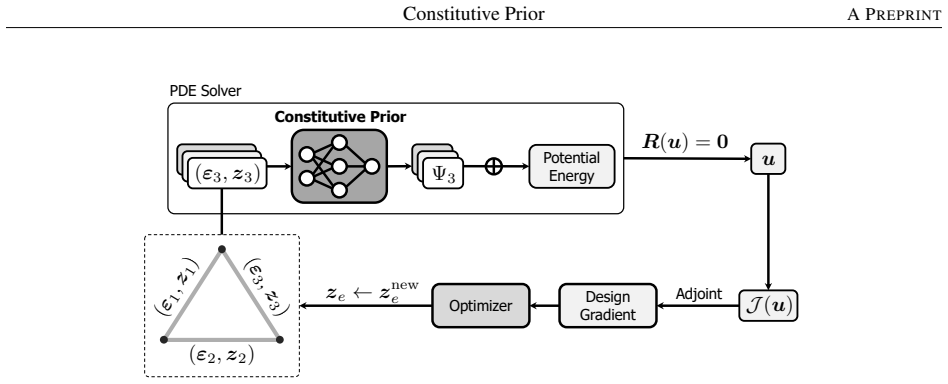
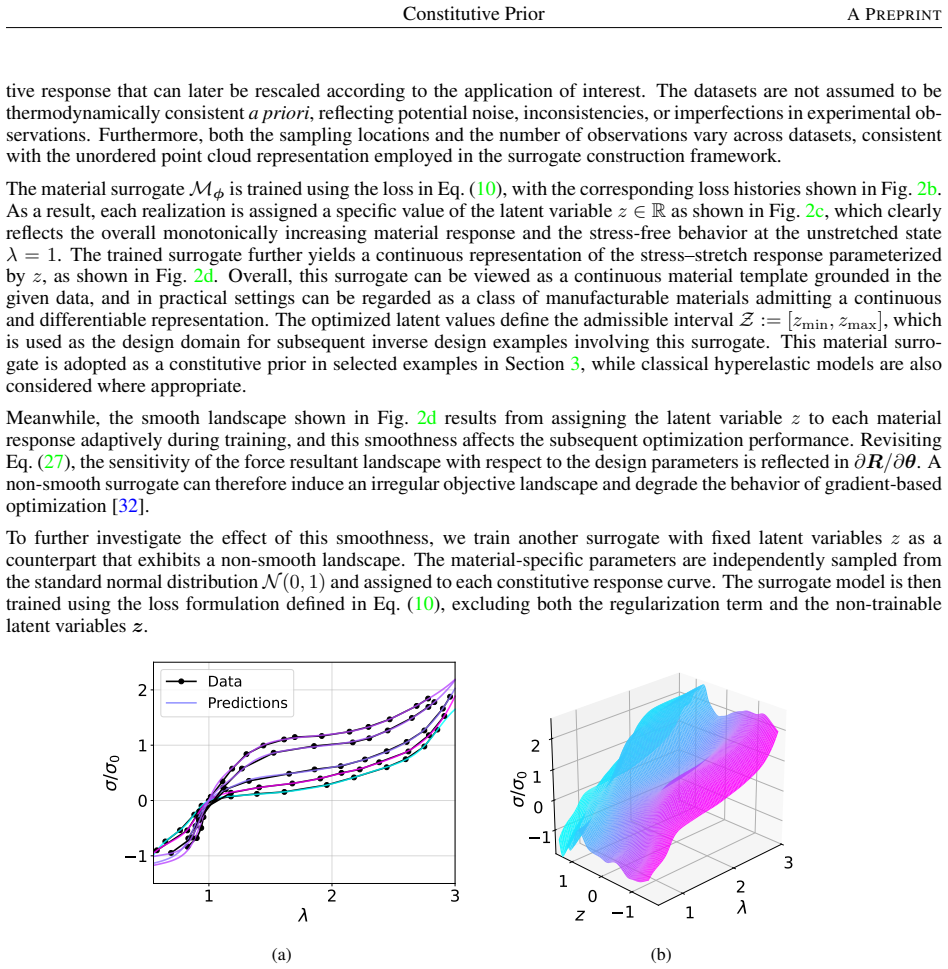
IndisputableMonolith/Cost/FunctionalEquation.leanwashburn_uniqueness_aczel (J uniqueness and convexity) echoesWe construct a data-driven prior over admissible constitutive behaviors, represented as a parameterized family of energy-based material models... By constructing the prior in terms of an energy potential, thermodynamic consistency is enforced by design... we enforce convexity of the learned energy functional in the stretch variable, while allowing flexible dependence on the material latent variable z through a PICNN.
-
IndisputableMonolith/Cost.leanJcost convexity and positivity off-identity echoesTo ensure the existence of minimizers of the total energy functional, appropriate convexity conditions must be imposed on the constitutive model... In this work, we focus on lattice-based systems... well-posedness is ensured by convexity of the energy with respect to the elastic stretch.
Reference graph
Works this paper leans on
-
[1]
Brandon Amos, Lei Xu, and J Zico Kolter. Input convex neural networks. InInternational conference on machine learning, pages 146–155. PMLR, 2017
work page 2017
-
[2]
Faisal As’ ad, Philip Avery, and Charbel Farhat. A mechanics-informed artificial neural network approach in data-driven constitutive modeling.International Journal for Numerical Methods in Engineering, 123(12):2738– 2759, 2022
work page 2022
-
[3]
Bahador Bahmani. Conformal quantile regression for neural probabilistic constitutive modeling.Computer Methods in Applied Mechanics and Engineering, 457:118981, 2026
work page 2026
-
[4]
Bahador Bahmani and WaiChing Sun. Physics-constrained symbolic model discovery for polyconvex incom- pressible hyperelastic materials.International Journal for Numerical Methods in Engineering, 125(15):e7473, 2024
work page 2024
-
[5]
John M Ball. Convexity conditions and existence theorems in nonlinear elasticity.Archive for rational mechanics and Analysis, 63(4):337–403, 1976. 20 Constitutive PriorA PREPRINT
work page 1976
-
[6]
Springer Science & Business Media, 2013
Martin Philip Bendsoe and Ole Sigmund.Topology optimization: theory, methods, and applications. Springer Science & Business Media, 2013
work page 2013
-
[7]
Flexible mechanical metamaterials
Katia Bertoldi, Vincenzo Vitelli, Johan Christensen, and Martin Van Hecke. Flexible mechanical metamaterials. Nature Reviews Materials, 2(11):1–11, 2017
work page 2017
-
[8]
Miguel A Bessa, Ramin Bostanabad, Zeliang Liu, Anqi Hu, Daniel W Apley, Catherine Brinson, Wei Chen, and Wing Kam Liu. A framework for data-driven analysis of materials under uncertainty: Countering the curse of dimensionality.Computer Methods in Applied Mechanics and Engineering, 320:633–667, 2017
work page 2017
-
[9]
The elements of differentiable programming.arXiv preprint arXiv:2403.14606, 2024
Mathieu Blondel and Vincent Roulet. The elements of differentiable programming.arXiv preprint arXiv:2403.14606, 2024
-
[10]
J William Boley, Wim M Van Rees, Charles Lissandrello, Mark N Horenstein, Ryan L Truby, Arda Kotikian, Jennifer A Lewis, and L Mahadevan. Shape-shifting structured lattices via multimaterial 4d printing.Proceedings of the National Academy of Sciences, 116(42):20856–20862, 2019
work page 2019
-
[11]
Topology optimization for additive manufacturing
David Brackett, Ian Ashcroft, and R Hague. Topology optimization for additive manufacturing. 2011
work page 2011
-
[12]
Kai Jun Chen, Catherine Catrambone, Christopher Sowinski, Jacob Mukobi, Enzo Andreacchio, Enquan Chew, Alexandre Morland, and Maria Sakovsky. Physical learning in reprogrammable metamaterials for adaptation to unknown environments.arXiv preprint arXiv:2510.06442, 2025
-
[13]
Anders Clausen, Fengwen Wang, Jakob Søndergaard Jensen, Ole Sigmund, and Jennifer A Lewis. Topology optimized architectures with programmable poisson’s ratio over large deformations.Advanced Materials, 27 (37):5523–5527, 2015
work page 2015
-
[14]
Gustavo Assis Da Silva, Andre Teofilo Beck, and Ole Sigmund. Topology optimization of compliant mechanisms considering stress constraints, manufacturing uncertainty and geometric nonlinearity.Computer Methods in Applied Mechanics and Engineering, 365:112972, 2020
work page 2020
-
[15]
Jonas Degrave, Michiel Hermans, Joni Dambre, et al. A differentiable physics engine for deep learning in robotics.Frontiers in neurorobotics, 13:406386, 2019
work page 2019
-
[16]
Patrick E Farrell, David A Ham, Simon W Funke, and Marie E Rognes. Automated derivation of the adjoint of high-level transient finite element programs.SIAM Journal on Scientific Computing, 35(4):C369–C393, 2013
work page 2013
-
[17]
Moritz Flaschel, Siddhant Kumar, and Laura De Lorenzis. Unsupervised discovery of interpretable hyperelastic constitutive laws.Computer Methods in Applied Mechanics and Engineering, 381:113852, 2021
work page 2021
-
[18]
Alain Garaigordobil, Rubén Ansola, Estrella Veguería, and Igor Fernandez. Overhang constraint for topology optimization of self-supported compliant mechanisms considering additive manufacturing.Computer-Aided De- sign, 109:33–48, 2019
work page 2019
-
[19]
Christophe Geuzaine and Jean-François Remacle. Gmsh: A 3-d finite element mesh generator with built-in pre- and post-processing facilities.International journal for numerical methods in engineering, 79(11):1309–1331, 2009
work page 2009
-
[20]
naca: Generate 4 and 5 digit naca airfoil sections
Dirk Gorissen. naca: Generate 4 and 5 digit naca airfoil sections. GitHub repository, 2026. URLhttps: //github.com/dgorissen/naca. Accessed: 2026-01-29
work page 2026
-
[21]
Xu Guo, Jianhua Zhou, Weisheng Zhang, Zongliang Du, Chang Liu, and Ying Liu. Self-supporting structure de- sign in additive manufacturing through explicit topology optimization.Computer Methods in Applied Mechanics and Engineering, 323:27–63, 2017
work page 2017
-
[22]
Ehsan Hajiesmaili, Natalie M Larson, Jennifer A Lewis, and David R Clarke. Programmed shape-morphing into complex target shapes using architected dielectric elastomer actuators.Science advances, 8(28):eabn9198, 2022
work page 2022
-
[23]
Yoonho Kim, Hyunwoo Yuk, Ruike Zhao, Shawn A Chester, and Xuanhe Zhao. Printing ferromagnetic domains for untethered fast-transforming soft materials.Nature, 558(7709):274–279, 2018
work page 2018
-
[24]
Adam: A Method for Stochastic Optimization
Diederik P Kingma and Jimmy Ba. Adam: A method for stochastic optimization.arXiv preprint arXiv:1412.6980, 2014
work page internal anchor Pith review Pith/arXiv arXiv 2014
-
[25]
Dominik K Klein, Mauricio Fernández, Robert J Martin, Patrizio Neff, and Oliver Weeger. Polyconvex anisotropic hyperelasticity with neural networks.Journal of the Mechanics and Physics of Solids, 159:104703, 2022
work page 2022
-
[26]
Arda Kotikian, Audrey A Watkins, Giovanni Bordiga, Andrew Spielberg, Zoey S Davidson, Katia Bertoldi, and Jennifer A Lewis. Liquid crystal elastomer lattices with thermally programmable deformation via multi-material 3d printing.Advanced Materials, 36(34):2310743, 2024. 21 Constitutive PriorA PREPRINT
work page 2024
-
[27]
Xiao Kuang, Devin J Roach, Jiangtao Wu, Craig M Hamel, Zhen Ding, Tiejun Wang, Martin L Dunn, and Hang Jerry Qi. Advances in 4d printing: materials and applications.Advanced Functional Materials, 29(2): 1805290, 2019
work page 2019
-
[28]
Hao Li, Zhen Luo, Liang Gao, and Qinghua Qin. Topology optimization for concurrent design of structures with multi-patch microstructures by level sets.Computer Methods in Applied Mechanics and Engineering, 331: 536–561, 2018
work page 2018
-
[29]
Lennart Linden, Dominik K Klein, Karl A Kalina, Jörg Brummund, Oliver Weeger, and Markus Kästner. Neural networks meet hyperelasticity: A guide to enforcing physics.Journal of the Mechanics and Physics of Solids, 179:105363, 2023
work page 2023
-
[30]
Kevin Linka and Ellen Kuhl. A new family of constitutive artificial neural networks towards automated model discovery.Computer Methods in Applied Mechanics and Engineering, 403:115731, 2023
work page 2023
-
[31]
Zeliang Liu, MA Bessa, and Wing Kam Liu. Self-consistent clustering analysis: an efficient multi-scale scheme for inelastic heterogeneous materials.Computer methods in applied mechanics and engineering, 306:319–341, 2016
work page 2016
-
[32]
Jorge Nocedal and Stephen J Wright.Numerical optimization. Springer, 2006
work page 2006
-
[33]
Mikhail Osanov and James K Guest. Topology optimization for architected materials design.Annual Review of Materials Research, 46(1):211–233, 2016
work page 2016
-
[34]
Deepsdf: Learning continuous signed distance functions for shape representation
Jeong Joon Park, Peter Florence, Julian Straub, Richard Newcombe, and Steven Lovegrove. Deepsdf: Learning continuous signed distance functions for shape representation. InProceedings of the IEEE/CVF conference on computer vision and pattern recognition, pages 165–174, 2019
work page 2019
-
[35]
Kirigami skins make a simple soft actuator crawl.Science Robotics, 3(15):eaar7555, 2018
Ahmad Rafsanjani, Yuerou Zhang, Bangyuan Liu, Shmuel M Rubinstein, and Katia Bertoldi. Kirigami skins make a simple soft actuator crawl.Science Robotics, 3(15):eaar7555, 2018
work page 2018
-
[36]
Adeildo S Ramos Jr and Glaucio H Paulino. Convex topology optimization for hyperelastic trusses based on the ground-structure approach: Convex topology optimization for hyperelastic trusses based.Structural and Multidisciplinary Optimization, 51(2):287–304, 2015
work page 2015
-
[37]
Suryanarayanan Manoj Sanu, Alejandro M Aragon, and Miguel A Bessa. Neural topology optimization: the good, the bad, and the ugly: Sm sanu et al.Structural and Multidisciplinary Optimization, 68(10):213, 2025
work page 2025
-
[38]
Samuel Schoenholz and Ekin Dogus Cubuk. Jax md: a framework for differentiable physics.Advances in Neural Information Processing Systems, 33:11428–11441, 2020
work page 2020
-
[39]
Jörg Schröder and Patrizio Neff. Invariant formulation of hyperelastic transverse isotropy based on polyconvex free energy functions.International journal of solids and structures, 40(2):401–445, 2003
work page 2003
-
[40]
Ole Sigmund. Materials with prescribed constitutive parameters: an inverse homogenization problem.Interna- tional Journal of Solids and Structures, 31(17):2313–2329, 1994
work page 1994
-
[41]
Tailoring materials with prescribed elastic properties.Mechanics of materials, 20(4):351–368, 1995
Ole Sigmund. Tailoring materials with prescribed elastic properties.Mechanics of materials, 20(4):351–368, 1995
work page 1995
-
[42]
Vincent Sitzmann, Julien Martel, Alexander Bergman, David Lindell, and Gordon Wetzstein. Implicit neural representations with periodic activation functions.Advances in neural information processing systems, 33:7462– 7473, 2020
work page 2020
-
[43]
Craig A Steeves, Sergio L dos Santos e Lucato, Ming He, Emilio Antinucci, John W Hutchinson, and Anthony G Evans. Concepts for structurally robust materials that combine low thermal expansion with high stiffness.Journal of the Mechanics and Physics of Solids, 55(9):1803–1822, 2007
work page 2007
-
[44]
Krister Svanberg. The method of moving asymptotes—a new method for structural optimization.International journal for numerical methods in engineering, 24(2):359–373, 1987
work page 1987
-
[45]
Gabriel Taubin. Rasterizing algebraic curves and surfaces.IEEE Computer graphics and applications, 14(2): 14–23, 1994
work page 1994
-
[46]
Dmitry Ulyanov, Andrea Vedaldi, and Victor Lempitsky. Deep image prior. InProceedings of the IEEE confer- ence on computer vision and pattern recognition, pages 9446–9454, 2018
work page 2018
-
[47]
Harikrishnan Vijayakumaran, Jonathan B Russ, Glaucio H Paulino, and Miguel A Bessa. Consistent machine learning for topology optimization with microstructure-dependent neural network material models.Journal of the Mechanics and Physics of Solids, 196:106015, 2025
work page 2025
-
[48]
Nikolaos N Vlassis, Ran Ma, and WaiChing Sun. Geometric deep learning for computational mechanics part i: Anisotropic hyperelasticity.Computer Methods in Applied Mechanics and Engineering, 371:113299, 2020. 22 Constitutive PriorA PREPRINT
work page 2020
-
[49]
Chao Wang, Zhi Zhao, and Xiaojia Shelly Zhang. Inverse design of magneto-active metasurfaces and robots: Theory, computation, and experimental validation.Computer Methods in Applied Mechanics and Engineering, 413:116065, 2023
work page 2023
-
[50]
Liwei Wang, Alexander L Evenchik, Jared M Yang, Ryan L Truby, and Wei Chen. Autonomous codesign and fabrication of multistimuli-responsive material systems.Science Advances, 11(37):eadx4409, 2025
work page 2025
-
[51]
Tianju Xue, Shuheng Liao, Zhengtao Gan, Chanwook Park, Xiaoyu Xie, Wing Kam Liu, and Jian Cao. Jax- fem: A differentiable gpu-accelerated 3d finite element solver for automatic inverse design and mechanistic data science.Computer Physics Communications, 291:108802, 2023
work page 2023
-
[52]
Ultralight, ultrastiff mechanical metamaterials.Science, 344 (6190):1373–1377, 2014
Xiaoyu Zheng, Howon Lee, Todd H Weisgraber, Maxim Shusteff, Joshua DeOtte, Eric B Duoss, Joshua D Kuntz, Monika M Biener, Qi Ge, Julie A Jackson, et al. Ultralight, ultrastiff mechanical metamaterials.Science, 344 (6190):1373–1377, 2014
work page 2014
-
[53]
Dengyong Zhou, Olivier Bousquet, Thomas Lal, Jason Weston, and Bernhard Schölkopf. Learning with local and global consistency.Advances in neural information processing systems, 16, 2003. Appendix A Partially Input-Convex Neural Networks In this section, we briefly review the partially input-convex neural networks (PICNNs) architecture introduced in [1]. T...
work page 2003
discussion (0)
Sign in with ORCID, Apple, or X to comment. Anyone can read and Pith papers without signing in.