Recognition: 2 theorem links
· Lean TheoremResonant transmission of scalar waves through rotating traversable wormhole
Pith reviewed 2026-05-12 04:29 UTC · model grok-4.3
The pith
Rotation strengthens Breit-Wigner resonances in scalar transmission through Teo wormholes.
A machine-rendered reading of the paper's core claim, the machinery that carries it, and where it could break.
Core claim
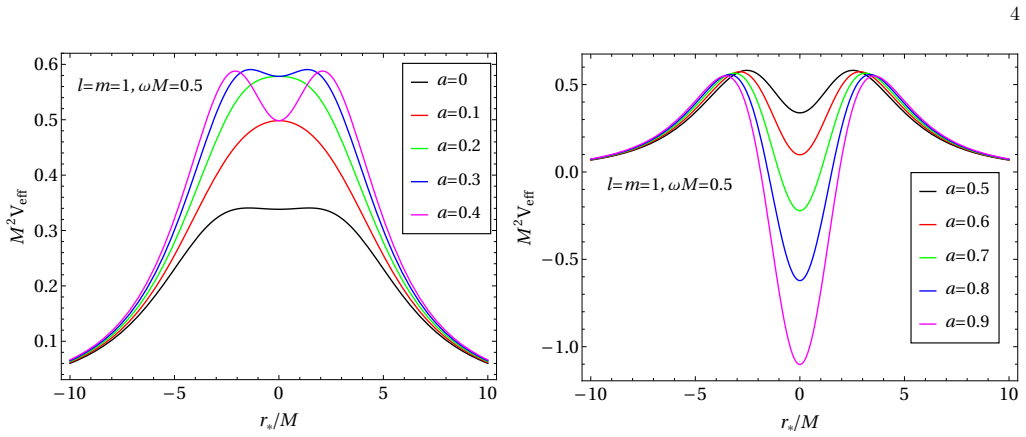
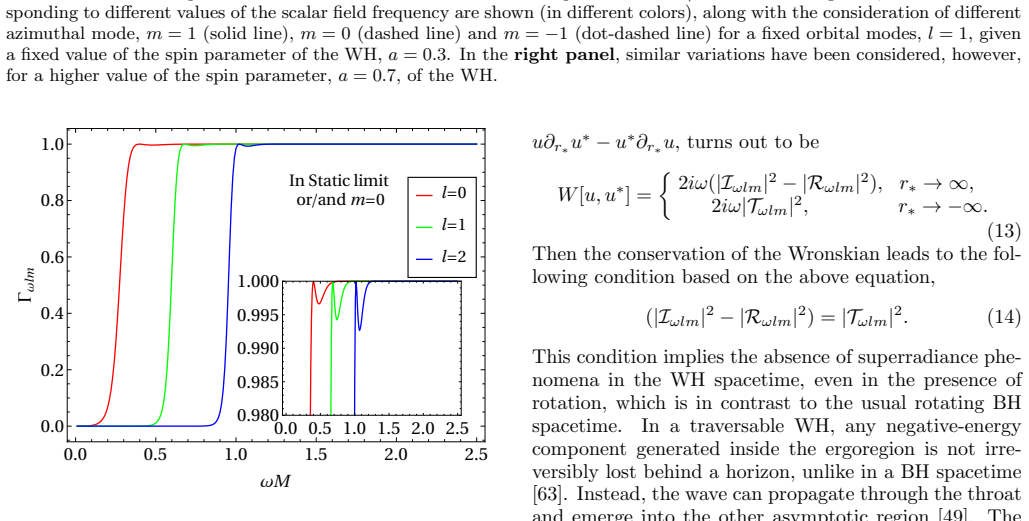
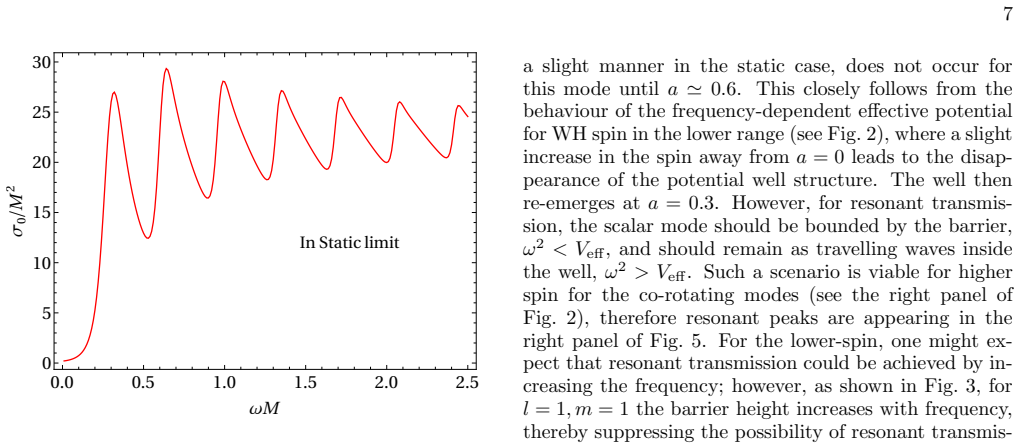
In the Teo rotating wormhole background, numerical solution of the massless scalar wave equation yields transmission and absorption spectra containing a series of sharp peaks identified as Breit-Wigner resonances; these arise from temporary trapping of modes in the potential well formed by barriers flanking the throat, and the inclusion of rotation enhances the strength of the resonances compared with the static wormhole case.
What carries the argument
The Teo metric for rotating traversable wormholes together with the effective potential it generates for scalar perturbations, whose numerical solution produces frequency-dependent transmission coefficients that display resonance peaks.
If this is right
- The resonant peaks remain present and become stronger once rotation is added to Teo's wormhole.
- The peaks correspond to scalar modes that are temporarily confined by the double-barrier potential around the throat.
- These resonant features in the absorption spectrum serve as characteristic signatures of wormhole geometries.
- The overall transmission behavior is shaped by the absence of an event horizon and the presence of the throat structure.
Where Pith is reading between the lines
- The same resonance enhancement could appear when other fields or different wormhole families are examined under rotation.
- Frequency-dependent transmission data from compact-object mergers might eventually be searched for matching peak patterns.
- The mechanism suggests that rotation generally modulates wave-trapping efficiency near any throat-like structure.
Load-bearing premise
The Teo metric accurately represents a physically stable, traversable rotating wormhole, and the numerical solution of the wave equation faithfully captures the resonant trapping without discretization artifacts or boundary condition sensitivities.
What would settle it
A direct numerical recomputation of the transmission factor for the same Teo metric but with the rotation parameter set to zero, followed by comparison of peak amplitudes, would show whether rotation actually increases resonance strength.
Figures





read the original abstract
The viability of traversable wormholes as exotic compact objects requires the identification of signatures that distinguish them from other compact objects. Given recent advances in observing rotating black hole signatures, identifying characteristic imprints that reflect the absence of an event horizon and the presence of a throat structure is of considerable significance. Motivated by this, in the present work, we analyze the propagation of a massless scalar field in a rotating traversable wormhole spacetime described by Teo's class of solutions. We numerically compute the transmission (greybody) factor and the corresponding absorption spectrum across a broad range of frequencies. The spectrum exhibits a series of sharp peaks in the amplitudes, which we identify as Breit-Wigner-type resonances. The emergence of such peaks can be attributed to the scalar modes temporarily trapped within the potential well formed by barriers on either side of the throat. These resonant features, previously identified in static wormhole backgrounds, persist in the rotating case. In particular, for Teo's class of wormholes, we find that rotation enhances the strength of the resonances. Overall, our results demonstrate the role of rotation in shaping the resonance effect and indicate these features as characteristic signatures of wormhole geometries.
Editorial analysis
A structured set of objections, weighed in public.
Referee Report
Summary. The manuscript numerically studies the propagation of a massless scalar field through a rotating traversable wormhole described by Teo's metric. It computes the frequency-dependent transmission (greybody) factors and absorption spectrum, identifies a series of sharp peaks as Breit-Wigner-type resonances caused by temporary trapping of modes in the potential barriers flanking the throat, and reports that nonzero rotation enhances the amplitude of these resonances relative to the static limit, proposing the features as characteristic signatures of wormhole geometries.
Significance. If the reported enhancement of resonances with rotation is robust, the work supplies concrete, falsifiable predictions for scalar-wave scattering that could help distinguish rotating wormholes from black holes in future observations. The extension of resonance analyses from static to rotating Teo backgrounds and the direct numerical evaluation of transmission spectra constitute a clear incremental advance in the study of wave propagation on exotic compact-object spacetimes.
major comments (1)
- [Numerical computation of transmission factors] The central claim that rotation enhances resonance strength rests on the numerical computation of transmission peak amplitudes (abstract). The manuscript provides no description of the discretization scheme, radial grid resolution, convergence tests with respect to step size or outer boundary location, or error estimates on the reported peak heights. This omission is load-bearing: without such verification, it remains possible that the apparent increase in peak strength is influenced by numerical artifacts rather than the physical modification of the effective potential by the rotation parameter.
minor comments (1)
- [Abstract] The abstract states that resonances 'persist in the rotating case' but does not quantify the frequency range or rotation-parameter values explored; adding a brief statement of the parameter domain would improve clarity.
Simulated Author's Rebuttal
We thank the referee for the careful reading of our manuscript and the constructive feedback. We address the major comment below and will revise the manuscript accordingly.
read point-by-point responses
-
Referee: [Numerical computation of transmission factors] The central claim that rotation enhances resonance strength rests on the numerical computation of transmission peak amplitudes (abstract). The manuscript provides no description of the discretization scheme, radial grid resolution, convergence tests with respect to step size or outer boundary location, or error estimates on the reported peak heights. This omission is load-bearing: without such verification, it remains possible that the apparent increase in peak strength is influenced by numerical artifacts rather than the physical modification of the effective potential by the rotation parameter.
Authors: We agree that the submitted manuscript does not include a description of the numerical scheme, grid resolution, convergence tests, or error estimates for the transmission factors. This omission weakens the presentation of the central claim. In the revised version we will add a dedicated subsection detailing the discretization method, radial grid parameters, outer boundary placement, convergence tests under variations of step size and boundary location, and numerical error estimates on the reported peak amplitudes. These additions will establish that the enhancement of resonances with rotation originates from the modification of the effective potential. revision: yes
Circularity Check
No significant circularity in numerical transmission computation
full rationale
The paper computes the transmission factor and absorption spectrum by direct numerical integration of the massless scalar wave equation on the fixed Teo rotating wormhole background. Resonances are identified as peaks in the resulting spectrum and the enhancement due to rotation is reported as an output of that integration. No parameters are fitted to the resonance amplitudes or transmission values, no self-definitional relations appear in the equations, and the central claim does not reduce to a prior self-citation or ansatz. The derivation chain is therefore an independent numerical experiment rather than a tautological restatement of its inputs.
Axiom & Free-Parameter Ledger
free parameters (1)
- Teo metric parameters including rotation parameter
axioms (2)
- domain assumption The spacetime is described by Teo's class of rotating traversable wormhole solutions.
- standard math The scalar field is massless and obeys the Klein-Gordon equation in the given curved spacetime.
Lean theorems connected to this paper
-
IndisputableMonolith/Cost/FunctionalEquation.leanwashburn_uniqueness_aczel unclear?
unclearRelation between the paper passage and the cited Recognition theorem.
We numerically compute the transmission (greybody) factor and the corresponding absorption spectrum... sharp peaks... Breit-Wigner-type resonances... effective potential
-
IndisputableMonolith/Foundation/RealityFromDistinction.leanreality_from_one_distinction unclear?
unclearRelation between the paper passage and the cited Recognition theorem.
The Teo metric... rotating traversable wormhole spacetime
What do these tags mean?
- matches
- The paper's claim is directly supported by a theorem in the formal canon.
- supports
- The theorem supports part of the paper's argument, but the paper may add assumptions or extra steps.
- extends
- The paper goes beyond the formal theorem; the theorem is a base layer rather than the whole result.
- uses
- The paper appears to rely on the theorem as machinery.
- contradicts
- The paper's claim conflicts with a theorem or certificate in the canon.
- unclear
- Pith found a possible connection, but the passage is too broad, indirect, or ambiguous to say the theorem truly supports the claim.
Reference graph
Works this paper leans on
-
[1]
constitutes a generalization of the Morris–Thorne traversable WHs, extending them from a static spher- ically symmetric configuration to a stationary axially symmetric framework. The associated spacetime met- ric, in its original form as proposed by Teo, is expressed as ds2 =−N 2dt2 + dr2 1− b r +r 2K2 dθ2 + sin2 θ(dφ−Ωdt) 2 , (1) where the four functions...
work page 2026
-
[2]
Tests of General Relativity with GWTC-3
R. Abbottet al.(LIGO Scientific, VIRGO, KAGRA), Phys. Rev. D112, 084080 (2025), arXiv:2112.06861 [gr- qc]
work page internal anchor Pith review Pith/arXiv arXiv 2025
-
[3]
S. Vagnozziet al., Class. Quant. Grav.40, 165007 (2023), arXiv:2205.07787 [gr-qc]
- [4]
-
[5]
C. W. Misner and J. A. Wheeler, Annals Phys.2, 525 (1957)
work page 1957
-
[6]
H. G. Ellis, J. Math. Phys.14, 104 (1973)
work page 1973
- [7]
-
[8]
M. S. Morris and K. S. Thorne, Am. J. Phys.56, 395 (1988)
work page 1988
- [9]
- [10]
- [11]
-
[12]
G. Antoniou, A. Bakopoulos, P. Kanti, B. Kleihaus, and J. Kunz, Phys. Rev. D101, 024033 (2020), arXiv:1904.13091 [hep-th]
-
[13]
H. Huang and J. Yang, Phys. Rev. D100, 124063 (2019), arXiv:1909.04603 [gr-qc]
- [14]
- [15]
-
[16]
F. Rahaman, A. Aziz, T. Manna, A. Islam, N. A. Pun- deer, and S. Islam, J. Korean Phys. Soc.86, 1204 (2025)
work page 2025
-
[17]
B. Turimov, A. Abdujabbarov, B. Ahmedov, and Z. Stuchl´ ık, Phys. Lett. B868, 139800 (2025)
work page 2025
- [18]
- [19]
- [20]
- [21]
-
[22]
Realistic classical charge from an asymmetric wormhole
V. Dzhunushaliev and V. Folomeev, (2025), arXiv:2512.00958 [gr-qc]
work page internal anchor Pith review Pith/arXiv arXiv 2025
-
[23]
Visser,Lorentzian wormholes: From Einstein to Hawking(1995)
M. Visser,Lorentzian wormholes: From Einstein to Hawking(1995)
work page 1995
-
[24]
C. Hoffmann, T. Ioannidou, S. Kahlen, B. Klei- haus, and J. Kunz, Phys. Rev. D97, 124019 (2018), arXiv:1803.11044 [gr-qc]
- [25]
- [26]
- [27]
- [28]
-
[29]
K. Uemichi, Y. Koga, D. Saito, C.-M. Yoo, and D. Yoshida, (2026), arXiv:2603.12748 [gr-qc]
-
[30]
Thin accretion disks in stationary axisymmetric wormhole spacetimes
T. Harko, Z. Kovacs, and F. S. N. Lobo, Phys. Rev. D 79, 064001 (2009), arXiv:0901.3926 [gr-qc]
work page Pith review arXiv 2009
- [31]
- [32]
- [33]
-
[34]
S. E. Perez Bergliaffa and K. E. Hibberd, (2000), arXiv:gr-qc/0006041
work page internal anchor Pith review arXiv 2000
-
[35]
P. Kashargin and S. Sushkov, Physical Review D—Particles, Fields, Gravitation, and Cosmology78, 064071 (2008)
work page 2008
- [36]
-
[37]
A. Cisterna, K. M¨ uller, K. Pallikaris, and A. Vigan` o, Phys. Rev. D108, 024066 (2023), arXiv:2306.14541 [gr- qc]
-
[38]
N. Tsukamoto, T. Harada, and K. Yajima, Phys. Rev. D86, 104062 (2012), arXiv:1207.0047 [gr-qc]
- [39]
-
[40]
Azreg-A¨ ınou, JCAP07, 037 (2015), arXiv:1412.8282 [gr-qc]
M. Azreg-A¨ ınou, JCAP07, 037 (2015), arXiv:1412.8282 [gr-qc]
-
[41]
A. Abdujabbarov, B. Juraev, B. Ahmedov, and Z. Stuchl´ ık, Astrophys. Space Sci.361, 226 (2016). 11
work page 2016
- [42]
-
[43]
V. De Falco, E. Battista, S. Capozziello, and M. De Laurentis, Phys. Rev. D101, 104037 (2020), arXiv:2004.14849 [gr-qc]
- [44]
-
[45]
N. Godani and G. C. Samanta, Annals Phys.429, 168460 (2021), arXiv:2105.08517 [gr-qc]
- [46]
-
[47]
S. Kar, S. Minwalla, D. Mishra, and D. Sahdev, Phys. Rev. D51, 1632 (1995)
work page 1995
- [48]
- [49]
- [50]
- [51]
-
[52]
D. Hochberg and M. Visser, Phys. Rev. Lett.81, 746 (1998), arXiv:gr-qc/9802048
- [53]
-
[54]
G. Gyulchev, P. Nedkova, V. Tinchev, and S. Yazadjiev, Eur. Phys. J. C78, 544 (2018), arXiv:1805.11591 [gr-qc]
- [55]
-
[56]
D. Hochberg and M. Visser, Phys. Rev. D56, 4745 (1997), arXiv:gr-qc/9704082
- [57]
-
[58]
F. Gray and D. Kubiznak, Phys. Rev. D105, 064017 (2022), arXiv:2110.14671 [gr-qc]
- [59]
- [60]
-
[61]
M. Demianski and M. Francaviglia, Int. J. Theor. Phys. 19, 675 (1980)
work page 1980
- [62]
- [63]
- [64]
-
[65]
R. F. Rosato, S. Biswas, S. Chakraborty, and P. Pani, Phys. Rev. D111, 084051 (2025), arXiv:2501.16433 [gr- qc]
work page internal anchor Pith review arXiv 2025
- [66]
-
[67]
J. J. Sakurai, S. Fu Tuan, and R. G. Newton, “Modern quantum mechanics,” (1986)
work page 1986
-
[68]
W. G. Unruh, Phys. Rev. D14, 3251 (1976)
work page 1976
-
[69]
M. Abramowitz and I. A. Stegun,Handbook of Math- ematical Functions with Formulas, Graphs, and Math- ematical Tables, National Bureau of Standards Applied Mathematics Series, Vol. 55 (U.S. Government Printing Office, Washington, D.C., 1964) reprinted by Dover Pub- lications, 1965
work page 1964
-
[70]
V. Cardoso and R. Vicente, Phys. Rev. D100, 084001 (2019), arXiv:1906.10140 [gr-qc]
-
[71]
J. Riley, (2026), arXiv:2604.14238 [gr-qc]
work page internal anchor Pith review Pith/arXiv arXiv 2026
-
[72]
B. Kleihaus and J. Kunz, Phys. Rev. D90, 121503 (2014), arXiv:1409.1503 [gr-qc]
- [73]
discussion (0)
Sign in with ORCID, Apple, or X to comment. Anyone can read and Pith papers without signing in.