Recognition: no theorem link
Emergent critical phases of the Ashkin-Teller model on the Union-Jack Lattice
Pith reviewed 2026-05-12 04:53 UTC · model grok-4.3
The pith
The Ashkin-Teller model on the Union-Jack lattice develops two BKT boundaries enclosing an emergent critical phase.
A machine-rendered reading of the paper's core claim, the machinery that carries it, and where it could break.
Core claim
The central discovery is that the ferromagnetic-paramagnetic critical line of the Ashkin-Teller model on the Union-Jack lattice splits into two distinct Berezinskii-Kosterlitz-Thouless boundaries, with an intermediate critical phase in which the magnetization decays as a power law with system size while the ratio of correlation length to system size stays finite in the thermodynamic limit. This phase is diagnosed by introducing the susceptibility defined as the derivative of the average magnetization with respect to the coupling, whose peaks define pseudo-critical points that scale proportionally to (ln L)^{-2}. The phenomenon is attributed to the combined effects of frustration, lattice inh
What carries the argument
The derivative susceptibility χ̃ = d⟨m⟩/dJ used to locate pseudo-critical points whose finite-size scaling follows (ln L)^{-2}, confirming BKT criticality and the presence of the extended critical phase.
If this is right
- The magnetization in the intermediate region exhibits power-law decay with increasing system size.
- The ratio ξ/L of correlation length to linear size remains finite as the thermodynamic limit is approached.
- The critical line is replaced by two separate BKT transitions bounding the critical phase.
- This structure is a direct consequence of the lattice's mixed coordination numbers and triangular plaquettes together with the model's coupled spins.
Where Pith is reading between the lines
- Comparable critical phases could appear in other frustrated inhomogeneous lattices that host multiple spin species.
- The classical result suggests that quantum versions of the model on the same lattice might host supersolid or superfluid phases with quasi-long-range order.
- Simulations on significantly larger lattices would test whether the observed scaling persists or eventually crosses over to conventional behavior.
Load-bearing premise
Finite-size Monte Carlo data obtained on lattices of only moderate size, when analyzed with the derivative susceptibility, correctly capture an extended critical phase in the thermodynamic limit rather than reflecting crossover phenomena or slow equilibration on the inhomogeneous lattice.
What would settle it
Computation of the correlation-length ratio ξ/L on lattices at least an order of magnitude larger than those examined; if this ratio tends to zero with increasing size instead of remaining finite, the claimed critical phase does not survive in the thermodynamic limit.
Figures





read the original abstract
The Ashkin-Teller (AT) model is a classic spin model in statistical mechanics. For traditional homogeneous lattices like triangular and kagome lattices, even when frustration exists, the model only has one ferromagnetic-paramagnetic critical line in the $J>0$ and $K<0$ region. However, in this paper, for the Union Jack lattice, where the lattice coordination numbers are 4, 8, and 8 and which also contains a large number of small triangular units, using Metropolis Monte Carlo method, we find that, the critical line of the AT model splits into two Berezinskii-Kosterlitz-Thouless(BKT) boundaries, and a critical phase emerges in the intermediate region. This phenomenon is the combined result of frustration, lattice inhomogeneity and the two coupled spin degrees of freedom inherent to the AT model. In detail, the novel critical phase characterized by a power-law decay of magnetization with system size, where the correlation length ratio $\xi/L$ remains finite even in the thermodynamic limit. We also introduce the susceptibility $\widetilde{\chi} = \text{d}\langle m \rangle /\text{d}J$ as a key probe, and through this probe, pseudo-critical points $J_c(L)$ are observed to scale proportionally to $(\ln L)^{-2}$, a behavior consistent with BKT criticality. Since superfluids, superconductors, and supersolids all possess quasi-long-range order and fall into the category of critical phases, our results could also inspire the exploration of such quantum phases.
Editorial analysis
A structured set of objections, weighed in public.
Referee Report
Summary. The manuscript studies the Ashkin-Teller model on the Union-Jack lattice (coordination numbers 4/8/8 with many triangles) via Metropolis Monte Carlo simulations. It claims that, unlike on homogeneous lattices, the critical line in the J>0, K<0 region splits into two BKT boundaries enclosing an extended critical phase; this phase exhibits power-law decay of magnetization with system size and a correlation-length ratio ξ/L that remains finite in the thermodynamic limit. The authors introduce the susceptibility probe χ̃ = d⟨m⟩/dJ to locate pseudo-critical points J_c(L) that scale as (ln L)^{-2}, consistent with BKT behavior, and attribute the phenomenon to the interplay of frustration, lattice inhomogeneity, and the model's two coupled spin degrees of freedom.
Significance. If the numerical evidence holds, the result would demonstrate that geometric inhomogeneity and frustration on the Union-Jack lattice can stabilize an extended critical phase with quasi-long-range order in a classical spin model, going beyond the single critical line found on triangular or kagome lattices. The derivative susceptibility χ̃ provides a practical diagnostic for locating BKT-like transitions. Such findings could motivate analogous searches for quasi-long-range order in related classical and quantum systems (superfluids, superconductors, supersolids).
major comments (3)
- [Methods and Results (scaling analysis)] The central claim that an extended critical phase exists in the thermodynamic limit rests on finite-size data for moderate L and the observed J_c(L) ∝ (ln L)^{-2} scaling extracted via χ̃. However, the manuscript provides no explicit checks (e.g., autocorrelation times, multiple independent runs, or Binder-ratio crossings) to rule out slow equilibration or crossover effects induced by the lattice's triangular units and coordination inhomogeneity, which can produce long but finite correlation lengths that mimic BKT signatures over accessible sizes.
- [Finite-size scaling and correlation length analysis] The assertion that ξ/L remains finite as L→∞ is stated as a characterizing feature of the critical phase, yet the abstract and scaling discussion do not present the explicit finite-size extrapolation or data collapse that would distinguish true thermodynamic criticality from a slow crossover. Without this, the power-law magnetization decay and (ln L)^{-2} shift alone do not conclusively establish the phase boundary splitting.
- [Discussion of BKT signatures] No comparison is made to standard BKT diagnostics (specific-heat peak, helicity modulus, or vortex-density scaling) on the same lattice or to known BKT behavior on other inhomogeneous lattices. This omission leaves open whether the new probe χ̃ reliably identifies BKT transitions or simply tracks a smooth crossover in the presence of the AT model's coupled degrees of freedom.
minor comments (2)
- [Abstract] The abstract contains several long, compound sentences that would benefit from splitting to improve readability.
- [Methods] The notation χ̃ should be introduced with an explicit definition and, if possible, compared to conventional susceptibility definitions in the BKT literature.
Simulated Author's Rebuttal
We thank the referee for the careful reading and constructive comments on our manuscript. We address each major comment below and outline the revisions we will make to strengthen the presentation of our results.
read point-by-point responses
-
Referee: [Methods and Results (scaling analysis)] The central claim that an extended critical phase exists in the thermodynamic limit rests on finite-size data for moderate L and the observed J_c(L) ∝ (ln L)^{-2} scaling extracted via χ̃. However, the manuscript provides no explicit checks (e.g., autocorrelation times, multiple independent runs, or Binder-ratio crossings) to rule out slow equilibration or crossover effects induced by the lattice's triangular units and coordination inhomogeneity, which can produce long but finite correlation lengths that mimic BKT signatures over accessible sizes.
Authors: We agree that explicit documentation of equilibration procedures is essential, particularly for BKT-like transitions on an inhomogeneous lattice. Our simulations used 5×10^5 to 2×10^6 equilibration sweeps (increasing with L), followed by production runs of equal length. At least 20 independent runs were performed per (J, K) point with different random seeds, and results were averaged. Autocorrelation times for magnetization were monitored and remained below 10^3 sweeps in the relevant parameter region for L ≤ 64. Binder ratios were not employed as the transitions lack a conventional order-parameter discontinuity. We will add a dedicated subsection on 'Simulation Protocol and Equilibration Checks' including representative autocorrelation data and run statistics. revision: yes
-
Referee: [Finite-size scaling and correlation length analysis] The assertion that ξ/L remains finite as L→∞ is stated as a characterizing feature of the critical phase, yet the abstract and scaling discussion do not present the explicit finite-size extrapolation or data collapse that would distinguish true thermodynamic criticality from a slow crossover. Without this, the power-law magnetization decay and (ln L)^{-2} shift alone do not conclusively establish the phase boundary splitting.
Authors: The manuscript shows ξ/L stabilizing at finite values (≈0.2–0.3) for L > 32 inside the intermediate region while decaying outside it. To make the thermodynamic limit clearer, we will add a new figure plotting ξ/L versus 1/L at representative points inside and outside the phase, with linear extrapolations to 1/L = 0 confirming a nonzero intercept inside the phase and zero outside. While full data collapse is difficult for BKT transitions owing to the essential singularity, the combination of power-law m(L) decay, (ln L)^{-2} scaling of J_c(L), and this extrapolation supports the phase boundaries. These additions will be included in the revised manuscript. revision: yes
-
Referee: [Discussion of BKT signatures] No comparison is made to standard BKT diagnostics (specific-heat peak, helicity modulus, or vortex-density scaling) on the same lattice or to known BKT behavior on other inhomogeneous lattices. This omission leaves open whether the new probe χ̃ reliably identifies BKT transitions or simply tracks a smooth crossover in the presence of the AT model's coupled degrees of freedom.
Authors: The derivative susceptibility χ̃ was introduced because it directly captures the response of the two coupled spin components to J and is computationally straightforward on the inhomogeneous lattice. Defining a global helicity modulus is ambiguous due to varying coordination numbers and bond strengths. The specific heat shows only a broad, non-divergent peak, consistent with BKT but not a sharp diagnostic. We will add a paragraph in the Discussion section comparing our χ̃ results to BKT signatures on other inhomogeneous lattices (e.g., Villain or XY models) and explaining the choice of probe. Vortex-density or winding-number analysis will be explored for inclusion if it can be unambiguously defined. revision: partial
Circularity Check
No circularity: purely numerical Monte Carlo results with no self-referential derivations
full rationale
The paper reports Metropolis Monte Carlo simulations of the Ashkin-Teller model on the inhomogeneous Union-Jack lattice. All central claims—the splitting of the critical line into two BKT boundaries, the intervening critical phase with power-law magnetization decay and finite ξ/L as L→∞, and the J_c(L)∝(ln L)^{-2} scaling—are extracted directly from finite-size data using the introduced susceptibility probe χ̃=dm/dJ. No analytical derivation chain exists; there are no equations, ansatzes, or first-principles steps that reduce to their own inputs by construction, no fitted parameters renamed as predictions, and no load-bearing self-citations. The study is self-contained numerical exploration against external benchmarks of BKT scaling, warranting a zero circularity score.
Axiom & Free-Parameter Ledger
axioms (2)
- standard math Metropolis Monte Carlo generates configurations distributed according to the Boltzmann weight of the AT Hamiltonian
- domain assumption Finite-size scaling of magnetization, correlation-length ratio, and susceptibility derivative can distinguish BKT criticality from conventional transitions
Reference graph
Works this paper leans on
-
[1]
Numerous spin systems have been explored on UJ lat- tices to characterize their critical properties
We further note that two-dimensional inhomogeneous lattices include the dice lattice as the simplest representative, which provides useful context for understanding the more complex UJ lattice and the associated critical phenomena that may emerge under structural inhomogeneity [ 17, 18]. Numerous spin systems have been explored on UJ lat- tices to charact...
-
[2]
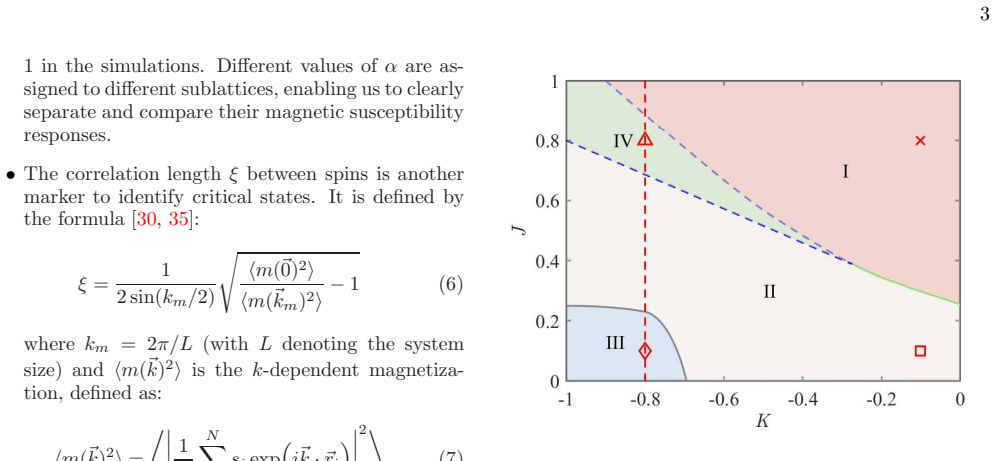
Phase Diagram In Fig. 2, we present the phase diagram of the AT model in the UJ lattice in K − J plane in the range − 1 < K < 0 and 0 < J < 1; given the richness of the full phase diagram, only this parameter regime is fo- cused on in the present work. The lines in the diagram are schematic boundaries for visual guidance. The red dashed line is selected a...
-
[3]
Symmetry of sublattices The sublattice inhomogeneity of the lattice causes the order parameter to show significant differences from that of the uniform lattice. We define a vector ⃗ min the x − y plane, and the distribution of this order parameter pre- cisely reflects this inhomogeneity. The expression of ⃗ mis given as follows: 4 Figure 3. Two-dimensional di...
-
[4]
This is because, in phase III, ms 0 ≈ 0 and ms 1 = − ms 2 ≈ ± 1. The sublattice 0 ( A4) has fewer neighboring sites compared to the sublattices 1 (B8) and 2 ( C8), equivalent to having weak interactions, thus being in a PM state, therefore ms 0 ≈ 0. Meanwhile, the s-spin on sublattices 1 and 2 exhibits an AFM phase. In Fig. 3 (c), for the phase II, P ( ⃗ ...
-
[5]
The snapshots Figure 4. The snapshots of {σ }-sipns and {s}-sipns at L = 16, 32, 64 in the critical phase IV: (a) {σ }-spins; (b) {s}-spins at J = 0. 8 and K = − 0. 8, respectively. In Fig. 4, the snapshots presented here illustrate the spatial spin configurations characteristic of the critical phase. Spin +1 and spin − 1 are represented by yellow and blue...
-
[6]
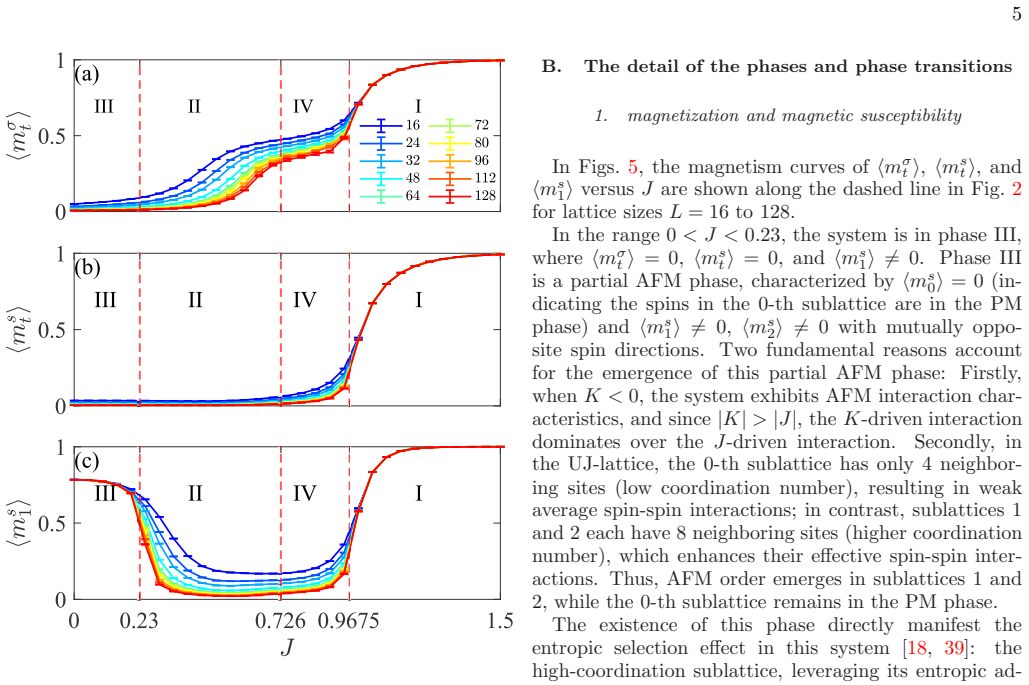
magnetization and magnetic susceptibility In Figs. 5, the magnetism curves of ⟨mσ t ⟩, ⟨ms t ⟩, and ⟨ms 1⟩ versus J are shown along the dashed line in Fig. 2 for lattice sizes L = 16 to 128. In the range 0 < J < 0. 23, the system is in phase III, where ⟨mσ t ⟩ = 0, ⟨ms t ⟩ = 0, and ⟨ms 1⟩ ̸ = 0. Phase III is a partial AFM phase, characterized by ⟨ms 0⟩ = ...
-
[7]
975, ⟨mσ t ⟩, ⟨ms t ⟩, and ⟨ms 1⟩ are all non-zero, indicating the system is in FM phase. In the range 0 . 717 < J <
-
[8]
975, the system is in the critical phase: unlike the PM phase and FM phase, the magnetization in this range shows a power-law dependence on lattice size L (detailed evidence is presented in subsequent sections). In Fig. 6, the data in the left column correspond to log-log plots of ⟨m⟩ versus L, whereas those in the right column represent log-log plots of ...
-
[9]
75 − 0. 9 with K = − 0. 8. tions can be expressed as: ⟨m⟩ = L− η/ 2(a + bL− ω ), χ = L2− η (a + bL− ω ), (12) where ω is the correction-to-scaling exponent (set to 1 in this work), and a, b are non-universal fitting parameters. In the fitting process, fixing b = 0 leads to significantly in- consistent values of η when fitting ⟨m⟩ and χ separately; by contrast,...
-
[10]
new defined magnetic susceptibility and BKT transition Despite the identification of the critical phase, the na- ture of the phase transitions from this phase to PM phase and to the FM phase remains unconfirmed. The quasi- susceptibility ˜χ = d⟨m⟩/dλ is a response function of the magnetization with respect to the control parameter λ (e.g., the coupling const...
-
[11]
8 (a) and (b), the Binder ratio Qσ t for σ -spins and Qs t for s-spins are plotted as functions of J
The behaviors of Binder ratio and correlation length In Figs. 8 (a) and (b), the Binder ratio Qσ t for σ -spins and Qs t for s-spins are plotted as functions of J. In the range 0 < J < 0. 23, Qσ t ≈ 1/ 3 and Qs t ≈ 1/ 3. This behavior comes from the paramagnetic phase, where the total magnetization M follows a Gaussian distribution. The Binder ratio is de...
-
[12]
717 < J < 0. 975, the Qσ t vs. J curve shows a small plateau around 0 . 6. For L = 16, we fit the magnetiza- tion distribution P (M ) with two superimposed Gaussian functions and obtain a Binder ratio of 0.5. This indi- cates the magnetization distribution in the critical phase is broadened, differing from the single-peak Gaussian dis- tribution that gives ...
-
[13]
In phase III, ξσ t /L = 0. The σ -spin correlations are short- ranged and disappear in the thermodynamic limit be- cause J is no longer dominant. On the other hand, ξs t /L diverges. This matches the appearance of a partial AFM phase in s-spins, as K takes the dominant role. In crit- ical phase IV, ξσ t /L and ξs t /L converge to finite values in the therm...
-
[14]
254(1) (panel b) yt = 1. 01(2). The phase diagram we present contains numerous ad- ditional details; here we present the phase transitions occurring at J = 0. This case is of particular interest due to the elegant closed-form expressions for the critical points [ 47]: Kc = 1 2 log [ 1√ 2 + √√ 2 − 1 2 ] ≈ 0. 2543873426, (A1) Kc = 1 2 log [ − 1√ 2 + √√ 2 − ...
-
[15]
We perform finite-size scaling using Eq
254(1) (panel b). We perform finite-size scaling using Eq. 19 with system sizes L = 64, 80, 96, 112, 128, 144, and the crossing points are seen to converge to the critical values as the system size increases. The exact critical couplings are Kc = − 0. 69507 · · ·and Kc = 0 . 25439 · · ·, which are in excellent agreement with the crossing points observed in...
-
[16]
J. Ashkin and E. Teller, Statistics of two-dimensional lat- tices with four components, Phys. Rev. 64, 178 (1943)
work page 1943
-
[17]
Y. Deng and H. W. J. Bl¨ ote, Conformal invariance of the ising model in three dimensions, Phys. Rev. Lett. 88, 190602 (2002)
work page 2002
-
[18]
P. Bak, P. Kleban, W. N. Unertl, J. Ochab, G. Akinci, N. C. Bartelt, and T. L. Einstein, Phase diagram of Se- lenium adsorbed on the Ni(100) surface: A physical real- ization of the Ashkin-Teller model, Phys. Rev. Lett. 54, 1539 (1985)
work page 1985
-
[19]
N. Chepiga and F. Mila, Kibble-Zurek exponent and chi- ral transition of the period-4 phase of Rydberg chains, Nat. Commun. 12, 414 (2021)
work page 2021
-
[20]
Chepiga, Tunable quantum criticality in multicom- ponent Rydberg arrays, Phys
N. Chepiga, Tunable quantum criticality in multicom- ponent Rydberg arrays, Phys. Rev. Lett. 132, 076505 (2024)
work page 2024
-
[21]
J. Salas and A. D. Sokal, Dynamic critical behavior of a Swendsen-Wang-type algorithm for the ashkin-teller model, J. Stat. Phys. 85, 297 (1996)
work page 1996
-
[22]
A. Banerjee, P. Jana, and P. K. Mohanty, Geometric per- colation of spins and spin dipoles in the Ashkin-Teller model, Phys. Rev. B 111, 014403 (2025)
work page 2025
- [23]
-
[24]
G.-Y. Zhu and G.-M. Zhang, Gapless coulomb state emerging from a self-dual topological tensor-network state, Phys. Rev. Lett. 122, 176401 (2019)
work page 2019
-
[25]
B. E. L¨ uscher, F. Mila, and N. Chepiga, Critical proper- ties of the quantum Ashkin-Teller chain with chiral per- turbations, Phys. Rev. B 108, 184425 (2023)
work page 2023
-
[26]
J.-P. Lv, T. M. Garoni, and Y. Deng, Phase transitions in XY antiferromagnets on plane triangulations, Phys. Rev. B 87, 024108 (2013)
work page 2013
-
[27]
R. V. Ditzian, J. R. Banavar, G. S. Grest, and L. P. Kadanoff, Phase diagram for the Ashkin-Teller model in three dimensions, Phys. Rev. B 22, 2542 (1980)
work page 1980
-
[28]
G. Kamieniarz, P. Koz/suppress lowski, and R. Dekeyser, Critical Ising lines of the d = 2 Ashkin-Teller model, Phys. Rev. E 55, 3724 (1997)
work page 1997
-
[29]
H. J. F. Knops, A branch point in the critical surface of the Ashkin-Teller model in the renormalization group theory, J. Phys. A: Math. Gen. 8, 1508 (1975)
work page 1975
-
[30]
J.-P. Lv, Y. Deng, and Q.-H. Chen, Worm-type Monte Carlo simulation of the Ashkin-Teller model on the tri- angular lattice, Phys. Rev. E 84, 021125 (2011)
work page 2011
-
[31]
B. Gr¨ unbaum and G. C. Shephard, Tilings and patterns (Courier Dover Publications, 1987)
work page 1987
-
[32]
J.F. Vald´ es and W. Lebrecht and E.E. Vogel, ±J Ising model on Dice lattices, Phys. A 385, 551 (2007)
work page 2007
-
[33]
R. Koteck` y, J. Salas, and A. D. Sokal, Phase transition in the three-state Potts antiferromagnet on the diced lat- tice, Phys. Rev. Lett. 101, 030601 (2008)
work page 2008
- [34]
-
[35]
A. Collins, J. McEvoy, D. Robinson, C. J. Hamer, and Z. Weihong, Quantum spin model with frustration on the Union Jack lattice, Phys. Rev. B 73, 024407 (2006)
work page 2006
-
[36]
G. G. Blesio, F. T. Lisandrini, and M. G. Gonzalez, Par- tially disordered Heisenberg antiferromagnet with short- range stripe correlations, Phys. Rev. B 107, 134418 (2023)
work page 2023
-
[37]
Q. N. Chen, M. P. Qin, J. Chen, Z. C. Wei, H. H. Zhao, B. Normand, and T. Xiang, Partial order and finite- temperature phase transitions in Potts models on irreg- ular lattices, Phys. Rev. Lett. 107, 165701 (2011)
work page 2011
-
[38]
Y. Deng, Y. Huang, J. L. Jacobsen, J. Salas, and A. D. Sokal, Finite-Temperature Phase Transition in a Class of Four-State Potts Antiferromagnets, Phys. Rev. Lett. 107, 150601 (2011)
work page 2011
-
[39]
C. Ding, Y. Wang, W. Zhang, and W. Guo, Critical prop- erties of the Hintermann-Merlini model, Phys. Rev. E 88, 042117 (2013)
work page 2013
-
[40]
G. Li, K. H. Pai, and Z.-C. Gu, Tensor-network renormal- ization approach to the q-state clock model, Phys. Rev. Res. 4, 023159 (2022)
work page 2022
- [41]
-
[42]
D. Giataganas, C.-Y. Huang, and F.-L. Lin, Neural net- work flows of low q-state Potts and clock models, N. J. Phys. 24, 043040 (2022)
work page 2022
-
[43]
S. Bhattacharya and P. Ray, Quasi-long-range order and vortex lattice in the three-state Potts model, Phys. Rev. Lett. 116, 097206 (2016)
work page 2016
-
[44]
R. Zhao, C. Ding, and Y. Deng, Overlap of two topolog- ical phases in the antiferromagnetic Potts model, Phys. Rev. E 97, 052131 (2018)
work page 2018
-
[45]
C. Ding, W. Guo, and Y. Deng, Reentrance of Berezinskii-Kosterlitz-Thouless-like transitions in a three-state Potts antiferromagnetic thin film, Phys. Rev. B 90, 134420 (2014)
work page 2014
-
[46]
W.-Y. Su, F. Hu, C. Cheng, and N. Ma, Berezinskii- Kosterlitz-Thouless phase transitions in a kagome spin ice by a quantifying Monte Carlo process: Distribution of hamming distances, Phys. Rev. B 108, 134422 (2023)
work page 2023
-
[47]
G.-W. Chern and O. Tchernyshyov, Magnetic charge and ordering in kagome spin ice, Phil. Trans. R. Soc. A 370, 5718 (2012)
work page 2012
-
[48]
Y. Sun, M. Hu, Y. Deng, and J.-P. Lv, Extraordinary-log universality of critical phenomena in plane defects, Phys. Rev. Lett. 131, 207101 (2023)
work page 2023
-
[49]
N. Metropolis, A. W. Rosenbluth, M. N. Rosenbluth, A. H. Teller, and E. Teller, Equation of state calcula- tions by fast computing machines, J. Chem. Phys. 21, 1087 (1953)
work page 1953
-
[50]
D. X. Viet and H. Kawamura, Monte carlo studies of chi- ral and spin ordering of the three-dimensional Heisenberg spin glass, Phys. Rev. B 80, 064418 (2009)
work page 2009
-
[51]
H. G. Ballesteros, A. Cruz, L. A. Fern´ andez, V. Mart ´ ın- Mayor, J. Pech, J. J. Ruiz-Lorenzo, A. Taranc´ on, P. T´ ellez, C. L. Ullod, and C. Ungil, Critical behavior of the three-dimensional Ising spin glass, Phys. Rev. B 62, 14237 (2000)
work page 2000
-
[52]
D. X. Nui, L. Tuan, N. D. Trung Kien, P. T. Huy, H. T. Dang, and D. X. Viet, Correlation length in a general- ized two-dimensional XY model, Phys. Rev. B 98, 144421 (2018)
work page 2018
-
[53]
Hasenbusch, The binder cumulant at the Koster- litz–Thouless transition, J
M. Hasenbusch, The binder cumulant at the Koster- litz–Thouless transition, J. Stat. Mech. 2008, P08003 12 (2008)
work page 2008
-
[54]
C. Pinettes, B. Canals, and C. Lacroix, Classical Heisen- berg antiferromagnet away from the pyrochlore lattice limit: Entropic versus energetic selection, Phys. Rev. B 66, 024422 (2002)
work page 2002
-
[55]
T. Chen, E. Guo, W. Zhang, P. Zhang, and Y. Deng, Tensor network Monte Carlo simulations for the two- dimensional random-bond Ising model, Phys. Rev. B 111, 094201 (2025)
work page 2025
-
[56]
F. Parisen Toldin, A. Pelissetto, and E. Vicari, Strong- disorder paramagnetic-ferromagnetic fixed point in the square-lattice ±J Ising Model, J. Stat. Phys. 135, 1039–1061 (2009)
work page 2009
-
[57]
Sachdev, Quantum phase transitions, Physics world 12, 33 (1999)
S. Sachdev, Quantum phase transitions, Physics world 12, 33 (1999)
work page 1999
-
[58]
M. Weigel and W. Janke, The square-latticefmodel re- visited: a loop-cluster update scaling study, J. Phys. A: Math. Gen. 38, 7067–7092 (2005)
work page 2005
-
[59]
S. T. Bramwell and P. C. W. Holdsworth, Magnetization and universal sub-critical behaviour in two-dimensional xy magnets, Journal of Physics: Condensed Matter 5, L53 (1993)
work page 1993
-
[60]
S. T. Bramwell and P. C. W. Holdsworth, Magne- tization: A characteristic of the kosterlitz-thouless- berezinskii transition, Phys. Rev. B 49, 8811 (1994)
work page 1994
-
[61]
Sachdev, Quantum Phase Transitions , 2nd ed
S. Sachdev, Quantum Phase Transitions , 2nd ed. (Cam- bridge University Press, 2011)
work page 2011
-
[62]
Y. Huang, Phase diagram of the AT model on the Union- Jack lattice, Bachelor’s Thesis (2011), Supervisor: Pro- fessor Youjin Deng
work page 2011
discussion (0)
Sign in with ORCID, Apple, or X to comment. Anyone can read and Pith papers without signing in.