Recognition: no theorem link
The Statistical Cost of Adaptation in Multi-Source Transfer Learning
Pith reviewed 2026-05-12 04:15 UTC · model grok-4.3
The pith
Multi-source transfer learning cannot always match oracle performance without knowing biases, even with two sources.
A machine-rendered reading of the paper's core claim, the machinery that carries it, and where it could break.
Core claim
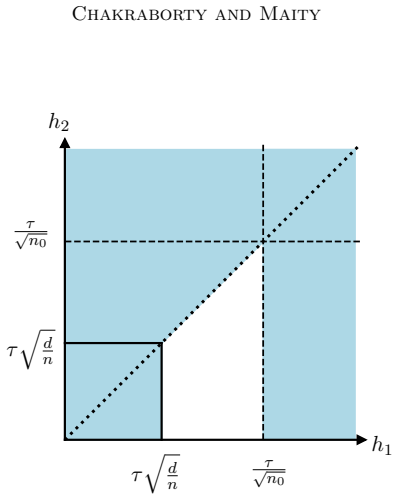
The central claim is that the intrinsic cost of adaptation, defined as the infimum over all bias-agnostic estimators of the supremum over bias configurations of the ratio of their risk to the oracle risk, is strictly greater than one for some multi-source parametric problems. Even with two sources, the configuration space of fixed unknown biases can place the problem past a phase transition where no estimator achieves the oracle rate; the cost grows with the number of sources, while additional structure on the biases permits specially designed estimators that reduce the cost.
What carries the argument
The intrinsic cost of adaptation, which is the minimal worst-case ratio of the risk of a bias-agnostic estimator to the oracle risk over the space of possible source-to-target biases.
If this is right
- For any fixed number of sources there exist bias configurations where oracle performance is attainable by a bias-agnostic estimator and others where it is not.
- The adaptation cost grows as the number of sources increases.
- When adaptation over the full bias space is impossible, imposing ordered biases, clustered source parameters, or sufficiently separated non-informative sources allows tailored estimators to achieve substantially lower cost.
- Theoretical guarantees and empirical results support the existence of these lower-cost estimators under the added structure.
Where Pith is reading between the lines
- The phase transition may be used to design practical tests that decide whether to employ a fully agnostic estimator or one that exploits suspected structure.
- In applications with many sources the rising cost suggests that simple pooling strategies will increasingly underperform unless structure is exploited or bias information is collected.
- The same worst-case ratio construction could be applied to non-parametric or high-dimensional estimation to obtain analogous limits.
Load-bearing premise
The source-to-target biases are fixed but unknown parameters whose configuration space admits a well-defined worst-case ratio in a correctly specified parametric model.
What would settle it
Compute the minimal worst-case risk ratio for a concrete two-source Gaussian location model whose bias vectors lie past the predicted phase-transition boundary; the ratio should exceed one.
Figures


read the original abstract
Multi-source transfer learning can improve target-domain estimation by leveraging related source data, but its benefits depend on unknown source-to-target biases. This raises a fundamental question: can a bias-agnostic estimator perform as well as an oracle that knows the true bias configuration? To study this, we introduce the intrinsic cost of adaptation, defined as the smallest worst-case ratio between the risk of any bias-agnostic estimator and the oracle risk. An intrinsic cost of one means oracle performance is achievable without knowing the biases, whereas a larger cost quantifies the unavoidable price of adaptation. Focusing on parametric estimation, we show that multi-source transfer behaves fundamentally differently from the single-source setting: adaptation is not always possible, even with only two sources. For a fixed number of sources, we characterize the intrinsic cost of adaptation and identify a phase transition separating regimes where oracle performance is achievable from those where it is not. As the number of sources grows, we further show that the adaptation cost increases. When adaptation over the full bias configuration space is impossible, additional structure can substantially reduce the cost. We study settings with ordered biases, clustered source parameters, and sufficiently separated non-informative sources, and propose estimators tailored to each regime, with supporting theoretical and empirical results. Overall, our results delineate the statistical limits of multi-source transfer, clarifying when oracle performance is attainable, when structural assumptions help, and when adaptation is fundamentally impossible.
Editorial analysis
A structured set of objections, weighed in public.
Referee Report
Summary. The manuscript introduces the intrinsic cost of adaptation in multi-source transfer learning, defined as the smallest worst-case ratio between the risk of any bias-agnostic estimator and the oracle risk that knows the source-to-target biases. Focusing on parametric estimation, it shows that multi-source transfer differs fundamentally from single-source: adaptation is not always possible even with two sources. For a fixed number of sources, the paper characterizes this cost and identifies a phase transition separating regimes where oracle performance is achievable from those where it is not. It further shows that the adaptation cost increases with the number of sources. When full adaptation over the bias space is impossible, the work examines structured regimes (ordered biases, clustered source parameters, sufficiently separated non-informative sources), proposes tailored estimators, and provides supporting theoretical and empirical results.
Significance. If the phase-transition characterization and cost bounds hold, this work makes a valuable contribution by delineating the statistical limits of bias-agnostic multi-source transfer learning. The explicit distinction from the single-source case, the identification of regimes where oracle performance is attainable without bias knowledge, and the analysis of how cost scales with the number of sources clarify fundamental trade-offs. The additional results on structured bias settings and corresponding estimators further strengthen the practical relevance by showing how modest assumptions can reduce the adaptation cost.
minor comments (3)
- The definition of the intrinsic cost (as the infimum over estimators of the supremum risk ratio) is central; ensure the main text explicitly states the precise function classes and risk measures used in the parametric model to avoid any ambiguity in the worst-case quantification.
- In the sections presenting the phase-transition results, include a brief discussion of how the transition thresholds depend on the dimension or other model parameters, as this would help readers assess the practical scope of the 'oracle achievable' regime.
- For the empirical results supporting the structured-bias estimators, add a short paragraph on the simulation design (e.g., how bias configurations are sampled and how many Monte Carlo repetitions are used) to facilitate reproducibility.
Simulated Author's Rebuttal
We thank the referee for the positive assessment of our work on the intrinsic cost of adaptation in multi-source transfer learning. The summary accurately captures the key distinctions from the single-source setting, the phase-transition characterization, and the analysis of structured bias regimes. We appreciate the recommendation for minor revision and will incorporate any editorial improvements in the revised manuscript.
Circularity Check
No significant circularity; definition and characterizations are self-contained
full rationale
The paper defines the intrinsic cost of adaptation explicitly as the smallest worst-case ratio of risks between any bias-agnostic estimator and the oracle risk over the bias configuration space. It then analyzes this quantity in parametric models to derive phase transitions and cost increases with the number of sources. These results follow from direct minimax analysis over the fixed but unknown biases rather than from any self-referential fitting, renaming of known patterns, or load-bearing self-citations that reduce the central claims to tautologies. The distinction from single-source transfer and the identification of regimes where adaptation is impossible emerge from the multi-source setup and worst-case ratio without circular reduction to the inputs.
Axiom & Free-Parameter Ledger
axioms (1)
- domain assumption Parametric estimation model with fixed unknown source-to-target biases
invented entities (1)
-
Intrinsic cost of adaptation
no independent evidence
Reference graph
Works this paper leans on
-
[1]
C. K. Chow and C. N. Liu , title =. IEEE Transactions on Information Theory , year =
- [2]
-
[3]
Maity, Subha and Dutta, Diptavo and Terhorst, Jonathan and Sun, Yuekai and Banerjee, Moulinath , number =. 2024 , journal =. doi:10.1093/BIOMET/ASAD029 , issn =
-
[4]
Hanneke, Steve and Kpotufe, Samory , number =. 2022 , journal =. doi:10.1214/22-AOS2189 , issn =
-
[5]
Tang, Minh and Athreya, Avanti and Sussman, Daniel L and Lyzinski, Vince and Priebe, Carey E , arxivId =
-
[6]
Luo, Bin and Robles-Kelly, Antonio and Torsello, Andrea and Wilson, Richard C. and Hancock, Edwin R. , volume =. 2001 , journal =. doi:10.1109/CVPR.2001.990621 , issn =
-
[7]
doi:10.1056/NEJMOA1511939;PAGE:STRING:ARTICLE/CHAPTER , issn =
2015 , journal =. doi:10.1056/NEJMOA1511939;PAGE:STRING:ARTICLE/CHAPTER , issn =
work page doi:10.1056/nejmoa1511939;page:string:article/chapter 2015
-
[8]
Weiss, Karl and Khoshgoftaar, Taghi M. and Wang, Ding Ding , number =. 2016 , journal =. doi:10.1186/S40537-016-0043-6 , issn =
-
[9]
IEEE Trans. Knowl. Data Eng , author =
-
[10]
Greenewald, Kristjan and Tewari, Ambuj and Klasnja, Predrag and Murphy, Susan , month =. 2017 , journal =
work page 2017
-
[11]
Reeve, Henry W.J. and Cannings, Timothy I. and Samworth, Richard J. , number =. 2021 , journal =. doi:10.1214/21-AOS2102 , issn =
-
[12]
Ann. Statist. , author =
-
[13]
Qin, Caihong and Xie, Jinhan and Li, Ting and Bai, Yang , number =. 2025 , journal =. doi:10.1080/01621459.2024.2403788 , issn =
-
[14]
Dzemski, Andreas , number =. 2019 , journal =. doi:10.1162/REST
-
[15]
Lattimore, Tor and Szepesv
-
[16]
Waldron, Maja , arxivId =
-
[17]
Chen, Li and Lin, D. Y. and Zeng, Donglin , number =. 2012 , journal =. doi:10.1093/BIOSTATISTICS/KXR017 , issn =
-
[18]
Yang, Jichen and Wang, Lei and Lian, Heng , number =. 2025 , journal =. doi:10.1007/S11222-025-10685-9 , issn =
-
[19]
Yan, Bowei and Sarkar, Purnamrita , number =. 2021 , journal =. doi:10.1080/01621459.2019.1706541 , issn =
-
[20]
Journal of the American Statistical Association , volume =
Niu, Yabo and Ni, Yang and Pati, Debdeep and Mallick, Bani K. , number =. 2024 , journal =. doi:10.1080/01621459.2023.2233744;REQUESTEDJOURNAL:JOURNAL:UASA20;WGROUP:STRING:PUBLICATION , issn =
work page doi:10.1080/01621459.2023.2233744;requestedjournal:journal:uasa20;wgroup:string:publication 2024
-
[21]
Xu, Shirong and Zhen, Yaoming and Wang, Junhui , number =. 2023 , journal =. doi:10.1080/07350015.2022.2085726 , issn =
-
[22]
Binkiewicz, N. and Vogelstein, J. T. and Rohe, K. , number =. 2017 , journal =. doi:10.1093/BIOMET/ASX008 , issn =
-
[23]
Giessing, Alexander and Wang, Jingshen , number =. 2024 , journal =. doi:10.1093/JRSSSB/QKAD075 , issn =
-
[24]
Yang, Jichen and Wang, Lei and Lian, Heng , number =. 2025 , journal =. doi:10.1007/S11222-025-10607-9 , issn =
-
[25]
Zhao, Junlong and Liu, Xiumin and Wang, Hansheng and Leng, Chenlei , number =. 2022 , journal =. doi:10.1093/BIOMET/ASAB006 , issn =
-
[26]
Wang, Ziyuan and Wang, Lei and Lian, Heng , number =. 2024 , journal =. doi:10.1111/SJOS.12723 , issn =
-
[27]
Zhou, Doudou and Liu, Molei and Li, Mengyan and Cai, Tianxi , number =. 2025 , journal =. doi:10.1080/01621459.2024.2356291 , issn =
-
[28]
Zhao, Pan and Josse, Julie and Yang, Shu , pages =. 2025 , journal =
work page 2025
-
[29]
Zhou, Xingcai and Zheng, Haotian and Zhang, Haoran and Huang, Chao , number =. 2024 , journal =. doi:10.1002/STA4.70004 , issn =
-
[30]
Huang, Jian , number =. 1996 , journal =. doi:10.1214/AOS/1032894452 , issn =
-
[31]
J. Am. Statist. Assoc , author =
-
[32]
Abbe, Emmanuel and Bandeira, Afonso S. and Hall, Georgina , number =. 2016 , journal =. doi:10.1109/TIT.2015.2490670 , issn =
-
[34]
Wang, Jiangzhou and Zhang, Jingfei and Liu, Binghui and Zhu, Ji and Guo, Jianhua , number =. 2023 , journal =. doi:10.1080/01621459.2021.1996378;REQUESTEDJOURNAL:JOURNAL:UASA20;WGROUP:STRING:PUBLICATION , issn =
work page doi:10.1080/01621459.2021.1996378;requestedjournal:journal:uasa20;wgroup:string:publication 2023
-
[35]
Chen, Chen and Xu, Dawei and Ding, Juan and Zhang, Junjian and Xiong, Wenjun , number =. 2025 , journal =. doi:10.1002/STA4.70041 , issn =
-
[36]
doi:10.1214/23-EJS2147 , arxivId =
2023 , author =. doi:10.1214/23-EJS2147 , arxivId =
-
[37]
Tan, Kean Ming and Wang, Lan and Zhou, Wen Xin , number =. 2022 , journal =. doi:10.1111/RSSB.12485 , issn =
-
[38]
Arroyo, Jesús and Chen, Guodong and Priebe, Carey E and Vogelstein, Joshua T , pages =. 2021 , journal =
work page 2021
-
[39]
MacDonald, P. W. and Levina, E. and Zhu, J. , number =. 2022 , journal =. doi:10.1093/BIOMET/ASAB058 , issn =
-
[40]
Farias, Vivek F. and Li, Andrew A. , number =. 2019 , journal =. doi:10.1287/MNSC.2018.3092 , issn =
-
[41]
Hanneke, Steve and Kpotufe, Samory and Mahdaviyeh, Yasaman and Neu, Gergely and Rosasco, Lorenzo , pages =. 2023 , journal =
work page 2023
-
[42]
Kpotufe, Samory and Martinet, Guillaume , number =. 2021 , journal =. doi:10.1214/21-AOS2084 , issn =
-
[43]
Zeng, Donglin and Mao, Lu and Lin, D. Y. , number =. 2016 , journal =. doi:10.1093/BIOMET/ASW013 , issn =
-
[44]
Gentleman, Robert and Geyer, Charles J. , number =. 1994 , journal =. doi:10.1093/BIOMET/81.3.618 , issn =
-
[45]
Maity, Subha and Sun, Yuekai and Banerjee, Moulinath , number =. 2022 , journal =
work page 2022
-
[46]
Maity, Subha and Sun, Yuekai and Banerjee, Moulinath , pages =. 2022 , journal =
work page 2022
-
[47]
Chen, Shuxiao and Li, Sai and Zhang, Bo and Ye, Ting , number =. 2025 , journal =. doi:10.1515/JCI-2024-0024/XML , issn =
-
[48]
Zhang, Anderson Y. and Zhou, Harrison H. , number =. 2016 , journal =
work page 2016
-
[49]
Rozemberczki, Benedek and Allen, Carl and Sarkar, Rik , pages =. 2021 , journal =. doi:10.1093/comnet/xxx000 , arxivId =
-
[50]
Chernozhukov, Victor and Fern. 2024 , journal =. doi:10.1016/j.jeconom.2020.08.009 , issn =
-
[51]
Hu, Y. and Wang, W. , number =. 2024 , journal =. doi:10.1093/BIOMET/ASAE011 , issn =
-
[52]
Chen, Mingli and Fern. 2021 , journal =. doi:10.1016/J.JECONOM.2020.04.004 , issn =
-
[53]
Gao, Wayne Yuan , number =. 2020 , journal =. doi:10.1016/j.jeconom.2019.09.005 , issn =
-
[54]
Zheng, Cheng and Dasgupta, Sayan and Xie, Yuxiang and Haris, Asad and Chen, Ying Qing , number =. 2025 , journal =. doi:10.3390/math13030441 , issn =
- [55]
-
[56]
Li, Sai and Zhang, Linjun , arxivId =
-
[57]
Bastani, Hamsa , number =. 2020 , journal =. doi:10.1287/MNSC.2020.3729 , issn =
- [58]
-
[59]
and Chatterjee, Snigdhansu , publisher =
Chandna, Swati and Bagozzi, Benjamin E. and Chatterjee, Snigdhansu , publisher =. 2025 , journal =. doi:10.1109/TNSE.2025.3598705 , issn =
-
[61]
Zhou, Zhixin and Li, Ping , pages =. 2020 , journal =. doi:10.1214/20-EJS1686 , issn =
-
[62]
Cox, D. R. , number =. 1972 , journal =. doi:10.1111/J.2517-6161.1972.TB00899.X , issn =
-
[63]
Fan, Jianqing and Gao, Cheng and Klusowski, Jason M. , number =. 2025 , journal =. doi:10.1214/25-AOS2534 , issn =
-
[64]
Cai, Tianxi and Li, Mengyan and Liu, Molei , number =. 2025 , journal =. doi:10.1080/01621459.2024.2393463 , issn =
-
[65]
Jochmans, Koen , number =. 2018 , journal =. doi:10.1080/07350015.2017.1286242;CTYPE:STRING:JOURNAL , issn =
work page doi:10.1080/07350015.2017.1286242;ctype:string:journal 2018
-
[66]
Chen, Kani and Jin, Zhezhen and Ying, Zhiliang , number =. 2002 , journal =. doi:10.1093/BIOMET/89.3.659 , issn =
-
[67]
Mao, Guangcai and Yang, Shu and Wang, Xiaofei , number =. 2025 , journal =. doi:10.1093/BIOMTC/UJAF131 , issn =
-
[68]
Yan, Ting and Jiang, Binyan and Fienberg, Stephen E. and Leng, Chenlei , number =. 2019 , journal =. doi:10.1080/01621459.2018.1448829 , issn =
-
[69]
Xie, Wenyi and Zeng, Donglin and Wang, Yuanjia , number =. 2024 , journal =. doi:10.1214/24-AOAS1875 , keywords =
-
[70]
Duan, Junting and Pelger, Markus and Xiong, Ruoxuan , number =. 2024 , journal =. doi:10.1016/J.JECONOM.2023.105521 , issn =
-
[71]
Yao, Chengyuan and Cortez, Carmen and Yu, Renzhe , month =. 2025 , journal =. doi:10.1145/3706468.3706567 , arxivId =
-
[72]
Wang, Yu Mei and Sun, Yuzhi and Wang, Beiying and Wu, Zhiping and He, Xiao Ying and Zhao, Yuansong , number =. 2023 , journal =. doi:10.1093/BIB/BBAD426 , issn =
-
[73]
Wu, Jou Chin and Chen, Li Pang , number =. 2025 , journal =. doi:10.1002/SIM.70163 , issn =
-
[74]
Zheng, Zejing and Zheng, Shengbing and Zhao, Junlong , month =. 2026 , journal =. doi:10.1016/J.CSDA.2025.108292 , issn =
-
[75]
Liu, Jiaxin and Song, Yunquan , publisher =. 2025 , journal =. doi:10.1080/03610918.2025.2578277 , issn =
-
[76]
Fu, Bo and Jiang, Dandan , arxivId =
-
[77]
Tony and Li, Hongzhe , number =
Li, Sai and Cai, T. Tony and Li, Hongzhe , number =. 2022 , journal =. doi:10.1111/RSSB.12479 , issn =
-
[78]
J. R. Statist. Soc. B , author =
-
[79]
Zhang, Yijiao and Zhu, Zhongyi , month =. 2022 , journal =. doi:10.5705/ss.202022.0396 , issn =
-
[80]
Zhang, Yuhao and Yu, Yang and Sheng, Danshu and Liang, Wanfeng , publisher =. 2025 , journal =. doi:10.1080/00949655.2025.2539481 , issn =
-
[81]
Tony and Wei, Hongji , number =
Cai, T. Tony and Wei, Hongji , number =. 2021 , journal =. doi:10.1214/20-AOS1949 , issn =
-
[82]
Wang, F. and Yu, Y. , number =. 2025 , journal =. doi:10.1093/BIOMET/ASAF018 , issn =
discussion (0)
Sign in with ORCID, Apple, or X to comment. Anyone can read and Pith papers without signing in.