Recognition: no theorem link
Orienting-Field Effects on Instability and Mode Selection in Active Nematics
Pith reviewed 2026-05-12 02:46 UTC · model grok-4.3
The pith
An orienting field aligned perpendicular to substrate anchoring lowers activity thresholds for instability in confined active nematics and enables a field-driven even-symmetry mode.
A machine-rendered reading of the paper's core claim, the machinery that carries it, and where it could break.
Core claim
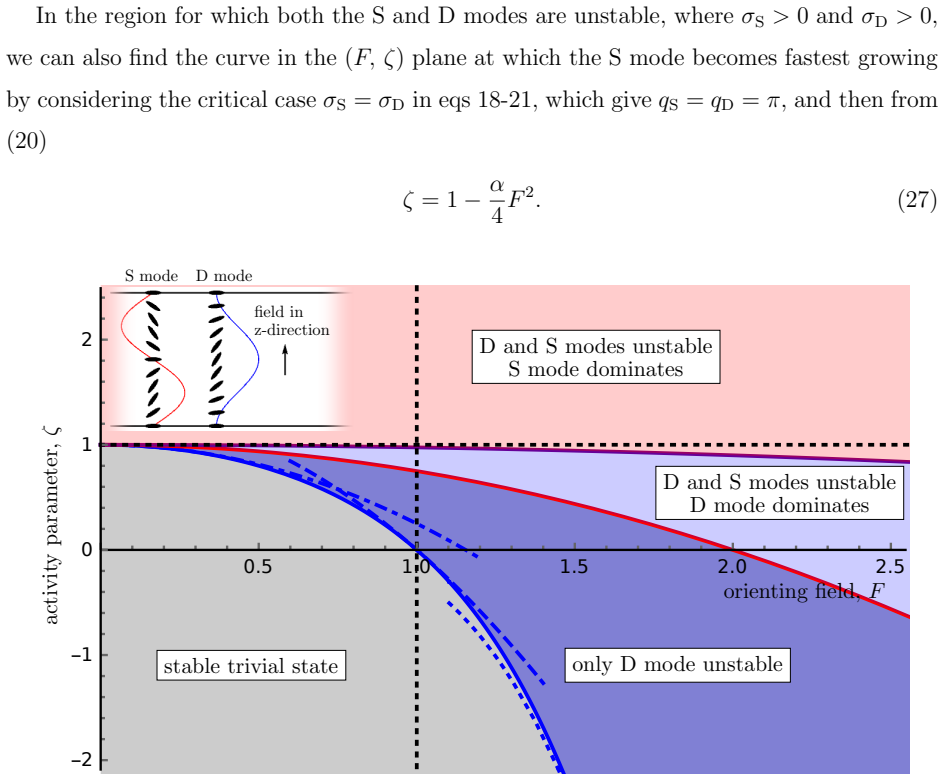
Linear analysis of the Ericksen-Leslie framework reveals that an orienting field perpendicular to the substrate anchoring direction cooperatively lowers activity thresholds and enables a field-driven even symmetry mode instability, while a parallel field tends to stabilise the system. Exact and approximate analytic forms of the stability boundaries are derived, and numerical solutions of the nonlinear equations show that the linear analysis correctly identifies the symmetries of the resulting long-time states.
What carries the argument
Linear stability analysis of odd- and even-symmetry director perturbations under the combined action of active stresses and field-induced torques within the Ericksen-Leslie model.
If this is right
- Orienting fields can promote instability below the classical critical activity value.
- Field orientation can be used to tune the onset threshold of the instability.
- Field direction selects between odd and even director symmetry modes.
- Long-time nonlinear states preserve the symmetry predicted by the linear analysis.
Where Pith is reading between the lines
- The same field-control mechanism could be tested in other confined active systems such as microtubule bundles or bacterial films.
- Even-symmetry modes may produce distinct flow topologies or defect arrangements compared with the usual odd-symmetry states.
- Combining the field with patterned substrate anchoring could enable spatial selection of instability regions.
Load-bearing premise
The low Reynolds number Ericksen-Leslie framework with the chosen forms of active stresses and field-induced torques accurately describes the system, and linear analysis plus numerics fully capture the relevant physics.
What would settle it
Measuring whether the critical activity for onset of director instability decreases when a perpendicular orienting field is applied to a confined active nematic film.
Figures


read the original abstract
We examine the instabilities of a confined active nematic subjected to an orienting field using a low Reynolds number Ericksen-Leslie framework with active stresses and field-induced torques. Linear analysis reveals two distinct modes, with odd and even director symmetry, the instabilities of which depend on the interplay between activity and field strength. We derive exact and approximate analytic forms of the stability boundaries and show that an orienting field that aligns the director perpendicular to the substrate anchoring direction cooperatively lowers activity thresholds and enables a field-driven even symmetry mode instability, while an orienting field that aligns the director parallel to the substrate anchoring tends to stabilise the system. Numerical solutions of the full nonlinear equations show that the linear stability analysis correctly identifies the symmetries of long-time states. These results demonstrate how orienting fields can promote an instability below the classical critical activity and can be used to both tune the instability onset and control the mode selection in confined active nematics.
Editorial analysis
A structured set of objections, weighed in public.
Referee Report
Summary. The manuscript examines instabilities in a confined active nematic under an external orienting field within the low-Reynolds-number Ericksen-Leslie framework, incorporating standard active stresses and field-induced torques. Linear stability analysis of the director field identifies two modes (odd and even symmetry) whose thresholds depend on the interplay of activity and field strength. Exact and approximate analytic stability boundaries are derived, demonstrating that a perpendicular-aligning field cooperatively lowers the activity threshold for instability and enables a field-driven even-symmetry mode, while a parallel-aligning field stabilizes the system. Direct numerical integration of the nonlinear equations confirms that the long-time states retain the symmetries predicted by linear analysis.
Significance. If the results hold, the work provides analytic control over instability onset and mode selection in confined active nematics via orienting fields, which is relevant for microfluidic and biological applications of active matter. The derivation of explicit stability boundaries (both exact and approximate) combined with nonlinear numerical confirmation is a strength, as it allows quantitative tuning without relying solely on simulation. The reduction to the zero-field limit is internally consistent with prior literature on active nematics.
minor comments (4)
- The abstract and introduction should explicitly define the nondimensional groups (activity number, field strength, and anchoring strength) at first use to improve readability for readers outside the immediate subfield.
- In the linear stability analysis, the transition between the exact and approximate analytic boundary expressions should be accompanied by a quantitative statement of the approximation error (e.g., relative deviation as a function of field strength) rather than a qualitative description.
- Figure captions for the stability diagrams should include the zero-field critical activity value as a reference line to make the claimed cooperative lowering and stabilization effects immediately visible.
- The numerical section would benefit from a brief statement of the spatial discretization scheme, time-stepping method, and convergence checks performed to confirm that the observed long-time symmetries are not artifacts of the solver.
Simulated Author's Rebuttal
We thank the referee for their positive summary of the work, the assessment of its significance for microfluidic and biological applications, and the recommendation for minor revision. No specific major comments were listed in the report, so we have no points to address point by point. The manuscript's analytic stability boundaries, reduction to the zero-field limit, and nonlinear confirmation of mode symmetries remain as presented.
Circularity Check
No significant circularity
full rationale
The paper performs a standard linear stability analysis on the linearized Ericksen-Leslie equations for confined active nematics, deriving analytic stability boundaries for odd- and even-symmetry modes directly from the model PDEs without any parameter fitting, self-referential definitions, or load-bearing self-citations. The active stress and field-torque terms are the conventional forms from the literature; the zero-field limit recovers the known activity threshold, and nonlinear numerics serve only as confirmation rather than input. No step reduces the claimed field-dependent mode selection or cooperative threshold lowering to a tautology or prior result by the same authors.
Axiom & Free-Parameter Ledger
axioms (2)
- domain assumption Low Reynolds number approximation is valid for the flow
- domain assumption Linear stability analysis identifies the symmetries of long-time nonlinear states
Reference graph
Works this paper leans on
-
[1]
M. B. Miller and B. L. Bassler, Annual Review of Microbiology55, 165 (2001)
work page 2001
-
[2]
C. A. Parent and P. N. Devreotes, Science284, 765 (1999)
work page 1999
- [3]
- [4]
-
[5]
G. H. Wadhams and J. P. Armitage, Nature Reviews Molecular Cell Biology5, 1024 (2004)
work page 2004
- [6]
-
[7]
Ramaswamy, Annual Review of Condensed Matter Physics1, 323 (2010)
S. Ramaswamy, Annual Review of Condensed Matter Physics1, 323 (2010)
work page 2010
-
[8]
M. Marchetti, J. Joanny, S. Ramaswamy, T. Liverpool, J. Prost, M. Rao, and R. Simha, 16 Reviews of Modern Physics85, 1143 (2013)
work page 2013
-
[9]
A. Doostmohammadi, J. Ign´ es-Mullol, J. Yeomans, and F. Sagu´ es, Nature Communications 9, 3246 (2018)
work page 2018
-
[10]
P. de Gennes and J. Prost,The Physics of Liquid Crystals(Oxford University Press, 1993)
work page 1993
-
[11]
T. B. Saw, A. Doostmohammadi, V. Nier, L. Kocgozlu, S. Thampi, Y. Toyama, P. Marcq, C. T. Lim, J. M. Yeomans, and B. Ladoux, Nature544, 212 (2017)
work page 2017
-
[12]
A. Doostmohammadi, S. P. Thampi, and J. M. Yeomans, Physical Review Letters117, 048102 (2016)
work page 2016
-
[13]
D. Dell’Arciprete, M. L. Blow, A. T. Brown, F. D. Farrell, J. S. Lintuvuori, A. F. McVey, D. Marenduzzo, and W. C. Poon, Nature Communications9, 4190 (2018)
work page 2018
-
[14]
M. Basaran, Y. I. Yaman, T. C. Y¨ uce, R. Vetter, and A. Kocabas, eLife11, e72187 (2022)
work page 2022
- [15]
-
[16]
Y. Maroudas-Sacks, L. Garion, L. Shani-Zerbib, A. Livshits, E. Braun, and K. Keren, Nature Physics17, 251 (2021)
work page 2021
-
[17]
P. Guillamat, C. Blanch-Mercader, G. Pernollet, K. Kruse, and A. Roux, Nature Materials 21, 588 (2022)
work page 2022
-
[18]
Z. Wang, M. C. Marchetti, and F. Brauns, Proceedings of the National Academy of Sciences 120, e2220167120 (2023)
work page 2023
- [19]
-
[20]
C. Bechinger, R. Di Leonardo, H. L¨ owen, C. Reichhardt, G. Volpe, and G. Volpe, Reviews of Modern Physics88, 045006 (2016)
work page 2016
-
[21]
J. Hardo¨ uin, R. Hughes, A. Doostmohammadi, J. Laurent, T. Lopez-Leon, J. Yeomans, J. Ign´ es-Mullol, and F. Sagu´ es, Communications Physics2, 121 (2019)
work page 2019
-
[22]
Hardo¨ uin,Active Liquid Crystals in Confinement, Ph.D
J. Hardo¨ uin,Active Liquid Crystals in Confinement, Ph.D. thesis, Universitat de Barcelona (2020)
work page 2020
-
[23]
S. Ray, J. Zhang, and Z. Dogic, Physical Review Letters130, 238301 (2023)
work page 2023
-
[24]
A. J. Houston and G. P. Alexander, New Journal of Physics25, 123006 (2023)
work page 2023
-
[25]
T. B. Saw, W. Xi, B. Ladoux, and C. T. Lim, Advanced Materials30, 1802579 (2018)
work page 2018
-
[26]
Z. You, D. Pearce, and L. Giomi, Science Advances7, eabc8685 (2021)
work page 2021
-
[27]
F. G. Woodhouse and R. E. Goldstein, Proceedings of the National Academy of Sciences110, 14132 (2013). 17
work page 2013
-
[28]
R. Voituriez, J. Joanny, and J. Prost, Europhysics Letters70, 404 (2005)
work page 2005
- [29]
-
[30]
D. Marenduzzo, E. Orlandini, M. Cates, and J. Yeomans, Physical Review E76, 031921 (2007)
work page 2007
- [31]
-
[32]
T. Shendruk, A. Doostmohammadi, K. Thijssen, and J. Yeomans, Soft Matter13, 3853 (2017)
work page 2017
-
[33]
H. Wensink, J. Dunkel, S. Heidenreich, K. Drescher, R. Goldstein, H. L¨ owen, and J. Yeomans, Proceedings of the National Academy of Sciences109, 14308 (2012)
work page 2012
- [34]
-
[35]
Thampi, Current Opinion in Colloid & Interface Science61, 101613 (2022)
S. Thampi, Current Opinion in Colloid & Interface Science61, 101613 (2022)
work page 2022
- [36]
-
[37]
A. Opathalage, M. Norton, M. Juniper, B. Langeslay, S. Aghvami, S. Fraden, and Z. Dogic, Proceedings of the National Academy of Sciences116, 4788 (2019)
work page 2019
-
[38]
S. Alam, B. Najma, A. Singh, J. Laprade, G. Gajeshwar, H. Yevick, A. Baskaran, P. Foster, and G. Duclos, Physical Review X14, 041002 (2024)
work page 2024
-
[39]
J. P. Vaidya, T. N. Shendruk, and S. P. Thampi, Soft Matter20, 8230 (2024)
work page 2024
- [40]
-
[41]
R. R. Keogh, S. Chandragiri, B. Loewe, T. Ala-Nissila, S. P. Thampi, and T. N. Shendruk, Physical Review E106, L012602 (2022)
work page 2022
-
[42]
V. Pratley, E. Caf, M. Ravnik, and G. Alexander, Communications Physics7, 127 (2024)
work page 2024
-
[43]
A. J. H. Houston and N. J. Mottram, Communications Physics7, 375 (2024)
work page 2024
- [44]
- [45]
-
[46]
P. G. de Gennes, Molecular Crystals and Liquid Crystals12, 193 (1971)
work page 1971
- [47]
-
[48]
Walton,Mathematical Modelling of Active Nematic Liquid Crystals in Confined Regions, Ph.D
J. Walton,Mathematical Modelling of Active Nematic Liquid Crystals in Confined Regions, Ph.D. thesis, University of Strathclyde (2020)
work page 2020
-
[49]
I. Stewart,Static and Dynamic Continuum Theory of Liquid Crystals: A Mathematical Intro- 18 duction(Taylor & Francis Group, 2004)
work page 2004
- [50]
-
[51]
I. K. Joseph,Mathematical Modelling of Active Fluids in a Channel, Ph.D. thesis, University of Glasgow (2025)
work page 2025
-
[52]
COMSOL, Inc.,COMSOL Multiphysics Version 6.3, Burlington, MA, USA (2025). 19
work page 2025
discussion (0)
Sign in with ORCID, Apple, or X to comment. Anyone can read and Pith papers without signing in.