Recognition: 2 theorem links
· Lean TheoremLLM-Driven Performance-Space Augmentation for Meta-Learning-Based Algorithm Selection
Pith reviewed 2026-05-12 03:35 UTC · model grok-4.3
The pith
LLM-generated synthetic datasets distributed uniformly across a low-dimensional performance space improve meta-learning for algorithm selection.
A machine-rendered reading of the paper's core claim, the machinery that carries it, and where it could break.
Core claim
Steering an LLM to produce synthetic regression datasets that maximise uniform coverage of the two-dimensional performance space spanned by the R-squared scores of two landmarkers reduces reconstruction bias in the meta-dataset, yielding a 17.47 percent relative reduction in Hamming loss, a 100.41 percent relative gain in subset accuracy, and a 6.09 percent relative improvement in pooled out-of-fold R-squared compared with the unaugmented baseline and outperforming margin-based placement.
What carries the argument
The two-dimensional performance space whose coordinates are the cross-validated R-squared values of two fixed anchor algorithms (landmarkers), used to guide LLM generation of synthetic datasets for uniform epsilon-cover augmentation of the meta-dataset.
If this is right
- Uniform sampling of synthetic datasets across the performance space produces a 17.47 percent relative reduction in Hamming loss for the multi-label formulation.
- The same uniform strategy yields a 100.41 percent relative increase in subset accuracy.
- Pooled out-of-fold R-squared rises by 6.09 percent relative to the unaugmented case.
- Margin-based placement near decision boundaries improves results over the baseline yet remains inferior to uniform placement.
- The performance of algorithms can be treated as residing on a low-dimensional manifold that uniform epsilon-cover minimises bias in reconstructing.
Where Pith is reading between the lines
- If the low-dimensional manifold structure is general, the number of real datasets required for effective meta-learning could be reduced by careful synthetic filling.
- The same steering method could be tested on classification tasks once suitable landmarkers are chosen for that setting.
- Increasing the number of landmarkers beyond two might be examined to see whether coverage improves without raising the dimensionality of the space.
Load-bearing premise
The LLM can be directed to create synthetic datasets whose performance on the two landmarkers matches the statistical distribution of real-world datasets without introducing systematic biases or artifacts.
What would settle it
Augmenting the meta-dataset with the LLM synthetics and then measuring meta-learner performance on a fresh collection of real datasets yields no improvement over the unaugmented baseline, or the landmarker scores of the synthetics fail to overlap the spread seen in real data.
Figures
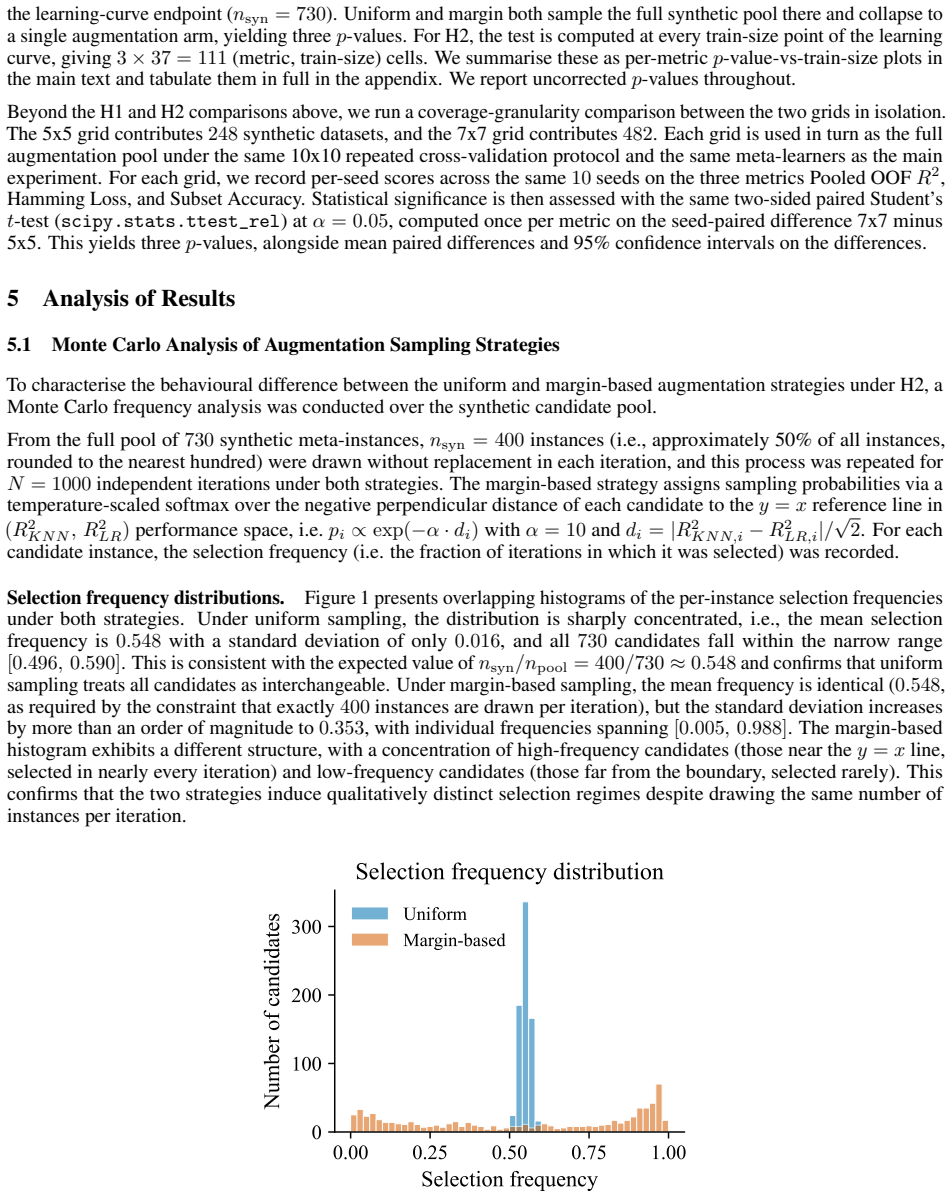
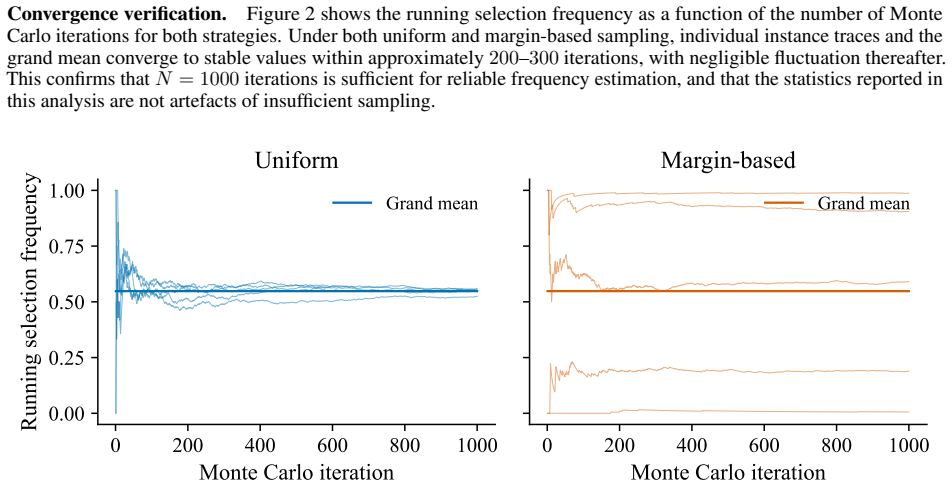


read the original abstract
Meta-learning for algorithm selection relies on a meta-dataset in which each row corresponds to a supervised learning dataset described by meta-features and labelled with a target value that is associated with algorithm choice (typically, some function of algorithm performance). A persistent limitation is that the number of curated real-world datasets is small, resulting in sparse meta-datasets that constrain meta-learner generalisation. In this paper, we address this problem by augmenting the meta-dataset with synthetic regression datasets produced via a large language model (LLM), with generation steered toward target regions of a low-dimensionality performance space. In our experiments, we adopt a two-dimensional geometric setting defined by the cross-validated $R^2$ scores of two anchor algorithms, known as landmarkers. We compare two augmentation strategies: (1) uniform sampling, which distributes synthetic datasets across the performance space; and (2) margin-based sampling, which concentrates them near the decision boundary where landmarker preference is most ambiguous. Across 42 real-world UCI regression datasets and 730 synthetic datasets, both strategies substantially improve meta-learner performance over the unaugmented baseline under regression and multi-label evaluation formulations. However, uniform augmentation consistently outperforms margin-based augmentation, achieving a 17.47% relative reduction in Hamming loss, a 100.41% relative improvement in subset accuracy, and a +6.09% relative gain in pooled out-of-fold $R^2$. These results lead us to postulate a central thesis: the performance of algorithms resides on a low-dimensional performance manifold, whose reconstruction bias may be minimised by user-guided LLMs that seek to maximise uniform $\epsilon$-cover, and consequently, lead to improved meta-learning for algorithm selection.
Editorial analysis
A structured set of objections, weighed in public.
Referee Report
Summary. The paper claims that augmenting sparse meta-datasets for algorithm selection with 730 LLM-generated synthetic regression datasets, steered via two landmarkers' cross-validated R² scores into a 2D performance space, improves meta-learner performance over an unaugmented baseline on 42 real UCI datasets. Uniform sampling across the space outperforms margin-based sampling near decision boundaries, yielding 17.47% relative Hamming loss reduction, 100.41% subset accuracy gain, and +6.09% pooled out-of-fold R²; this leads to a post-hoc thesis that algorithm performances lie on a low-dimensional manifold whose reconstruction bias is minimized by uniform ε-cover via user-guided LLMs.
Significance. If the empirical gains hold after validation, the work offers a practical advance in meta-learning for algorithm selection by mitigating data scarcity through targeted LLM augmentation in performance space rather than feature space. Credit is due for the scale of evaluation (42 real + 730 synthetic datasets), the direct comparison of uniform vs. margin strategies, and the reproducible framing of the augmentation as conditioning on landmarker R² targets. The approach could generalize to other meta-learning tasks if the synthetic data realism is confirmed.
major comments (3)
- [Experimental evaluation and results] The central empirical claim of improved meta-learner performance rests on synthetic datasets whose generation is conditioned only on the two landmarkers' R² values; no check is reported that the joint performance vectors (or higher-order correlations) across the remaining algorithms match the real-data distribution. This is load-bearing because the meta-labels and meta-learner training use the full algorithm performance matrix, so any LLM-induced distortion in non-landmarker performances could produce the observed gains in R², Hamming loss, and subset accuracy as an artifact rather than evidence of manifold reconstruction.
- [Results (quantitative comparisons)] The reported relative improvements (17.47% Hamming loss reduction, 100.41% subset accuracy improvement, +6.09% pooled R²) are given without accompanying statistical tests, confidence intervals, or details on the number of meta-learner runs and variance estimation. This weakens the ability to conclude that uniform augmentation is reliably superior and that the gains exceed what would be expected from random augmentation or label-distribution shifts.
- [Conclusion and discussion] The low-dimensional performance manifold thesis is presented as a concluding postulate without any direct test (e.g., intrinsic dimensionality estimation, manifold reconstruction error on held-out real data, or comparison against alternative explanations such as simple density filling). Because the thesis is used to interpret why uniform sampling succeeds, its lack of supporting analysis makes the explanatory claim speculative rather than demonstrated.
minor comments (2)
- [Methodology] The manuscript should provide the exact LLM prompts, temperature settings, and any post-generation filtering used to steer datasets toward target (R²_landmarker1, R²_landmarker2) regions, as these details are essential for reproducibility.
- [Meta-learning formulation] The list of meta-features employed by the meta-learner is not enumerated; adding this (or a reference to a standard set) would clarify the experimental setup.
Simulated Author's Rebuttal
We thank the referee for their insightful comments, which have helped us identify areas for improvement in our manuscript. We address each major comment below and outline the revisions we will make.
read point-by-point responses
-
Referee: [Experimental evaluation and results] The central empirical claim of improved meta-learner performance rests on synthetic datasets whose generation is conditioned only on the two landmarkers' R² values; no check is reported that the joint performance vectors (or higher-order correlations) across the remaining algorithms match the real-data distribution. This is load-bearing because the meta-labels and meta-learner training use the full algorithm performance matrix, so any LLM-induced distortion in non-landmarker performances could produce the observed gains in R², Hamming loss, and subset accuracy as an artifact rather than evidence of manifold reconstruction.
Authors: We agree that this is an important validation step that was omitted in the original submission. To address this, we will add a new subsection in the experimental evaluation that compares the performance distributions. Specifically, we will compute the pairwise correlations between all algorithms' R² scores on the real datasets and on the synthetic ones, and report the mean absolute difference in these correlations. Additionally, we will visualize the distribution of performances for a few non-landmarker algorithms to show alignment. This analysis will confirm that the synthetic data preserves the necessary correlations, supporting that the improvements are due to better coverage of the performance space rather than artifacts. revision: yes
-
Referee: [Results (quantitative comparisons)] The reported relative improvements (17.47% Hamming loss reduction, 100.41% subset accuracy improvement, +6.09% pooled R²) are given without accompanying statistical tests, confidence intervals, or details on the number of meta-learner runs and variance estimation. This weakens the ability to conclude that uniform augmentation is reliably superior and that the gains exceed what would be expected from random augmentation or label-distribution shifts.
Authors: We appreciate this point and will strengthen the results section accordingly. In the revised manuscript, we will specify that all experiments were run with 5 different random seeds for the meta-learner training and report the mean and standard deviation for each metric. We will also include 95% confidence intervals computed via bootstrapping over the 42 datasets. Furthermore, we will add a comparison against a random augmentation baseline (sampling synthetic datasets without performance-space steering) to demonstrate that the gains are not merely from increasing dataset size or shifting label distributions. Paired statistical tests (Wilcoxon signed-rank) will be reported to assess significance. revision: yes
-
Referee: [Conclusion and discussion] The low-dimensional performance manifold thesis is presented as a concluding postulate without any direct test (e.g., intrinsic dimensionality estimation, manifold reconstruction error on held-out real data, or comparison against alternative explanations such as simple density filling). Because the thesis is used to interpret why uniform sampling succeeds, its lack of supporting analysis makes the explanatory claim speculative rather than demonstrated.
Authors: The thesis is indeed offered as an interpretive postulate based on the counterintuitive result that uniform sampling outperforms margin-based sampling. We do not claim to have performed a direct manifold analysis in the current work. In the revision, we will reframe this as a hypothesis motivated by the results and expand the discussion to include potential alternative explanations, such as the benefits of uniform coverage in reducing bias in meta-feature space. We will also outline how future work could test the manifold hypothesis using techniques like PCA on the algorithm performance matrix or estimating intrinsic dimensionality. This keeps the claim appropriately qualified while preserving the empirical contributions. revision: partial
Circularity Check
No circularity: empirical results on held-out data with no self-referential derivation
full rationale
The paper reports an empirical augmentation experiment: LLM-generated synthetic datasets are steered only by two landmarker R² values, added to a meta-dataset, and evaluated via regression and multi-label metrics on 42 held-out real UCI datasets. All reported gains (Hamming loss, subset accuracy, pooled R²) are measured against an unaugmented baseline on real data. The central thesis about a low-dimensional performance manifold is explicitly postulated from these observed improvements rather than derived from any equation or prior self-citation. No load-bearing step reduces a prediction to a fitted parameter, renames a known result, or imports uniqueness via self-citation. The work is therefore self-contained against external benchmarks.
Axiom & Free-Parameter Ledger
free parameters (2)
- choice of two landmark algorithms
- number of synthetic datasets (730)
axioms (2)
- domain assumption Algorithm performance on regression tasks can be meaningfully projected onto a low-dimensional space spanned by a small number of landmark algorithms.
- ad hoc to paper LLM-generated synthetic datasets can be conditioned on target performance regions without introducing non-representative artifacts.
invented entities (1)
-
low-dimensional performance manifold
no independent evidence
Lean theorems connected to this paper
-
IndisputableMonolith/Foundation/AlexanderDuality.leanalexander_duality_circle_linking unclear?
unclearRelation between the paper passage and the cited Recognition theorem.
the performance of algorithms resides on a low-dimensional performance manifold, whose reconstruction bias may be minimised by user-guided LLMs that seek to maximise uniform ε-cover
-
IndisputableMonolith/Cost/FunctionalEquation.leanwashburn_uniqueness_aczel unclear?
unclearRelation between the paper passage and the cited Recognition theorem.
ϕ(D) = (R²_KNN, R²_LR) ∈ [0,1]² ... uniform sampling ... margin-based sampling
What do these tags mean?
- matches
- The paper's claim is directly supported by a theorem in the formal canon.
- supports
- The theorem supports part of the paper's argument, but the paper may add assumptions or extra steps.
- extends
- The paper goes beyond the formal theorem; the theorem is a base layer rather than the whole result.
- uses
- The paper appears to rely on the theorem as machinery.
- contradicts
- The paper's claim conflicts with a theorem or certificate in the canon.
- unclear
- Pith found a possible connection, but the passage is too broad, indirect, or ambiguous to say the theorem truly supports the claim.
Reference graph
Works this paper leans on
-
[1]
Data complexity meta-features for regression problems , author=. Machine Learning , volume=. 2018 , publisher=
work page 2018
-
[2]
ACM Transactions on Knowledge Discovery from Data (TKDD) , volume=
A generic multilabel learning-based classification algorithm recommendation method , author=. ACM Transactions on Knowledge Discovery from Data (TKDD) , volume=. 2014 , publisher=
work page 2014
-
[3]
A literature survey and empirical study of meta-learning for classifier selection , author=. IEEE Access , volume=. 2020 , publisher=
work page 2020
-
[4]
Pacific-Asia Conference on Knowledge Discovery and Data Mining , pages=
UCI++: Improved support for algorithm selection using datasetoids , author=. Pacific-Asia Conference on Knowledge Discovery and Data Mining , pages=. 2009 , organization=
work page 2009
-
[5]
KI-2012: Poster and Demo Track , pages=
Dataset generation for meta-learning , author=. KI-2012: Poster and Demo Track , pages=. 2012 , publisher=
work page 2012
-
[6]
arXiv preprint arXiv:2601.17717 , year=
The LLM Data Auditor: A Metric-oriented Survey on Quality and Trustworthiness in Evaluating Synthetic Data , author=. arXiv preprint arXiv:2601.17717 , year=
-
[7]
ACM Computing Surveys (CSUR) , volume=
Cross-disciplinary perspectives on meta-learning for algorithm selection , author=. ACM Computing Surveys (CSUR) , volume=. 2009 , publisher=
work page 2009
-
[8]
arXiv preprint arXiv:2507.15132 , year=
Transforming Datasets to Requested Complexity with Projection-based Many-Objective Genetic Algorithm , author=. arXiv preprint arXiv:2507.15132 , year=
-
[9]
Advances in computers , volume=
The algorithm selection problem , author=. Advances in computers , volume=. 1976 , publisher=
work page 1976
-
[10]
arXiv preprint arXiv:2312.12112 , year=
Curated LLM: Synergy of LLMs and Data Curation for tabular augmentation in low-data regimes , author=. arXiv preprint arXiv:2312.12112 , year=
-
[11]
Advances in Neural Information Processing Systems , volume=
Epic: Effective prompting for imbalanced-class data synthesis in tabular data classification via large language models , author=. Advances in Neural Information Processing Systems , volume=
-
[12]
The Twelfth International Conference on Learning Representations , year=
Language-interfaced tabular oversampling via progressive imputation and self-authentication , author=. The Twelfth International Conference on Learning Representations , year=
-
[13]
Findings of the Association for Computational Linguistics: ACL 2025 , pages=
Tabgen-icl: Residual-aware in-context example selection for tabular data generation , author=. Findings of the Association for Computational Linguistics: ACL 2025 , pages=
work page 2025
-
[14]
arXiv preprint arXiv:2210.06280 , year=
Language models are realistic tabular data generators , author=. arXiv preprint arXiv:2210.06280 , year=
-
[15]
Proceedings of the 31st International Conference on Computational Linguistics , pages=
Aigt: Ai generative table based on prompt , author=. Proceedings of the 31st International Conference on Computational Linguistics , pages=
-
[16]
problexity—An open-source Python library for supervised learning problem complexity assessment , author=. Neurocomputing , volume=. 2023 , publisher=
work page 2023
-
[17]
Pedregosa, F. and Varoquaux, G. and Gramfort, A. and Michel, V. and Thirion, B. and Grisel, O. and Blondel, M. and Prettenhofer, P. and Weiss, R. and Dubourg, V. and Vanderplas, J. and Passos, A. and Cournapeau, D. and Brucher, M. and Perrot, M. and Duchesnay, E. , journal=. Scikit-learn: Machine Learning in
-
[18]
Akiba, Takuya and Sano, Shotaro and Yanase, Toshihiko and Ohta, Takeru and Koyama, Masanori , booktitle=
-
[19]
Impact of regressand stratification in dataset shift caused by cross-validation , author=. Mathematics , volume=. 2022 , publisher=
work page 2022
-
[20]
Markelle Kelly and Rachel Longjohn and Kolby Nottingham , title =
-
[21]
European conference on machine learning , pages=
Characterizing the applicability of classification algorithms using meta-level learning , author=. European conference on machine learning , pages=. 1994 , organization=
work page 1994
-
[22]
2008 Seventh International Conference on Machine Learning and Applications , pages=
Predicting algorithm accuracy with a small set of effective meta-features , author=. 2008 Seventh International Conference on Machine Learning and Applications , pages=. 2008 , organization=
work page 2008
-
[23]
IEEE transactions on pattern analysis and machine intelligence , volume=
Complexity measures of supervised classification problems , author=. IEEE transactions on pattern analysis and machine intelligence , volume=. 2002 , publisher=
work page 2002
-
[24]
European Conference on Machine Learning , pages=
God doesn't always shave with Occam's razor—Learning when and how to prune , author=. European Conference on Machine Learning , pages=. 1998 , organization=
work page 1998
-
[25]
European Conference on Principles of Data Mining and Knowledge Discovery , pages=
Discovering task neighbourhoods through landmark learning performances , author=. European Conference on Principles of Data Mining and Knowledge Discovery , pages=. 2000 , organization=
work page 2000
- [26]
-
[27]
Journal of Machine Learning Research , volume=
Distances between data sets based on summary statistics , author=. Journal of Machine Learning Research , volume=
-
[28]
Automatic recommendation of classification algorithms based on data set characteristics , author=. Pattern recognition , volume=. 2012 , publisher=
work page 2012
-
[29]
Applied Soft Computing , volume=
On learning algorithm selection for classification , author=. Applied Soft Computing , volume=. 2006 , publisher=
work page 2006
-
[30]
Data Mining and Knowledge Discovery , volume=
Ensembles of label noise filters: a ranking approach , author=. Data Mining and Knowledge Discovery , volume=. 2016 , publisher=
work page 2016
-
[31]
Pattern Analysis and Applications , volume=
Automatic classifier selection for non-experts , author=. Pattern Analysis and Applications , volume=. 2014 , publisher=
work page 2014
-
[32]
European Conference on Machine Learning , pages=
Estimating the predictive accuracy of a classifier , author=. European Conference on Machine Learning , pages=. 2001 , organization=
work page 2001
-
[33]
Ranking learning algorithms: Using IBL and meta-learning on accuracy and time results , author=. Machine Learning , volume=. 2003 , publisher=
work page 2003
-
[34]
Journal of Artificial Intelligence Research , volume=
A feature subset selection algorithm automatic recommendation method , author=. Journal of Artificial Intelligence Research , volume=
-
[35]
Applied Mathematics and Computation , volume=
An instance-based learning recommendation algorithm of imbalance handling methods , author=. Applied Mathematics and Computation , volume=. 2019 , publisher=
work page 2019
-
[36]
Applied Intelligence , volume=
An improved data characterization method and its application in classification algorithm recommendation , author=. Applied Intelligence , volume=. 2015 , publisher=
work page 2015
-
[37]
Knowledge-Based Systems , volume=
A new classification algorithm recommendation method based on link prediction , author=. Knowledge-Based Systems , volume=. 2018 , publisher=
work page 2018
-
[38]
Proceedings of the 2006 ACM symposium on Applied computing , pages=
Selecting parameters of SVM using meta-learning and kernel matrix-based meta-features , author=. Proceedings of the 2006 ACM symposium on Applied computing , pages=
work page 2006
-
[39]
Advances in neural information processing systems , volume=
On kernel-target alignment , author=. Advances in neural information processing systems , volume=
-
[40]
Combining meta-learning and search techniques to select parameters for support vector machines , author=. Neurocomputing , volume=. 2012 , publisher=
work page 2012
-
[41]
Exploiting sampling and meta-learning for parameter setting for support vector machines , author=. 2002 , publisher=
work page 2002
-
[42]
A meta-learning method to select the kernel width in support vector regression , author=. Machine learning , volume=. 2004 , publisher=
work page 2004
-
[43]
ECE Technical Reports , pages=
A study of meta learning for regression , author=. ECE Technical Reports , pages=
-
[44]
Australasian Joint Conference on Artificial Intelligence , pages=
A landmarker selection algorithm based on correlation and efficiency criteria , author=. Australasian Joint Conference on Artificial Intelligence , pages=. 2004 , organization=
work page 2004
-
[45]
In Automated machine learning: methods, systems, challenges , pages=
Meta-learning , author=. In Automated machine learning: methods, systems, challenges , pages=
-
[46]
The lack of a priori distinctions between learning algorithms , author=. Neural Computation , volume=
-
[47]
The existence of a priori distinctions between learning algorithms , author=. Neural Computation , volume=
discussion (0)
Sign in with ORCID, Apple, or X to comment. Anyone can read and Pith papers without signing in.