Recognition: 2 theorem links
· Lean TheoremOn the thermal properties of knotted block copolymer rings
Pith reviewed 2026-05-12 04:52 UTC · model grok-4.3
The pith
Knot topology interacts with monomer composition to produce nonmonotonic temperature-dependent conformations and localization transitions in block copolymer rings.
A machine-rendered reading of the paper's core claim, the machinery that carries it, and where it could break.
Core claim
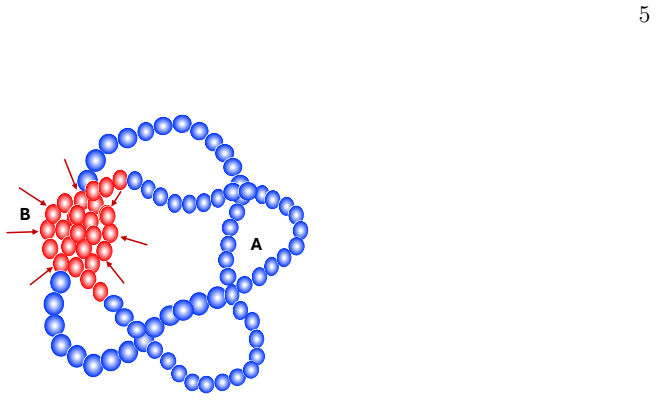
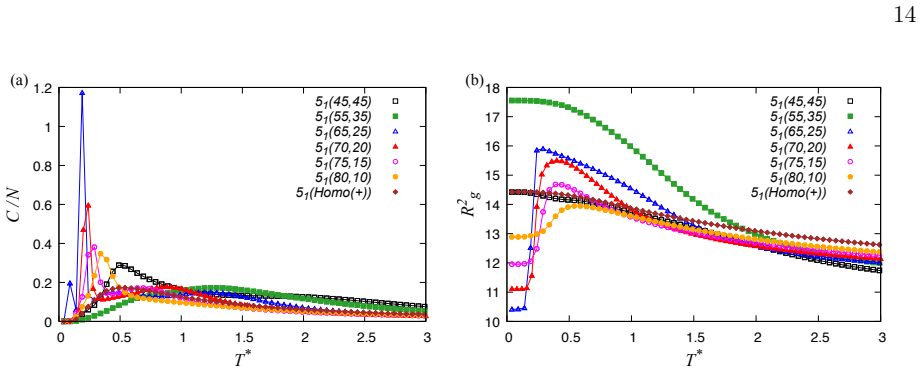
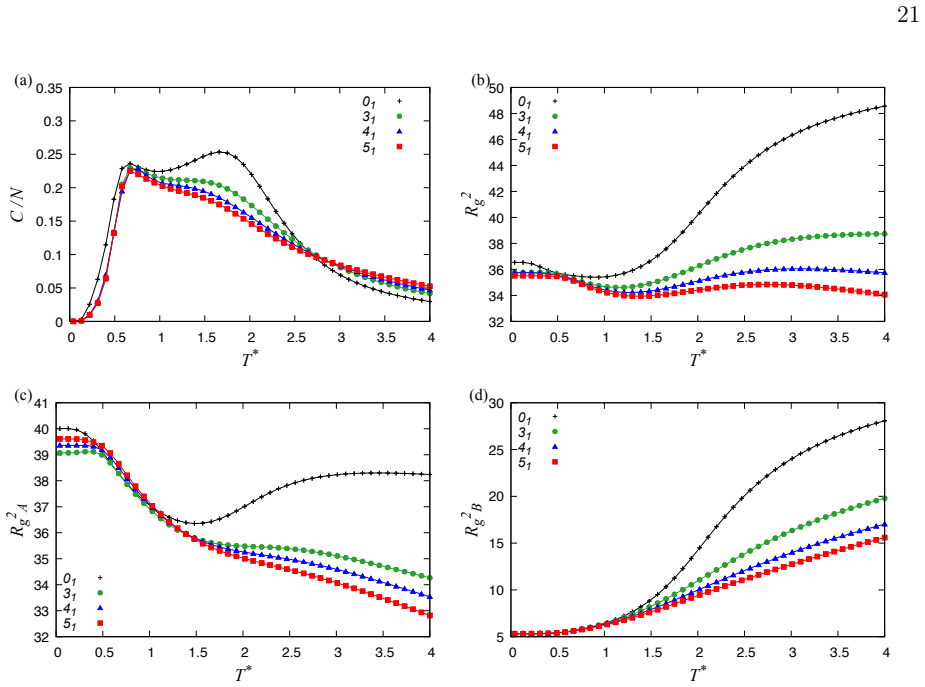
In the AB lattice model with self-repulsive A monomers, self-attractive B monomers, and neutral A-B interactions, simulations of rings carrying unknots, trefoils, figure-eights, or pentafoils demonstrate that knot topology combined with B-block length strongly modulates conformational properties over a wide temperature range. Small variations in B-block length produce nonmonotonic, reentrant-like behavior in radius of gyration and related quantities, accompanied by transitions between knot localization and delocalization at low temperatures, originating from the competition between energetic gains from B-monomer attractions and entropic penalties imposed by the knot topology.
What carries the argument
Probability that a monomer belongs to the knotted region, tracked together with heat capacity and radius of gyration for the full ring and each block, as temperature and composition are varied for fixed knot topologies.
If this is right
- Different knot topologies (trefoil, figure-eight, pentafoil) produce distinct temperature and composition responses in size and knot position.
- Transitions between localized and delocalized knots appear at low temperatures specifically for certain asymmetric B-block lengths.
- Heat-capacity peaks and size derivatives mark the locations of these conformational shifts.
- The reentrant and localization effects are stronger in asymmetric than in symmetric monomer compositions.
- The same competition between energy and topology persists across the studied knot types.
Where Pith is reading between the lines
- Knot topology could serve as a design handle for creating temperature-tunable switching in polymer gels or nanoparticles.
- Analogous reentrant localization might appear in knotted biomolecules such as DNA or proteins when solvent quality changes.
- The lattice results invite direct comparison with continuous-space models or explicit-solvent simulations to check whether the nonmonotonicity survives.
Load-bearing premise
The chosen lattice interactions and Wang-Landau sampling accurately reproduce the thermodynamic and structural responses of real knotted diblock copolymer rings.
What would settle it
Direct observation of strictly monotonic radius-of-gyration curves versus temperature for small B-block variations in either experiment or off-lattice simulation would falsify the predicted nonmonotonic reentrant responses and localization transitions.
Figures






read the original abstract
We investigate the thermal and structural properties of knotted diblock copolymer rings using a coarse-grained lattice model in an implicit solvent. The system is studied by means of the Wang--Landau Monte Carlo algorithm, allowing us to analyze thermodynamic and conformational responses over a wide temperature range. Different knot topologies, including the unknot, trefoil, figure-eight, and pentafoil knots, are considered for both symmetric and asymmetric monomer compositions. In the AB model employed here, A-type monomers are self-repulsive, B-type monomers are self-attractive, and A-B interactions are neutral, such that the solvent is effectively good for A-type monomers and poor for B-type monomers at low temperatures. We analyze several key observables, including the heat capacity, the radius of gyration, and its temperature derivative for both the entire copolymer ring and the individual blocks, and the probability that a monomer belongs to the knotted region. Our results show that the interplay between knot topology, monomer composition, and temperature strongly influences polymer conformations. Small variations in the B-block length induce nonmonotonic, reentrant-like conformational behavior as a function of temperature, including transitions between knot localization and delocalization at low temperatures. These effects arise from the competition between energetic and entropic contributions imposed by topological constraints.
Editorial analysis
A structured set of objections, weighed in public.
Referee Report
Summary. The manuscript investigates the thermal and structural properties of knotted diblock copolymer rings via a coarse-grained lattice model in implicit solvent, simulated with the Wang-Landau Monte Carlo algorithm. It considers unknot, trefoil, figure-eight, and pentafoil topologies for both symmetric and asymmetric A-B compositions, analyzing heat capacity, radius of gyration (and its temperature derivative) for the full ring and blocks, and the probability that a monomer lies in the knotted region. The central claim is that small changes in B-block length produce nonmonotonic, reentrant conformational responses with temperature, including low-T transitions between knot localization and delocalization arising from the competition between energetic (B-attraction) and entropic (topological) contributions.
Significance. If the reported nonmonotonic behaviors prove robust, the work illustrates how knot topology can qualitatively alter the temperature-driven collapse and localization patterns of block copolymers, an effect that is amplified in asymmetric compositions. The broad temperature window afforded by Wang-Landau sampling is a methodological strength that enables detection of reentrant features inaccessible to conventional Metropolis runs. These findings add to the literature on topological constraints in soft-matter systems and could guide future studies of knotted polymers in biological or materials contexts.
major comments (2)
- [Methods] Methods section: The central claim of reentrant knot localization/delocalization for small B-block length variations rests on ergodic sampling by Wang-Landau across the full temperature range. The manuscript must supply explicit diagnostics (histogram flatness criterion, number of independent runs, autocorrelation times for the knot-region probability observable) because local Monte Carlo moves face topological barriers when attractive B-blocks drive compact states at low T; without these checks the reported nonmonotonicity in the radius-of-gyration derivative could reflect incomplete exploration rather than physical behavior.
- [Results] Results section (observables for asymmetric compositions): The probability that a monomer belongs to the knotted region and the temperature derivative of the radius of gyration are the key quantities used to identify localization/delocalization transitions. These must be accompanied by statistical uncertainties or convergence tests; the absence of error bars leaves open whether the claimed nonmonotonic, reentrant features survive finite-sample fluctuations.
minor comments (2)
- [Abstract] The abstract states that 'small variations in the B-block length' induce the reported effects but does not list the specific block lengths or the range examined; adding these values would allow readers to judge the sensitivity of the reentrant behavior.
- Figure captions and legends should explicitly label curves by knot type (e.g., 3_1, 4_1, 5_1) and by A/B composition ratio to facilitate direct comparison across panels.
Simulated Author's Rebuttal
We thank the referee for the careful reading of our manuscript and the constructive comments, which help clarify the presentation of our results on knotted diblock copolymer rings. We address each major comment below and will revise the manuscript accordingly to strengthen the evidence for our claims.
read point-by-point responses
-
Referee: [Methods] Methods section: The central claim of reentrant knot localization/delocalization for small B-block length variations rests on ergodic sampling by Wang-Landau across the full temperature range. The manuscript must supply explicit diagnostics (histogram flatness criterion, number of independent runs, autocorrelation times for the knot-region probability observable) because local Monte Carlo moves face topological barriers when attractive B-blocks drive compact states at low T; without these checks the reported nonmonotonicity in the radius-of-gyration derivative could reflect incomplete exploration rather than physical behavior.
Authors: We agree that explicit diagnostics are necessary to rigorously establish the ergodicity of the Wang-Landau sampling, especially given the topological barriers that can arise in compact low-temperature states. In the revised manuscript we will add a dedicated subsection in Methods detailing the histogram flatness criterion (with the specific tolerance threshold employed), the number of independent Wang-Landau runs performed for each topology and composition, and autocorrelation times computed for the knot-region probability observable via block-averaging analysis. These additions will directly address the concern that the reported nonmonotonic features might stem from incomplete exploration. revision: yes
-
Referee: [Results] Results section (observables for asymmetric compositions): The probability that a monomer belongs to the knotted region and the temperature derivative of the radius of gyration are the key quantities used to identify localization/delocalization transitions. These must be accompanied by statistical uncertainties or convergence tests; the absence of error bars leaves open whether the claimed nonmonotonic, reentrant features survive finite-sample fluctuations.
Authors: We acknowledge that the lack of statistical uncertainties on the knot-region probability and the temperature derivative of the radius of gyration weakens the presentation of the reentrant transitions for asymmetric compositions. In the revised manuscript we will include error bars obtained from multiple independent runs (or block-averaging within each run) for these observables, together with a brief convergence test showing that the locations and amplitudes of the nonmonotonic peaks remain stable within the reported uncertainties. This will confirm that the localization-delocalization transitions are robust against finite-sample fluctuations. revision: yes
Circularity Check
No circularity in numerical simulation study
full rationale
The paper is a purely numerical investigation using Wang-Landau Monte Carlo sampling on a coarse-grained lattice AB model with specified interactions. All reported observables (heat capacity, radius of gyration, knot localization probabilities) are direct outputs of the simulations over the temperature range. There are no analytic derivations, parameter fittings presented as predictions, self-definitional steps, or load-bearing self-citations that reduce claims to inputs by construction. The central findings on nonmonotonic reentrant behavior emerge from the model Hamiltonian and ergodic sampling without tautological reduction.
Axiom & Free-Parameter Ledger
axioms (2)
- domain assumption Lattice polymer models with nearest-neighbor interactions capture essential thermodynamic behavior of real block copolymers in implicit solvent
- domain assumption Wang-Landau algorithm provides accurate density of states for the studied temperature range and knot topologies
Lean theorems connected to this paper
-
IndisputableMonolith/Cost/FunctionalEquation.leanwashburn_uniqueness_aczel unclearWe investigate the thermal and structural properties of knotted diblock copolymer rings using a coarse-grained lattice model... Wang–Landau Monte Carlo algorithm... Hamiltonian H(X) = ε(m_AA − m_BB)
-
IndisputableMonolith/Foundation/RealityFromDistinction.leanreality_from_one_distinction unclearSmall variations in the B-block length induce nonmonotonic, reentrant-like conformational behavior
Reference graph
Works this paper leans on
- [1]
-
[2]
S. D. P. Fielden, D. A. Leigh, and S. L. Woltering, Angew. Chem. Int. Ed.56, 11166 (2017)
work page 2017
-
[3]
K. E. Horneret al., Chem. Soc. Rev.45, 6432 (2016)
work page 2016
-
[4]
N. C. H. Lim and S. E. Jackson, J. Phys.: Condens. Matter27, 354101 (2015)
work page 2015
-
[5]
C. Micheletti, D. Marenduzzo, and E. Orlandini, Phys. Rep.504, 1 (2011)
work page 2011
- [6]
- [7]
- [8]
-
[9]
L. H. Kauffman,Knots and Physics(World Scientific, 2001)
work page 2001
- [10]
-
[11]
E. J. Janse van Rensburg and A. Rechnitzer, J. Knot Theory Ramifications20, 1145 (2011)
work page 2011
- [12]
-
[13]
Z. Ashbridge, S. D. P. Fielden, D. A. Leigh, L. Pirvu, F. Schaufelberger, and L. Zhang, Chem. Soc. Rev.51, 7779 (2022)
work page 2022
-
[14]
J.-P. Sauvage and C. Dietrich-Buchecker,Molecular Catenanes, Rotaxanes and Knots(Wiley, 2008)
work page 2008
-
[15]
X. Fan, B. Huang, G. Wang, and J. Huang, Macromolecules45, 3779 (2012)
work page 2012
-
[16]
B. A. Laurent and S. M. Grayson, Polym. Chem.3, 1846 (2012)
work page 2012
-
[17]
J.-F. Ayme, J. E. Beves, C. J. Campbell, and D. A. Leigh, Chem. Soc. Rev.42, 1700 (2013)
work page 2013
-
[18]
S. A. Wasserman and N. R. Cozzarelli, Science232, 951 (1986)
work page 1986
- [19]
-
[20]
A. P. Perlińska, W. H. Niemyska, B. A. Gren, M. Bukowicki, S. Nowakowski, P. Rubach, and J. I. Sułkowska, Protein Sci.32, e4631 (2023)
work page 2023
-
[21]
P. F. N. Faísca, Comput. Struct. Biotechnol. J.13, 459 (2015)
work page 2015
-
[22]
W. R. Taylor, Nature406, 916 (2000)
work page 2000
-
[23]
P. Dabrowski-Tumanski and J. I. Sulkowska, Proc. Natl. Acad. Sci. U.S.A.114, 3415 (2017)
work page 2017
-
[24]
D. Marenduzzo, E. Orlandini, A. Stasiak, D. W. Sumners, L. Tubiana, and C. Micheletti, Proc. 27 Natl. Acad. Sci. U.S.A.106, 22269 (2009)
work page 2009
-
[25]
A. L. Mallam and S. E. Jackson, J. Mol. Biol.359, 1420 (2006)
work page 2006
-
[26]
S. E. Jackson, Topol. Geom. Biopolym746, 129 (2020)
work page 2020
-
[27]
Majumderet al., Macromolecules54, 5321 (2021)
S. Majumderet al., Macromolecules54, 5321 (2021)
work page 2021
-
[28]
L. Tubiana, E. Orlandini, and C. Micheletti, Phys. Rev. Lett.107, 188302 (2011)
work page 2011
- [29]
- [30]
-
[31]
B. W. Soh, V. Narsimhan, A. R. Klotz, and P. S. Doyle, Soft Matter14, 1689 (2018)
work page 2018
-
[32]
B. Marcone, E. Orlandini, A. L. Stella, and F. Zonta, Phys. Rev. E75, 041105 (2007)
work page 2007
- [33]
-
[34]
M. Caraglio, C. Micheletti, and E. Orlandini, Phys. Rev. Lett.115, 188301 (2015)
work page 2015
-
[35]
M. D. Frank-Kamenetskii, A. V. Lukashin, and A. V. Vologodskii, Nature258, 398 (1975)
work page 1975
-
[36]
Grzybet al., Macromolecules58, 1521 (2025)
A. Grzybet al., Macromolecules58, 1521 (2025)
work page 2025
- [37]
-
[38]
T. Herschberg, J.-M. Y. Carrillo, B. G. Sumpter, E. Panagiotou, and R. Ku- mar,Macromolecules54, 7492 (2021)
work page 2021
-
[39]
G. S. Grest, T. Ge, S. J. Plimpton, M. Rubinstein, and T. C. O’Connor, ACS Polym. Au3, 209 (2022)
work page 2022
-
[40]
R. J. Williams, A. P. Dove, and R. K. O’Reilly, Polym. Chem.6, 2998 (2015)
work page 2015
- [41]
- [42]
-
[43]
W. Wang, Y. Li, and Z. Lu, Sci. China Chem.58, 1471 (2015)
work page 2015
- [44]
-
[45]
N. A. Taklimi, F. Ferrari, M. R. Piątek, and L. Tubiana, Phys. Rev. E108, 034503 (2023)
work page 2023
-
[46]
N. A. Taklimi, F. Ferrari, M. R. Piątek, and L. Tubiana, Phys. Rev. E112, 045421 (2025)
work page 2025
-
[47]
K. A. Dillet al., Protein Sci.4, 561 (1995)
work page 1995
-
[48]
A. Tagliabue, C. Micheletti, and M. Mella, ACS Macro Lett.10, 1365 (2021)
work page 2021
-
[49]
A. Tagliabue, C. Micheletti, and M. Mella, Macromolecules55, 10761 (2022)
work page 2022
- [50]
- [51]
-
[52]
L. Lu, Q. Qiu, Y. Lu, L. An, and L. Dai, Macromolecules57, 5330 (2024). 28
work page 2024
- [53]
-
[54]
L. Tubiana, G. Polles, E. Orlandini, and C. Micheletti, Eur. Phys. J. E41, 72 (2018)
work page 2018
- [55]
-
[56]
E. J. J. van Rensburg and A. Rechnitzer, J. Stat. Mech. P09008 (2011)
work page 2011
- [57]
- [58]
- [59]
- [60]
- [61]
-
[62]
Fredrickson,The equilibrium Theory of Inhomogeneous Polymers(Oxford Univ
G. Fredrickson,The equilibrium Theory of Inhomogeneous Polymers(Oxford Univ. Press, 2005)
work page 2005
-
[63]
M. Rubinstein and R. H. Colby,Polymer Physics(Oxford University Press, Oxford, 2003)
work page 2003
- [64]
- [65]
- [66]
-
[67]
M. P. Taylor, W. Paul, and K. Binder,J. Chem. Phys.131, 114907 (2009)
work page 2009
discussion (0)
Sign in with ORCID, Apple, or X to comment. Anyone can read and Pith papers without signing in.